
– Episode #41
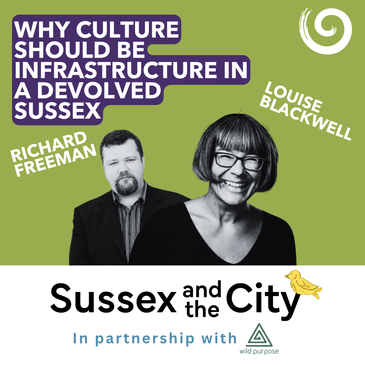
Why Culture Should Be Infrastructure In A Devolved SussexHost: Richard Freeman Guest: Louise Blackwell – producer, cultural strategist and founder of Creative Crawley
🔍 Episode summary
Culture is often treated as the product of a vibrant place, and a thriving economy. A mural here, a festival there, something colourful once the serious work of housing, transport and economic growth has been done.
This episode makes a very different argument.
Richard Freeman speaks with Louise Blackwell, one of the most influential cultural producers working in Sussex, about Crawley, creativity and why arts and culture should be understood as part of the region's civic infrastructure.
Louise grew up in Crawley before building a major national career in the arts, including co-founding Fuel, one of the UK's most respected independent producing organisations. More recently, she has brought that experience back into Sussex through Creative Crawley and Crawley's Creative Playground, securing £millions in funding to help local people shape what culture looks like in their own town.
Together they explore why Crawley matters in the cultural life of Sussex, how culture can improve safety, confidence, belonging and public space, and why devolution creates a rare opportunity to rethink the role of creativity across the county.
This month, it was confirmed in parliament that arts, culture and high street regeneration will become the responsibilities of directly elected mayors and their strategic authorities. So it is timely to discuss power, participation, identity, regeneration, young people, civic pride, and who gets to tell the story of Sussex next, through the lens of devolution.
This episode is brought to you in partnership with Wild Purpose.
Wild Purpose helps build stronger communities through nature and intergenerational understanding.
This week is Global Intergenerational Week, which champions meaningful connections between generations across the world. Wild Purpose works across Sussex and beyond, running learning and community programmes that bring adults of all ages together to understand one another, gain fresh perspectives and grow life skills.
Their co-mentoring programme, community connection walks, conversation cafes, and growing and creative allotment sessions are all designed with a collaborative, nature-based ethos.
In a county shaped by coastline, countryside and a strong independent spirit, Wild Purpose asks what becomes possible when we take the connection between people and place seriously.
Find out more at wildpurpose.org
🎯 In this episode
Why Crawley deserves a stronger place in Sussex's cultural story How Louise's own Crawley upbringing shaped her career in the arts Why Creative Crawley was created How local people helped identify the town's cultural gaps and opportunities Why murals, festivals and creative activity can be part of civic infrastructure How culture can support safety, pride, belonging and regeneration Why Crawley's diversity, young population and location make it culturally important What devolution could mean for arts and culture across Sussex How cultural strategy can connect tourism, skills, innovation and community life Why Sussex needs to tell a bigger, bolder cultural story
🧠 Key themes
Culture is not an optional extra. It shapes how people feel about where they live, how they use public space, and how communities build confidence and connection.
Crawley has often been underestimated in Sussex's cultural identity, but its diversity, young population, new town heritage and location between London, Brighton and Gatwick give it huge creative potential.
Creative work becomes more powerful when it is rooted in listening. Louise describes how residents, community groups, businesses and local leaders have helped shape Creative Crawley's approach.
Devolution could create new opportunities for Sussex to think more strategically about culture, but only if creativity is understood as central to growth, skills, health, tourism and place-making.
Sussex's cultural story is bigger than the familiar postcard version. It includes Crawley, Worthing, Chichester, Bexhill, Eastbourne, Brighton, rural communities, grassroots festivals, underground music, contemporary circus, youth theatre and creative education.
The challenge is not just to celebrate culture, but to organise it better, resource it more intelligently, and connect it to the places and people who are too often left out of the story.
💬 What Louise says
"There is something going on here, because it's not just me advocating."
"What is missing is places and opportunities for people to come together and for their lives to get better through arts and culture."
"We have such a broad definition of what creativity and culture is."
"Nobody's taking it for granted that arts and culture is valuable. I have to show it by doing."
"Where the money lies is where the power lies."
"It could change the lives of people in Sussex and change the perspective of Sussex as the most exciting cultural destination in the UK."
WANT TO ASK QUESTIONS OF NATIONAL AND LOCAL POWER BROKERS?
Join us for a special online briefing and Q+A on 30 April 2026, 1 - 2.30pm
BOOK TICKETS >> HERE
🎧 Production credits
Host: Richard Freeman Guest: Louise Blackwell Sound design / editing / original music: Chris Thorpe-Tracey Production management: Letitia McConalogue
📣 Get involved
👉 sussexandthecity.info - episodes, resources and events
[00:00:00] This episode is brought to you in partnership with Wild Purpose, the organisation helping to build stronger communities through nature and intergenerational understanding. This week is Global Intergenerational Week, which champions and celebrates meaningful connections between generations across the world. So it's fitting to hear about the work Wild Purpose does. Working across Sussex and beyond, Wild Purpose runs learning and community programmes to bring
[00:00:29] adults of all ages together to help them understand one another, gain fresh perspectives and grow life skills, cultivating purpose, connection and community. Their co-mentoring programme, community connection walks, conversation cafes and growing and creative allotment sessions are all designed with a non-hierarchical, nature-based and collaborative ethos. In a county shaped by coastline, countryside and a strong independent spirit, Wild Purpose
[00:00:59] that deeper connection between people and place, and asks what becomes possible when we take it seriously. Find out more at wildpurpose.org. That's wildpurpose.org. This podcast is brought to you by Always Possible. Alwayspossible.co.uk
[00:01:26] You're listening to Sussex And The City with Richard Freeman. Hello, I hope you're very well. This is the Sussex and the City podcast, and I'm Richard Freeman, and I want to remind you that on the 30th of April, hopefully that is in the future and not in the past, it's in the past, how much I can do about that, but if it's in the future, then you can still book a ticket to our very special briefing webinar. It is called What Do We Know and Where Are We Going?
[00:01:53] All about devolution in Sussex and Brighton. I will be joined by some very special guests. Akash Pound from the Institute for Government, a national devolution expert who's going to be giving us the bigger picture context, but also what he understands and has learned about the Sussex journey. I'll be joined by Mark Rogers, the Interim Chief Executive of the new Sussex and Brighton Strategic Authority.
[00:02:18] Right in the thick of it, this is the man leading the new architecture for our county. And Natalie Orange, a communications expert who is working with me on developing something called the Sussex Intelligence Unit, a brand new independent platform all about data and insight in new ways. So I hope you can join all of us for what I think will be a really interesting, discursive
[00:02:44] chat through the past year of getting our heads around this change, and then more importantly, what to expect in the coming months and years. Plenty of opportunity for you to ask questions directly of all of the speakers. So 30th of April, 1 till 2.30pm. So it's a lunchtime gig, live online information on how to get tickets in the show notes for this episode. Good.
[00:03:11] So in this episode, I'm going to be returning to the subject of culture. If you've been following this podcast from the beginning, you'll have heard my chats with people like Stuart Drew from the Delaware Pavilion, Leslie Sams from the Pure Arts Group, and Nick Connerton from the Old Market in Hove, amongst many others that have been championing
[00:03:32] the role of arts culture and the creative sector as the absolute spine of the Sussex economy. So we're going to have another look at that subject, particularly as now arts and culture has been put as an amendment on the Devolution and Communities Bill as something that mayors and mayoral authorities will now have responsibility for in their strategic region, which is very
[00:04:01] interesting and actually is an update since my conversation with today's guests. So culture becoming more and more vital as an accountable pillar for devolved authorities. We're going to look through the lens of Crawley. My guest is Louise Blackwell. She's a producer, cultural strategist, collaborator, and frankly, one of the most influential people shaping how culture happens in Sussex right now. Louise grew up in Crawley.
[00:04:28] She studied drama and built a substantial career over more than 25 years in the arts. She co-founded the producing company Fuel in 2004 and helped grow it from a tiny startup at Battersea Arts Centre into one of the UK's most respected independent producing organisations, delivering more than 120 projects in over 70 places for hundreds of thousands of people. She's since then worked across the sector in a whole range of roles and was a key part of Brighton's cultural recovery work, as well as working for national producing organisations
[00:04:57] and mentoring many others, always with a strong interest in how creativity can improve people's lives and change places for the better. More recently, she's brought that energy back to Sussex in a very direct way. Following a public consultation for Crawley Borough Council that she led in 2019, Louise helped mobilise local arts, community, and business leaders, going on to found Creative Crawley in 2021. Through Creative Crawley, she's also helped develop something
[00:05:25] called Crawley's Creative Playground, an arts council-backed programme where local people help decide what arts and culture they want to make and see in their town. Overall, Louise has helped secure millions of pounds of investment in Crawley's cultural infrastructure, from public murals to pop-up events and bringing really high-class touring organisations to come and perform to audiences in Crawley. And why does this matter? It's because it's not just about culture as
[00:05:51] decoration. It's not just about sticking a mural on the wall and hoping everyone claps politely. This is about culture as infrastructure, as something that affects confidence, belonging, participation, safety, skills, public space, and the story a place tells about itself. The argument is also in something that I've helped a little bit Louise produce, which is called the West Sussex Cultural Prospectus. I'm called From West Sussex to the World, a strategic snapshot which has been developed
[00:06:16] with nearly 100 creative professionals across West Sussex to feed in to a pan-Sussex document. It makes the case that culture is not just discretionary, part of a system that helps West Sussex to grow, adapt, and thrive, linking creativity to innovation, youth skills, regeneration, tourism, health, community resilience, and inward investment. And the document sets out three big priorities that it would like a mayor to listen to and maybe adopt. Again, I'll put a link to that document in the show notes.
[00:06:47] So, enough of me rabbiting on. In this chat, I talked to Louise about her own Sussex story, about Crawley, and why Crawley matters in the cultural life of Sussex. What Creative Crawley is trying to do, and why a devolved Sussex will need to think more boldly about culture, not just as an optional extra, but as part of how places actually change. Here is my conversation with the brilliant Louise Blackwell.
[00:07:24] Hello, welcome, welcome, welcome. I am joined today by Louise Blackwell. Oh, a powerhouse. I don't use that word lightly. I'm going to use it authentically and with absolute sincerity. She has been an architect of culture and creativity in so many places, but especially in Crawley and the north end of Sussex.
[00:07:46] I've known Louise for a few years, a friend and a collaborator, as well as someone I speak to a lot around where culture in Sussex is going. So, I'm delighted to have you on the pod. How are you today, Louise? Good. I'm feeling even better after that lovely introduction. Thank you. Let's talk a little bit about your Sussex story, because you are a Sussex gal. I am. Crawley gal. Yeah. So, how, where, what? What was life like when you grew up there?
[00:08:14] So, I was born and raised in Crawley and left when I was 18 to go to university, as many young people still do in the town. What was life like? I mean, I went to school at Eifield Community College and that was where I met an extraordinary drama teacher called Debbie Hewitt, who kind of sent me on the journey of culture and creativity. And she, yeah, she said, as a result of my A-levels, I should go to university.
[00:08:43] I was the first one to do that in my family and went to Dartington College of Arts, which was an extraordinary moment in time where I learned all sorts of things. But before that, or maybe when I came home in the holidays, I worked in the bar at the horse. Yeah. And at the time, Alistair Spaulding, who now runs Sadler's Wells and has done for many, many years, was programming at least the studio,
[00:09:07] maybe across the whole, all of the spaces, but he was programming people like Adventures in Motion Pictures, which is Matthew Bourne's company and Forced Entertainment. And so I really learned my, or started to understand my interest in kind of cross art form, the power of performance and culture while chatting to the punters in the bar and finding out what they thought about it too. So that was really influential for me.
[00:09:35] I also used to dance in a dance school called Jordan Ayres, which doesn't exist anymore. And so, you know, there's pictures of me doing a tap dance on the bandstand in Queen Square in Crawley, which is now Memorial Gardens. You've not pointed that out before. Yeah, I know. There's a revelation for you. And that was amazing. I mean, Jordan Ayres was really also, we used to perform in all sorts of like old people's homes and school fates.
[00:10:03] And looking back, my mum, when I was 40, my mum did me a like Bible of me, which was a kind of extraordinary thing of newspaper clippings. And my granddad used to work for the Crawley Observer. So somehow I always ended up in the newspaper. I can't imagine why. And so I was just like looking at the kind of little, you know, going, oh, my God, there is a real thread through, you know, we did for our work experience in GCSE.
[00:10:29] Debbie invited us to set up our own theatre company, produce a show, make a show, tour it. And I see in the programme note that I like raising money. I actually enjoyed raising the sponsorship. So, you know, even at that age, there was a kind of entrepreneur trying to get out, I think. And was Crawley a creative place then? So I would say, you know, I've just described some experiences that I've had at the horse and, you know,
[00:10:58] through a kind of community, there's a grassroots community, but post-school and post-18, like I couldn't get out of there quick enough, which, you know, is a common thing across my current 18-year-old. I live in Brighton and Hope and she's desperate to leave. So that's not a kind of reflection on Crawley, really. But in terms of thinking about a creative career, that just wasn't, it wasn't possible. I mean, I used to do life drawing classes.
[00:11:28] I'd take part, not be a model in Crawley College, you know. So there were things in statutory education, but outside of that and in terms of wanting to get a job in the industries, definitely not. But you went on to find a career and a pathway through that, mainly in that there, London, is that right? That's where I was based for a very long time with the producing company Fuel that I set up, but spent quite a lot of time touring. So that was a touring company. So I toured around the country and around the world, but our base was London.
[00:11:59] So fast forward, what was the genesis? Because you say you live in Brighton and Hope and I remember chatting to you. When was it? Certainly pre-COVID, wasn't it? Thinking of doing something different and thinking of, you know, setting up some kind of bit more of a regeneration, grassroots. Yeah. And doing it back in Crawley. Where did that come from?
[00:12:19] Well, I found myself touring and spending time in places around the country, like Preston or Stockton or Margate, doing quite a lot of work on trying to kind of bring new theatre and contemporary performance and film to those places and work with the local artists there. And it came to a point where I was like, what am I actually doing where I live, you know, in my region? And what's on my doorstep? What can I do on my doorstep?
[00:12:49] And then somebody, I think it might have been Anna Jefferson, in fact, who now runs New Writing South, said, oh, you should go and meet Liz Hart, who was the Arts Development Officer at Crawley Borough Council until fairly recently. Because Anna knew that I was from Crawley and Crawley became an Arts Council priority place. And it still is. So that sort of was all around that time of like 2018, 19.
[00:13:18] And then when I met Liz, she was about to do a kind of study into what was missing from the arts, culture and leisure offer in Crawley. And we were talking and she said, oh, are you interested in working with me on this? And I said, well, I'm not really a consultant, but I am interested in what exists as well as what's missing. And if you let me commission an artist, then I'm really happy to do it that way, because that will be a more fun way of having conversations with people.
[00:13:47] And so a fantastic Horsham-based artist called Joe McAllister worked with us to create a thing called Mystic Joe, which was basically a touring fortune booth. Essentially had an iPad in it with a questionnaire and then you got a fortune printed out once you'd completed the questionnaire. It was super fun. And the Community Development Department at Crawley Borough Council toured that around loads, like 60 different locations across six months and got really fantastic data.
[00:14:11] And that resulted in a report that I worked with actually with Naomi from Brighton People's Theatre on pulling together. That process introduced me to a whole range of incredible leaders in Crawley. Business leaders, education leaders, community leaders, all of whom had a passion for arts and culture. And I was just like, hang on a minute. There is something going on here because it's not just me advocating.
[00:14:40] There is actually a kind of real desire and a bit of an understanding about what the power of arts and culture can be. There's a gap here because there is no one organisation or there's no infrastructure to gather together this momentum and to change the offer and to build on what exists and to make the offer for arts and culture better. And so that's where Creative Crawley came from. It's a big and stupid question, but why does Crawley need that?
[00:15:08] I think it has a very crucial role in the cultural infrastructure of our region because it's geographically beautifully placed between London and Brighton. It's harder and harder for creative professionals to make work in those bigger cities. It's next to Gatwick Airport. And therefore, as a result, it has an extraordinarily diverse population. So I think over 100 different languages are spoken in Crawley.
[00:15:38] So that means there is a kind of unbelievable, exciting mix of potential cultural offers already in the town. The people there are amazing and the young people, it's got a really, really high, I think the highest percentage of young people in West Sussex, certainly. And it's the most diverse town in the South East. That means there is huge potential.
[00:16:06] And what is missing is places and opportunities for people to come together and for their lives to get better through arts and culture. And so that's why I think there is, like Crawley's also got incredible new town architecture, right? Yeah. It's like a beautiful canvas. So it has wonderful green spaces and it has these really amazing grey brick buildings.
[00:16:35] The brutalism is so beautiful and it's crying out for art. We are part of a project called Creative Playground, which is one of the creative people in places. I think there's 40 now places around the country that's funded by Arts Council to develop kind of everyday creativity for people that might not have access to it necessarily. My goodness, the residents have got some brilliant ideas. There's, you know, a huge amount of regeneration going on in Crawley.
[00:17:04] What is the potential for our town to be a cultural hotspot because of where it is and because of the people that are there? I think it's just waiting to happen. It feels like there's something really tangible going on in that place at the moment. What I think is interesting about what you've been doing is kind of the glue between so many of those things. So talk to me through how have you done that? OK, yeah.
[00:17:32] So we have various different ways of doing that. Mainly, we have parties and we have feasts and we have moments where we go to people's meetings, coffee mornings, fates, all sorts of things, and listen and talk to them about what they're interested in.
[00:17:58] You know, at the beginning of Creative Crawley, we did a theory of change process with Loeb with 60 different residents, which kind of has been our blueprint. It might appear that it's a nice to have, but you talk about creating safer spaces. So one of the, we made six murals over the last year or so and public murals outdoors. And in one of the spaces, it was a kind of subway in a fantastic neighbourhood called Bewbush.
[00:18:27] And the head of Sussex Police has kind of said, well, it's made that place safer. Like there's less crime there now. So actually what we are doing is also speaking to those important basic needs, like you say. You know, we work with the free shop in Bewbush, which is one of the food banks in the town. You know, we have such a broad definition of what creativity and culture is, I think. So it can be from, you know, one of the most popular things we do is foraging. People love foraging.
[00:18:55] And through to kind of, you know, the more traditional kind of performances with the Royal Philharmonic Orchestra are coming to a community centre in West Green in Crawley. You know, for me, it's about being able to, being fleet of foot and being meanwhile enough to be able to respond rather than have a set building that we're programming or a set. I mean, you know, we have very clear frameworks. But like the project with Manor Royal, Steve at Manor Royal has been, is one of the reasons that Creative Crawley exists.
[00:19:24] Yeah, I think that's an unlikely but brilliant collaboration, partnership. I love it because the first meeting I had with Steve, because I'd been in this kind of bubble of producing work, being artist-led, being really artist-led and me being the kind of bridge between the artist and the audience. But it mostly happening in spaces where people would expect arts and culture to happen.
[00:19:47] But I had been in this, where it was just a given that arts and culture is important in that kind of sphere that I was in. I rock up to Manor Royal. It's not a beautiful part of the town. Yeah, well. Well, it wasn't. I can't argue with you on that, Richard, at the moment. But yeah, so it's the biggest, I think it's the biggest business improvement district in the South. And Steve is the exec director. And he grilled me.
[00:20:12] He grilled me in a way that I found completely thrilling because nobody had questioned my kind of core beliefs in a way that he did, in a very generous and charming manner.
[00:20:25] But I thought, OK, I'm up for this because there's people like him who remind me why it's important and that I do truly believe that positive change can happen through these kind of collaborations. And it's not just talking to the converted or in an echo chamber. And it's the hardest thing I've ever done, this job, I have to say. Sure. Because nobody's taking it for granted that arts and culture is valuable.
[00:20:56] I, on a daily basis, have to kind of argue the case. And, well, not, you know, I'm not always arguing, but just show by doing. You've probably got a strategy, a vision, a roadmap, maybe even a post-it note empire on your office wall. But has anyone asked the really awkward questions yet? Like, is it actually working?
[00:21:22] At Always Possible, we help senior leaders challenge the obvious, rethink the possible and deliver the extraordinary without losing their sanity or their sense of humour. Enabling private and public sector innovators to navigate a changing economy.
[00:21:39] We help complex organisations to humanise data and to translate the big picture into hyper-local engagement, trust and sustainable growth. If you're ready to bring people with you because your leadership truly inspires, visit alwayspossible.co.uk. That's alwayspossible.co.uk. Always possible.
[00:22:08] We make bold business brilliant. I think the fact that what you've done is like, do you know what, come along and let's try something. Let's build something. Let's mess around. That's a safer place now. Whereas if you'd written a report on that, it would have been a very different kind of framing. Or even if I've said, oh, we should put a mural there. That's not how it works.
[00:22:37] A mural was there because the residents who were working on the project designated that place as a place that needed some light brightening up and needed to be safer. And so it's, you know, I suppose I have a kind of, because I'm from Crawley, I feel like this might be completely not right. But I've lived there. I live there. It's my place. So I've got a kind of right in a way to be, I feel like I have a confidence at least, not a right, but a confidence to kind of make these big interventions.
[00:23:05] Because it's not just my opinion or my taste. It's through conversation with all of these extraordinary people that, that's why I'm loving my job at the moment. I meet all these people that I just would never come into contact with and learn loads about the different cultures, but also what arts and culture means to people. And there's this whole conversation around quality and, you know, all of that and what quality is to me is different.
[00:23:31] So we also have a conversation every year with a group of residents making a definition of what quality is to us. And that's what guides us for the next year. So one of the things in the year just gone was the wow factor. And so we made this giant mural in the Hazelwick flyover on the way into Manor Royal, which people, you know, talk about loads. So I've been working, you know, focusing my work on Crawley sort of since 2019, really.
[00:24:00] And Creative Crawley became a charity in 2021. But now is the perfect moment to look outwards and to start to think about what our role is across Sussex, obviously, because of what's happening with DeVolition and LGR. But also to be like, right, what is our place as a town in this ecology? What's missing? Where are the gaps? What's needed?
[00:24:25] And some of the conversations that we've instigated, you know, with Chichester Festival Theatre for West Sussex creative professionals has suddenly gone, oh, this conversation hasn't actually happened before. There's not been a moment where these people have come together. But that's kind of thrilling because suddenly new partnerships and new possibilities are emerging. And that's sort of how I feel about the potential across Sussex. Yeah. With DeVolition. That's why I wanted to talk to you in this context of DeVolition.
[00:24:54] So, you know, those who've been following the podcast, you know, have had conversations with Stuart Drew at the Delaware Pavilion. And we've talked very much, you know, a lot of that was framed around kind of tourism in Sussex. And talked to Nick Connaughton at the Old Market. And that was about some of the sort of messy edges and the venues and what role they can have. Talked to Leslie Sams at Pure Arts Group. And very much around the sort of the network of artists and how artists are quite embedded in place. And that's a big part of the Sussex tradition.
[00:25:21] So I think all of that is sort of there and people can check that out. But I'm quite, I am interested in talking to you very much. There's a sort of different kind of civic organizing going on. That's an angle I really want to explore. You know, how can that be amplified and do something really exciting in a DeVolition? Yeah. I think that there is lots of talk about co-creation, co-production, that sort of thing. And actually, for me, you know, where the money lies is where the power lies, right?
[00:25:51] That's just the kind of basics. So there's something about collaboration and conversation that feels more relevant in this moment of civic organization. Because somebody has always got more power in different ways. And that's what I'm interested in, in how we work and how we'll think about the work across Sussex is that we are bringing expertise and cultural capital.
[00:26:16] And others are bringing lived experience and cultural capital and their lives to the conversation. And that's, for me, where the kind of real sweet spot is, because it's not a bunch of arts professionals making a decision about what we should talk to the mayor about. It's truly a kind of reflection of what's happening on the ground.
[00:26:46] And therefore, like I say, where the gaps are and what's needed and the power of the creative industries, essentially, to deliver on the mayoral strategic responsibilities. But what's exciting about these conversations that are emerging is that there are new collaborations that have never happened before. There are new conversations happening that have never happened before, which for me can only mean something good is going to come out of this. It's going to be knotty and, you know, messy and all of that. That's creativity.
[00:27:17] I guess what I feel like is a moment of openness and the possibility of working in a different way. There has to be. We're forced to. It has to be like that. So for me, that's exciting. And for others, it's scary and difficult. And it will be scary and difficult for me, too, I'm sure. So what can that tangibly mean then at maybe both ends? We're going to have a big concentration of power, don't say at the bottom.
[00:27:42] At the other end, you know, communities, those that probably feel they don't have a huge amount of agency, don't have a huge amount of stake and actually feel some of it's being shifted away from them, perhaps. If you take those two parts of the conversation, how can the kind of the work you're talking about, what would be the sort of benefit or the call to action? I think one of the key things is helping those in power understand how culture runs through all of those strategic priorities.
[00:28:09] So working out how we tell the story and celebrate what already exists across Sussex in terms of the impact of arts and culture. So that that big power can start to commission or, you know, resource ideas that builds on what people have already been doing in across Sussex.
[00:28:30] But crucially, can then benefit pan Sussex rather than there just being extraordinary things happening in Eastbourne or in Bexhill or in Brighton & Hove. So, you know, how, I don't know what's just popped to my head, you know, how could the Town of Price be cross Sussex? How can we have the kind of thinking about, you know, Lisa Nandy's new town of culture? What does that mean for Sussex? You know, how can there be more shared big moments? But that's a really good example.
[00:28:59] The potential danger is with something like that town or Town of Culture nationally or Greater Manchester, I think, West Midlands, one of them under the mayor authority had a town, their own within the region, Town of Culture or Borough of Culture theme. How do we stop that being competitive and divisive? Well, it will always be competitive, won't it? Because one town will win and another one won't.
[00:29:19] But I think what's interesting, you know, in the London Borough of Cultures, for example, you know, there's the winner, but there's also a way of that resource being spread more across some of the other boroughs as well. So for me, it's about like focusing the potential to focus on really brilliant things that are happening and that that then has a ripple effect. West Sussex has a really amazing network of grassroots community festivals. There's no flagship festival in West Sussex, for example.
[00:29:49] How do we celebrate and share resource across, you know, commissioning ideas that then go from West Sussex to Brighton and Hove to East Sussex? You know, we were talking the other day about the cultural exports. Yeah. Those bigger things about what we export as well as what we can celebrate in terms of what exists in the county is that for me, that's that bigger, you know, co-commissioning across the counties. Yes. That powers it for me.
[00:30:16] Like if Crawley is a kind of microcosm of that, I wouldn't dare say that nothing happens in terms of arts and culture in Crawley because my goodness, pretty much every voluntary organisation that I know of use arts and culture in some way in their practice, whether it's, you know, Crawley Open House or Blue Bush Food Bank, you know. Community sewing projects and music clubs. Exactly.
[00:30:45] And how the resource trickles down to that is a really important question. And also, you know, community leadership, community, you know, make it, make people, there's the people that make things happen. There's community leaders, there's people that make things happen. And councils, yes, are important in that. But they're not the only thing.
[00:31:11] They're not the only way in which change can happen in a place. And have you been excited about how arts and culture has been used as a catalyst, as a kind of scale for a lot of the things that you've been talking about in other parts of the country that we can learn from? Yeah, I mean, Manchester for me is interesting in terms of having a coordinated way of supporting the extraordinary arts and culture that is there and also amplifying it.
[00:31:41] I think that they're a good beacon of an example of good practice in terms of how different organisations that people can come together to really make change happen. It's maybe an odd question and feel free not to answer it. But there's something about celebrating the kind of modern cultural heritage in Sussex. Good. Okay. Yeah, this is so what's come out of the conversations that we're having in the West Sussex Creatives Group is that there's something about innovation.
[00:32:08] There's something about young, which because there's lots of like, you know, there's NEP in terms of rewilding. There's Wakehurst in terms of the Seed Bank. You know, there's lots of information. There's something around young people. There's the biggest youth theatre in the country. You know, there's an amazing, inclusive young people's theatre company. And one of the things was about celebrating the historic as well as looking forward to the future. You know, apart from poor old Norman Cook who does so much heavy lifting in Brighton, you know, I think there's...
[00:32:38] I mean, you know, let's give a nod to Romesh here, please. I will happily give a nod to Romesh. You know, obviously everyone talks about... Comedy is different to other cultural products. I think Romesh is a great ambassador for Crawley and obviously still lives there and talks about it a lot. But I mean, you know, but the cure and Crawley in the 70s had a kind of rich, you know, so did Hayward's Heath, where Suede came from. You know, there's a whole lot of sort of 80s and 90s music that came from... That's right.
[00:33:07] ...from mid-Sussex that it's not really... Celebrating. No. That's true. That's a brilliant point. And that's one of the, yeah, one of the kind of discussions that in that kind of history to future-facing, you know, theme that we've been talking about is who are the cultural ambassadors of Sussex? Because also, particularly West Sussex, it's such a mix of rural, coastal and also urban, but it can be kind of seen from the outside, I think, as a kind of, you know, quite posh... Yeah.
[00:33:37] ...countryside place. Yeah. And it's like, well, that's not the story of West Sussex and certainly not the cultural story of West Sussex. But when you do go to Pallant House, when you do go to Chis Fus for Theatre, when you do go to Worthing, there are much more interesting stories. Yeah. You're talking about kind of contemporary circus and Worthing. And then there's Audioactive, who work Worthing and, you know, who work Pan Sussex, but also in Worthing and Crawley. And so you're like from Worthing to Glastonbury. No, I live in Worthing. And, you know, the Worthing techno-militia.
[00:34:07] Yeah. Amazing group of sort of ex-ravers from the 80s that were all doing, you know, legal raves then. And now, you know, they're a little bit older and maybe, you know, less prone to fields in the middle of the night. But they run clubs. You know, you've got the Cellar Arts Club that's run by community. You've got... So actually, there's a real movement of kind of underground dance music that's brilliant. It's beautiful, but it's quite niche. That could connect into a wider story of Sussex. And in terms of innovation of the talent pipeline, a phrase I don't really like, but it's used a lot.
[00:34:36] But there is Chichester College Group, you know, which is a huge college group, which has a lot of kind of really amazing... Particularly music tech. Well, people like Mike Dunlop, absolute trailblazer, the head of music at Northbrook College. Yes, exactly. So, you know, there's also something about how we are... We had a big conversation in the meeting last week about apprenticeships and how actually, you know, CCG has just won a really fantastic award for kind of like the best apprenticeships.
[00:35:02] So there's something also really brilliant about what is going on in terms of training people into the creative industries. But that's so good, Rich, telling that story of the unexpected... The recent past. The recent past. The unexpected. Brilliant. The last cultural strategy for West Sussex was 2009 to 2014. And so how we are collectively coming together, you know, to check, to kind of tell this story, you know, the story hasn't been told.
[00:35:31] So what about, you know, a commitment from a new mayor just to go, do you know what? There will be a cultural strategy, a tool in a vehicle for communities, for participation, for being part... You know, and like Stu was saying, you know, tourism, of course, it all kind of links to, you know, I am biased, aren't I? But, you know, for me, it is the golden thread that runs through everything. So now it's happened here, I've got all over-excited and I'm having it going great, Ganttons. Yeah, we should stop. I'll use the point of time.
[00:35:59] What would you most be excited about, Devolution? The kind of idea of it, what might it do that we haven't been able to do before? I think that it could change the lives of people in Sussex and change the perspective of Sussex as the most exciting cultural destination in the UK. Louise Blackwell, thank you so much for being my guest on the Sussex and the City podcast.
[00:36:35] Thank you very much to this episode's guest and to you for tuning in. Sussex and the City is an independent and non-political project about devolution as it happens, explained in human. It is led by Always Possible. You can find other episodes, resources, events and blogs about change in Sussex and Brighton by visiting sussexandthecity.info.
[00:37:02] That's sussexandthecity.info. This episode was written and presented by Richard Freeman for Always Possible. The editor was me, Chris Thorpe-Tracey for Lo-Fi Arts. I did the music too. Production management was by Letitia McConnellogue for Always Possible. Talk to you next time.
[00:37:36] Always Possible.co.uk