
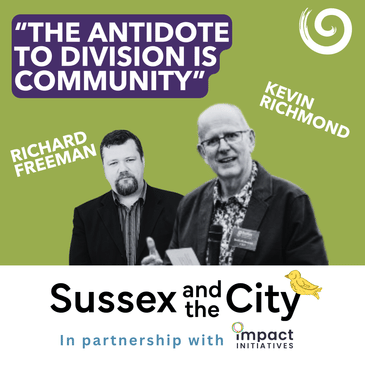
– Episode #42
"The Antidote To Division Is Community"
Host: Richard Freeman Guest: Kevin Richmond – former CEO, Sussex Community Foundation
🔍 Episode summary
Sussex is full of wealth, talent, creativity and civic energy. It is also home to deep inequality, entrenched coastal deprivation, loneliness, mental health pressures and communities facing rising need.
In this episode, Richard Freeman speaks with Kevin Richmond, founding CEO of Sussex Community Foundation, about what he has learned from nearly 20 years connecting local philanthropy with grassroots organisations across the county.
Kevin explains what community foundations do, why small charities are often closest to the people most in need, and how local giving can reach places that bigger systems often miss.
The conversation explores the gap between the wealth that exists in Sussex and the needs that sit alongside it, from Hastings and Bexhill to Eastbourne, East Brighton, Crawley, Littlehampton and beyond.
As Sussex moves towards devolution, Kevin argues that the voluntary and community sector cannot be treated as an afterthought or emergency safety net. It is part of the core infrastructure of the county: trusted, local, responsive and often holding communities together long before official systems arrive.
This is a conversation about money, but also about trust, power, pride, inequality, local agency and why any serious future plan for Sussex has to start with the people already doing the work.
This episode is brought to you in partnership with Impact Initiatives.
Impact Initiatives is a community-led charity proving that local action still packs a punch.
Working across Brighton and Hove and beyond, Impact Initiatives supports people facing some of life's toughest challenges, from social isolation and homelessness to mental health pressures and financial hardship.
Their approach is practical, compassionate and rooted in the belief that everyone deserves the chance to feel connected and valued.
Through community hubs, peer support networks and targeted wellbeing programmes, they help turn loneliness into belonging and crisis into stability. It is steady, often quiet work, but its impact ripples widely across Sussex neighbourhoods.
Find out more at impact-initiatives.org.uk
🎯 In this episode
What Sussex Community Foundation does and why it exists Why most charities are small, local and often hard to find How philanthropy can reach grassroots organisations with deep community trust What Kevin has learned from nearly 20 years of Sussex giving Why coastal deprivation remains one of the county's most entrenched challenges How local charities help people regain confidence, connection and agency Why philanthropy cannot replace public services, but can take risks and back local action How devolution could strengthen or weaken local community power Why Sussex's wealth does not always connect with Sussex's need What a future Sussex mayor should understand about the voluntary sector
🧠 Key themes
Small charities are often closest to the people and places experiencing the greatest need, but they are not always visible to donors, public bodies or larger institutions.
Philanthropy works best when it builds trust, backs local people and strengthens community agency, rather than parachuting in solutions from outside.
Sussex contains sharp contrasts: significant wealth, vibrant communities and deep-rooted deprivation often exist very close together.
The coastal strip faces long-term economic challenges that cannot be solved by charity alone, but grassroots organisations are essential to any meaningful response.
Devolution could bring useful strategic focus, but there is a real risk that localism is weakened if power moves further away from communities.
The voluntary sector should be seen as civic infrastructure, not a back-up plan. It carries weight across health, education, loneliness, poverty, youth opportunity and community resilience.
💬 What Kevin says
"Our mission is to build a fairer and more equal Sussex through investing in local community action."
"The vast majority of the charity sector is grassroots."
"Sussex is full of people who see a problem and say, let's sort this out."
"The grassroots is where the hope is."
"Philanthropy can never be a substitute for public services."
"You don't solve things by parachuting in."
"Invest and let go of control."
"Giving back is one of the most rewarding things you can do in your life."
ENJOY THESE PODCASTS?
Please consider giving a rating or review on your podcast platform of choice.
🎧 Production credits
Host: Richard Freeman Guest: Kevin Richmond Sound design / editing / original music: Chris Thorpe-Tracey Production management: Letitia McConalogue
📣 Get involved
👉 sussexandthecity.info — episodes, resources and events
[00:00:01] This episode is brought to you in partnership with Impact Initiatives, a community-led charity that proves local action still packs a punch. Working across Brighton & Hove and beyond, Impact Initiatives supports people facing some of life's toughest challenges, from social isolation and homelessness, to mental health pressures and financial hardship. Their approach is practical, compassionate and rooted in the belief that everyone deserves the chance to feel connected and valued. Through projects that bring people together, whether that's
[00:00:30] community hubs, peer support networks or targeted wellbeing programmes, they help turn loneliness into belonging and crisis into stability. It's steady, often quiet work but the Impact ripples widely across Sussex neighbourhoods. If you're interested in community action that doesn't just talk about change but rolls up its sleeves and gets on with it, discover more at impact-initiatives.org.uk. That's impact-initiatives.org.uk.
[00:01:00] This podcast is brought to you by Always Possible. Always Possible.co.uk. You're listening to Sussex and the City with Richard Freeman. Hello and welcome to Sussex and the City podcast. It's me, Richard Freeman. I hope you are enjoying the sunshine where you are. Hopefully there is some sunshine. These are febrile, turbulent times
[00:01:29] with lots of change. New landscapes to navigate. Whatever your political persuasion, there's a sense that people are unhappy, right? So I'm not going to talk about politics but I am going to talk about trust and community power. And what happens when the people holding Sussex together are maybe the least visible in some of the official stories. My guest in this episode is Kevin Richmond. He was the
[00:01:57] founding chief executive of Sussex Community Foundation, leading the foundation from its launch in 2006 to become one of the leading independent funders of the voluntary and community sector right across Sussex, connecting local philanthropy with small charities and grassroots organisations across the county. Kevin stepped down from being CEO just a few weeks ago in April to move towards
[00:02:22] consultancy and I'm sure some form of deserved retirement. But 20 years at the head of this organisation has given him a really, really interesting insight into actually what's happening at the grassroots across Sussex. And before leading the Community Foundation, he ran the Carers Centre in Brighton & Hove, working in youth support and community development. But his whole career has been built around charity leadership, philanthropy, advice and place-based funding.
[00:02:50] And so in this chat, we look at what community foundations actually do and why their role is as much about the glue, the insights, the understanding, the hand-holding as much as it is about dishing out money. Kevin explains how Sussex Community Foundation has helped donors, families, companies and local authorities get money to where it can have the greatest impact, often into organisations with deep local trust that might have very little visibility.
[00:03:16] We also talk about Sussex itself. The coastal strip where deprivation has become deeply embedded, grassroots organisations creating hope in places like Hastings, Bexhill, Eastbourne, Whitehawk and Brighton, Crawley, Littlehampton, and the uncomfortable gap between the wealth that exists in Sussex, and it does, and there's lots of money here, and then the needs that exist alongside it that maybe that money doesn't always connect with. There's a strong devolution thread in this
[00:03:45] conversation, of course. If Sussex is moving towards this strategic authority within a directly elected mayor and a new local government map, then the voluntary sector can't just be treated as a safety net once everything else has failed, or once decisions have been delayed, or crises have been, it's taken too long to realise what's happening. The voluntary sector is part of the core infrastructure of Sussex, often closer to people than politicians will ever get. Charities are more trusted than the anchor
[00:04:15] institutions and are always quicker to respond when a crisis hits. So Kevin makes the case that philanthropy can never be a substitute for public services. It cannot fix broken housing markets, underfunded councils, or long-term economic decline. But philanthropy can take risks. It can back local people and it can strengthen community agency, often funding the small human things that the big
[00:04:41] systems can miss. So this is an interesting conversation about giving, but also about power, inequality, local pride, coastal economy, public trust, and why any serious plan for Sussex has to start with the people already doing the work. Here's my conversation with Kevin Richmond.
[00:05:11] Welcome to the Sussex And The City podcast. It's Richard here. Hello. Joined by a brilliant guest, as always. I think this is going to be a really interesting episode talking about all things charity and philanthropy, kind of pan-Sussex understanding of how we move money around so that those with it can support those without it or the organisations with clear charitable aims can multiply the impact they
[00:05:40] have through their relationship with funders and donors. And I've got no one better to paint a picture, certainly over what the last 20 years in Sussex has looked like, and perhaps what is to come through the evolution. And that's Kevin Richmond, the Chief Executive of the Sussex Community Foundation. Kevin, how are you? Very well. Thank you, Richard. Yeah. Thanks very much for inviting me along. Let's start with the Sussex Community Foundation. What is a community foundation for starting?
[00:06:10] What is a community foundation? Well, I guess you've given quite a good summary, really. It's about making sure that the people who have got money to give can invest that well in the local community sector and invest in impactful local charities. Our mission is to build a fairer, more equal Sussex through investing in local community action right across the county. It's also to increase the
[00:06:34] value and effectiveness of philanthropy, of public giving, if you like. So it's a bridge between people who've got money and charities on the ground doing the great work. And people say, well, why do we need that? We all know that there's charities. We can find them easily. But of course, the ones that are easy to find are the very big ones. They do great work. Your local hospice, Oxfam, you know, you can find those easily. They do great and very important work at a big scale. But that's only a tiny proportion
[00:07:03] of charities. 97% of charities in the UK, and it's the same in Sussex, have a turnover less than a million pounds. And something like 80,000 have a turnover less than 100,000. The vast majority of the charity sector is grassroots, small organisations run by and for local people. There can be a brilliant charity on your doorstep that's addressing the cause that you're really passionate about, but you'll never know. So that's what a
[00:07:30] community foundation is there for, to build that bridge and to get money right to the front line of people making change, building a fairer world on the open-minded doorstep. And what's the mechanism that the foundation provides then? It's actually a brokerage relationship. If you like, we are a grant-making trust. Like any grant-making trust, we have in downward funds, we manage investments that are given for the long term.
[00:07:58] We have a grant-making team that gives grants out. We've got a fundraising team that's building relationships with donors. So we're like a grant-making trust, but the difference with us is we're kind of a white label service. So actually, the majority of our grants are given out in the name of our donors. So Rampian Wind Farm has a community benefit fund and Rampian Community
[00:08:23] Benefit Fund is much better known. Gatwick Airport has a grant fund with us. That's much better known than we are, you know. And we will help those companies, for instance, to A, reach the charities that match with their brand or with their mission. B, make sure there's maximum impact on the community, but also get recognition. Companies don't want to give no one know about it. They want people to know they're doing it. On the other hand, someone might leave a legacy and they don't want to be completely anonymous.
[00:08:52] They're the only one. Maybe they lived in a village, doesn't want to leave their house to charity, if you like. Don't necessarily want, if you want to know that it came from them, but they want their village to benefit, we can do that as well. So it's a kind of bespoke service for donors, so that whatever people's causes are, whatever they care about, we can match that with what's happening in the community. And it means for charities, we are kind of a generic grant-maker. So any charity can apply
[00:09:20] to us. And then we match those charities with each donor, if you like. And what's the kind of scale that you're operating on in terms of money in and money out each year? Money in and money out. So currently we're giving out around £3 million per year in grants. The average grant is just under £5,000. So they're mainly small grants to small charities.
[00:09:43] So around 500, 600 grants a year. We have an endowment fund, which is £27 million. That's the capital where, like I say, for example, people have left legacies or when people have sold businesses and they want to give a big chunk of money at once, but invest that for the long term. That's the endowment. And that's around £27 million. And 5% of that per year will be used for grant-making. So just under
[00:10:10] £1.5 million a year. And the great thing about that is that because of that, we know the community foundation will be there forever. The other brilliant thing about that, it makes us really responsive. So when COVID started, you know, when lockdown was on the 20th of March, by the 31st, we were giving out grants to help charities go online or to deliver food because we had that endowment fund that was there and we could just change the purpose of the grant-making. That's the beauty of
[00:10:38] the community foundation is really building up a long-term sustainable fund and also being really responsive to what's happening in the community. You know, you mentioned COVID there, but looking back over the last 20 years, goodness me, can we think of a more turbulent 20 years for this sort of UK economy and for the challenges and opportunities for communities in Sussex than, you know, outside of wartime? I'd love to hear a little bit about your reflection on that time and what you've learned,
[00:11:07] and particularly what you've learned about Sussex as a place. I mean, the world's changed so much. You're right in the last 20 years, how could we have imagined what we would experience? Because when I started was, I suppose, just before the 2009 crash on stock markets. And I think I've already started saying to donors, well, charitable giving has never been more needed. And actually, I think I've said that every year
[00:11:31] for the last, you know, COVID and since, the need in the community has just skyrocketed. I think the community response has been fantastic as well. And that's, that is a really crucial thing about Sussex. I think the community in Sussex is so vibrant. It's full of people who will see a problem and say, well, let's sort this out. Let's do something about this. Let's get organized. Let's, you know, they can do something differently. It's an incredibly innovative community, I think.
[00:12:00] And that goes across all sectors. I've been incredibly proud really of Sussex to be, you know, heading the community foundation. It does give you the most unique reach into the community of Sussex. I suppose thinking of my first contact with the community foundation was my interview for the job, which was in, in the, one of the turrets of Goodwood House, in the Duke of Richmond's office, coming into this circular room with a round table. And there were 10 people around the
[00:12:29] and the table interviewing me, which is probably the most intimidating moment of my life. I was like the traitors. Actually, it was a bit like the traitors, how you said it. Yeah. But also, in the early days as well, you know, one of the funniest stories of that was the late Duke of Richmond knew absolutely everybody in Sussex, who was a, who's especially all the gentry and all the landowners. But he knew their history going back hundreds of years. My second day in the job, he said, well, we're going
[00:12:58] to do a launch at the Royal Pavilion in Brighton months, the first 31st of March, which was three months away. And I said, great, but I don't know anyone. I don't know anyone. So, you know, I know everyone in the charity sector, but that's not what you need. So, well, don't worry. So we'll get all the trustees in the same room in Goodwood House. And we started, we got all the trustees to put their names into an Excel spreadsheet and you can't do it now because of GDPR, but that's what we did then.
[00:13:26] We sat around this table and the Duke started. So they had first name. Okay. Well, his great grandfather in 1750 ran off with this gardener or something. And we thought, okay, this is going to be a long evening. Yes. And we eventually got kicked out by the security guard and had to turn the alarms on at about 11 o'clock at night. And we've gone through, you know, you've gone through all this incredible gossip of Sussex history. The land of gentry or knowing each other is one thing,
[00:13:52] but I think actually those that thrive or get through it, regardless of where you sit, is those that have a network, those that feel part of something bigger, those that feel able to connect to and draw on the support of other people. And I think Sussex is particularly good at that, right? Yeah. And I think you're right. I think all those things talking about that, that ability to work with others or to share a common interest, that's what gives people agency, isn't it? A sense that
[00:14:19] actually I've got some control over my life. And I think the, sometimes the saddest thing to see is people who are really lonely and people who are isolated because then they feel they can't change anything. And so, I mean, that's one of the many reasons, really, why I think small community organisations are so vital because they, even the very step of people coming together in one place,
[00:14:46] getting over, getting over loneliness, getting over isolation. So we're talking in the context of devolution and you are a pan Sussex organisation that has existed for some time. That's not that common, but we're about to go through quite a big shift. And so I can imagine they will come to you fairly early on as an organisation and say, look, you know, one of the KPIs of the mayor is going to be around public health outcomes. It's going to be a lot around opportunity
[00:15:12] and social mobility, even, you know, through a growth lens, their job is going to have a pan Sussex strategic approach. So the data that you guys have, the knowledge that you guys will have built up and the understanding of, you know, let's be blunt, where things are falling apart. I imagine that could be quite an interesting conversation with a new administration to sort of sit about, okay, where can you have the biggest impact, the quickest?
[00:15:37] That's a really crucial thing about the organisation and the new mayor. I'm really supportive of that strategic approach. I think Sussex will really benefit from that strategic approach across the whole area, but the risk is losing the localism. The districts that are going, how are the places like Bexhill, like Cobra, Wisbur Green, how are they going to get their sense of localism that you have
[00:16:03] from the moment, you know, that your services are local. We mustn't lose that. And actually, I think your work is really interesting on that because you're talking to businesses and you're talking to charities and actually that's where the localism comes in. You know, it's small local charities and also small local businesses that make community. The mayor should be talking to us very early, very early on. And the first thing I would say is that the way you can make most impact
[00:16:29] is at the grassroots. Someone who's feeling lonely and very isolated, by getting involved in something, that's how they get a sense of agency, that's how they get back into work, that's how a young person finds their skills that they can think, oh yeah, I can develop that into a career. You've probably got a strategy, a vision, a road map, maybe even a post-it note empire on your office
[00:16:52] wall. But has anyone asked the really awkward questions yet? Like, is it actually working? At Always Possible, we help senior leaders challenge the obvious, rethink the possible and deliver the extraordinary without losing their sanity or their sense of humour. Enabling private and public sector
[00:17:15] innovators to navigate a changing economy. We help complex organisations to humanise data and to translate the big picture into hyper-local engagement, trust and sustainable growth. If you're ready to bring people with you because your leadership truly inspires, visit alwayspossible.co.uk.
[00:17:40] That's alwayspossible.co.uk. Always possible. We make bold business brilliant. The Sussex Community Foundation, we have been producing data around Sussex since about 2013, looking at where the areas of greatest need are and where the greatest challenges are. So we've
[00:18:07] looked at deprivation, we've looked at poverty, we look at reaching potential, we're looking at health and wellbeing. And we're looking at climate change. The really consistent patterns of all those areas is the coastal deprivation. You know, Hastings, Bexhill, Eastbourne, East Brighton, Angleton, Bogner, Little Hampton, all along that coastal strip. Time and again you see that the most
[00:18:33] entrenched issues are on that coastal strip. It's an economic issue. It's a long-term economic issue which is not getting solved. The mayor should be looking at that very strongly. How can we invest in those economies? But also how do we invest in those communities? I guess the question is, good philanthropy, generous philanthropy, you know, charitable giving
[00:18:56] can go a long way to responding to some of that need. But it's not a solution. You said the problem is economic. So philanthropy doesn't change economics. So is there innovation through philanthropic giving that's also looking at solutions to some of this? Well, I think you're absolutely right. I mean, the infrastructure needs to be in place. So you say, you know, you need to have transport, roads, buildings, you know, that must, you know,
[00:19:26] government needs to do that, private sector needs to do that. So, you know, taxation plays a really important part. Of course it does. Public service delivery is critical. And public sector should also create the conditions for both private investment and philanthropic investment and problem solving. I think actually philanthropy can be an economic driver. I mean, if you look at what Roger DeHaan's doing in
[00:19:52] Folkestone, he's investing pretty much all his philanthropy as far as I don't know, into the one town. And he's making a huge difference to it because he's taking that strategy of how can my giving really focus on on the place. At the other level, you've got, and again, this comes back to the kind of activist Sussex, if you like, but you know, you've got community land trusts, you've got people looking at different ways that communities can take ownership of space, different ways that people can organize together and fund their
[00:20:22] work, circular economies. You know, your village shops, they are absolutely economic interventions, owned by and run by a community. The grassroots is where the hope is. It needs an infrastructure, it needs the big picture, it needs government funding, you know, the lights to still be on and the NHS to be working and so on. But there's stuff that can do become from the grassroots that
[00:20:49] the state can't do. And what it should do is fund it and get out of the way. Let people get on with it. It feels like there's a lot of people that live in Sussex and make a lot of money, but they don't make it in Sussex. They make it in London because of our proximity there, or they make it internationally. So Sussex has had the reputation of, it's the nice place you live, nice big house on the beach, but you get away to somewhere else if you're going to make some serious money because, you know, wages are quite low and it's a small business economy.
[00:21:17] We don't have particularly big corporates. I've always wondered if that has had quite a psychological distancing, perhaps. That wealth hasn't always benefited. I think that's very interesting. I think certainly in the early days of the Foundation, that was very much the case. You know, people who are making big money were in in the city, in London, or they were global. Back in 2009, we created our Sussex in the City events, which we did for exactly that market. We do an annual event for people who are living in
[00:21:47] London or have connections to London, but also connections with Sussex. And that's been very effective. In the early days, it was people who had a weekend home. But actually, I think that's changed a lot because, not least because of COVID, because there's a lot of people who were commuting five days a week up to London and now maybe going one day a week, even though they may still be working in the city. They are in the communities a lot more, they're seeing the community a lot more, and they're getting involved in it a lot more. I think that's true. But I do think one of the
[00:22:16] reasons people choose to live in Sussex is because of the kind of vibrant place that it is. So even the wealthy people are here. David If I hear a criticism about that, it's sort of, yeah, you're here for what this community has built and created, and a lot of it on the back of penniless artists and shopkeepers and restaurateurs, you know, creating extraordinary sort of experiences. But it's then not fair if you spend all your money somewhere else. That's a reductionist statement there. But I think there's
[00:22:46] been an element of that. So I wonder if rebuilding of Sussex as a confident place, it's really cool to live and work. And you see money flowing through the lens of the community foundation, because you do that bridging anyway. But you know, something that a new mayor should come in and say, you know, Sussex is an incredible place, but we need to think about it as this holistic place. David So two things I'd say, I mean,
[00:23:16] coming back to your point about people spending their money here, that's absolutely the case with high net worth people. With giving, you know, if you've got a million pounds to give, it's quite tempting to fund a wing in the National Gallery in every name. Whereas actually, with a million pounds spent in Sussex for local charities, it's transformative. It would transform hundreds of people's lives. That's our job is to say, look, this is what you can do here in your
[00:23:41] community. And secondly, the thing that I'm really passionate about is building that bridge emotionally, the bridge of empathy, if you like, because the real danger of like, like our reports saying, okay, there's lots of deprivation in Hastings. It reinforces the vision of Hastings as being a problem, a problem place. But Hastings is an amazing place. And you want to talk about pride, people in Hastings are proud of Hastings and quite rightly.
[00:24:10] David Yeah. And they're pissed off with everyone else telling them it was fresh. David Well, there's more festivals in Hastings than anywhere else in the country. David Yeah. David There's so much music going on there. There's, you know, there's so much stuff happening in Hastings. And I think that they often get really, like you say, annoyed about things being parachuted into, or we're going to solve Hastings. David Oh, your language is more delicate than mine. David Yes. David Yeah. And, but you don't solve things by parachuting in, you solve things from,
[00:24:39] by investing in the grassroots and supporting people to, David To solve their own problems and get agency and work together. And that's what, David That's what community foundation do. And that's what the mayor should be doing. And you're right. That's what we, I think we hope is you build a thriving economy, which is, which is really inspiring and mixing and, and, and the best of the events that I go to in Sussex,
[00:25:06] David You see, you've got small businesses, big businesses, charities, community activists, um, landowners, all saying, let's do something different. And, and that's where real change can happen. And I think the mayor can really, really help with that, but will only happen if this is baked in from the beginning. David The solution of the district and boroughs, well, that's a lot of uncertainty for a lot of organizations that have got contracts with those councils and they know, they don't know who they're going to have contracts with anymore.
[00:25:36] There's a sense of hyperlocalism is kind of what drives a lot of the, the support infrastructure. So if we, if we move everything upwards in terms of democracy, franchisement, kind of civic engagement, we don't know what that's going to do to some neighborhoods. A, what's your message to potential mayor about treading carefully, or what could they do to try mitigate some of that? But also secondly, what's the biggest opportunity? What do you think actually
[00:26:03] could be a real lifeline to a pretty fragile, but vital part of Sussex community life if it was done well? David The first message is we've got an incredibly vital community and it's vibrant, I think right across the county. That drive for community action is unstoppable. Yeah, Sussex, we won't be drove, you know, they're the people that they've got their own drive.
[00:26:29] So let's unleash that. Let's not try and control it. Let's invest in it. Let's give people the chance to build the communities that they want to bring people together, create the conditions for people to organize. And yes, provide funding. That's really important. I would say, of course, Sussex Community Foundation is, is expert at getting funding to where it's needed, to get funding that's right to the grassroots right across the county, where expert in investing for
[00:26:58] the long term, to really provide the funding in the way that charities need it and not in a bureaucratic way. And of course, I would say we, we did it at the fraction of the cost. I know, I know what it costs the local authority to run a grant making program. I know what it costs us to do it. It's a tiny fraction and we did it a lot better. So the mayor should be talking to Sussex Community Foundation about a long-term investment in the community because we, we give funding in the way that
[00:27:24] charities need it, not in the way that we think they need it. I think the second thing, the mayor, they've got to have a strategy for community. Community carries the weight of public services, you know, whether it's health, whether it's education, you know, everything, you know, the country's with nature. It's, it's the community that's, that's doing the majority of the heavy lifting. And if that goes, the state system will collapse. Invest in the infrastructure of that as well,
[00:27:52] because there are organizations across that are helping people to get started, giving people the, the tools to set up their community group or the tools to merge, you know, and you need that locally to support and, and help this thrive. And I suppose most importantly, ensure we're supporting the diversity of Sussex. Again, that's one of the great strengths of Sussex. It is a place people come because you can be who you want to be. And people say that about Brighton, but it's the same,
[00:28:21] especially in, just as much in Hastings as it is in Brighton, but a lot of Sussex, it is a liberal minded kind of place. We live and let live, you know, but that is part of the, that's part of the vibrancy of it, both for the, the community economy and the business economy. I think so. The thing I've seen most of all in over the 20 years I've been in, in this job working with local authorities, as money's got tighter and tighter, they've got more and more risk averse and they try
[00:28:51] and control things more and more. If you control things, you can be sure the thing you ask people to do it will get done because if they don't do it, they don't get the money, but they will only do what you tell them to do. They wouldn't do anything else because they, because they need to do what you said. So actually by controlling these, you're actually restricting and you're losing all of that vibrancy. So that's the big message is to invest and let go of control, let communities control things. And then, then you at least the power of that action.
[00:29:21] Yeah. Very important. Are there ways that they could kind of rethink how to leverage, maximize, match fund, target investment from people in a way that Sussex hasn't sort of seen before? I think absolutely. I mean, you know, different kinds of power, aren't they? But often the most effective one is convening power. And if you've got people's ear, what do you do with that ear? What do
[00:29:46] you say? But if you bring people together to have influence, what can you do with that? You know, and you would hope that people will be influential. People will walk to the mayor because they'll have power. So it's how they use that, not just in terms of the direct power, but that convening soft power and the influence. And I've really hoped that they would, you know, build a culture,
[00:30:10] help to build a culture within business and the leadership in the county that really values what we have in this place and that we can give back. And I think the thing that I, you know, one of the things that surprised me coming into this job is, is actually how much we are helping our donors. And, and the, when someone gives to a charity and I think, oh, do you know what? That's exactly, they're doing exactly what I would do. Do you know what I mean?
[00:30:40] That's exactly what I care about. You know, you can see people are tearing their eyes sometimes because they think, I didn't know that existed, but I'm so pleased that I can fund that, you know. And it is so rewarding for the donors, whatever level people are giving at. And I think that's something that a mayor can help people to understand that actually giving back is one of the best things you can do. One of the most rewarding things you can do in your life.
[00:31:07] David Well, on that note, that feels a good note to say, thank you, Kevin Richmond, for being my guest on the Sussex in the City podcast. David Thank you very much. David Thank you very much to this episode's guest and to you for tuning in. Sussex And The City is an
[00:31:34] independent and non-political project about devolution as it happens, explained in human. It is led by always possible. You can find other episodes, resources, events and blogs about change in Sussex and Brighton by visiting sussexandthecity.info. That's sussexandthecity.info.
[00:31:58] This episode was written and presented by Richard Freeman for Always Possible. The editor was me, Chris Thorpe Tracy for Lo-Fi Arts. I did the music too. Production management was by Letitia McConnellogue for Always Possible. Talk to you next time.
[00:32:28] Always possible.co.uk