
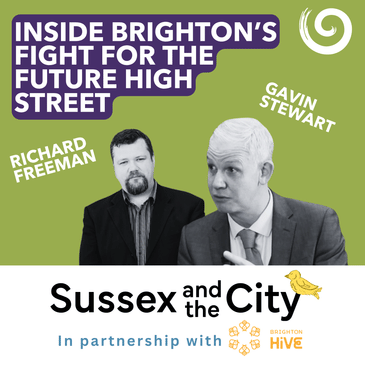
– Episode #43
Inside Brighton's Fight For The Future High StreetHost: Richard Freeman Guest: Gavin Stewart – Chief Executive, Brilliant Brighton BID / Executive Director, Brighton Economic Growth Board
🔍 Episode summary
Brighton and Hove has always had a complicated relationship with its own story. To some, it is one of the UK's most creative, entrepreneurial and culturally alive cities. To others, it is a place under pressure from rising rents, empty shops, homelessness, graffiti, changing consumer habits and a fragile public realm.
In this episode, Richard Freeman speaks with Gavin Stewart, Chief Executive of Brilliant Brighton (Business Improvement District) and Executive Director of the Brighton & Hove Economic Growth Board, about what is really happening in the city centre economy.
Gavin explains the role of the Business Improvement District, how businesses collectively fund projects such as Christmas lights, street dressing, security ambassadors and support for local traders, and why Brighton's high street story is more nuanced than the familiar 'UK city in decline' narrative.
The conversation explores vacancy rates, independent retail, landlords, inward investment, tourism, the changing purpose of the high street, and what Brighton needs to do if it wants to remain distinctive, resilient and economically important.
As Sussex moves towards devolution and a future mayoral authority, Brighton's role becomes even more significant. Is it the region's economic engine, its cultural shop window, its tourism magnet or something more complex? And how can Brighton's success create a ripple effect across the wider Sussex economy?
This is a conversation about high streets, but also about confidence, identity, partnership, investment and what kind of city Brighton & Hove wants to become.
This episode is brought to you in partnership with Brighton Hive.
Brighton Hive is a growing community built on the idea that business works better when it behaves a bit more like nature.
Founded by Kyriakos Baxevanis, the award-winning entrepreneur and former Sussex and the City podcast guest, Brighton Hive brings together people, organisations and purpose-led brands to create something more connected, more human and more useful than going it alone.
Inspired by how a natural hive functions, it is about everyone playing a part, sharing skills, supporting each other and building something bigger than any single business.
Rooted in Brighton and focused on food, wellbeing and community, the Hive is already home to ventures including Nostos Greek Restaurant, Little Jasmine Spa and Be Well Live Well.
Find out more at brightonhive.co.uk
🎯 In this episode
Why Brighton's city centre story is more complicated than "boom" or "decline" What a Business Improvement District actually does How Brighton businesses collectively invest in the city centre experience Why Brighton's retail vacancy rate is lower than many people assume How independent shops help shape the city's distinct identity Why landlords are such a powerful but under-discussed force in high street change What inward investment could look like for Brighton and Hove How tourism, retail, housing, schools, culture and lifestyle all shape the local economy Why devolution could change how Brighton works with the rest of Sussex What a future Sussex mayor should understand about Brighton's economic role
🧠 Key themes
Brighton is not collapsing, but it is under pressure. The city centre still performs strongly in many areas, but rising costs, changing shopping habits and public realm challenges are affecting confidence.
Independent businesses remain central to Brighton's identity. The city's character depends on small, creative and distinctive traders, particularly in areas such as the North Laine and The Lanes.
Vacancy rates only tell part of the story. Empty units are visible and send a negative signal, even when the data shows Brighton performing better than the national average.
Landlords have a major influence over the future of the high street. Rent levels, lease terms and the willingness to back more experimental uses all shape what kind of city centre can emerge.
The high street needs to become more than retail. Culture, leisure, circular economy, repair, food, events, social infrastructure and public experience all matter.
Devolution could help Brighton make a stronger case for investment, but only if the city works in genuine partnership with the rest of Sussex rather than behaving like the whole region revolves around it.
💬 What Gavin says
"We've got one of the lowest vacancy rates in the country."
"We all believe in the city so much, and we all really want it to succeed."
"We're not a cookie-cutter type place."
"It's a market, and there's very little we can do to curb those businesses opening up."
"Our success is a partnership."
"The diversity of that group is absolutely its strength."
"There is an opportunity for much more leisure usage of the high street."
"I'm a big believer in working together. I'm a big believer in this region."
You might enjoy our podcast investigation into the first 20 years of Brighton & Hove as a city
🎧 Sussex And The City production credits
Host: Richard Freeman Guest: Gavin Stewart Sound design / editing / original music: Chris Thorpe-Tracey Production management: Letitia McConalogue
📣 Get involved
👉 sussexandthecity.info — episodes, resources and events
[00:00:00] This episode is brought to you in partnership with Brighton Hive, a growing community built on the idea that business works better when it behaves a bit more like nature. Founded by Kyriakos Baksavanis, the award-winning entrepreneur and former Sussex And The City podcast guest, Brighton Hive brings together people, organisations and purpose-led brands to create something more connected, more human and frankly more useful than going it alone.
[00:00:27] Inspired by how a natural hive functions, it's about everyone playing a part, sharing skills, supporting each other and building something bigger than any single business. Rooted in Brighton and focused on food, wellbeing and community, The Hive is already home to ventures like Nostos Greek Restaurant, Little Jasmine Spa and Be Well Live Well, each contributing to a wider ecosystem where collaboration replaces competition and wellbeing isn't an afterthought.
[00:00:55] It's not a network, it's a living, evolving community and one that believes business can genuinely serve people, planet and place. If that sounds like your kind of thinking, step into The Hive at brightonhive.co.uk. That's brightonhive.co.uk. This podcast is brought to you by Always Possible. Always Possible.co.uk
[00:01:26] You're listening to Sussex and The City with Richard Freeman. Welcome, welcome to another edition of the podcast and I've got some big news. We are moving back to a weekly release. For the first few months of this year we've been doing fortnightly episodes. It's, you know, as the timetable has shifted and this project is definitely going to be lasting longer than we originally thought. So we thought fortnightly was, you know, kind of made more sense.
[00:01:54] But there are just too many interesting voices to talk to and we're really excited that we're moving back to weekly. We're going to bring a whole wider diversity of thought and opinion from right across Sussex. We're going to have some specials through partnerships and some mini-series and it's going to be great. So if you're listening to this and you're not yet subscribed or following on your favourite podcast platform,
[00:02:20] then get on it so that you get it in your feed without any effort every Monday morning. So this episode, Brighton & Hove has always had a slightly complicated relationship with itself. Depending on who you ask, It is either one of the most creative, entrepreneurial and culturally alive places in the country, maybe even the world.
[00:02:44] Or someone else will tell you that it is a collapsing into a sinkhole of empty shops, rising rents, graffiti, traffic cones and oat milk. The truth, as ever, is probably somewhere in the middle. And some of you may know I did a big podcast project about this called The Brighton Paradox. It involved over 100 voices from across the city looking at the first 20 years of city status.
[00:03:09] So if you want to go much, much, much, much deeper into a story about Brighton and where it's got to and where it might be going. And we even talk about some early ideas about what Brighton would benefit from a mayor. But that was long before we knew any of this was happening. So have a listen to that if you want to catch up. But I'm going to revisit some of these conversations in this episode. And we're talking about the Brighton economy, not just the dry spreadsheet of GDP and GVA.
[00:03:38] We're talking about confidence, perception, place, investment, independent business, the future of the high street. And what actually makes a city like Brighton and Hove feel alive? My guest is Gavin Stewart, chief executive of Brilliant Brighton, the city centre business improvement district. Gavin is also the executive director of the Brighton Economic Growth Board, which I will declare an interest in. I sit on.
[00:04:05] And Gavin has been involved in Brighton and Hove's economic and civic life for decades. For over 20 years, he's steered everything from the city growth agenda to tourism, inward investment and high street regeneration. And this chat gets into some quite important territory, I think, because whilst Brighton is often hyped as the most incredible space on earth or derided as a city in decline, the reality is much more nuanced.
[00:04:33] Retail vacancy rates are actually far lower than the national average. Independent businesses still give the city a distinct identity, far more than many other cities of equivalent size. And there are serious questions emerging about what the next phase of Brighton should look like, especially in the context of Sussex devolution and the arrival of a future strategic mayoral authority.
[00:04:56] We talk about whether Brighton has ever properly learned how to sell itself economically and why so much of the city centre experience is already funded privately by businesses themselves. Why landlords remain one of the most untalked about forces shaping the future of the high street.
[00:05:13] And whether cities like Brighton and Hove need to stop thinking purely in terms of growth and start thinking more about resilience, experience, creativity, quality of life and putting some metrics on those and shouting about those. And this conversation comes in a moment when the rules of the game are changing.
[00:05:31] The government's new devolution legislation, which has just passed through the Commons, gives mayors stronger powers around regeneration, planning and economic development, alongside new tools linked specifically to high streets, vacant buildings and community assets. There are proposals around community ownership, commercial leasing reform and new ways to coordinate investment into town and city centres.
[00:05:54] So when Gavin talks about landlords, vacant units, independent traders, business improvement districts and the future of Brighton city centre, this is not just a hyper-local conversation. A future Sussex mayor can't magically fix all the problems overnight, but they can have far more influence over how places evolve, who benefits from regeneration and what sort of economy Sussex wants to build, especially with a city and economic lung like Brighton in the centre of it.
[00:06:22] There's also a really interesting discussion about the role of Brighton plays in the wider Sussex economy. Is it the economic engine of the region? Is it the cultural shop window? Is it a tourism magnet? Or is there something more complicated going on? And perhaps more importantly, what kind of city does everybody in Sussex want Brighton to be and to become over the next 10 years so that that ripple effect is really felt? Here's my conversation with Gavin Stewart.
[00:07:02] I'm joined by the wonderful Gavin Stewart. If you don't know Gavin, he is Mr. Central Brighton Economy, really, in charge of the Business Improvement District. And for many, many years been heavily involved with the Economic Partnership and the Growth Board and different iterations of that way back to when Brighton Hove first got city status. How are you on this rainy, sunny, rainy?
[00:07:27] I'm very well, thank you. Yes, it's a bit of a shock to the system, isn't it? But to be honest, I'm from Scotland, so I quite enjoy a little bit of the grey sky and the rain, so it's not really bothering me that much. You've got slightly more waterproof skin than the Sussex onions. Possibly. Let's start a little bit with your history, maybe. If you could sort of summarise some of the key things that maybe you've seen or noticed, what would you say?
[00:07:48] Yeah. It's a really interesting question because Brighton and Hove has been certainly on a trajectory, but it's also always been in a slight element of flux. You know, there's been different views, different viewpoints, certainly different administrations over the years. And as we're all aware, for a long time, the political colour of the city hasn't been a solid one.
[00:08:14] So decisions possibly have been harder to make during that time. So we find ourselves, as you very rightly put it, I've been involved in the city now for some years, and I wrote a paper, an article, I should say, a few years ago, when Brighton and Hove had turned 18, it would become an adult, essentially.
[00:08:36] And, you know, what does that mean for it? We can put away those foolish things of childhood, and as a city, we can actually start to look forward and really start to think about what our future looks like. And certainly over the past few years, I do believe to some degree that is what has been happening in the city. And there has been a much more solid belief, I think, behind the more recent iterations of the economic strategy for the city.
[00:09:01] Certainly having a non-hung council is a helpful thing, regardless of what colour you support. Having a direction and having a clear vision for the city is something that we've needed for a long time. So, again, that's a really positive piece. The city itself, in many ways, bucks numerous national trends.
[00:09:23] The one that springs to mind at the moment, I'm sure people listening to this might kind of roll their eyes when I say this, because when I talk to people about this on the streets, usually they don't believe me. But we've got one of the lowest vacancy rates, for example, in the country. In terms of retail shops? In terms of retail shops in the city. Sorry, I should have clarified that. So, you said that I'd look after the business improvement district. So, the business improvement district at the moment is about 3.6% vacant.
[00:09:51] Wider city centre, about 8.3%, 8.5% vacant. The national average is about 14% vacant. It's a massive discrepancy between the two. Now, when you talk to local businesses, although, or even just talk to local people, most people will say, hang on a minute, Brighton's going to the dogs, you walk down the street, there's lots of empty shops, there's lots of empty premises. At the moment, actually, the data doesn't suggest that that's the case. But I think what this exemplifies is something on a much bigger scale.
[00:10:19] You know, as people that live and work here, we all believe in the city so much, and we all really want it to succeed. So, the second you see anything wrong with it, you tend to maybe overblow it, or you think that it's a massive, huge problem. When you crystallise it down to this issue around how the retail vacancy works in the city, actually, as I say, we're doing really, really well. But it's our natural knee-jerk reaction to go, oh gosh, we're going to the dogs.
[00:10:46] But that seems to happen in a lot of different silos across the city. We have a homeless problem, there's no two ways about it. The street community is certainly growing, there's no question about that. But also, equally, we're very, very well served with a number of amazing agencies and organisations in the city to actually look after and support those groups of individuals. There's always a spike in the summer, certainly, with the street community. Equally, we are really good at supporting those organisations.
[00:11:13] The BID certainly does that a lot, but there's an awful lot of other organisations as well out there that do that. Inward investment, again, is something that I was quite keen to have a little chat about today. It's something that we've never really managed to really nail in the city, largely because we haven't really had the funding to be able to set up an inward investment. And when we say inward investment, we talk about sort of marketing the city. And unlike other areas, what we don't have is a landing site. We don't have a website.
[00:11:41] We don't have brochures and, you know, come and set up your business in Brighton. But what we do have is this amazing lifestyle offer that, you know, yeah, sure, you can come set your business up. But also, what else do you get on the backside of that? You also get great schools. You get great entertainment, expensive housing, admittedly, but still great housing if you can afford it. But the heritage offer, outdoors offer within the wider region is really fantastic.
[00:12:07] Well, we just need to do a bit of work to bring all that together and create a much more of a proposition and a package around it for people. But having said that, without having created all that big package around it, we do still get a lot of interest from people wanting to come and set up business here. I mean, the big one, of course, at the moment is IKEA having set up shop in Brighton, which is a really fantastic mark in the sand for an international organization wanting to set up a business here in the city. So a few things to delve into there.
[00:12:35] As you've suggested, an economy of a city or a city region. You cannot extrapolate the business from the tourism, from the housing, from the education, from the public health. These are all part of a constellation. Absolutely. So your day to day there is really looking at the kind of profile of the shops in the city center. And I think you've got a unique perspective on that. So going back to that, what is a bid? So without boring you or anybody listening to this, I'll try to keep it into a nutshell.
[00:13:05] But there's a piece of government legislation, the 2004 Business Improvement District legislation, which allows businesses within any geographical area to come together and they decide to pay an additional levy on top of their business rates to provide a bunch of projects that they think are going to improve their trading environment. We've been running a business improvement district here since 2006. The legislation came in 2004.
[00:13:32] Of course, we weren't the first people out there, but we were in the vanguard of cities that delivered on this. Yes, there is the bottom line. They want to improve their trading environment because they want to make more money and they want to be a successful, sustainable business. But there is also philanthropy in there because the projects that quite largely we end up delivering are things that you would normally imagine would be spent from the public purse. But they're not. It's projects that are delivered through the private purse. So the legislation allows you to set up a project and you run it for five years.
[00:14:01] At the end of that five years, you go back out to the business community and you say, hey, everyone, how was it for you? What sort of projects do you want to see happening now? How much money are you willing to spend on those projects? Yeah, and what's your vision really for the future? And we're at that point actually just now within Brighton City Centre. So for the last iteration of this business improvement district, current one, which ends in June 2026, we've delivered about £2 million worth of additional investment in the city centre. There's 517 businesses that are part of our umbrella.
[00:14:31] They all put 1.5% of their rateable value into the pot and that gives us a budget to deliver a range of projects. So we put up the Christmas lights every year in the city centre. We dress the city every summer. So from May through to September, it's all high in baskets, banners and bunting and trying to keep that festival feel going. We have a security ambassador offer that we deliver as well.
[00:14:55] So that's four individuals out on the street, 364 days a year. And their job is to, well, do a number of things. They're there to help grandma across the street or direct you to the shops or the local toilets or the seafund or wherever. But also they engage with local businesses if they have experienced antisocial behaviour or theft. So, for example, in the last year alone, we've returned something like £60,000 worth of stolen goods back to business improvement district businesses.
[00:15:25] So we're helping them maintain their sustainability. And we also work very closely with the Business Crime Reduction Partnership and Sussex Police in the city as well. Now, I'll be very clear about this. We're not the organisation that goes and stops anybody in the street or we don't apprehend anybody. But certainly we can help provide positive IDs if there's CCTV and we can help that judicial process. This is businesses clubbing together, essentially, to put some of their own money in for the greater good of the centre of the city.
[00:15:55] Absolutely. Absolutely. Yeah. Is the plan to expand it, to build on some of the things that are business? So the plan at the moment is to include the offices above the shops. So at the moment, if you're a ground floor retail slash hospitality business and you're in the defined area, you're part of the bid. But none of the professional services are currently included. We're a bit of an outlier in the UK. Pretty much, I would say, 99% of other bids just automatically include the professional services. And we've never done that in Brighton.
[00:16:22] So this time we're moving forward and we're doing that to include them. So that means that there's going to be a little bit of an uplift in terms of the income that the bid has. But actually, that's quite helpful at the moment because, as we're all aware, costs of things have gone astronomically high as well. So it's been very hard to deliver on that business plan going forwards. But really, this business improvement district model is the only sustainable model for town or city centre management within the country. There's about, what, 340?
[00:16:52] Yeah, I was just going to say, I mean, Brighton were in the early vanguards, but actually the rollout's been quite big. So across Sussex, there's probably a dozen of them, aren't there? You know, I don't know, Worthing's got one. Crawley's recently had two. There's one in Chichester. So people might be familiar with the impact of that kind of way of working, even if they don't necessarily know who runs the bid or how it works. Brighton's always going to attract people. What's the churn like? Are businesses that are coming in, are they then succeeding and sticking around?
[00:17:20] Or are they working out that after six months it's not sustainable, the rent's too high, they haven't got the footfall, and so then another one can come in pretty quickly? Yeah. Churn isn't as high as one might imagine for the reasons that you've just outlined there, actually. And for that, we're quite grateful.
[00:17:36] But also, we can, and in a short quarter, we can thank the council for some of this because of the planning that was put in place, particularly around the North Lane back in the 1970s, which stops any of those small units being knocked into being larger units. We're very lucky in that regard. We have a whole area of our city, and I include the lanes with this as well, actually. We're not a cookie cutter type place. Yes, we've got a high street that looks, you know, Western Road that looks pretty much like every other high street in the country.
[00:18:05] But the second you step away from that area, and actually, to be fair to Western Road, there are some really interesting independent businesses along there as well. So it's not even a state where even our cookie cutter high street is completely over-familiar. Yeah, absolutely. It's got its own unique character. And so come to the city centre, you get this really great feeling that you're actually getting something unique.
[00:18:30] You're seeing all these amazing creative individuals running the really fantastic creative small businesses in the city centre. But when you look at the stats again, actually, we haven't got a whoppingly high proportion of independent businesses. It just so happens that they're all in the same place. So as a visitor, you get this feeling that you're really in this kind of unique environment.
[00:18:52] You've probably got a strategy, a vision, a roadmap, maybe even a post-it note empire on your office wall. But has anyone asked the really awkward questions yet? Like, is it actually working? At Always Possible, we help senior leaders challenge the obvious, rethink the possible and deliver the extraordinary without losing their sanity or their sense of humour.
[00:19:20] Enabling private and public sector innovators to navigate a changing economy. We help complex organisations to humanise data and to translate the big picture into hyper-local engagement, trust and sustainable growth. If you're ready to bring people with you because your leadership truly inspires, visit alwayspossible.co.uk.
[00:19:48] That's alwayspossible.co.uk. Always Possible. We make bold business brilliant. So put to bed or confirm, you know, I think there's a perception that, you know, actually for those independent businesses, it's harder than it's ever been. Oh yes, it is. There's no two ways about that. And every, you know, couple of months it feels like there's a story of a long-standing business.
[00:20:16] Tar and Amp Centre, the GAC Audio, being one of the more high-profile recent ones, Dock Rills. These were Sussex institutions or Brighton institutions that seem to have fallen by the wayside. Now, times are changing, consumer, you know, consumer behaviour is changing. So I guess the question is, are they being replaced? You know, are there new, up-and-coming, interesting, sort of Brighton-born businesses that, you know, will have that longevity and will have that sort of life? Can that still happen?
[00:20:46] Do you know, that's a question, I suppose, for the landlords to answer and whether or not they're pitching their rents at a reasonable level. Now, I know for a fact that a lot of them aren't. And one of the main issues that we get, do you know, having me just kind of lauded the fact that we've got all these wonderful independent shops and you can't knock two units together so they're kept small and so they're attractive for independence. We are starting to see large international companies opening up smaller retail units. Now, the problem with that happening, it's a double-edged sword because we want the units to be open.
[00:21:15] We want them to be busy. We want people to be spending money and going in there and enjoying the offer that's on the table. The issue that we get when a large multiple opens up is that largely they will possibly just pay the going rate. They'll probably pay more than the going rate, which then brings up the rate with all the other premises in that street as well. This is where the problems arise because if it was kept truly independent, you could have an independent register of businesses. You can have an independent understanding of how much everybody's paying in the street and those rates can be kept down.
[00:21:45] The second you get somebody coming in that's just got a portfolio and they're just looking at the numbers on the spreadsheet and they go, yeah, we'll pay 10% over the else just so we can get that unit. Suddenly, that means that everybody's rates in the street go up by that same amount potentially when they come to renew their lease. We're starting to see that happening. It's certainly in the North Lane. Not on a huge level, but enough to start to worry people and understandably enough to start to worry people. So it's something that we need to keep an eye on.
[00:22:13] But the rub is that this is a market and there's very little that we can do to curb those businesses opening up, certainly. And there's very little that we can do to help maintain lower rates. There's going to be a new player with an interest in the whole of Sussex. Whoever they are, whatever their politics, they have to recognise that Brighton is the economic lung and how well Brighton does will have an impact on how well everywhere else does.
[00:22:41] Now, I can hear people screaming at me from Hastings and Chichester and Horsham saying, Brighton's prosperity has done nothing for us in the past. It's not been joined up enough. We've not seen the ripple effects. So the future needs to look like that ripple effect being really visible. You know, Brighton is a catalyst for jobs, for tourism in a way that no other part of Sussex can ever be.
[00:23:04] But the mayor coming in needs to think really carefully about how to preserve and grow Brighton as the kind of jewel in this offer that benefits the whole region. Can they be part of this we? Can they have any impact on landlords? Can they put any levers or pulleys if they've got an ear of central government? Can they work with other city region leaders to say, we've got to do this differently? Actually, you know, we're being squeezed and squashed here. Yeah, yeah, I think so.
[00:23:33] And very much so as well. One of the interesting things about business improvement districts is that the great thing about the legislation around it is that it's loose enough for us all in different towns or cities to cut our cloth depending on what issues that we're facing. Now, in our case in Brighton, we've cut our cloth in a specific way. We've got our business plan. We've got the amount of money that we're going to be getting in. We've got our projects that we're looking at.
[00:23:54] But if we go and talk to Horsham or you go and talk to Hastings or wherever, actually those bids there are cutting their cloth depending on how the winds are blowing with them locally. And one of the really useful things actually about bids being the same but different means that, one, there's a lobbying voice that we've got. But we're all coming from slightly different places as well. Having a voice in central government so that we can actually talk to the central government very clearly. I get it.
[00:24:25] Brighton, economic lung, all the stuff that you're talking about, that's all great. But equally, we're just part of that puzzle is what I'm trying to say. And when you look at it on that regional area, that mayoral area, there are so many different nuances at play that you can't kind of talk about it all in the same way. And particularly just thinking about, you know, you were talking about tourism earlier on with the creation of the LVIP, the Local Visitor Economic Partnership.
[00:24:52] Equally, what we're trying to do, ostensibly with that, is share, really. You know, come to Brighton, also go to Hastings. Come to Brighton, also go to Horsham. Come to Brighton, also go to Crawley. Whatever that happens to look like. Have spent some time in Worthing. Move along the coast. Move around. Go and get some wine. Go and check out the South Downs. Whatever that happens to be. But equally, it's an understanding that our success is a partnership. And we will not be a success if we're not a partnership.
[00:25:19] What do you think the role of a city growth board might be when a mayor is elected under devolution? You know, do you see any kind of future considerations, trends, partnerships that maybe don't already exist? When we're talking about the growth board, and as it currently stands, we've got to understand that it's in an embryonic state. It hasn't even begun to walk yet. In fact, it hasn't really got out of nappies, if it's even still in nappies.
[00:25:43] The benefit of the growth board, though, is bringing as diverse a voice to that economic development piece as we possibly can. And that's going to be an iterative process. As we all know, within placemaking, there are so many areas of flux and movement. Places change and flow. Ideas change and flow.
[00:26:06] So the benefit of this growth board, where we currently are, is that we've tried to set up a group of people who have links into education, transport, tourism, retail, whatever it happens to be. And they sit around the table with a hinterland of connectivity behind them. So we're not talking about just a group of, say, 12 people sitting around the table just thinking, well, this is what I think.
[00:26:33] Actually, hopefully, the people sitting around the table are reporting back and responding to their hinterland of either businesses or organizations or their network or whoever it is they're talking to. Now, I'm not saying by any stretch of the imagination that we've got it right first time. I really hope we've got it right because there's a really strong group of people around that table. And it's going to be exciting to see how they grow and how that develops and who gets brought on. But at the moment, the diversity of that group is absolutely its strength.
[00:27:02] Because hopefully we're needling into areas where we've just never had conversations with people before. Some new ideas, some fresh ideas from maybe some unheard voices that haven't really felt that they have a place at the table previously. And hopefully some of those conversations will grow and evolve. But one of the main pieces is to start to get a wish list of what are the things,
[00:27:29] what are the main big economic drivers that we're going to be wanting the city to be looking at going forwards? And how are we going to be able to express that to whoever happens to be the new mayor? And how do we pitch Brighton so that we've still got a voice and we're at the table, but we're not taking over? There's no kind of Brighton us and them scenario going on. How do we celebrate Brighton's success? But then how do we also share that more widely across the region as well?
[00:27:56] It feels like we're moving into a more sophisticated age where we need to look at social mobility. We need to look at the labour market. You know, the rapid change of technology means that the headcount of a business and that being the metric of success is going to be very different. You know, there are businesses in Brighton making millions and millions and millions of pounds with three staff. By Treasury metrics, they've failed because they're not employing hundreds of people.
[00:28:23] We need to think a little bit differently about what growth looks like and the makeup of a new economy. You know, what's the role of the physical high street in that? You know, great that we don't have high vacancies, but parts of Sussex do. Could there be a much better mix of kind of cultural offer? You know, we've lost a lot of pubs. We've lost a lot of music venues.
[00:28:43] If we want to engineer as much as we can, if we want to have a wish list for what great looks like, how bold can we be to say, actually, the centre of Brighton has always been an experimental place with exciting things happening? Let's not lose that by just chasing the sort of cash register tills being the only sound that we want to hear. Pardon my weird metaphor. Yeah, yeah, absolutely.
[00:29:08] And the kind of utopia that you're talking about there has been within the conversation of city centre management for some time now. And this reimagining what the high street looks like and how people use the high street. And particularly, we were talking about this pre-COVID, actually. And then post-COVID, as we all emerged from that kind of bleak loneliness, we were hoping for a real step change in what our cities, our town centres were used for. Now, we're not quite there yet.
[00:29:38] But yeah, you're absolutely right. There's an opportunity for much more leisure usage of the high street. Just talking to small businesses, as I do, they're telling me that people are spending less. They're coming out to check items and have a look at touch and feel stuff, but they're not necessarily buying stuff. They're not buying it online from China. Yeah, absolutely, unfortunately. But having said that, when people do spend, they tend to be spending a little bit more as well. So there's a bit of a kind of quick pro quo kind of thing going on there.
[00:30:07] And there is an opportunity for us to start utilising some of those empty spaces in a much more innovative ways. Again, it boils down to your friendly landlord and whether or not they are land banking or just waiting for that big cash cow moment for someone to sign a 20-year lease at the high end of their rate card bracket. And the trouble is, it's very hard finding those philanthropic landlords that are really open to going, yeah, sure, have my unit.
[00:30:37] Don't worry, we'll pay the electricity fee. Sure. Don't worry, we'll pay the rates and the rates on that. But there's a difference between expecting philanthropy and sort of altruism. And it feels like, you know, if that's your starting point, then good luck. But on the other side of that coin, there is having a vision. So it feels like, you know, for the past 20 years, any economic development team, its vision has been, we just don't want to be as bad as it is. We just want things to get a bit better. And so we'll try and pull the very small number of levers that we've got.
[00:31:06] It doesn't feel very ambitious. Yeah, yeah, yeah. There's such talent and skill and expertise around circular economy. Why can't Brighton have, you know, locally grown food on every street corner? You know, could we not incentivize ways to be able to show off Sussex produce better? You know, what about, you know, repair shops? There's a couple on North Street and some things have been tried. This is utopia. I get it.
[00:32:00] Yeah. They go directly to the landlord and get money from them. And they occur in London, but I don't think they've reached outside London. There might be one in Birmingham possibly, but I think mostly in London. And when you start looking at those different models, I think they're the types of vehicle where you can start to create some of the stuff that you're talking about. But also, even within the model of the current business improvement district, we do have a
[00:32:26] bit of a budget around events, a bit of a budget around security and the ambassador service and what have you. So we want to get to a point where we are significantly investing in all of the stuff that you're talking about here. So rather than just having, say, £20,000 a year to put on events, we're talking about having £100,000 a year putting on events and we can go to the Arts Council or whoever and get some additional funding. Now, we have done that in the past with the bid, but unfortunately, our funding pot has decreased over the years. So we're looking to potentially do that in the future.
[00:32:56] But equally, as with everything, it boils down to hard cash. And if we do have the hard cash available, then there's literally nothing stopping us. Talking to our business community and saying, what's your vision for the city? How do you want to present yourself to the outside world? Do you want to present yourself as a circular economy bastion of best practice? Do you want to actually be investing in being an exemplar for supporting the street community
[00:33:22] and helping people get off drug or alcohol addiction, for example, or a skills program whereby we're engaging with people that maybe have been street homeless to actually get them off the street, get them working, actually working in some of your businesses? There's a whole range of different kind of concepts or ideas which could be exemplars in terms of how we prove ourselves to be this wonderful, exciting, original city that we are. But it all boils down to the end of the day, the means to deliver on that.
[00:33:51] And also, very much from a bid perspective, we only ever do anything that our businesses ask us to do. We wouldn't kind of come and go, this is what we think would look really good on you. It's always a case of, tell us what you need as a group, and then we'll try to deliver it. Final question, and it's a big one, you know, do you think a mayor for Sussex and Brighton will be good for Brighton? Do you know, I think it boils down to having that clear political direction for a place
[00:34:20] and being able to cut through a lot of that noise. Not that the noise is a bad thing. We need to have debate. We need to have discussion. But we also need to have something which can rise above that and look at that overall piece. And so from that perspective, I think it's great. And it's something that I never genuinely thought I was going to see. I think when we spoke about this years ago, and we have been speaking about this years ago, it was just a laughable concept. We're never going to get a mayor in this area.
[00:34:48] The political landscape was just far too patchwork and was never going to come together. So to be at this point now feels like a future that I never genuinely thought that we were going to be looking at. I'm very hopeful that when the time comes, there is the true understanding of the word partnership. And I hope genuinely that all of us, not just Brighton, but all the areas across Sussex that are going to be brought together
[00:35:15] are brought together within that true spirit of partnership. And that we can all put whatever differences we have aside and get our top five or our top 10 aims and objectives and work cohesively together to deliver them. But overall, I'm a big believer in working together. I'm a big believer in this region as well. So hopefully it will be a good thing to happen to us. Amen. Gavin Stewart, thank you for being my guest on the Sussex and the City podcast.
[00:35:52] Thank you very much to this episode's guest and to you for tuning in. Sussex And The City is an independent and non-political project about devolution as it happens, explained in human. It is led by Always Possible. You can find other episodes, resources, events and blogs about change in Sussex and Brighton by visiting sussexandthecity.info.
[00:36:20] That's sussexandthecity.info. This episode was written and presented by Richard Freeman for Always Possible. The editor was me, Chris Thorpe Tracy for Lo-Fi Arts. I did the music too. Production management was by Letitia McConnellogue for Always Possible. Talk to you next time.