
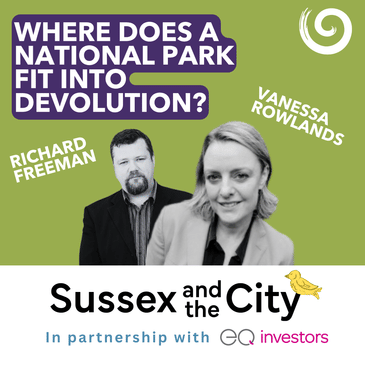
– Episode #45
Where Does A National Park Fit Into Devolution?Host: Richard Freeman Guest: Vanessa Rowlands – Chair, South Downs National Park Authority; Chair, National Parks England
🔍 Episode summary
The South Downs National Park is one of Sussex's core systems for water, climate resilience, biodiversity, tourism, farming, health and long-term prosperity.
Richard Freeman speaks with Vanessa Rowlands, Chair of the South Downs National Park Authority and Chair of National Parks England, about where protected landscapes fit into devolution. As Sussex prepares for new regional governance, the conversation asks whether a future mayor can genuinely plan for growth without understanding land, water and nature.
The South Downs is unusual. It stretches across Hampshire and Sussex, includes large market towns such as Lewes, Petersfield, Petworth and Midhurst, and works across multiple council boundaries. Can Sussex think strategically about the systems that do not fit neatly inside administrative lines?
The conversation explores planning, farming, chalk aquifers, tourism, nature recovery, renewable energy, flooding, rural businesses and the need to stop treating environment and economy as separate conversations.
This episode is brought to you in partnership with EQ Investors.
EQ Investors helps people invest with purpose, long-term thinking and a commitment to positive impact.
Their work supports clients to make informed decisions while considering the wider social and environmental effects of where money is invested. It reflects a growing recognition that prosperity is not just about short-term returns, but about building a more resilient future.
Find out more at eqinvestors.co.uk
🎯 In this episode
What the South Downs National Park Authority actually does Why national parks are more than conservation bodies How the South Downs fits into Sussex devolution Why water security could become a defining issue for Sussex The role of chalk aquifers, wetlands and sustainable land management How nature recovery and economic growth can support each other Why protected landscapes should be seen as infrastructure What tourism growth could mean for Eastbourne, Lewes and the wider park How farming, food supply chains and rural businesses fit into the devolution debate What a future Sussex mayor needs to understand about land, climate and place
🧠 Key themes
The National Park is infrastructure, not backdrop. It supports water supply, flood mitigation, biodiversity, tourism and public wellbeing.
Growth depends on environmental capacity. Housing, business expansion and tourism all rely on land, water, energy and climate resilience.
Devolution could overlook bodies that already think strategically. The South Downs National Park Authority works across boundaries, but protected landscapes need a clearer role in emerging regional structures.
Water is the hidden strategic issue. Flooding, drought, aquifers, wastewater and soil health may become as politically important as housing and transport.
The countryside is economically active. Farming, tourism, green finance, rural businesses and cultural assets are part of the real economy, not an add-on.
Sussex needs a better story about itself. The region's rural, coastal, urban and cultural assets need to be joined up into a clearer proposition.
💬 What Vanessa says
"These countryside protected landscapes aren't just passive places. They are critical pieces of national infrastructure."
"How can we be good neighbours for everybody else?"
"We've got to start creating this story about Sussex and drawing people into it."
"Everything we do across any national park can always be related to water."
"Nature is our business."
🎧 Production credits
Host: Richard Freeman Guest: Vanessa Rowlands Sound design / editing / original music: Chris Thorpe-Tracey Production management: Letitia McConalogue
📣 Get involved
👉 sussexandthecity.info — episodes, resources and events
[00:00:00] This episode is brought to you in partnership with EQ Investors, helping people invest with purpose, long-term thinking and a commitment to positive impact. EQ Investors supports clients to make informed decisions while considering the wider social and environmental effects of where money is invested. Their work reflects a growing recognition that prosperity is not just about short-term returns, but about building a more resilient future.
[00:00:24] We hope you enjoy this conversation with Vanessa Rowlands, exploring the South Downs, natural capital, climate adaption and the role protected landscapes can play in future prosperity of Sussex. To find out more, visit equinvestors.co.uk. That's equinvestors.co.uk. This podcast is brought to you by Always Possible. Alwayspossible.co.uk
[00:00:57] You're listening to Sussex and the City with Richard Freeman. Hello, it's Richard here. Welcome to the Sussex and the City podcast. I hope you are splendid. So in this episode, you see it as a bit of a trilogy, third part in a trinity of exploration of the glorious Sussex countryside. I spoke to Jeremy Kurzweil from Plumpton College a few weeks ago and then Paul Steedman from the Campaign for the Protection of Rural England.
[00:01:26] And in this episode, I'm going to be talking to Vanessa Rowlands, chair of the South Downs National Park Authority and chair of National Parks England for another in-depth conversation about one of the biggest and most important, often misunderstood parts of the Sussex story.
[00:01:42] The South Downs are not just a lovely backdrop. They are a living economy, a planning authority, a water system, a tourism asset, a wildlife corridor, a cultural landscape and increasingly a piece of critical regional infrastructure.
[00:01:57] If you ask anybody who lives and works in Sussex what helps anchor them to Sussex, and this cuts through ages, cuts through demographics, cuts through background, is their relationship to the countryside and particularly the South Downs.
[00:02:16] And as we trundle forward with devolution and local government reorganisation, the question in how we protect landscapes like the South Downs, but more importantly how they help shape the future of the whole region.
[00:02:29] So, not just a broad countryside view, we look specifically at what a National Park Authority actually does and how the South Downs National Park particularly plays a practical role in things like water security, climate adaptation, nature recovery, farming, tourism, housing pressures and economic growth.
[00:02:49] We talk about the park's unusual geography from Winchester in Hampshire over on the west side of the park all the way snaking down through Sussex to Eastbourne and Beachy Head in the south-east corner. And its role as a planning authority and its role as a planning authority and what that actually means.
[00:03:10] The importance of chalk aquifers, the future of rural businesses and why Sussex needs to stop seeing environment and economy as two separate conversations. So, we're going to talk about land, water, power and place and why the future mayor of Sussex and Brighton has to understand that the countryside and in particular the South Downs National Park are not peripheral.
[00:03:36] Are not blockers or pains in the bum, that they are absolutely cornerstones to whatever comes next. And it may be one of the main assets that actually makes growth possible. I hope you enjoy my conversation with Vanessa Rowlands.
[00:04:05] Hello, mid-spring, it's very sunny. Woohoo! Makes a change from the long, wet, cold winter. And I'm very delighted to be joined by someone I've wanted to talk to for a long time as part of this project. I've been doing some work recently with the South Downs National Park and through that, been looking at national parks generally. I think they have a huge role to play within devolved authorities, old and new.
[00:04:32] And I have absolutely no one better to chat through that with than Vanessa Rowlands, the chair of the South Downs National Park, but also chair of National Parks England. How are you, Vanessa? Yeah, hi Richard. Yeah, I'm great. I'm sitting in front of my window in East Sussex looking out on daffodils and blue sky. Can you believe it? It's amazing. And it feels full of promise, excitement. So I'm feeling really good. Thank you. Thank you for having me.
[00:05:02] Not at all. Not at all. Yes, let's hunker down in our idyll here in Sussex and ignore what's going on around the rest of the world for this moment. What's your Sussex story? What's the Vanessa journey? I actually, I don't have a connection to Sussex, but I've lived here for 23 years now. You know what it's like when you come into a village, it's like, oh yes, still the newbies.
[00:05:29] So my husband and I moved to Sussex 23 years ago. I just was about to have my second child and we were living in London at the time. We needed space and we needed to get out and we really loved exploring the countryside on bikes. And we were looking all over the place and we came down to where we are, which is very near. I live in the Kootmear Valley, so very close to Seven Sisters, which is such an important place. Literally my favourite place.
[00:05:58] That's where I want to be scattered when I'm long gone. Do you know, I think it's the same, but we have to, let's organise our spot so we don't overlap. Yeah, yeah, yeah. That's all right. We don't want too many people coming to Kootmear. I don't know. Yeah. So I moved down, brought up my kids here in the village and I'm just someone who really believes in the power of community and working with others that you get out of things the more that you put in.
[00:06:28] And so I've been very much involved in my local community on village hall committees. And now I'm part of the parish council here, but I do lots of community schemes such as we do a community apple juice every year and organise a little produce store that we sell to walk us on the Southlands Way. I've been involved in the schools and stuff around me.
[00:06:53] So it's kind of like that real belief that you have to be part of something. That's my Sussex story. Well, it sounds like you earned your Sussex stripes and then some. My three kids. So one of them was actually, my last one was born at home. And so they are proper Sussex, those three. South Downs National Park. What is it? Where is it? What isn't it? And let's get really back to kind of the fundamentals.
[00:07:21] The South Downs is the newest one and also has some peculiar boundaries as well compared to what people visualise in a kind of Dartmoor or the Lake District, which is sort of a bit more of a blob. South Downs kind of snakes through quite a lot of different places. So give us the sort of the overview. It's a very long park and living at one end of it and having to kind of do meetings all over. I really, I feel it. I feel it. We are the newest of the national park.
[00:07:47] So we celebrated our 16th anniversary last week, which is very, very exciting. Yeah, national parks. I mean, they're such an intrinsic part of this country's story. So they were started post the Second World War as part of this national renewal that the Labour government did when they came in after the war as a kind of really building the nation. They were created alongside the NHS.
[00:08:13] They really were thinking about this natural health service sitting alongside the kind of conventional doctors and everything. Where areas designated for special properties, national park authorities are kind of governed by two legal purposes to conserve and enhance the wildlife, natural beauty and cultural heritage of the place, while also promoting the enjoyment and understanding of those places.
[00:08:43] So those two purposes are what sort of drives us. We also have a duty to foster the well-being of local communities and local businesses, mainly land-based businesses that are kind of connected to the workings and the outcomes of those purposes. We are special purpose local authorities. We're planning authorities. That's our main statutory power that we have.
[00:09:08] But instead of sitting under MHCLG, where all the other planning authorities are, we sit under DEFRA. So we get our grant settlement from DEFRA. So MHCLG is the Ministry for Government, Communities and Housing. DEFRA is Environment and Rural Affairs. That's right. That's right. The planning stuff, obviously, that is housing. And we also do cultural heritage. That's a massive part of our thing. And that's obviously the culture and sport department.
[00:09:37] And that's pretty much, I think, where most people come into contact with us. If they're putting in a planning application, those are the people that live within the park. So the South Downs National Park, we are the third largest national park in the country. We're the most densely populated. So we've got just under 120,000 people live actually within the park. And then we've got 2 million people that live within 10 kilometers of our boundaries.
[00:10:03] So if you think about everybody along the coast, and then we've got Crawley and Winchester and things like that around us. That's a lot of people. And we're the closest national park to London as well. So we've got lots of opportunities for that kind of outreach that we can do and get people to understand the kind of workings of us. It's really important. We have two statutory documents that we have to produce every five years.
[00:10:32] One is the local plans. That's our planning side of things. But the other, which is our most important document, and all national park authorities do this as well, is our partnership management plan. And that's a plan that we produce, but it's written by all the partners across the park. And when I say partners, I'm thinking stakeholders.
[00:10:51] I'm thinking other local councils, government bodies, water companies, businesses, landowners, farmers, communities, parish councils, individuals, everybody. So every five years, we go out to all these groups of people and say to them that these are the kind of priorities we think we're being told by DEFRA that we need to do these things. But also what we feel are really important to this place and how we want to see this place be in the future. What do you think about this?
[00:11:21] Can you give us some feedback? What are your kind of priorities? What would you like to see this part? So we actually just got our new plan adopted at the end of last year. And we spent most of last year producing that plan. And we're very proud of it. And if anyone's interested, please go and have a look on our website. It's really exciting to look at and very interactive. But we hope over the next five years that we keep this engagement going with everybody. I don't want it to be one of these like you go out and consult. See you later.
[00:11:51] See you in five years when we need you again. No, I think it's so, so important to keep a dialogue. Because our sponsor body, government department, if you like, is Department of Farming and Rural Affairs, Environment and Rural Affairs, they have their priorities that they want us to deliver as well.
[00:12:10] And for them at the moment, the kind of number one thing is this international agreement that the UK signed up to in 2023, which is for all countries to deliver 30% of their land managed for nature. By 2030, which is shorthand, we call that 30 by 30. And so that is a really, really major priority for the DEFRA team and actually across protected landscapes.
[00:12:39] Now, when I say protected landscape, it's just another jargon busting here that relates to national park authorities, national landscapes, which were AOMBs and the national trails. So together we are the country's protected landscapes. And in England, that combined covers 25% of the country. And within that 25%, we've been told we're going to have to deliver 50% of that 30% total.
[00:13:08] So we've got to work hard, basically. You know, what's that going to look like? Well, that's going to look like us getting some really large scale landscape recovery projects happening across our areas. Probably quite a lot of your listeners may have heard of Wheel to Waves. If they've listened to this podcast before and our chats with Sussex Bay and with other conservationists, you know, Wheel to Waves has come up a lot as a great case study.
[00:13:37] When I think of landscape scale work, that's what that looks like. We've also got another thing that's been happening across Sussex on our chalk called Big Chalk. Quite an important part of that is where I live along the Heritage Coast, that bit between Seaford and Eastbourne. And that's the only coastal bit of the park boundary, isn't it? It is. We have a tiny little bit comes down at Tide Mills around New Haven. So little bits come down.
[00:14:07] And I think at Ovingdine as well, there's some tiny little bits. I should get my map out. But yeah, when you think about the coastal bit, it is that Heritage Coast. Sort of in the middle of March. You had a visitor, didn't you? We had a very important visitor. We were very lucky that the king came down and he officially opened the King Charles coastal path, which is going all the way around the country, which is incredible. Largely uninterrupted sort of pathway.
[00:14:37] Yeah, it's incredible. So that obviously comes through us. And also he designated the Seven Sisters Super National Nature Reserve, which is the Heritage Coast. And then it goes up and includes Briston Forest and Lullington Heath. The reason why the part of the Heritage Coast was designated as a nature reserve is because of its groundwater. You know, that's feeding like over 700,000 people.
[00:15:04] Giving them their drinking water is incredibly important to this area. You've probably got a strategy, a vision, a roadmap, maybe even a post-it note empire on your office wall. But has anyone asked the really awkward questions yet? Like, is it actually working? At Always Possible, we help senior leaders challenge the obvious, rethink the possible and deliver the extraordinary.
[00:15:34] Without losing their sanity or their sense of humour. Enabling private and public sector innovators to navigate a changing economy. We help complex organisations to humanise data and to translate the big picture into hyper-local engagement, trust and sustainable growth.
[00:15:56] If you're ready to bring people with you because your leadership truly inspires, visit alwayspossible.co.uk. That's alwayspossible.co.uk. Always possible. We make bold business brilliant. We've talked about some specific parts of the park. We've talked about it kind of being long and snaking through.
[00:16:22] But the sort of north-west of the park is in Hampshire. And a third of the park comes under Hampshire, which itself is going through the same local government reorganisation and devolution sort of process at the same time as Sussex. And then comes down through, kind of diagonal down through West Sussex and then north of Brighton. But quite a lot of Lewis districts is within the park, including the town of Lewis itself. I think that's what people don't kind of fully understand necessarily.
[00:16:51] You know, you've got four reasonably sized market towns within the park. Petersfield in Hampshire, but then Petworth, Midhurst in Chichester District and Lewis, which is obviously the county town of East Sussex. That's quite unusual, isn't it? And actually, Lewis is the largest town in any national park in the country. For sure, it must be. And then Petersfield. Yeah. For me, that is the essence of thinking about what a modern Sussex can be.
[00:17:21] It should be. These places should be thriving, multifunctional landscapes where people are living, working and nature side by side. And I just was thinking about when you had your, I listened to your interview with Peter Lamb the other week. And he just spoke so eloquently about everything that's happening at Crawley and the kind of, you know, the busyness of having Gatwick there. We have Gatwick on our doorstep, all this sort of stuff.
[00:17:48] And it's like, but the rural areas are kind of dragging us down. And it's like, oh, no, we've got to find a way to come together and tell a connected story about how we will balance each other out. Because the stuff that we're doing in the park can balance the growth that he wants to see around Crawley and that Gatwick's going to be bringing in. And we want people to come.
[00:18:08] We want young people to be coming, coming to our amazing universities and colleges and staying and starting up businesses and growing their families and their businesses here and the economy. There's this once in a generation sort of structural change that is going, right, now's the moment that Sussex can be put on the map, can go for growth, can, you know, et cetera, et cetera, et cetera. And absolutely at the same time, sometimes by the same people. And that's what encourages me.
[00:18:38] But there is a tussle and we'll come to that, you know, saying, well, what is our USP? You know, all life is here. We have the most spectacular natural capital. People want to live and work here because you can live in the heart of the biggest towns or cities. And within five minutes, you are in the most glorious countryside. Yeah. What we've got to do is I'll get to that understanding that these countryside protected landscapes aren't just kind of passive places. Yes.
[00:19:08] They are going to be working hard. These are critical pieces of national infrastructure that are going to be working hard for the nation. So for me, when I think about what's coming on the horizon, you know, for me, it's like water.
[00:19:23] We're not having a national conversation about water in this country, I feel, in terms of looking after the water supply, looking after that quality, the way that the landscapes can help in terms of flood mitigation and climate change adaption. We're both recording this on a gorgeous spring sunny day. And we've probably forgotten about only like a month or two ago.
[00:19:49] We were having the most extreme weather downpours. The rainfall has been coming. There's more rain events. And those rain events are holding a lot more water. Us as landscapes can help with that. Yeah, we're not set up for this bigger change. And there is a tension here. And I'm sure that would have surfaced a lot in your partnership management plan. But, you know, I've been having conversations about the Sussex economy for a long time.
[00:20:17] And invariably in any meeting, there'll be someone that says, yeah, but, you know, Blimmin National Park. I mean, they're great, but they're just blockers. You know, they'll just say, no, their job is to stop any development, any growth. True or not, if that becomes a perception that then becomes a sort of a narrative without looking through that and kind of saying, well, actually, as you've said, how do we have a kind of grown up conversation together about things like water?
[00:20:44] It's water neutrality issues that are stopping developments happening in places like Crawley, which is a right place for housing. It was a new town built in the 40s. It's got space, more space than Brighton to build new housing. But at the moment, there are rules saying you cannot build new houses if you're going to increase the pressure on water need. You know, so basically you can't have any more water used. You know, how do we solve that through better understanding all of the land that we have in this place? How is that conversation changing?
[00:21:14] We can't take the level of housing development that other places outside the park are going to be asked to take because we have got this legal duty to conserve and enhance these places. So for me, it's like, how can we be good neighbours for everybody else? What is our role in this area that we provide to balance this growth and keep this as a kind of the economy thriving? And you touched on water neutrality.
[00:21:43] And I think actually that's sort of been lifted now. I think Natural England did that last year. For me, it's like, you know, how do we create more water? How do we look after the water that we've got?
[00:21:56] So when we're working with a lot of the water companies with them on how can we help them do landscape projects that slows the flow on all the, you know, when we have those extreme weather events, how can we help them not get overwhelmed with all the kind of water and waste coming towards their waste treatment plants that they get overwhelmed with and it all gets pumped into the sea? How can we help them to get them to farm in a more sustainable way?
[00:22:24] So they're not using a lot of chemicals on their ground, which the water companies then have to extract to create our drinking water. But also if they're focused on the soil and the soil health, that then holds a lot more water in the ground, locking in more water into that aquifer. So when it rains, it's held in there more and we don't waste it. And also nature restoration projects where we're creating more wetland. Because if we create more wetland, we're slowing the flow.
[00:22:54] We're holding onto that water in the land. There's lots of kind of layers to how we do it. But that I think is a really, really important job. If we're going to have industry and businesses thrive here, the things that they need are energy and water, aren't they? I mean, on the energy thing, we, with our local plan, we actually did a call for sites for renewable energy because we feel that's really, really important. You're not going to see wind turbines across the South Downs. But where can we do it?
[00:23:23] What can we do to help? A lot of it is actually supporting the Rampian offshore wind farm. A big part of that offshore wind farm is knowing that it has to come onshore. And there's a lot of cabling that's going to be coming right through the park. So it's working with them on how we do that. Water quality, waterways, water pollution, the rivers is one of the number one priorities of people in Sussex. But actually, how does the water system work? Very, very little understanding of that.
[00:23:52] You know, I don't think there's a sense of kind of connecting or thinking about infrastructure and so on. All of the area that the park sits within is about to go through a kind of a very different system in terms of long term spatial planning, of being able to think strategically around how economy, environment, jobs, transport all connects together.
[00:24:16] This is the idea anyway, with, you know, directly elected mayors who speak to both MHCLG and DEFRA and cabinet and say, look, we need more investment. We need more funding. We need policy that supports what's happening in Sussex and Hampshire, not just a kind of one size fits all. On paper, I imagine the park sees that as a big opportunity. But where will the park sit in terms of influence and decision making?
[00:24:43] We see a lot of opportunity because we already work at a landscape scale. We already work at this sort of strategic scale and thinking. So for us, the kind of mayor county combined authority feels quite, you know, we can relate to that. And we've got a lot of things that we think we can bring to the table. We've sort of forgotten about, like we're not on the list, the localism act of like what are local authorities.
[00:25:09] And so when things have been going through on the devolution bill, for example, the spatial development strategies that the mayor is going to come in and do, something like that, we're not actually specifically mentioned that we should be part of that process. Which feels crazy. For me, it's an oversight. For me, it doesn't make any sense. And actually talking to all the people involved, I don't think they would think that we shouldn't be at the table on that.
[00:25:37] It's not just the South Downs I'm talking about as well. I'm talking about the High Wield, which covers a huge part of Sussex. And then also Chichester Harbour, which is really important and strategic as well. But also in terms of the local economic plan, the National Park is a massive draw for visitors at the moment. When you compare us to like the Cotswolds or somewhere like that, the amount of overnight stays that are happening there, compared to what we're getting here, I mean, there's so much potential.
[00:26:05] But we've also got to start creating this story about Sussex and drawing people into it. If you live here, you've never really thought about this as somewhere that people go on holiday to. And so, oh, OK, we're going to have people coming and staying. What's that going to look like? Is that going to change how our villages are? You know, you hear about things in like the Lake District and places like that when there's a lot of second homeowners and things, and that kind of destroys the fabric of a community.
[00:26:33] So how do we protect that and don't let that happen here? But also just get people to understand why local authorities are investing in cultural institutions like Charleston in Lewes and all the stuff that's happening over in Chichester. Why that is so important to create a draw and a story to get people to come in and stay.
[00:26:57] You know, we've seen a lot of push towards premium and luxury tourism, which has an amazing offer for Sussex. And obviously that's great for the economy if it can attract wealthy Europeans to come and choose to spend a bit of time here versus in the south of France or whatever. But that more affordable accommodation, those hotels that we've lost are probably ones that might have been more accessible to people versus the renovated manors.
[00:27:23] Yeah, but that's why I think there's so much opportunity in Eastbourne, just along that section. And Bexhill, there's so many hotels in Eastbourne, so many hotel rooms. If we could get people coming and using that and the work that the council are doing, trying to programme what's happening at the Congress, having really good shows on there and the stuff that Towner are doing, it just starts having a story. And if for ages people thought about coming to somewhere like Eastbourne and you were just looking at the sea, there's actually a lot going on behind you on the down.
[00:27:52] So if you can combine that, go out and explore the kind of landscape as well as the beaches, as well as the cultural places. Are there any differences from your perspective in the way that the new authorities are being set up in Hampshire versus Sussex at the moment? I mean, they've been given a clearer decision on what the new unitaries are going to look like. But in a way, you've got a kind of a unique position working with these two places going through this change at the same time. I'm just being nosy, really.
[00:28:22] No, it is. If there's a sense of what Hampshire are doing. It is really different. In Hampshire, it feels a little bit more bottom up approach. Whereas in Sussex, you've got the three main authorities running that. And now we've got Mark Rogers in place and his team. So they've setting up the combined authority. And I think that's actually being designated now, hasn't it? Yes, yes. It's a legal entity now. It's a legal entity. And then they set up an informal partnership board to run alongside.
[00:28:52] And we've had a couple of meetings of that. And I have been attending those representing the protected landscapes. And actually, the protected landscapes are the only sort of land affiliated body at all on that partnership board. The Royal Accompany is really important. I mean, we managed to have employment in the National Park from 2020 to 2023. Went up about 10%, which is much greater than outside of the National Park.
[00:29:21] The whole green skills area is really kind of sought after. In Hampshire, it's different. In Hampshire, it's different. They haven't set up the non-constituent member board yet. Right. So I don't know where that is. I have been a bit more removed from the Hampshire negotiations and the dealings with that. Sussex, when I've been in the rooms at those partnership board meetings, it feels exciting.
[00:29:47] I think Bella, Sankey, Paul Marshall and Keith Glaser are really energised and want to make this happen. And they really want to create a Sussex for the future. What does modern Sussex look like? And bring some energy to that. And when I look at Sussex University, I don't know if you've seen their new strategy that they produced last year. And it's in combination of like the whole community got behind it about what they wanted it to be like.
[00:30:15] Yes, they want it to be like this first class educational establishment and doing incredible research. But they also really want to have a meaningful impact on the world. Yes. As well as surrounding. And part of that was thinking about the natural environment. One of the biggest issues in the 2024 election was the state of our water. And I think kind of read into that green issues. So it's important for people. It has to be multifunctional. We have to think of these things as connected.
[00:30:42] You know, if everything goes to plan, we get to the devolution we want, whatever that means. You know, 10 years time, how will devolution have been good for the park? And how will the park have been good for devolution? For us, you're going to have these new authorities that are being built from scratch up. So they've got to be thinking about the climate and nature that's designated to them to do. Whereas we as a National Park Authority, we're not changing. We're one of the few bodies. I think it's us and Brighton Hove that's still going to be existing.
[00:31:12] And we're the constant. Also, nature is our business, right? We know how to do this. We can be this conduit to do this work for them. And we're strategically planning ahead the really extreme rainfall events throughout the winter months. That's not changing. That's what's happening now. So it's like, how do we work outside of our boundaries with our other protected landscapes, but also just within? How can we help the kind of authority come up with a climate strategy and hold onto this water using nature-based solutions?
[00:31:42] We're really leading in innovative ways on how we're bringing external green finance money into the area to do these nature-based solutions works. Sorry, that's quite jargon heavy for people listening. And at the same time, what's wonderful about these schemes is that you're also creating nature habitats as well. So it's kind of like a win-win-win.
[00:32:04] So we're delivering on our 30 by 30 targets that DEFRA want us to do, but we're also helping with climate adaptation, which we're really going to need to see. I want to get to the future where we're not going to have those flash flooding events that means that roads get cut off. We can't move things around. You know, businesses need to move their stuff around the place. We can help with that.
[00:32:24] And also we can help the combined authority with the nature work, working with the rural businesses, farmers, taking them into the future, giving farmer advice, helping their businesses diversify. But also looking after strategic businesses that help with the food supply chains in the area. For me, really, really important is the future of abattoirs. So I think there's one key abattoir in the area. I think it's in Henfield.
[00:32:52] I don't know if you've spoken to anyone about this, but oh, it's a massive, massive thing. How do we keep hold of that and help our farmers along those ways as well? As well as the winters, the wetter winters, we've got the hotter, drier summers that you mentioned. Overheating is going to be a massive, massive problem in this country. How do we manage that? But everything we do across any national park can always be related to water. It's the one thing that links all the 10 English national parks. Amazing.
[00:33:21] Thank you so much. Yeah, really, really good to tap into your expertise and knowledge there. I think people would have learned a lot. Vanessa Rowlands, thank you so much for being my guest on the Sussex and the City podcast. It's such a pleasure, Richard. Thank you. Thank you. Thank you. Thank you. Thank you. Thank you. Thank you. Thank you. Thank you very much to this episode's guest and to you for tuning in.
[00:33:51] Sussex and the City is an independent and non-political project about devolution as it happens, explained in human. It is led by always possible. You can find other episodes, resources, events and blogs about change in Sussex and Brighton by visiting sussexandthecity.info. That's sussexandthecity.info.
[00:34:17] This episode was written and presented by Richard Freeman for Always Possible. The editor was me, Chris Thorpe-Tracey for Lo-Fi Arts. I did the music too. Production management was by Letitia McConnellogue for Always Possible. Talk to you next time.
[00:34:35] Always Possible.co.uk