
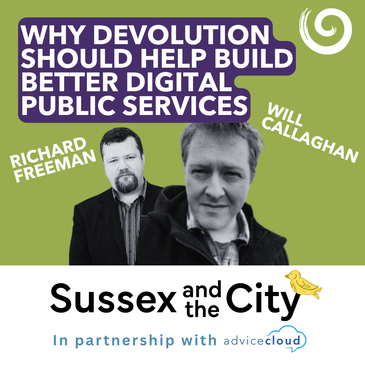
– Episode #46
Why Devolution Should Help Build Better Digital Public ServicesHost: Richard Freeman Guest: Will Callaghan – Tech Resort / local government digital consultant
🔍 Episode summary
Richard Freeman speaks with Will Callaghan, a public sector digital specialist and volunteer leader at Eastbourne-based Tech Resort, about digital exclusion, local government reform and why being offline now means being locked out of work, benefits, healthcare, education and everyday services.
Will explains how Tech Resort supports people who cannot afford devices, data or basic digital confidence, and why demand for this support has grown sharply. The conversation also explores LocalGov Drupal, a Sussex-born civic tech project now used by councils across the UK and Ireland.
As Sussex moves towards devolution and local government reorganisation, this episode asks what kind of digital region Sussex wants to become. Not just one with AI strategies and better websites, but one that designs public services around the people most likely to be excluded.
---
This episode is brought to you by Advice Cloud. Public sector procurement can be complex, and right now, with councils reorganising, budgets tightening, and technology decisions that will shape services for years, getting it right has never mattered more. Advice Cloud are a Sussex-based team of procurement specialists who've helped over 600 organisations win public sector business, with clients typically seeing their bid success rate increase by at least a third. They harness smart technology to stay ahead, but at the heart of everything is a real team who know and understand your business - so whether you're a tech company trying to crack public procurement frameworks, or a public sector buyer trying to make better technology choices, you get real advice from people who genuinely know this world. Book a free consultation at advice-cloud.co.uk🎯 In this episode
What digital inclusion really means Why digital poverty affects working-age adults as well as older people How lack of phones, data and broadband deepens poverty Why Universal Credit, job applications and health support now depend on digital access How Tech Resort supports people across Eastbourne, Hastings and beyond Why digital inclusion should become a statutory responsibility What devolution could mean for digital strategy in Sussex How local government reorganisation will affect council staff and services Why councils need to stop rebuilding the same digital tools repeatedly How LocalGov Drupal became a Sussex civic tech success story
🧠 Key themes
Digital exclusion is not a side issue. It is now central to poverty, employability, health access and public service reform.
Technology can save money, but badly designed digital change can also push people further away from help.
Devolution gives Sussex a chance to build a proper digital inclusion strategy across the whole region, rather than relying on patchy local provision.
Local government reorganisation will place huge pressure on council staff, systems and services. Digital change needs to be humane, not just efficient.
Sussex already has serious civic tech expertise. Projects like LocalGov Drupal show how councils can collaborate, share code and avoid wasting public money.
The future digital region should not only be about AI, automation and innovation. It should be about access, dignity and public services that work for everyone.
🎧 Production credits
Host: Richard Freeman Guest: Will Callaghan Sound design / editing / original music: Chris Thorpe-Tracey Production management: Letitia McConalogue
📣 Get involved
👉 sussexandthecity.info — episodes, resources and events
[00:00:00] This episode is brought to you by Advice Cloud. Public sector procurement can be complex, and right now, with councils reorganising, budgets tightening and technology decisions that will shape services for years, getting it right has never mattered more. Advice Cloud are a Sussex-based team of procurement specialists who've helped over 600 organisations win public sector business, with clients typically seeing their bid success rate increase by at least a third.
[00:00:30] Advice Cloud harness smart technology to stay ahead, but at the heart of everything is a real team who know and understand your business. So, whether you're a tech company trying to crack public procurement frameworks, or a public sector buyer trying to make better technology choices, you get real advice from people who genuinely know this world.
[00:00:53] Book a free consultation at advice-cloud.co.uk. That's advice-cloud.co.uk. This podcast is brought to you by Always Possible. Always Possible.co.uk. You're listening to Sussex And The City, with Richard Freeman.
[00:01:22] Hello, it's Richard here. Welcome to the Sussex and the City podcast. This episode is about technology, but I promise you, we're not going to be saying AI, AI, AI, a hundred times. This is about digital as a basic condition of modern life, whether access to the internet is a right rather than privilege, and who gets to decide where and how that happens. My guest is Will Callaghan.
[00:01:52] Will is a very, very interesting guy that I've got to know a little bit over the last few years. By day, Will works in public sector digital transformation as a product delivery and program manager, and he helps councils and government bodies collaborate better, build better services, and avoid reinventing the same wheels with slightly different shades of beige. Will is a pioneer, actually.
[00:02:14] He co-founded LocalGovDrupal, which is an open source web publishing system that's now used by local government right across the UK and Ireland, and really is a Sussex technology success story. But he's also deeply rooted in Eastbourne through Tech Resort, which is a community interest company that he helps lead as a volunteer.
[00:02:36] And Tech Resort has spent more than a decade helping people of all ages build digital confidence, access devices, get online, and navigate services that increasingly assume everybody has already got access to. And digital poverty is one of those real hidden challenges across Sussex that not enough people know is a reality.
[00:02:59] Now, this conversation I had with Will actually took place months and months and months ago, so apologies to Will for it being so late in getting this out. But everything that we talk about is still very deeply relevant, especially in the context of, you know, so many people not in education, employment, training, and thinking about skills gaps and thinking about how maybe the technology race is leaving many, many people behind.
[00:03:24] If we make assumptions about, you know, who is in that race and at what speed they're running, then we have a problem. Because if you can't get online, or your phone is broken, or you can't afford data, it's not just a mild inconvenience, you can be locked out of everything. Digital exclusion isn't on the edge of poverty, it is at the heart of 21st century poverty in England.
[00:03:47] So we also have a chat about Eastbourne, and we have a chat about why very interesting movements or social enterprises like tech resorts are kind of taking hold in places that have maybe been overlooked as a little bit, I don't know, of the past. You know, I think Eastbourne's got a really interesting bubbling social enterprise network that, again, is not particularly understood.
[00:04:10] But as the whole of Sussex moves towards DEVO, local government reorganisation and a new strategic mayoral authority, we really need to think about what kind of digital region we want to become. It's not just a story of AI and quantum businesses. It's not just about better websites and cheaper systems or more strategies. We need to talk about digital inclusion and council reform, the pressure on local government staff, the risks of reorganisation and digital infrastructure that are going to be.
[00:04:40] What kind of underpins it, but also what are the opportunities to do it differently? And why Sussex born civic tech like local gov Drupal could from the grassroots up really help new council structures build, share properly and stop solving the same problem in 14 different ways and bring things together. So, yes, it's a tech chat, but it's also about fairness and access and public service and whether Sussex can use this moment to make digital work for people who are often designed out of the system.
[00:05:11] I hope you enjoy my conversation with Will Callaghan. I'm joined by the great Will Callaghan, an Eastbourne legend, a man with technology in his DNA. And I think we're going to talk a little bit about two ways in which Will is doing interesting things in tech.
[00:05:39] One through Tech Resort in Eastbourne, an organisation I've been a fan of for a very long time. And also in Will's knowledge around local government and how local government is adapting, changing, making decisions, because it's very relevant for all of this conversation around devolution. So before we get into that, how the devil are you, Will? You're so kind, Richard. Thank you for that amazing intro. I'll do my best to live up to those words that you said. We're having a really busy time, so I'm going to talk about two things today.
[00:06:08] There's my volunteer job, which you said is Tech Resort, and my day job, which is sort of local government consulting and digital. So we could maybe touch on both of those. We had a board meeting for Tech Resort last night. We're CIC. We're based at Eastbourne. We've been going for 12 years. We do digital skills work, digital inclusion work. If I could just do that and nothing else, like if that paid the bills, that would be amazing because we're surrounded by such talented people. Like our board is great. They're real doers. They're a real mix of skills, and we're all in it to help.
[00:06:37] And actually for the first time in a long time, we've got enough money. We're grant funded. We've got enough money for like three, four, five months, like where we can actually do work. Generally, we've got no money at all. Even though there's so much going on in the world and there's so much bad stuff happening, we are in a position to help more people. If it's good to be able to do something, it's cathartic. Digital inclusion will mean, it might mean different things to different people. So give some examples of the sorts of work that your volunteers do.
[00:07:06] For people who can't get online, it's a mix of issues generally. And it's not just old people that it applies to. I mean, the bulk of the people that we work with are working age adults. Like if you're on universal credit, the only way you can do it is online. So you need a phone or a laptop. You need data. Like what happens if you can't afford those things? And increasingly, the people like Joseph Roundtree are saying broadband is an essential need and it should be priced in.
[00:07:34] You know, when benefits are paid or the help is paid, then this stuff should be, you know, should be part of it. So we have people presenting, you know, at five o'clock on a Friday, I need to do my UC journal, but my phone screen is smashed. I haven't got any data. Or a family who are needing help trying to get sort of health stamps, sort of food vouchers that is only available online. Or, you know, an old couple who are subject to a phishing scam. You know, it's all sorts of people. The amount of demand, it's not going away.
[00:08:02] I mean, we were looking at some figures last night. I think a few years ago, we were doing what? 300 interventions a year. We reckon we're going to do 1,700 to 2,000 interventions this year. We run drop-ins in Eastbourne. We co-locate like in the food bank and places like that. In Hastings, we do that. And increasingly across Sussex. And we're there for people principally in poverty. That's most of our work. Like if you're going to somewhere like that, odds on you're digitally poor. You haven't got the devices you need. You can't afford them. You haven't got access to this stuff.
[00:08:32] So we're trying to be there for those people. And what we're seeing, and there's plenty of research on this, is if you haven't got access to these things, it's a bit of a vicious circle. You pay your property premium. Like everything's more expensive because you can't get the best deals online. Or you can't do a job application because that's all online these days. And so it kind of compounds, you know?
[00:09:20] Yeah. It's a bit of a bit of a deal. What does that tell us about the state of public health in Sussex that frankly such basic stuff feels so precarious? Yeah. Digital inclusion is not a statutory service for councils. Never has been. So there's a lot of people that care about this, but it's no one's actual problem to fix or to fund. The current government is more interested in that. The previous governments weren't really not at all.
[00:09:48] There was a digital inclusion strategy from 2014 that sat on the shelf for 10 years and didn't get updated. So, you know, it's good that the current government is taking this more seriously. They ran a digital inclusion fund recently. I think it was 9 million pounds, which frankly would, you know, scratch the surface. And they were saying only charities. We're not a charity. We're a CIC. We told them this. Sorry, moan, moan, moan at the start of the podcast. But we, you know, it's, you know, that's basic. You could easily fix that.
[00:10:16] And also only new projects that can be completed between now and next March. Well, who's got those projects at hand? And we found some. We've put, we've written three bids. We've partnered with that great local authority, Eastbourne, who really supportive and a few other organizations as well. We've got three bids in, but that's the nature of this. It's like, let's look out for the next pot of money.
[00:10:36] There'd be so many listeners to this podcast who are on grant funding and just literally, you know, there's a grant applying machine that they're tinkering with and fine tuning to get, to get the support that they need. And we are getting, we're getting better at it. You know, we're here to talk about LGR and, you know, mayors and devolution and everything else. One of these new bodies needs to have a statutory responsibility for digital inclusion to actually fix it, to support people who are in this, in this situation and the money to go with it.
[00:11:04] You shouldn't be taking money from someone else to fund this stuff. And actually, if you look around some of the mayoral authorities, even though it's not statutory, there are quite a few that take this seriously. So, um, there's a project called 100% Digital Leads, which is out of Leeds City Council. We're huge fans of them. And they're, they're an inspiration to us every day, but they're great. The West Yorkshire authority is really good at this. Steve Roblin is really into it.
[00:11:30] Andy Burnham's really into the Northern mayors are really into digital inclusion and they're doing a lot of work. I Googled before what's the London authority to what Sadiq done on this. And I think he gets asked questions by the GLA every couple of weeks. Like they're really into holding him to account for this. My company, always possible. We're working, doing some strategic evaluation for, for nine London boroughs. Yeah.
[00:11:54] Uh, that are doing some real experimental sort of trailblazer work around getting people into employment, you know, looking at some of those, those barriers and things like childcare, things like, you know, helping people start their own businesses or that, you know, but they're doing some real. It's really intensive, you know, quite well resourced work, but digital inclusion runs all the way through it. You know, you can't start a business if you're not online. You can't apply for work if you're not online. You can't access the right sorts of support and stepping stone benefits to get you to the next step if you're not online. Yeah.
[00:12:21] So taking that point then, you know, if we're going to see the mayoral candidates, you know, what would you like to see around digital inclusion? What kind of language, what kind of commitment, what would you like to see some of these candidates? I don't think hard commitments at this stage are what's needed, but an understanding of what people's lives and who are excluded, what that actually feels like. We're quite a political family. Like we go along to the hustings and things like that. I take my 80 year old lad who did politics. You know, we like talking about this stuff.
[00:12:49] We went to the hustings for Eastbourne's general election, the last one. And he asked a question about digital poverty. And you could tell across the room, like who understood this and who didn't. Like there was one, I won't say what party it was, but it was like, this doesn't exist. It was like just complete sort of denialism to another candidate who really did. So you'd actually had somebody come in and talk about this. So somebody in their family had these kinds of needs. And there was a, there was like an empathy and an understanding. We were asked the other day, how many people in Peacehaven are digitally included?
[00:13:19] We have no idea. Like there's a lot specifically don't know. There'll be bodies organizations in Sussex, you know, their turf. Like we know Eastbourne really well at Hastings. We don't know everywhere. So it's wrong to expect a mayor to say, we want the X, Y, and Z, and it's going to fix it for this many people. Cause we don't know the scale of the problem. We know it's a big problem. Isn't that part of what devolution can do is, is that data. The data is the best digital tool we have. Yeah. And we're in an age where we have more of it than often we know what to do with.
[00:13:48] For me, I kind of not knowing cannot really be an excuse anymore. But I think part of Sussex problem is that it's district by district, borough by borough. And some districts and boroughs have more resource to find that information out than others. You know, the data capabilities of a strategic mayoral authority.
[00:14:03] And we have seen that in parts of the country where they have a proper dedicated team of data collectors, data analysts that say, right, we know exactly what's needed, what's happening, how things are improving, how things are getting worse so that we can make proper decisions about where to invest money. And it's not as if this hasn't been worked through. So there are indicators of digital poverty. So if you can't say in a region, oh, it's this many, you can look at indicators where you will have data and say, here's where we would start.
[00:14:32] We ran a project with 100% digital leaders. It's called the Digital Inclusion Toolkit. And they wrote a document about how council should start doing a digital inclusion strategy. And part of that is the indicators of digital poverty. It's like you will have these data sets. You should be able to look at this stuff. You shouldn't have to talk for years and years or months or however long about where to start, because it will be right in front of you. Like you could hit the ground running on day one and do some meaningful work. I'd want the mayor to understand this and take it seriously.
[00:15:02] You should be able to command all the broadband providers because they will have the data. They should be able to provide anonymized data that says actually there's whole streets in Peacehaven, for example, that aren't accessing the internet. The base level is a mayor that understands this and doesn't dismiss it. I'm a very proud father of a son with good A-level results. At his college, an MP came in. I won't say which MP. They're all able to ask their MP questions about sort of whatever they like. And again, totally unprompted, I guarantee you.
[00:15:32] He said, I want to know what you think about digital poverty. And this MP basically said, well, I don't think there's such a thing. You know, I think poverty is a thing. Fair enough. But they weren't able to talk about how lack of access of this kind. It's an indicator of poverty. It also compounds these issues. It makes them worse over time. We demand better than that. Tech Resort isn't massively political, but we'll be talking about this and run up to the election the best we can. It's like these are issues that are important to us.
[00:16:00] I'm interested in that maybe scalability is the wrong word, but certainly cross-border collaboration where, you know, expertise like yours in the voluntary community sector can start to work across Sussex if we start to have a pan Sussex, you know, growth plan or pan Sussex public health strategies that look at some of these issues rather than reinventing the wheel and going, right. Okay, well, Tech Resort could just sort eSport out.
[00:16:26] How can there be, you know, ways of sharing best practice? And, you know, Sussex is a complicated county in terms of huge swathes of rural where, you know, broadband is almost completely impossible to get in some places. Yeah. But then there are bits of rural Sussex that actually the connectivity is really, really good. You know, we've done some work with the South Downs National Park. There are bits where the broadband speeds are faster than in central Brighton. And that sort of makes no sense, but it's all patchy. There's not a cohesive digital strategy.
[00:16:55] Yeah, absolutely. We're more active in East Sussex than in Brighton or West Sussex. You know, it's where we're based. But what we're increasingly finding, I mean, the citizens' advice bureaus have got a massive part to play and the food banks here. Because if you think about who presents for these kinds of issues, who has these kinds of challenges, they'll probably rock up there first at a cab or a food bank or a GP. We've worked on an idea locally, no wrong door, like a good front door to services of this kind.
[00:17:23] So as a group of organizations, we're quite good at referring to each other and referring without expecting a user to have to represent with all the same issues. You know, so the food bank might send us someone say, without sharing lots of personal detail, this person basically has this specific issue that we want you to talk about. We don't need their life history, but we do need to know what we're addressing. And we're getting quite good at those kinds of things. I mean, it's always it's cash dependent and time dependent.
[00:17:52] I think that kind of provision, you know, it doesn't matter where you present or in what way, but if you need this kind of help, you'll either find your way to our door or somebody like us. You know, we don't want a monopoly on this. We want more people doing this, like in Brighton and elsewhere. So it's like, how do we how do we grow this, this provision? And how do we properly signpost to it if they really need it? Anyone listening to this who wants to talk about that? We I mean, we'd love to. We want sort of fellow travelers, I guess.
[00:18:20] And what we want people to do this with. So please do get in touch. You've probably got a strategy, a vision, a roadmap, maybe even a post it note empire on your office wall. But has anyone asked the really awkward questions yet? Like, is it actually working?
[00:18:40] At Always Possible, we help senior leaders challenge the obvious, rethink the possible and deliver the extraordinary without losing their sanity or their sense of humor.
[00:18:58] We help complex organizations to humanize data and to translate the big picture into hyper-local engagement, trust and sustainable growth. If you're ready to bring people with you because your leadership truly inspires, visit alwayspossible.co.uk. That's alwayspossible.co.uk. Always possible.
[00:19:27] We make bold business brilliant. I'm really intrigued to hear a little bit more about where you feel the sort of digital capabilities and perhaps what the future looks like for a more digitally savvy and inclusive local government structures, particularly in the ages of AI. And we know how much that's dominating central governments. Yeah. AI is where to start with that.
[00:19:54] I think it's first like there's a little bit of sort of context setting. So I was in the private sector first, then I worked at the government digital service. Then my family moved to Eastbourne, what, 15, 16 years ago. And I started working for local government then. So I worked for Ada and Worthing back in the day, then Brighton for a bit, then Croydon. So I still do that kind of government consultancy work. It's digital transformation. For a while it was channel shift. It was getting people to go online.
[00:20:20] So, you know, I'm kind of fixing some of the stuff that I've helped create, you know, if I'm completely honest. But, you know, at the time I always thought, you know, you're trying to save money here, but you're actually disenfranchising people and you're firing people and you're actually making this more difficult. So, you know, I didn't do it without a fight in the places where I worked. I was very clear about, you know, having a digital strategy is also having a non-digital strategy for people who can't use this.
[00:20:48] Anyway, I digress. I think what I've seen is council officers basically having to do, it's not just more with less. It's just extreme levels of more with less. You might have had a team of five and now it's just you. You would have to reapply for your job. And then there's another round of reorganisation which you're in a pool that you might get picked from or not. Do you have to apply for that job? Oh, by the way, that job's got three more things that you need to do. Major things that you need to do alongside the tasks you were doing before.
[00:21:18] That's happened to colleagues and friends of mine continuously for the last decade. And they are really up against it. And what we're looking at now is in local government reorganisation, it's going to be similar again, you know, in that a lot of these organisations, local organisations will cease to exist. And the roles with them will also cease to exist. So it puts people under a lot of pressure. I worked in a local authority undergoing this up north, I won't say the name.
[00:21:47] One of the weirdest experiences of my life. You know, I was there to do a sort of content migration. I mean, nothing complicated really. But services stopped talking to us because they weren't sure whether they would be there next week. Or the most important thing is actually holding onto a job so that you will have money in the future. Often in places where local authorities are the biggest employers, like there are not employers of other kinds. This is tough for people.
[00:22:13] For the folks who go, well, councils should do better in their public service and their faceless blobs. Well, have a thought for the people who actually work there, who are, for the most part, really publicly minded good people who are talented. For some of the people I've worked to in local government, the most talented people I've ever worked with. They're not doing this stuff because they want to. They're not being obtuse because they want to. They're often in very tough situations. Certainly on this podcast, we've had our fair share of critique of the way that local government can operate.
[00:22:42] And I think that's reasonable. But I think you're absolutely right. You know, we're also keen to point out the reasons for that. And, you know, whilst we're focusing more on devolution and the sort of Sussex story, more than some of the real technical change. But I think the enormity of what is about to happen. Yeah. It's something that people have to be patient with and people have to be cognizant of. You know, there's going to be things that have got wrong. There are going to be things that take time.
[00:23:17] That is millions and millions of people. Assets, legacy deals, contracts, you know, hundreds of years worth of established ways of working to be dissolved and then rebuilt as potentially, we still don't know yet whether that's going to be three, four or five to replace those. Yeah, yeah, exactly. And then the establishment of a new strategic authority that has not existed before, not just in Sussex, but really anywhere in the southeast, apart from London. And that's different.
[00:23:47] That's the sort of city state structure. One of your previous interviewees talked about the speed at which it was being done. And I've got a thought about that. In the authority that I worked, it felt like it was taking forever. Like even it was a couple of years, it's like, let's let's get we need to get on with this because there's uncertainty and people are scared. And things started becoming real after the shadow elections and the shadow authority was in place. And then that then real decisions could be made until that point.
[00:24:16] It was hearsay, rumour, people frightened for their jobs. So that's the period they're in now. I think between now when when the elections kick in. These things take time to do, but there's not surety for the people that work there. How can those people be protected to do the best possible work and reimagine this in a way that works for everybody? You can't do it when there's a sword hanging over your head. It's very hard to do.
[00:24:42] Somebody's got to think about that for the people that work in the sector, you know. Let's be honest. A lot of this is about cost saving and efficiency. Yeah. The central government is pushing technology to be the solution to pretty much everything in terms of efficiency and welcoming huge amounts of foreign and local investment in digital infrastructure. It's a tricky question.
[00:25:06] How ready, how capable, you know, what might that change look like somewhere in Sussex, particularly in the context of digital inclusion? How fewer humans are going to be involved in some of the things that we are used to in dealing with local authorities? What sort of mechanics and tools might come in in a much bigger way than they are? Just first to the point about cost saving, because again, in the council I worked, there were big expectations about how much money would be saved.
[00:25:34] And there were ultimately, there were fewer people working in the technology, say. But the cost, the spend on technology didn't really change very much. In some cases actually went up. So if you think you've got a county that's split into two and it needs a piece of software to do, I don't know, planning, the license costs won't change very much. And the number of users that use it won't really change that much. So actually the cost doesn't change. It might just go up. So people expecting big technology savings just need to be wary of that.
[00:26:03] I'm doing some consultancy for NHCLG. So, um, and my views on some of this is well known. What I've been saying is there's an opportunity for councils to collaborate more and not just within LGR boundaries. So not just the Sussex councils teaming up, actually, if you find a council has got the same needs as you and they're willing to collaborate with you, you should just get on with it. You know, particularly if you're using the same kind of software, you've made the same kind of choices. So how can government enable that to happen a lot more than it does now?
[00:26:33] One of my day jobs is something called local group Drupal, which listeners might have heard of. What we've been able to do is build common technology based on needs from a lot of councils, 60 councils. And actually the people aren't really spending any less like as a group, but actually the value we're getting is enormously more. We need a feature to do an X. Well, actually we can build one of those and a lot of people can pour thought and time into it rather than building 40 versions of the same thing.
[00:27:01] So I think LGR offers those kinds of opportunities if we choose to take them. The interesting thing about, you know, this reorganization is at a certain time, all of these councils are either going to cease to exist or they'll appear in new guises and they all need to let new contracts and buy stuff. And we know when they need to do it. So it's like, how do we influence them in a positive way to actually be more representative of the citizens? More responsive to their needs, easier to use, more accessible.
[00:27:30] How do we build in offline routes as well as online ones? Yeah, this is a bit of a big bang moment that we could really seize and take, you know, take advantage of and do better. Because the local government technology stack right now is not great. It could actually be a lot better than it is, but we've got to seize that moment. You know, and that's hard. Tell me a little bit more about LocalGov Drupal. So what are the kind of principles behind that? Because it's quite different to some other sort of commercial licenses, isn't it? Yeah.
[00:27:57] So again, it's MHCLG had something called the Local Digital Fund a few years ago. And they asked councils to bid for money for collaborative ideas. This is actually made in Sussex. I was working at Brighton Council at the time. We rebuilt their website in something called Drupal. It's a content management product. And I just got a job in Croydon, Croydon Council. And they needed, they effectively needed the same thing that we built in Brighton. To which I said, well, let's just reuse that.
[00:28:26] Some of this code is open source already. Let's reuse it rather than having to pay for all the same stuff again. And to cut a long story short, with government funding, we've made a platform that 60 councils now reuse and contribute to. So councils don't pay license fees for this stuff. They can use it for free. It's open source. What they can do voluntary if they want is pay basically a donation or subscription to something called the Open Digital Co-op, which is based in Eastbourne.
[00:28:54] And that co-op basically funds a day a week, two days a week for me as product lead and other people to actually work on this code to make it better for everybody. So we've taken about the same money that councils were spending before, but we're channeling to common needs. We're creating open public code. And there's more value in this space for people than there was before. There are models of this kind, like the Swiss government have basically said public money for public code.
[00:29:23] Like if we're spending money on code, it's got to be open. Like I haven't seen anything from this government that's as kind of bold as that. I think there are things that government can do to say actually billions of pounds are spent in local government every year. There's an opportunity to open some of this up. Brighton's a very digitally savvy city. You know, maybe we'll get a mayor who understands this stuff and can say we're going to be an open source city. You know, there'll be loads of advocates for it. It feels quietly revolutionary. You know, what a really interesting way to kind of flip that whole model.
[00:29:54] The fact that you've got 60 councils now using it genuinely for public goods. And the fact that that was born in Sussex, an example of Sussex innovation, the kind of thing that as a county, as a region, as a story, we should be going, everybody should know about that. Oh, that, you know, Will and his team have, you know, developed this thing that's now being used across the country. It's absolute pioneering. We're not very good at that. No, I think there's so much great stuff.
[00:30:22] One of your other podcasts, you talked about all the amazing events that happen in Brighton. Like on any evening, you can go to, you know, stuff about Python or Agile or whatever it might be. Like we've got incredible people in Sussex and in Eastbourne. Chalk Eastbourne is a, they're kind of bedfellows at Tech Resort. And Worthing Digital's on the rise as well. Yeah, yeah, exactly. You know, a mayor that takes this stuff seriously and authorities that take this stuff seriously.
[00:30:52] I mean, one thing that we've not talked about, just looping back to Tech Resort for a second. We've become a digital inclusion organization, but we didn't start out as one. You know, we were very interested in the beginning as an organization that promotes digital skills generally. Like for... Yeah, I remember when you first started, it was much more sort of workshops for young people, wasn't it? Yeah, code clubs and people thought, oh, you're the organization that only does the code clubs for kids. And we're like, oh, I think we do so much more than that, which we still do.
[00:31:19] But it's technology enables, but also if you don't have it, it leaves you behind. You know, you're marginalized by it. And there's a spectrum here of people. It's from the person who's got a crack phone, who can't do their UC application through to... I do mock interviews in a local school. It's like the person that doesn't know that content design exists because careers teaching hasn't kept up. And they don't understand there's a whole industry out there that they could get involved with. Like, why does that happen?
[00:31:47] I think it was Rose's point from a few podcasts ago. She talked about a digital strategy. How do you wrap up all of this stuff? They're not unknown issues. Like, and a lot of this stuff is being dealt with elsewhere. We don't have to completely reinvent the wheel here and think about these things from scratch. A lot of good work has been done. There's an amazing opportunity to bring this stuff together. It doesn't cost lots of money to do, but it needs thought and it needs... It can't exist on volunteer effort alone.
[00:32:16] It does need some funding. I mean, he's a mayor that takes these issues. It takes digital skills, digital inclusion seriously. There are plenty of people who want to be part for this conversation. We want to do the best job that we can. Well, that feels like a good call to action to end this conversation for now. We'll keep coming back to this, I'm sure. Great insight and yeah, all power to Tech Resort in particular. I think, I think, I think what you're doing is brilliant.
[00:32:45] Thank you, Will, for being a guest on the Sussex and the City podcast. Thank you. Keep up the good work. Thank you very much to this episode's guest and to you for tuning in.
[00:33:08] Sussex and the City is an independent and non-political project about devolution as it happens, explained in human. It is led by Always Possible. You can find other episodes, resources, events and blogs about change in Sussex and Brighton by visiting sussexandthecity.info. That's sussexandthecity.info.
[00:33:34] This episode was written and presented by Richard Freeman for Always Possible. The editor was me, Chris Thorpe-Tracey for Lo-Fi Arts. I did the music too. Production management was by Letitia McConnellogue for Always Possible. Talk to you next time.