
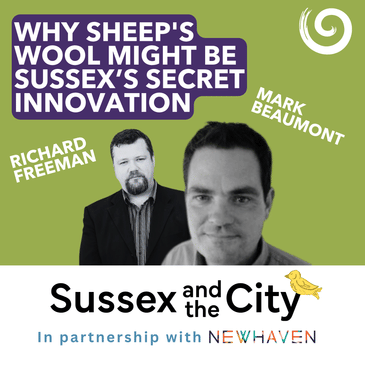
– Episode #47
Why Sheep's Wool Might Be Sussex's Secret InnovationHost: Richard Freeman Guest: Mark Beaumont – Founder of Lanoguard, community entrepreneur and Newhaven advocate
🔍 Episode summary
When people talk about Sussex's economic future, they often focus on Brighton, Gatwick, Crawley or the region's larger towns and cities. But what if one of Sussex's most strategically important places has been hiding in plain sight?
In this episode, Richard Freeman speaks with entrepreneur, manufacturer and community leader Mark Beaumont about Newhaven's future and why he believes the town could become one of Sussex's most important economic assets.
Mark's story is rooted in Sussex. From travelling the county with his family's organic food business as a child to building multiple ventures from Newhaven, he has spent decades exploring how entrepreneurship, community action and local pride can create opportunity.
Together they explore the unique combination of assets that Newhaven possesses: a working port, direct European connections, rail freight capability, manufacturing expertise, access to London, proximity to the South Downs National Park and a strong culture of grassroots action. They discuss why these strengths are often overlooked and why places with challenges frequently become places of innovation.
The conversation also explores Lanoguard, Mark's successful Sussex manufacturing business, which produces natural anti-corrosion products derived from sheep's wool and exports internationally from Newhaven. The story becomes a wider discussion about circular economy thinking, local supply chains, regenerative land use and how Sussex can build prosperity from its natural assets.
As devolution approaches, this episode asks an important question: could Sussex unlock greater prosperity by paying more attention to the places, industries and communities that have often sat outside the spotlight?
🎯 In this episode
- Why Newhaven's geography is both its greatest challenge and greatest opportunity
- The strategic importance of the Newhaven-Dieppe ferry
- How ports, rail freight and manufacturing fit into Sussex's future economy
- Why entrepreneurial communities thrive in overlooked places
- The role of local leadership in regeneration
- How Lanoguard grew from Newhaven into an international manufacturing business
- What sheep's wool has to do with corrosion protection
- Circular economy opportunities across Sussex
- The potential for local food, local supply chains and regenerative enterprise
- What a future Sussex mayor could learn from places like Newhaven
🧠 Key themes
Strategic assets hiding in plain sight Newhaven possesses a combination of transport, logistics, manufacturing and maritime assets that few places in Sussex can match, yet it rarely features prominently in regional economic conversations.
Innovation through constraint Mark argues that places facing geographical and economic challenges often develop stronger entrepreneurial instincts because they are forced to find new ways to solve problems.
Community as infrastructure The town's tightly connected networks create opportunities for collaboration, skills development and grassroots problem solving that larger places can sometimes struggle to replicate.
Manufacturing still matters While economic debates often focus on digital industries and services, manufacturing, logistics and maritime sectors remain vital sources of employment, productivity and resilience.
A different vision for growth The conversation challenges the idea that prosperity must always come from large-scale inward investment, suggesting that supporting local entrepreneurs and small businesses may deliver equally important long-term benefits.
💬 What Mark says
"The challenges and the opportunities go together."
"You can get the train directly to London and the ferry directly to Europe."
"There's a very deep community here."
"Those who can should be enabled to."
"We need to grow Sussex together."
🏭 About Lanoguard
Lanoguard manufactures natural anti-corrosion products using refined sheep's wool grease. Produced in Newhaven and exported internationally, the business demonstrates how Sussex-based manufacturing can combine innovation, sustainability and local supply chains.
This episode is brought to you in partnership with Newhaven Enterprise Zone.
Newhaven Enterprise Zone is working to transform Newhaven into a thriving and dynamic business destination by 2030, with a repurposed town centre, stronger growth sectors and a more resilient local economy.
Its current investment plan includes seven key initiatives, including targeted grant programmes to drive productivity, business growth and investment, helping to create sustainable, inclusive jobs for the whole community.
For Sussex, it means higher-value jobs, a stronger skills base and a culture of enterprise rooted in place.
Find out more at newhavenenterprisezone.com
ENJOY THESE PODCASTS?
Please like, subscribe or leave a review
🎧 Production credits
Host: Richard Freeman Guest: Mark Beaumont Sound design / editing / original music: Chris Thorpe-Tracey Production management: Letitia McConalogue
📣 Get involved
👉 sussexandthecity.info — episodes, resources, events and analysis on devolution, growth, infrastructure and the future of Sussex.
[00:00:01] This episode is brought to you in partnership with New Haven Enterprise Zone. New Haven Enterprise Zone's mission is to transform New Haven into a thriving and dynamic business destination by 2030, with a repurposed town centre to support growth sectors and boost the economy. Its current investment plan includes seven key initiatives, including targeted grant programs to drive productivity, business growth and investment, helping to create sustainable, inclusive jobs that benefit the entire community.
[00:00:29] For the Sussex economy, this is significant. It means our region is about higher value jobs, a stronger skills base and a culture of enterprise rooted in place. New Haven Enterprise Zone helps build a future where Sussex leads rather than follows. To find out more, visit newhavenenterprisezone.com. That's newhavenenterprisezone.com. This podcast is brought to you by Always Possible.
[00:00:57] Always possible.co.uk. You're listening to Sussex And The City with Richard Freeman. Hello, it's Richard here. Very quick reminder to please like, share, review if you can on your favourite podcast platform, the Sussex and the City podcast. If you do enjoy it.
[00:01:23] That three seconds of your time just to do a little five stars or to ensure, definitely ensure that you are subscribed so that it lands in your device every Monday morning makes a huge difference to us. Three seconds of your time. Massive, massive difference to the success of this podcast. It helps other people to find it. So that would be amazing if you could do that. Thank you so much. Right, pop quiz question.
[00:01:47] What has Sheepswole got to do with Sussex entrepreneurialism and innovation and the rust proofing of heavy machinery? Answers on a postcard. Well, at the end of this episode, when hopefully you will be illuminated. When we talk about the future of Sussex, we often talk about the big places. We talk about Brighton, we talk about Crawley, we talk about Gatwick, we talk about Worthing, Hastings, Chichester, the major infrastructure projects, the big investment announcements, the strategic plans.
[00:02:16] But some of the most interesting conversations about the future of Sussex are happening in places that don't always dominate the headlines. Now, we have had a conversation with Graeme Preece earlier on in this project about the New Haven to Dieppe Ferry. Today, we're going to go back to New Haven for this episode and have a little deeper dive
[00:02:38] on the enigma and jewel, I think, that is New Haven as a place in Sussex that not enough people understand. For decades, it's been a town that people have passed through, often rather than stopped in. A ferry port, an industrial town, somewhere squeezed between the downs and the sea with Brighton in one direction and Eastbourne in the other. But maybe that geographical quirk is actually its biggest advantage.
[00:03:07] And my guest in this episode is Mark Beaumont. He's an entrepreneur, a business builder, a community organiser, and one of New Haven's most passionate advocates and, frankly, one of their biggest assets. Mark is the founder of Lanogard, a manufacturing business they deliberately chose to build and keep in New Haven. Over the years, he has worked internationally, launched and grown multiple businesses, developed expertise in product innovation and market development, and built a successful UK-made
[00:03:36] brand, serving industrial, machine and consumer markets. But alongside that commercial work, he's been deeply involved in local regeneration, helping establish community initiatives, supporting the Made in New Haven movement, co-founding the New Haven regeneration group, and championing the town's future in every possible way. So this conversation is about much more than one business, much more than Mark's business.
[00:04:02] It's about the role of entrepreneurial activism in places that need that galvanising, that momentum. And it's about whether New Haven could actually become one of Sussex's most important economic assets. We talk about the unique combination of a working port, the direct European connections, rail freight capability, access to London, marine industries, manufacturing skills, and the proximity to the downs.
[00:04:28] And we explore why Mark believes that all of that, despite New Haven's challenges, and there are many, socioeconomic, the jobs and labour market, and some of the quality of the housing, all of that can actually become its strengths. And why industrial heritage still matters, and why too many places spend their time apologising for actually the stuff that makes them distinctive. We also discuss community-led regeneration, what is the role of local leadership in that,
[00:04:53] how entrepreneurs can be a massive part of placemaking, and what happens when people decide to stop waiting for permission, or waiting for somebody else to fix things, and roll their sleeves, and get on with it. And so as Sussex rattles on its devolution journey, there are some fascinating questions underneath this conversation. What happens when regional growth strategies start taking ports, manufacturing, and the maritime industries really seriously?
[00:05:21] How could Sussex think about places that have strategic assets, but haven't always received strategic attention? And how could towns like New Haven play a much, much bigger role in Sussex's economic future than people currently realise? Lots of interesting stuff, I hope you'll agree, and I think you'll like my guest this week, Mark Beaumont.
[00:05:52] I am joined today by Mark Beaumont. Now, some of you will know Mark very well, some of you not so well, but I really hope over the next 20 minutes or so, you'll get to delve a little bit into his brain, which I think is absolutely fascinating. I've only very recently met Mark, but been incredibly inspired by some of the things that he's doing in New Haven. So I want to delve into that. How are you, Mark? And what's your Sussex story? Mark Beaumont. Yeah, I'm very well, thank you.
[00:06:22] Slightly cold on the morning as it is now, fresh. It's funny, when you use the word Sussex, it harks me back to when I was, I don't know, six, seven, eight years old, roaming around Sussex with my father, who, mum and dad, ran an organic food business. And we collected lots of different organic produce from around Sussex. And his mum, my nan, lived in West Chiltington, part of far west, west Sussex.
[00:06:52] And so we would travel from, you know, Cookfield to maybe even Rhine, right over to there. You know, so anyway, that's a real grounding. So very Sussex in that regard. And then, yeah, my Sussex story, I suppose, really is very much living in the centre of it, as I like to think in New Haven. The centre on the coast, anyway. The centre on the bottom bit, yeah. And just, yeah, having grown up here from being in the school rugby team all the way through,
[00:07:21] playing all around Sussex and winning Sussex Cups for the school and all that, right through to starting businesses, social enterprises and charities to date, about nine of those, I think, all Sussex oriented, but largely all from New Haven as a nucleus and try and stay there. Stay there and do my bit for prosperity for the local area and have travelled globally,
[00:07:45] have had businesses globally and 15 years ago or so I thought I was in the middle of nowhere, 12,000 miles away thinking, why am I as far away as possible doing a deal from the town that I love and the people I love and my family I love and the rest is sort of history. I think it's focused even more on local. What's so good about New Haven? Make the pitch. It has a lot of challenges. And if you're like me, like a challenge and like to challenge convention, that's really good.
[00:08:14] But I mean, I'll start with these challenges and then I'll tell you its benefits because I think they go together. So the challenges are 54% of its topography, Northwood is National Park. So that means that 54% of your talent for employee or customers are blades of grass. So that's pretty difficult. Or sheep. Or sheep. Or water. And 180 degrees of its southward customers are fish. Yep. That's a big challenge. But dolphins more frequently these days. Yes.
[00:08:44] Occasionally dolphins indeed. And they are great for a bit of inspiration because, you know, dolphin in the ocean. And then you've got Brighton to its west and Eastbourne to its east, which makes it very, very difficult to compete for talent, fishing for your business and indeed customers and so on. And of course, largely speaking, you're just driving Northwood if you're a business. But then if you flip that round, that means there's talent in Brighton that you can fish for and poach. Attract would be a better word.
[00:09:13] And same for Eastbourne and same Northwood as well. And therefore offer an interesting different pitch to them because as a member of staff, you've got the sea all around you, which is, as we know, the benefits of that really. You've got the National Park, which you can take lunch in and go for walks in. And, you know, we walk and meet at work. You know, we don't have to meet in meeting rooms and stuffy places. This is open, fresh country. We can get the train directly to London from New Haven.
[00:09:40] We can get a ferry directly to Europe twice a day or four times a day in the summer. A gateway to the world. Literally a gateway to Europe. And a lot of our staff now use the ferry as a day trip thing. A lot of people don't even know that ferry exists, you know. I don't want to sidetrack there on your question. For me, that is a jewel in the crown of Sussex. It really is. And underutilised, you know, cargo, freight, passengers, holiday making, and the other way around. Get Europeans into Sussex.
[00:10:08] I will signpost to listeners the previous conversation we've had on this series with Graeme Preece. He's all over the future of the ferry. So if people want to dive into that a little bit more depth, check back a few episodes ago. So what's the character of New Haven then? You know, for someone who was born, bred there, lived there, built business there. As you say, you want to stay there and sort of be an architect of its prosperity in some ways. What does it add to the Sussex story, if we're going to go back to that slightly problematic phrase? Some of the above mentioned, you know.
[00:10:38] It's a gateway, it's a port, it's a train station. Remember, it's a railhead, freight railhead, pulling aggregates out and all industrial products, which is, you know, not everywhere at all. But I think having grown up here, it's a lot easier for me because, you know, I know a lot of people. I'm obviously quite extrovert and, you know, I therefore have quite a large network. But I remember there was a study done on it, and I think it was indeed by New Haven Enterprise Zone. And it was kind of one of the words that came out was gritty.
[00:11:05] And I kind of go along with that, but it was a little bit, I don't know, it could have been better put. But it's definitely real. It's very real. And there's a deep community, very deep. You know, I used to do a lot of New Haven-centric promotional stuff. And I still do, but I've got a different role, you know, more Sussex-oriented than just New Haven. But there was people that would say there's nothing to do in New Haven, or there doesn't seem to be any particular sort of friendship groups or networks in New Haven. And that couldn't be further from the truth.
[00:11:35] And I think, you know, after a while, they realised that's not the case. And it is very, very tightly knit. You can really, really work well with that. You know, you can leverage it to business and community advantage. It is probably like a real shining example of that, of a real tight community. But whether or not that's, you know, all over Sussex, I really don't know. I think some would say it is. And you're right. I think that's what I call the kind of network economy. You know, it's lots of tight-knit, small networks that are very generous with each other.
[00:12:04] I could give you an example. Just recently, I'd say one of my other hats, many of them. I'm a governor for Sea Haven Academy, responsible for careers and community, funnily enough. And I went to have a quick catch-up, funnily enough, with Graeme, just to hand something over to him in New Haven, in a lovely little coffee shop there. And, you know, that's quite busy now and frequented by various people. One of them was one of the technicians who work in the port.
[00:12:34] The result of that quick catch-up, and we call, I call, we call lots of people I'm around, call spaces in between. That's where everything happens. And you can do that so well in New Haven. And I'm not sure if that's true in every other sort of county or even town, because it's quite tight-knit. We have a pupil that we'd like to do a work placement with. You know, he struggles a bit more with, and this is not uncommon, he struggles with academia stuff. And so we're trying to find a work placement.
[00:13:03] It's difficult for small businesses to take them on because they're worried about health and safety and what they do and how they do it. But I've asked this guy there just, you know, literally a two-minute conversation results. And, yeah, we'll do that a day a week. You can come to us and we'll teach him about the technical side of ports and, you know, engineering side. And we'll take, we could take a bus of, once a month or every other month, we'll take a bus full of kids from the school, 16 kids.
[00:13:31] And if you bring them down, we'll give them lunch and show them all the maritime industry and jobs available on the doorstep. From ramping wind fireman engineering to high-tech engineering that's in there to belay rope access training through to their own port operations and cargo and shipment. And I think that's a great example. Community network really working.
[00:13:53] And the other one was recently the school opened their doors to the RNLI so they could do their fate there, which is not that common to do. But, you know, that works really well. So it all kind of connects up. And then the question is how do you, you know, you can use that for prosperity and business as well in the same sort of way. Tell me about Lanagard. Tell the listeners about Lanagard because I think it's a really interesting business. Yeah.
[00:14:16] So using all that kind of background there, you know, having a network here, having grown a number of businesses and really trying to sort of keep them here. It's not uncommon for a business that I've been involved with or grow that it moves on from here because it kind of has to. That's the thing it has to. So my intention was to kind of grow something that kind of fits all that we've just discussed, you know, benefits from all those things.
[00:14:40] And a lot of the staff around were from a manufacturing fabricating background and warehousing, you know, operatives. So we kind of built it around that. And Lanagard is a direct-to-consumer manufacturer of natural anti-corrosifs that protect the underbody of your vehicle, your car, from salt and water and prevent rust and degradation. And stop the rubber eroding and everything.
[00:15:08] So it's one product that will prevent the underneath of your car degrading. But it also gets used on the ferry, on the bridges to the ferry in New Haven. It gets used on Timemouth Bridge. It gets used on Sir David Attenborough's boat face. It's a lot of places, tens of thousands of customers. And we do all that from New Haven. So we manufacture and blend and bottle in New Haven. And we have a warehouse that picks and packs and logistically distributes all over the UK and Europe.
[00:15:38] And, of course, we export on the ferry, of course, to Europe. That is our gateway. It's the only, get this one, it's the only line, I believe, you might have to fact check this, but as I understand it, it's the only place that you can pre and post customs clear through one agent who has the exclusive arrangement to do so. So you can very simply go to Euro Channel Logistics. Bruno Benio is a great guy who owns that. He has a customs clearance house.
[00:16:07] He will pre-clear and post-check and store for you. So basically pull your product through. And that means quite a lot given Brexit and all the complexities and GPSR. So it's definitely an operational space you can use to get through it. So that's Land and Guard anyway. And my vision is we'll keep it in New Haven. We'll keep shaping it towards New Haven orientation. But we now moved into Marine Workshops, the old UTC. And lovely offices.
[00:16:35] And we're attracting some great staff. And that's my mission, to go back to the talent fishing thing. And we now have a lovely opportunity to say, look, this is a growing, going places business. You know that the salaries will be great. You will be paid well, remunerated well, looked after well. We'll make sure that you can have your days off and time slots to suit you and flex your work in. And, you know, come to New Haven. Of course, a lot of people originally say, oh, New Haven, not sure about that. But actually, we're managing to attract some great, great talent. And yeah, that ticks the box for me.
[00:17:03] And it also does a lot of social good because we have a baked in social business model, which enables us to fund some wonderful environmental, educational and social beneficiary business outcomes. You've probably got a strategy, a vision, a roadmap, maybe even a post-it note empire on your office wall. But has anyone asked the really awkward questions yet?
[00:17:31] Like, is it actually working? At Always Possible, we help senior leaders challenge the obvious, rethink the possible and deliver the extraordinary without losing their sanity or their sense of humour. Enabling private and public sector innovators to navigate a changing economy.
[00:17:52] We help complex organisations to humanise data and to translate the big picture into hyper-local engagement, trust and sustainable growth. If you're ready to bring people with you because your leadership truly inspires, visit alwayspossible.co.uk. That's alwayspossible.co.uk. Always Possible.
[00:18:20] We make bold business brilliant. And if that wasn't a compelling enough story, that link to the environment, because I think of people who didn't know much about it and I'm in that camp, I think when you go, oh, you know, rust prevention for the automotive industry, you think chemicals, you think greasy, you think... This comes from sheep wool. We have to process sheep wool. Well, yes.
[00:18:49] So I would think, you know, synthetic oils and agents and detergents and all these sorts of things that, you know, feel about as far away from nature as you can get, you know, and when you'd couple that with it being in New Haven, which is, as you've articulated, is gritty and industrial, you know, very easy to make some assumptions about the kind of world you're in. But sheep's wool. Yeah. Sheep's wool, Mark. Make the link. Yeah. So if you scrub sheep's wool, you get its grease out of there.
[00:19:18] And if you refine that and alter that and then put additives to it by cooking, you get a wonderful product that is, if you think about what the sheep's fleece needs to do, it's got skin under there and it can't keep getting wet, dry, wet, dry, wet, dry that. You know, as we know, you'd be like being in a bath all day long. So we take those properties largely, which is secreted from the glands of the sheep onto their wool,
[00:19:42] blend it and turn it into something that is jet wash proof and salt proof and draws salt out. But again, think about its natural thing. You know, it needs to draw salt from sweat. Well, suddenly your neighbours in the national park where you were saying this is a challenge because we don't have people living there. Well, you have a renewable, natural, circular economy resource that is helping to create jobs and drive industry in New Haven.
[00:20:09] I think that, for me, is a really interesting signal about Sussex at the moment. And the more I delve into what we're really good at here, the more I sense this sort of emerging, and it's not emerging because it's historical, we were using the land in order to create industry thousands of years ago, of course.
[00:20:32] But there feels a new sort of recognition of the natural capital and how to use it regeneratively in order to build an economy for a kind of, you know, a new world. And that might sound very grand, but I think that's the kind of thing that a new Sussex mayor can really put a flag around to say, well, this is a differentiator. Yeah, I know. I mean, Sussex to Sussex, right?
[00:20:58] Not forgetting that one of the things for me was Lanagard, about seven years ago, I made the decision to make it all UK sourced and all UK main. So that's today. Nothing isn't that. And that isn't just, you know, patriotic St. George's flag stuff. That is just, it makes sense. You know, carbon footprint, sustainability, supply chain logistics, length of supply chain, you know, just makes sense. Now, it's not going to be the cheapest. We know that. And we had to battle that.
[00:21:27] But the same applies for Sussex. You know, what can you do in Sussex? And that's what I was saying about how, you know, in Sussex right now, there's the finance director of TFL. He lived in Seaford. But he's going to London every day. And you think, well, there's Talon commuting out. How do we, how do we get him here? Why is he going up there? You know, and, and all of that. So if you can just sort of broaden that. And of course, that's possible. So there's a Sussex network, maybe.
[00:21:53] But there's also food distribution. I mean, I'm in talks with, I'm sure a lot of the listeners would know, Ruth Anseload, you know, light talks. We're just chatting around. How do, she run the HISB supermarkets. How do we, how do we get Sussex Food Hub so that growers of food have a distribution point that is truly local? And, and, and we can all, you know, use the land to make the money, make a circular economy. And we're not doing thousands of food markets. And we're not having to put the margin in, in, in supermarket pockets and so on.
[00:22:22] And that's close to my heart because we, you know, we have this piece of land from our social mission and protecting futures fund, PFF. We bought some land in New Haven, about 20 acres. And we are regeneratively farming that, making a community garden space, teaching kids how to grow, teaching them about natural cycles, all sorts of stuff, well-being and waterways and loads of things. But, you know, we're interested in that.
[00:22:47] So, so I think there's a nucleus of saying, well, we'll use these, not micro farms, but, you know, land masses that can produce fantastic food and get it directly to Sussex folk. Sussex onions, as we call it, trying to work out how we get to that. So I don't know if that's sort of answering the question or dancing around it, but it is, I agree that I think one of the ups and downs. So you think about 1066 country, you know, you go that kind of into that greenfield, open space, oak trees, you know, got family live there. You know, road links are still not good.
[00:23:16] Rail links are not good. And, and, and, and, and, and, and still there's thriving businesses, you know, and in Hastings and the surrounding areas. You know, you've got, for example, Marshall Tufflex. They've been there forever, as I can record, 34 years. Bastings, they make dado, rail. I'm not sure of their numbers now, but it's, you know, certainly tens of millions, hundreds of millions, 600 staff. And you think, how does it work? And it is, I think it requires some innovation. You need some ingenuity when you've got challenges.
[00:23:45] If you go back to what I first said, I wanted to start with the challenges before explaining, trying to pitch New Haven Street. Because I think that's where people start when they're slightly disadvantaged. And therefore, the production of that is business people who, and charities that have to fight a little harder and come up with some interesting stuff.
[00:24:03] So if we can pull that together, and maybe that could be authoritatively driven by Sussex Mayor Office, so that you've removed some of the layers of three-tier council and such. And funding can come directly to business teachings and assistance to let that flourish. That could be a real jewel there in the crown. I've used that term before, but it feels like that anyway. And it's a word that's overused and not always fully understood.
[00:24:32] And maybe there's a better word, but pitching Sussex as a county of innovation. As you say, it's a place where the size and the sort of networked effect and maybe having to struggle a little bit forces some really interesting ways to do things. New ways to solve old problems. Continually stretching what the art of the possible is. It's a place where so many things start, don't always scale. Don't always end, that's right. They don't scale there, yeah.
[00:25:01] But it just feels to me that that's an increasingly obvious narrative. To say, look, this is what we're good at. Look at Lanagard. Look at what Ruth was doing with his beat. Sadly, they couldn't sustain the bricks and mortar shops. But actually, there's a legacy of new ideas around food distribution. Absolutely, yeah. She's got some great ideas. Look at what we're doing in farming. Look at what Marcel Tough Legs are doing in plastics. There's story after story after story that just goes a little bit under the radar, often outside of some Sussex bubbles.
[00:25:31] So how can a mayor shout from the rooftops? How could it get you talked about in, I mean, lots of departments that would be interested in you. I think Department for Business, Department for Energy, Department for Technology. I hate the word innovation, really. But, you know, it's understood by people. So, I mean, I say I hate it. I just mean I don't like using generic terms that people struggle a lot. Entrepreneurialize. It's problematic, for sure. Ambiguous terms. Disambiguating, I'm happier.
[00:25:57] But don't you just simply need an advisory panel, friends of the Sussex mayor? I don't know. But, you know, it's not just business types. It is social entrepreneurs, social enterprises and charities. But great examples of how things can be done a little bit differently and maybe creating that kind of network. We definitely see that the Sussex mayor needs a business council. S-E-L, council.
[00:26:22] It needs to be able to take council from those on the ground in Sussex and not just, you know, directed from government. So, hopefully, you know, we've got government fee directly to the Sussex mayoral office. And if the mayoral office can be connected on the ground via what I've just described, then it should be pretty tight. And things should be able to happen in the way that Sussex can deliver and can benefit from. You know, live, work, rest and play should be improved if they achieve that.
[00:26:52] So, hopefully, it'll be tighter. They can leverage the likes of myself and those willing to help others, you know, because I really do believe that those who can should be enabled. Too many people who can are not enabled for lots of reasons. And maybe, you know, he, she could be an enabler. You've put a couple of ideas forward around, you know, the sort of distribution hub. You've talked a little bit about what's working in New Haven.
[00:27:18] But let's say, you know, 2035, I don't know, 2045, you know, if there's one or two things that you're like, okay, this has worked or this is working or this is, this is a new phase for the county. How would that enablement manifest itself, do you think? I know I've put you on the spot there. Yeah, it's a big question. It's getting me thinking. I've not answered that one yet for anyone.
[00:27:41] Enabling staff at a young age, you know, hence why I'm involved in an academy school governor level to truly believe we've got to build the community and connections better than they are today. Empower them, teach them differently. I don't know where we can get that authority from to alter curriculum and syllabus and content and teaching styles and out there vocational stuff. That's critical.
[00:28:06] Especially go back to the Sussex point, you know, Sussex has, there's a great study done by the Sussex Community Foundation that clearly tells you there's some massively challenging areas of educational attainment in Sussex, particularly along the coast, you know, in Bognor Regis and Hastings and New Haven. We have some real challenges there. And we need to flip that on its head, just like the Lanagard story, observe what's around us and then go with it with some key differentiators to the norm. What does it look like in 20 years from now?
[00:28:36] I think that we need to really support the micro and small businesses and charities and social enterprises by way of action that's directly delivered from the mayoral office through funding and teaching and training programs and encouragement and probably business council. Yeah. Something like that. Something like that. Prosperity. I very much would say, and, you know, we need to address that.
[00:29:01] And Sussex has some remarkable resources and opportunity that probably are underutilised and perhaps shadowed a bit by neighbouring home counties and London. And we can do something like that. We need to do it together. Well, that feels like a hopeful, pragmatic and sensible point to conclude. Good. I think there's so much more we could talk about, and I hope that we will. Really keen to involve you in the next phase of the Sussex and City project. Yeah.
[00:29:31] I think it's just growing Sussex together. There you go. There we go. What a nice, what a nice strapline. But for now, Mark Beaumont, thank you so much for being my guest on the Sussex and the City podcast. Thank you very much. It's been a pleasure. Thank you very much to this episode's guest and to you for tuning in.
[00:30:01] Sussex and the City is an independent and non-political project about devolution as it happens, explained in human. It is led by Always Possible. You can find other episodes, resources, events and blogs about change in Sussex and Brighton by visiting sussexandthecity.info. That's sussexandthecity.info.
[00:30:26] This episode was written and presented by Richard Freeman for Always Possible. The editor was me, Chris Thorpe-Tracy for Lo-Fi Arts. I did the music too. Production management was by Letitia McConnelogue for Always Possible. Talk to you next time.