
– Episode #48
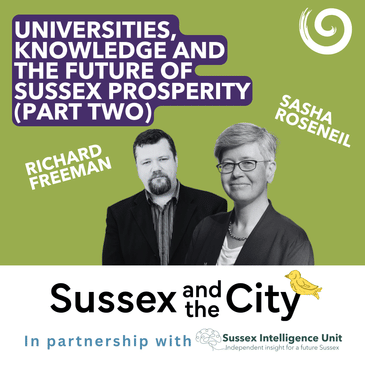
Universities, Knowledge and the Future of Sussex Prosperity (Part Two)Host: Richard Freeman Guest: Professor Sasha Roseneil – Vice-Chancellor, University of Sussex
🔍 Episode summary
What role should universities play in the future of Sussex?
As devolution reshapes local decision-making and the higher education sector faces mounting financial pressures, universities are being forced to think differently about their purpose, their partnerships and their place within local economies.
In this episode, Richard Freeman speaks with Professor Sasha Roseneil, Vice-Chancellor of the University of Sussex, about the future of higher education and why universities remain critical to innovation, economic growth and social mobility.
This conversation follows Richard's earlier discussion with Jo Havers from the University of Brighton and forms the second part of a wider exploration of how Sussex's universities contribute to the region's future prosperity.
Together they discuss the challenges currently facing the sector, including funding pressures, changing attitudes towards degrees, student finance and the future relationship between education and work. Sasha argues that universities are far more than providers of qualifications. They are places where new knowledge is created, where future industries emerge and where people develop the adaptability needed to thrive in an uncertain world.
The discussion also explores the University of Sussex's growing civic role within the county. From the Civic University Agreement to skills development, research partnerships and economic strategy, the conversation examines how universities can help shape a more connected, innovative and ambitious Sussex.
Along the way, they discuss artificial intelligence, quantum computing, regional identity and the opportunities that a future Sussex mayor could unlock through closer collaboration with higher education.
This episode is brought to you in partnership with the Sussex Intelligence Unit, the independent research platform from the team behind Sussex and the City, providing evidence-led insight into growth, infrastructure, governance and belonging across Sussex.
🎯 In this episode
- Why universities are facing significant financial pressures
- Whether degrees still represent value in a changing economy
- How universities help people navigate uncertainty and change
- The University of Sussex's global outlook and local impact
- Why research universities matter for economic growth
- The Civic University Agreement and its ambitions for Sussex
- Collaboration between universities, colleges and employers
- The future relationship between higher education and devolution
- Quantum computing and the vision for a Sussex innovation cluster
- What long-term prosperity could look like across Sussex
🧠 Key themes
Universities are more than teaching institutionsHigher education plays a crucial role in generating knowledge, developing future industries and preparing people for complex and changing careers.
Economic growth depends on research and innovationUniversities sit at the centre of many of the technologies and industries that will shape future prosperity, from artificial intelligence to quantum technologies.
Civic leadership is becoming more importantUniversities increasingly recognise their responsibility not just to global research communities, but also to the places and regions they serve.
Sussex needs stronger collaborationThe Civic University Agreement reflects a growing belief that universities, colleges, businesses and public institutions can achieve more by working together.
Opportunity remains unevenDespite Sussex's strengths, significant inequalities persist across the county. Addressing these disparities will be central to any long-term vision for prosperity.
Devolution creates new possibilitiesA future mayoral authority could provide new opportunities for strategic investment, partnership working and innovation-led economic growth.
💬 What Sasha says
"Universities are the engines of economic growth."
"What university, at its best, gives students is resilience, adaptability and the ability to ask difficult questions."
"The whole region will be stronger if it wasn't as unequal as it is now."
"We can do far more if we work together than if we work individually."
"It's not about building boundaries around Sussex. It will be a strong region in a strong country in a globally connected world."
🧠 Why quantum could matter to Sussex
The University of Sussex is home to world-leading research in quantum technologies and physics. The university is helping develop proposals for a Sussex-based quantum innovation cluster, building on strengths in research, advanced manufacturing and specialist engineering. The ambition is to create a globally significant centre for next-generation technologies within Sussex.
🎓 About Professor Sasha Roseneil
Professor Sasha Roseneil has been Vice-Chancellor of the University of Sussex since 2022 and is one of the UK's leading social scientists. Before joining Sussex, she held senior leadership positions at University College London (UCL), where she served as Pro-Vice-Provost for Equity and Inclusion and Dean of the Faculty of Social and Historical Sciences, and previously at Birkbeck, University of London.
Her academic work has focused on social change, citizenship, identities, relationships, gender, social movements and the ways people build communities and belonging. She has published extensively on questions of social transformation and has led major international research projects examining how societies adapt to cultural, economic and political change.
🎧 Production credits
Host: Richard Freeman Guest: Professor Sasha Roseneil Sound design / editing / original music: Chris Thorpe-Tracey Production management: Letitia McConalogue
📣 Get involved
👉 https://sussexandthecity.info — episodes, resources and events
👉 https://sussexintelligence.com — research, insight and analysis on Sussex's future
ENJOY THESE PODCASTS?
Please subscribe, like, share and review - it helps to spread the word.
[00:00:00] This episode is brought to you in partnership with the Sussex Intelligence Unit, a new independent research platform from the team behind Sussex and The City. Sussex is changing. Devolution is reshaping how major decisions and major investment gets made. But without the right evidence, how can it deliver what our communities need? The Sussex Intelligence Unit answers that challenge. It's the first independent cross-sector platform to look at growth, infrastructure,
[00:00:25] governance and belonging across East Sussex, West Sussex, Brighton and Hove. New data, fresh analysis, evidence-led insight designed to put businesses, voluntary sector organisations and policy makers ahead of what's next. Because the decisions made today will shape Sussex for a generation. For the intelligence you need, visit Sussex Intelligence. This podcast is brought to you by Always Possible. Always possible.co.uk
[00:01:00] You're listening to Sussex And The City with Richard Freeman. Hello, it's Richard Freeman here and welcome to the Sussex and The City podcast. I hope you are absolutely brilliant in yourself, in your world and all that's going on for you. So this episode, let's make no bones about it, what a really tough time it is for higher education at the moment. Universities are often in the news, not necessarily for the right reasons
[00:01:26] because there are funding challenges, student loans seems to be in a bit of a crisis and the kind of world of research and innovation feels desperately underfunded and the link between learning and work and the guarantees of jobs for young people, all of this stuff feels like a pretty hot
[00:01:45] and difficult subject for us to navigate at the moment. Which is why I particularly want to profile and get under the skin of the three Sussex universities, where they're at really, how they're trying to navigate this big change and particularly how they interact with the change that's happening in Sussex through devolution, local government reorganisation and a general renewal and
[00:02:15] rethink of the local economy, skills, jobs, innovation, all that sort of stuff. So a few weeks ago I had a chat with Joe Havers from the University of Brighton. If you've not listened to that I would have a listen back. I think it was a really interesting conversation all about knowledge exchange and the role of universities working with businesses and civic organisations.
[00:02:34] And if you have a look at the Sussex and the City website, sussexandthecity.info, you'll see we've got an expert opinion and a piece of written insight from Professor Simeon Dacast, the Vice Chancellor of the University of Chichester. So we've got a podcast with Brighton, we've got a really interesting think piece from Chichester and so today in this episode is the opportunity for you to hear my interview and chat with Professor Sasha Rose-Neill, Vice Chancellor of the University of Sussex.
[00:03:05] So universities are often talked about and understood as places where people go to get degrees, right? Sometimes they're also discussed as research institutions and occasionally they are seen as economic engines. And in a rapidly changing world where tech is transforming jobs, where regions are being asked to take more responsibility for their own futures and where Sussex particularly is preparing for a new era of devolution, then the roles of universities suddenly feels much bigger than that.
[00:03:31] And so my guest, Sasha Rosenil has been Vice Chancellor of the University of Sussex since 2022. She's been helping lead one of the UK's, I think, most distinctive universities through a period of significant change in higher education, whilst also strengthening the university's role within Sussex itself. University of Sussex has, fair to say, always had a reputation for doing things differently.
[00:03:54] Founded in the early 60s as one of Britain's first so-called plate glass universities, developing a global outlook, culture of interdiscipline research and thinking, building a record of pioneering research that does continue today, particularly in fields like international development.
[00:04:12] And it's home to world-leading work in a range of areas from global development and sustainability, but increasingly things like artificial intelligence, informatics and quantum, which we will talk about. And so we explore the pressures currently facing universities around student finance, funding challenges to changing attitudes towards degrees and the future of work. These challenges are big and we do get into them. And we discuss whether universities still matter in an age of AI, automation and economic uncertainty.
[00:04:43] And why Sasha believes that higher education is more important than ever in helping develop resilience, adaptability and how we navigate an unpredictable future. But as well as being a global outlook university, I push the question of its role in Sussex. We talk about the university's growing civic role, the new civic university agreement that all of the universities and many other institutions within Sussex have signed,
[00:05:08] that brings together a shared vision for the county and what genuine collaboration might look like in a region that has often struggled to think strategically. We discuss skills, growth, health, inequality, opportunity and how universities can help shape a more connected Sussex. And why the arrival of a mayoral combined authority could create new opportunities for investment, partnership and innovation led by the county's universities.
[00:05:33] And we look a little bit ahead from quantum computing and the possibility of a Sussex quantum Silicon Valley to the role universities could play in the future around greener, fairer prosperity. So this is a hopeful conversation, I think, even in tough times about knowledge, place, long term ambition. If Sussex is going to define a shared vision for its future, then universities like Sussex have to be a big, big part of that story.
[00:05:59] So I hope you enjoy my conversation with Professor Sasha Rose-Neill. Hello, I am sitting in the wonderful Sussex house at the University of Sussex, just been admiring the most beautiful pink blossom tree.
[00:06:24] It is a bright spring afternoon and I'm delighted to be spending a bit of time with the Vice-Chancellor of the University of Sussex, Professor Sasha Rose-Neill. Professor Rose-Neill, let's start with the big question. How are you? I'm very well, thank you. It's great to have you here. Welcome to the University of Sussex. It's lovely that you noticed the blossom in the campus because I came in a couple of weeks, maybe three weeks ago now,
[00:06:50] and the blossom had come out over the weekend and the campus was transformed. I mean, we'd had a very rainy period, hadn't we, in Sussex for, it felt like, many weeks. And then the weather turned and the blossom came out and the daffodils were out on campus. I started seeing rabbits again. Every spring that I've been here, I've just fallen in love again with this beautiful campus.
[00:07:13] So tell me about your journey as an academic and as a higher education leader, particularly what's brought you to Sussex? I've been at Sussex now since August 22, so it's getting on for four years. I think I don't feel new anymore, just about. I've been here long enough that I can't say I'm new. And Sussex is a fantastic university. I mean, we're coming up to 65 years, which is relatively young, as British universities are concerned,
[00:07:43] but certainly old enough to have a very strong sense of tradition and of what Sussex is about as a university. You know, it was all that attracted me. I mean, Sussex is a different type of university and, you know, was from its very beginnings. And I think it has carved a different path and is still doing really creative, different things now. I've always loved Brighton. I would come to Brighton for days out from London when I was a kid. My dad always talked about wanting to retire to Brighton. They never got to do it, sadly.
[00:08:12] But there's something very special about this part of the country. I've completely fallen in love with it. For those that aren't sort of living and breathing, the world of universities are kind of looking going, what's happening? It doesn't feel very secure anymore. It doesn't feel very radical or sort of big picture. So how does it feel for you as a leader at these times? Well, I mean, there is a huge difference between universities now and when Sussex was founded in 1961.
[00:08:39] Sussex was the first of the plate glass universities, those new post-Second World War universities, the sort of Harold Wilson project. And it was founded at a time of optimism. And Sussex really had a kind of global outlook from the very beginning. I mean, it was a sense that it was being founded at the point that the British Empire was kind of ending, but that the country needed a kind of new way of engaging with the world. And that was what Sussex set out to do. And we're still doing.
[00:09:08] It was just a few weeks ago, heard that for the 10th year running, we were ranked first in the world for development studies. So that kind of commitment to looking out at the whole world and working with the whole world has always been what Sussex has been about. I mean, times are difficult in UK higher education at the moment. And I think, you know, there's there's been a sort of long, slow downward spiral, really, because the current funding settlement, the financial deal isn't working.
[00:09:37] I mean, it dates back, I suppose, to the decision of the Conservative government to kind of create a market in higher education. Previously, there had been fairly strict student number controls exercised by the government. The government decided how many students would go to university and then allocated the places. And that meant that the government had control over how big universities grew, how many students were studying at university and to a large extent, what subjects they were studying.
[00:10:06] And there's many good things about releasing some of that government control because actually governments are slow to react. And actually students probably know best what they want to study. They certainly need to be able to respond to the job opportunities and the opportunities of the future that they will create. But what we have now is a situation where there is a very real market in higher education and student number controls were released. But student fees haven't gone up. They've barely gone up in many years.
[00:10:36] And if they had gone up with inflation, they would now be about 13,000, 14,000. But they've just recently gone up and they're now 9,500. So there's a big gap between what universities need to teach home undergraduates and what we actually get. So it's not a real market. In a real market, universities would sort of work out what it costs to teach the students and charge that.
[00:10:58] So it's a kind of complicated UK approach to this where there is a very high degree of state control over the costs, you know, the income students that the universities can get from student fees, home student fees. But actually no controls over how many students can go to university. And I think this is now seen by pretty much everyone to be really problematic. But the government hasn't yet grasped the problem. I think they don't really, my senses don't really know what to do about it because it is a big complex mess.
[00:11:28] You know, there are now generations of students who have substantial debt. I mean, if it hadn't ever been described as debt, if it had been actually a kind of a bit of additional tax that students paid, I think we'd be in quite a different situation. We might have been able to increase it as needed with inflation without students feeling weighed down by personal debt. I don't think the government is really grasping the problem.
[00:11:52] It is a very knotty problem, though, what to do about that when there are now many hundreds of thousands of students with these loans. How to kind of change that? It's a really complex kind of fiscal challenge. There is now pretty much no direct state funding of universities. The funding comes through the student fees. And that has created a real financial crisis in universities. I mean, probably about three quarters of universities will be posting deficits this year.
[00:12:20] And many have been running deficits now for several years. That's not sustainable. There's also the wider story about the sort of rapidly changing economy. You know, the adaptation of the workplace. You know, technology is changing fundamentally everything about how we work, which is fundamentally changing about how businesses recruit and the sort of skills they're looking for. Or bluntly, the value put on knowledge versus technical skills a lot of the time.
[00:12:48] You know, and also with Brexit and so on, and a disruption to access to certain European research funding parts and so on. It's causing people to think about what is a university for? You know, 50% of the population thinking, you know, well, naturally my child gets to 18, 19. They're going to go off and do a three-year full-time degree in a subject of their choosing, which means that they'll get the job, then they'll get the mortgage, then they'll get the whatever, whatever. It's just so fundamentally different to that landscape now.
[00:13:17] And so we're thinking, you know, all of us very differently and sort of, you know, building the plane as we're trying to fly it. From that perspective, you know, how are universities generally, but how is Sussex University sort of thinking of its position in that time? As you were talking there, I was thinking back to when I was graduating in the 1980s and how there was a sense that there were no jobs. You know, it was the middle of kind of Thatcherism
[00:13:43] and it was a very difficult economy to be graduating into. It's difficult to actually realise that things are always changing. And it feels like there are unprecedented changes happening at the moment with AI. But it wasn't that long ago that the internet was the big new change and everyone sort of was worrying about what was going to happen. Anxiety is understandable in times of change,
[00:14:09] but I think a university education is actually what helps people ultimately to navigate the uncertainty of the future. We absolutely need people who are skilled in trades, manual trades, but we also need people who are going to ask the questions that will lead to the new knowledge for the future, that will build the new technologies, that will lead to the scientific developments, and that will create the cultural environment that we all want to live in,
[00:14:36] you know, write the TV shows of the future and write the plays and compose the music and so on. So I don't think that universities are going to be less needed. I do think that what universities do changes all the time and how we teach people, how we teach our students, what we expect of our students needs to change and does change all the time. I mean, Sussex, it's interesting, the whole AI revolution, because Sussex was there at the very beginning. You know, a handful of universities in the UK,
[00:15:04] Sussex was doing research on artificial intelligence in the 60s. And in fact, Geoffrey Hinton, who won the Nobel Prize for his work in... Known as the Godfather of AI, isn't he? He did his early work at Sussex. You know, and Sussex was there at the beginning of the informatics revolution. I mean, one of my favourite Sussex facts is that the first ever transatlantic email was sent from the University of Sussex to the US in 1973. So this has been a place of incredible innovation. And our students get access to that.
[00:15:34] You know, students at research universities are being taught by people who are doing the research that's creating the future. One of the kind of joys of my job has been meeting generations of alumni of Sussex who talk about how they encountered, you know, cognitive science, AI in the 70s, and how that fed their future careers in ways that they never would have expected. So I think the experience of going to university and going to a research university where you're working, being taught by people who are at the cutting edge of knowledge
[00:16:04] is something that's always going to be needed because we're always going to be wanting to push the frontiers of knowledge. And actually what university at its best gives students is resilience, adaptability, the ability to ask difficult questions, to know what questions to ask, to think about, you know, what needs to be challenged and what needs to be thought differently about. And that's not about just learning an existing body of knowledge. You have to get to grips with where knowledge is, but you also have to be pushing at the frontiers.
[00:16:32] It also gives them an opportunity to explore, to work out who they are, to experiment. You know, not all students live away from home, but I think the opportunity to leave home in your late teens, your early 20s, and work out how to organise your life, how to get yourself up, get yourself fed, budget, all those kind of things are absolutely vital life skills. And I think it would be hugely disadvantageous if students,
[00:17:01] young people stopped having those advantages. So we are living at a moment where universities are being critiqued a lot. But actually, I think what underlies that is a concern about the uncertainties that the world's facing. And people are alighting on universities as somehow the crux of the problem, the difficulties that we're all facing are there's a huge amount of uncertainty about the future of work, about what jobs people are going to be doing, about whether there are enough jobs, about economic growth. But actually, it's universities that are the engines of economic growth.
[00:17:32] You've probably got a strategy, a vision, a roadmap, maybe even a post-it note empire on your office wall. But has anyone asked the really awkward questions yet? Like, is it actually working? At Always Possible, we help senior leaders challenge the obvious, rethink the possible, and deliver the extraordinary without losing their sanity or their sense of humour,
[00:18:01] enabling private and public sector innovators to navigate a changing economy. We help complex organisations to humanise data and to translate the big picture into hyper-local engagement, trust and sustainable growth. If you're ready to bring people with you because your leadership truly inspires, visit alwayspossible.co.uk.
[00:18:29] That's alwayspossible.co.uk. Always possible. We make bold business brilliant. So this project, this conversation is all about the changing identity in Sussex and Brighton. We now formally have a new combined county authority. So being the sort of county university, it'd be interesting to hear your involvement in that so far.
[00:18:56] But also, it's an opportunity to look at Sussex as a place that can be more than the sum of its parts. It sounds like a cliche phrase I keep talking about now, but I think that's the prize of devolution, is that there's a shared mission and a story. Now, Sussex has been a globally focused university with students from all around the world. It'd be really interesting to hear, first of all, what you think the role of Sussex is in Sussex.
[00:19:25] And as Sussex is beginning to have a conversation about what Sussex is at its best and how we make the most of quite fast-paced change, does the university sort of observe and sort of is a critical friend or is it kind of rolling its sleeves up and saying, right, we could do some really interesting different things now? Well, Sussex, the university, the university of Sussex was founded by the people of Sussex for Sussex. I mean, with generous government funding at the time,
[00:19:54] but also through the inspiration really of people living in Brighton and across Sussex who thought that the region needed a university. And they're absolutely right. I mean, you know, the university has brought an enormous amount to the region and continues to do so. When I arrived, I was kind of told from time to time in my sort of early explorations, oh, Sussex has always been just focused on the whole world, you know, not locally. I don't think that was actually true,
[00:20:22] but I did make it a kind of determined mission of my time as vice-chancellor that that would not be said anymore. It's actually what I saw immediately was that our staff are incredibly committed to the region, that they were doing a lot of work locally with local businesses, with local schools. Large numbers of local teachers have been educated at the University of Sussex. The medical school, which we share with the University of Brighton, is really, you know, populating the NHS locally. People come to Sussex to study to be teachers and doctors
[00:20:52] and they stay in the region. So the university has been feeding the region's public services as well as working very closely with business. But I really did want us to not be just seen as global. You know, number one in the world for development studies, absolutely, but also really contributing fundamentally to the region. So we have developed this civic university agreement. Robin Banerjee, who's created a new job of provis-chancellor for global and civic engagement, to bring those two together to actually say,
[00:21:21] well, you know, actually Sussex is also a very globally looking region. And Robin has led our work towards the civic university agreement. We worked together with the University of Brighton and the University of Chichester. In total, 18 major local organisations, both public sector and sort of big organisations from the private sector. The Chamber of Commerce, for instance, Brighton Hove Albion Football Club. And we've come together in a kind of compact, an agreement that we would work together for the benefit of the Sussex region.
[00:21:51] So in some ways, we were just a bit ahead in this thinking, ahead of the creation of the new authority. So it wasn't a response to it, it was already happening? No, no, we were already doing it. We basically started the work sort of when I arrived in 2022. And the idea of civic university agreements was already around. Other universities have done this. So there was a model to kind of adapt for our region. And, you know, I thought it was really important that we work with Chichester and Brighton on it as well. We're not the only university in the region. So civic universities agreement.
[00:22:21] But no, it wasn't a response to the new strategic authority. But I think it gives us a very strong base actually to work with the strategic authority. And what it shows is the same ambition of wanting to bring together organisations to work for the good of the people in the region, to grow the economy, to support the natural environment and to kind of harness our energies, you know, that we can do far more if we work together than if we work individually. There's a lot of talk of collaboration, but actually quite a lot
[00:22:51] gets in the way of doing it. Often a competition for resources or a very hyper-local sort of place-based sort of boundary view potentially of what is possible. So I thought this was really exciting. What we're finding with the conversation about devolution, there's still a long way to go to get most people thinking and understanding this beyond, well, what does this look like for me? You know, we know that most people are feeling pretty under the cosh at the moment. The whole generation's feeling that their kids' quality of life's worse
[00:23:21] than theirs and that's not how it should be. This agreement or this sort of set of principles, what will that do? In practical terms, what might that enable that wasn't happening before? I mean, that's the $6 million question, isn't it? I mean, I think one of the challenges that Sussex, the region, faces is that it's incredibly diverse. There's a very strong tendency for people to think Sussex, it's the South, it's South East, it's wealthy,
[00:23:51] it's close to London, several governments in a row have really been directing their attention elsewhere, not to the South East. You know, I worked for many years in Leeds. The North has been getting a lot of attention and there's a lot of challenge there, there's also a lot of opportunity, but there's also a lot of opportunity and a lot of challenge in Sussex too. If you look out, sort of East, Hastings is one of the most deprived parts of the country and yet we also have within the sort of Sussex region some of the most wealthy
[00:24:20] parts of the country. So making tackling social inequality is one of the kind of major themes of the Civic University Agreement was I think something we all, we could all agree on. Local authorities that came together, the universities and the other organisations and that the whole region will be stronger if it wasn't as unequal as it is. Now what we will do about that I think, you know, remains to be worked through and when we started the Civic University Agreement work we didn't have the strategic authority
[00:24:50] so we'll have to think about how to work with the strategic authority framework as well. You know, that's going to emerge over time, that's going to take some time to become a real thing although it is now real so, you know, we can actually talk about it as a real thing whereas I think we're already having the discussions within the Civic University Agreement partners about what we should do and what we can do. So I think that the Civic University Agreement, if we can realise its opportunity is a way to work perhaps at a lower level
[00:25:19] than the strategic authority will be able to do. The strategic authority is committed to economic growth, you know, shared prosperity. That's what the, you know, big part of what we're aiming to do through the Civic University Agreement as well. So I think there will be great synergies possible but both of these new initiatives need to be worked through. They're statements of intent now, there are promises that we're making more developed I suppose in the Civic University Agreement than in the strategic authority but I suppose my hope is that the strategic
[00:25:48] authority will also enable access to funding that Sussex hasn't had. We have actually been losing out I think quite a lot by not having a kind of mayoral authority and that this will be a positive change for the region. Are you already plotting how to build that story so that the mayor whoever they are in 2028 is sort of well equipped to go and make that case? A lot of the big northern universities do have very positive relationships
[00:26:18] with their local mayor. You can see this in Manchester, you see it in Newcastle. So I would definitely want us to prioritise building a good relationship with the mayor. I think the mayor undoubtedly would want to kind of know what was happening at the university and I think we'd very quickly see how the University of Sussex is a kind of engine for growth but actually could be even more so if we were able to work with the strategic authority and mobilise funding opportunities that will come to Sussex as a region as a result of having a mayor
[00:26:48] there will be interest on both sides. We are really looking forward to that opportunity and want to be part of the conversation as we move towards having a mayor as well as the authorities set up. One of the big pieces of work we're doing again that started before the post-16 skills white paper but we have got a group which we're now calling FESA Further in Higher Education Sussex Strategic Alliance. I do love education for its acronyms. It's not a great
[00:27:18] one but anyway it brings together all the FE colleges and the universities in the Sussex region and we're now working together much more closely. It's actually really exciting. I mean the FE colleges have been very well networked and have long worked together as FE Sussex. Universities work together a bit but we haven't all worked together as a group and I think we saw the direction of travel and it was before the post-16 skills white paper came out and said the government really wanted FE and HE to work much more closely so
[00:27:48] we've been starting to do that and one of the things that we're doing as our first piece of work is to map the whole provision of FE and HE across the Sussex region from level one to level eight. Level eight is PhD to see what we're doing to look at the overlaps you know because overlaps are not necessarily terribly efficient. You might want the same thing being taught you know in Hastings and in Chichester but you might not want all the same things being taught sort of very close together so we'll look at the overlaps and
[00:28:17] we'll also look at the gaps and I think that's really crucial is what is missing. See who is best placed to start filling those gaps how we might actually be able to do that much more easily if we work together across FE and HE or across the FE colleges and universities as well between all of us. it's creating a really exciting new kind of collaborative spirit amongst the leaders of those organisations to make sure that it's really clear to students going into FE that actually they can stay in the
[00:28:47] Sussex region and have access to really world-leading higher education they don't need to leave the region they can if they want but they could do it here. I think we will have a much stronger sense of the opportunities for all students once we've done this really kind of clear mapping of things and really look at what the skills gaps are and we've already been working on the local skills improvement plan and working with local employers about their needs so I think that's another it's kind
[00:29:15] of it's part of the same set of social changes that are going on it's not caused by the strategic authority but it's a recognition that actually place really matters and we need to work together much more intensely locally regionally to kind of build our region. It would be remiss of me not to talk about quantum. It would indeed yes yeah I mean quantum is I think it's one of the huge opportunities the country has the UK has there was really
[00:29:45] great foresight exercised by David Willits many years ago when he was in government recognised that there was huge potential in quantum and in sort of British universities in quantum physics. Sussex has been a pioneer in quantum physics. In fact we're number one in the world for research impact in physics. We have a relatively small physics department compared with some of the sort of big civic universities but we've been doing really impactful physics at Sussex
[00:30:14] since our foundation and quantum physics is really one of our greatest strengths. We've been putting together a proposal for what's being called sort of quantum Silicon Valley in Sussex. Got very successful still fairly early stage spin-out company Universal quantum that's come out of the university led by academics from Sussex. At the university the academics have been doing really kind of record breaking research and have got
[00:30:44] plans for quantum computing that are very well developed. I think there's an enormous opportunity in Sussex the region to build on Sussex University's strengths here and Universal Quantum as a spin-out because the region has a fortuitous I suppose collection of related industry so moon metal and vacuum industry both of which are absolutely crucial to developing quantum technologies. We have one of the highest concentrations in the world
[00:31:13] certainly in Europe of both of those industrial sectors so there's a lot of the ground ready for quantum to take off in the Sussex region and a lot of commitment I think from some of the local leadership. DSIT has invited a kind of proposal from us which we've sent in we're still waiting to hear what comes of that you know we really do now need to start getting proper investment. The danger with many areas in which British universities lead
[00:31:43] the world biosciences is another one life sciences is that actually we don't take those early foundational scientific discoveries and spin out we spin out the companies but then we don't grow the companies and the companies leave the country and we're in that sort of dangerous territory at the moment with quantum. The government said it's a priority and they've in fact just announced two billion pounds worth of investment into quantum. We've got to see where that goes but there's a huge opportunity in Sussex and what we've got to make sure is that
[00:32:12] all the money doesn't just go to the Oxford Cambridge corridor which is where it often does. It often does. For our lay listeners can you do a quick explainer of the basics of quantum and then I've put you on the spot there. That's very difficult. You need to interview Winnie Hensinger. If you haven't interviewed Winnie please do. I mean quantum computing offers the potential to solve problems well to do calculations but to solve kind of problems that would
[00:32:42] take many many thousands of years on conventional computers. I mean it blows your mind actually. I really can't hold it in my head. I'm a social scientist. I'm not a physicist. So don't ask me how it works. I know when I've been to the quantum labs at Sussex I have been blown away by the idea that one thing can be in two places at the same time and how that then relates to building quantum computers and other forms of quantum technology. I mean we're doing a lot of really interesting work on quantum navigation at Sussex as well.
[00:33:12] But it is the technology of now that will transform the future. I mean at the moment we're talking a lot about AI but quantum is coming up behind as the really transformative disruptive technology that is being developed right here a few metres away from my office. We've got to keep quantum in the UK because it offers enormous economic potential for the UK but also for this region if we can get the kind of scale up investment that we need both in the research
[00:33:41] the fundamental research and also in the sort of spin out company and its surrounding companies. So we come out of the mess whatever we're in politically sociologically economically and devolution is a big success in Sussex and all the higher education problems are solved you know let's dream. In 15-20 years sort of looking back you know what for you would be the priority kind of metric of Sussex as a different place to where it
[00:34:11] was? Well I think the region Sussex would be a less unequal region there would have been significant economic change the development of new technologies of the sort of digital and creative industries in Brighton the quantum Silicon Valley will be you know flourishing we will have you know a lot of green energy we've got enormous potential along the Sussex coast to generate more wind energy we will have done a lot
[00:34:41] of work to preserve and protect this beautiful environment that we live in I mean Sussex is a beautiful place and in 20 years time if the kind of region has really been realising its potential we will have done a lot of work to protect the natural environment kids in schools will be doing really well across the region there won't be the pockets of deprivation and underachievement and other areas of enormous kind of privilege and success don't want any less privilege and success I want
[00:35:11] those opportunities for everyone from Hastings to Chichester and every place in between and up to Crawley the whole of the region young people will have good mental health and opportunities to realise their potential and old people will be living secure lives too they will have certainty that they'll have heat to heat their homes and they'll be able to afford it I also think there will be a sense of possibility of movement within Sussex and beyond that we
[00:35:40] will be open to Europe and the world as a strategic authority it's not about building boundaries around Sussex it will be a strong region in a strong country in a globally connected world sounds good sign me up Professor Sasha Rose-Neill thank you so much for being my guest on the Sussex in the City podcast a pleasure lovely to talk to you thank you
[00:36:13] thank you very much to this episode's guest and to you for tuning in Sussex and the City is an independent and non-political project about devolution as it happens explained in human it is led by always possible you can find other episodes resources events and blogs about change in Sussex and Brighton by visiting sussexandthecity.info that's
[00:36:41] sussexandthecity.info this episode was written and presented by Richard Freeman for always possible the editor was me Chris Thorpe Tracy for lo-fi arts I did the music too production management was by Letitia McConnell for always possible talk to you next time