
The Sussex And The City Podcast
– Episode #49
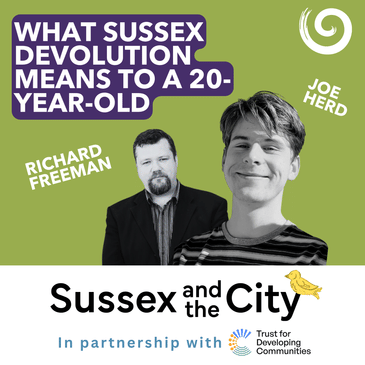
What Sussex devolution means to a 20-year-oldHost: Richard Freeman Guest: Joe Herd
🔍 Episode summaryWhat does Sussex devolution look like through the eyes of someone who will live with its consequences for the next 50 years?
Most Sussex And The City episodes feature politicians, academics, business leaders or public sector decision-makers. This conversation takes a different approach.
Recorded on Worthing seafront, Richard Freeman is joined by 20-year-old Brighton resident Joe Herd for an open discussion about devolution, democracy, trust and political participation.
Joe is not a councillor, civil servant or policy expert. He is simply a young Sussex resident who became curious about devolution and wanted to understand what it could mean for the place where he grew up.
The conversation begins with the question: why does devolution matter?
For Joe, the appeal lies in the possibility of a more collaborative and constructive form of politics than many people associate with Westminster. Together, Richard and Joe explore whether moving power closer to communities could help rebuild trust, improve participation and create a stronger sense of ownership over local decisions.
Along the way they discuss local government reorganisation, the future Sussex mayor, citizens' assemblies, regional identity, public engagement and the challenge of explaining political change in ways that people actually understand.
Despite the scale of the changes underway, relatively few younger people are actively involved in conversations about devolution. If Sussex is entering a new chapter of self-government, how can the next generation become active participants rather than passive observers?
--
This episode is brought to you in partnership with Trust for Developing Communities - a Brighton & Hove charity working alongside communities to tackle inequality and create lasting, community-led change.
TDC delivers community development, youth work, research and training across the city, supporting people and neighbourhoods to build confidence, connection and power. Its youth work helps young people feel safer, more connected, and more able to shape the places they live.
At a time when Sussex is facing major decisions about devolution, democracy and the future of local services, TDC's work is a reminder that change only works when people are genuinely involved, especially those whose voices are too often missing from the room. To find out more, visit trustdevcom.org.uk.
--
🎯 In this episode- Why devolution caught the attention of a 20-year-old Sussex resident
- Whether local politics feels more constructive than national politics
- Trust and confidence in democratic institutions
- The impact of local government reorganisation
- What younger people think about political participation
- The challenge of building a Sussex-wide identity
- Citizens' assemblies and new approaches to democracy
- The future role of a Sussex mayor
- Why communication matters as much as governance structures
- What success could look like for Sussex devolution
For younger people frustrated by national political division, devolution can represent a more practical and collaborative way of approaching local challenges.
Trust cannot be taken for grantedPublic confidence in institutions remains fragile. New structures alone will not rebuild trust without genuine engagement and transparency.
Young people are largely absent from the debateDespite being the generation most affected by long-term decisions, relatively few younger residents are participating in discussions about Sussex's future governance.
Sussex still needs a shared storyThe county contains diverse communities with different identities and priorities. Building a stronger sense of common purpose will be one of devolution's biggest challenges.
Participation mattersPeople are more likely to support political change when they feel involved in shaping it rather than simply being informed after decisions have been made.
Democracy works best when it feels localMany of the issues people care most about (housing, transport, public spaces and opportunity) are experienced locally, making local decision-making particularly important.
💬 What Joe says"I think devolution feels like an alternative to the combative and destructive nature of national politics."
"It's about moving power closer to the population."
"A lot of it comes down to trust."
"People need to feel like they're doing the politics, not that politics is being done to them."
"There is a Sussex identity somewhere, but making people feel connected to it is the challenge."
👤 About Joe Herd
Joe Herd is a Brighton-born student and lifelong Sussex resident.
Having studied history, Spanish and music, he developed a growing interest in politics, governance and democratic participation. His curiosity about devolution led him to contact Sussex and the City to better understand the changes taking place across Sussex and Brighton.
Joe represents a perspective that is often missing from policy discussions: that of younger residents who will inherit the long-term consequences of today's decisions and whose engagement will help shape the future success of devolution.
🎧 Production creditsHost: Richard Freeman Guest: Joe Herd Sound design / editing / original music: Chris Thorpe-Tracey Production management: Letitia McConalogue
📣 Get involved👉 https://sussexandthecity.info — episodes, resources and events
👉 https://sussexintelligence.com — research, insight and analysis on Sussex's future
[00:00:00] This episode is brought to you in partnership with Trust for Developing Communities, a Brighton & Hove charity working alongside communities to tackle inequality and create lasting community-led change. TDC delivers community development, youth work, research and training across the city, supporting people and neighbourhoods to build confidence, connection and power.
[00:00:22] Its youth work is especially relevant to this conversation, helping young people feel safer, more connected and more able to shape the places they live. At a time when Sussex is facing major decisions about devolution, democracy and the future of local services, TDC's work is a reminder that change only works when people are genuinely involved, especially those whose voices are too often missing from the room.
[00:00:51] To find out more, visit trustdevcom.org.uk. That's trustdevcom.org.uk. This podcast is brought to you by Always Possible. Alwayspossible.co.uk You're listening to Sussex And The City with Richard Freeman.
[00:01:22] Hello, it's Richard here. This episode of the Sussex and the City podcast is a little bit different to usual. Most weeks I'm talking to politicians, business leaders, academics, campaigners, public sector figures about the future of Sussex. And generally these are people who spend a lot of time thinking about policy, economics, infrastructure, investment and governance.
[00:01:48] This week I wanted to look at something a little simpler perhaps. A few months ago I received a message via LinkedIn from a 20-year-old Brighton resident called Joe Hurd. Joe wasn't writing on behalf of an organisation. He wasn't lobbying for a cause. He didn't have a particular angle or business interest. He just wanted to understand what devolution actually is.
[00:02:17] He wanted to know why Sussex was getting a mayor and why now. And why so much seems to be changing in local government all at once. And this struck me as both unusual to get somebody so young and I guess not representing anything. Just sort of contact me out the blue. But also brilliant, right? And so after dozens of conversations about devolution, local government reorganisation and the future of Sussex,
[00:02:44] I just, you know, acknowledge very few people under the age of 30, probably under the age of 50, have contacted me to ask me about it. And ultimately the decisions being made about governance, skills, housing, transport, investment will affect younger generations far more than they affect mine.
[00:03:05] So rather than another expert interview, I asked Joe if he'd meet me on Worthing Seafront to record a conversation unlike any others that we've had. So this is less of an interview and more of an exploration. Joe asks me some deceptively simple and useful questions, I think. What is devolution actually for? Why is it happening now? Can it make politics feel less tribal and more collaborative? And why does local government seem so complicated?
[00:03:35] And how do you persuade people to care about something that feels both important yet incredibly abstract at the same time? These were great questions. And along the way we talk about trust in politics, the challenges facing the current government, the cancellation and return of local elections, the future role of a Sussex mayor, and whether devolution could create space for a different kind of political conversation altogether. More than anything though, this episode really is about participation.
[00:04:01] If Sussex is genuinely entering a new chapter, who gets to shape it? How do younger people become involved more? And what would make politics feel less like something done to people and more like something they can help create? So Joe brought curiosity, optimism, some sharp observation and intelligent questions to a conversation that many people twice his age are still finding very confusing. I really enjoyed this one and I enjoyed spending some time with Joe.
[00:04:31] So I hope you enjoy my recording of a conversation with Joe Hurd on Worthing Beach. And some apologies for the seagulls, the wind and the occasional passing aircraft. But, you know, Sussex, right? Hello. I'm on Worthing Beach and it's a bit noisy.
[00:05:00] So I'm introduced to Joe Hurd. Joe, can you tell everybody a little bit about who you are first? I was born in Brighton, have lived there my whole life, only 20, so not that long. Went to school at Fairlight, Varndeen and Basvik. So I've always, always been interested in this stuff. Firstly, because I'm a bit of a nerd about politics and really like it. What did you study?
[00:05:28] College, I did history and Spanish music. So not really, not really political. I think I just became more interested in independently reading about it and kind of, it feels like a kind of alternative and quite a big thing that's coming to Brighton. And to me, it's just, it seems like fresh and new and quite exciting.
[00:05:50] So you're 20 and you contacted me a few weeks ago and said, I want to know a bit more about devolution. It feels like there's something interesting and exciting happening here. But, you know, fully understand that you seem to be the guy to talk to, which was very flattering. I can exclusively reveal you are the only 20-year-old that has imagined to start a conversation like that. In fact, I think you're probably the only person under the age of about 50. Don't know that for sure, though.
[00:06:20] Well, I know how many have contacted me. So I thought it would be a good idea to have a chat with you as somebody who is, you know, clearly, because of your curiosity and your intellect and your enthusiasm, going to go very far. And you're the future of whatever happens next much more than I am. Joe's wincing. So let's have a chat where we'll really unpick, from your perspective, what all this is about.
[00:06:48] Yeah, and I guess what I'm really interested in at first is just why devolution? And for me, I think devolution is almost like an escape or an alternative to what we've got in Westminster, the kind of combative and destructive nature of our politics.
[00:07:07] And I think I was led to be interested in devolution and local government reorganisation because it feels like the avenue to more sort of cooperative and constructive politics, just less horrible. That's the main thing I think is interesting about it. What do you think devolution is? And I want, you know, a pure answer, a gut instinct answer.
[00:07:30] I spend so much time talking about it from a very technical and, you know, talking about statutory instruments and white papers. You know, from a psychological perspective, what do you feel it actually is and could be for Sussex and Brighton? Well, I think it's about moving power downwards towards the population and just decentralisation, I guess, is the key word for it.
[00:07:53] I think also a really important thing about it that I find appealing is that a lot of it is about trust and trusting people to make their own decisions, not leaving it to a centralised authority. For me, devolution is that sort of an alternative way of making decisions at a more local level. So you've used some really interesting words there. You've used that national politics is combative, but this form of local politics could be more collegiate, I guess, a bit more cohesive.
[00:08:23] And you've used the word trust quite a few times. I share the ingredients of your optimism there. I think that's absolutely what devolution should lead to. I'm very worried that that's not quite what we're getting or going to get. Maybe I'll qualify that. I actually think, looking at some of the other parts of the UK, the different political parties and the council leaders in the upper tier authorities,
[00:08:51] so East Sussex, West Sussex, Brighton House, have actually done a pretty good job of overcoming some of their quite profound differences. And there's differences politically, but also in ways of working. And they're all very, very different kind of institutions. To agree that getting a combined strategic authority can unlock a lot of really important things for the region.
[00:09:11] And I think they came together under immense pressure and at great speed to sort of start to imagine what that could look like and figure out how to speak with one voice around that. I don't think they're quite as agreed on local government reorganisation, but we'll maybe come to that later. So I think that's shown Sussex in quite a good light. So that kind of speaks to what you're saying already, is that actually all of the adversarial party politics and all that sort of combative stuff that is often exported from national politics.
[00:09:39] Actually, Sussex has shown that we can sort of overcome that. I think it's the dream, but I do think that the way local governments have been forced to compete with each other, with their neighbours, and the way that they have been scrabbling around for quite scant resources. Frankly, the kind of initial reason to follow the promise of devolution is to get some money, to save some money and to get some more money. Which is definitely fine. And making local government more efficient in saving money, there's nothing wrong with doing that either.
[00:10:09] And it can lead to maybe a different philosophy and governing at the same time. But the issue of trust, though, there's so little trust at the moment, I think, across Sussex, between institutions, between the people, the demos, and their elected politicians. Maybe there's good relationships at hyper-local level, but I don't think there's a shared sense much that this is going to benefit, because I don't think a vision has been put forward.
[00:10:37] But all their feeling is that it's more chaos, potentially more red tape. A lot of people in Sussex didn't know this was coming. They weren't asking for this. Devolution's been a conversation. It was in Scotland, Northern Ireland, Wales. It's been there forever. And then north of England, Midlands, those areas that felt quite far away from London. It's been a conversation in the southwest. It's not something we've been talking about in the southeast.
[00:10:59] And maybe that's a critique for Starmer's government and their slightly unprepared entry to governance. It definitely feels like a lot of the stuff they've brought has been sprung on us a little bit, which is probably, I mean, it's probably a shame, because maybe it will negatively impact some of the goodwill that people have for devolution. I would also say, though, that I agree that there's probably not a huge amount of trust in local politics.
[00:11:28] But compared to national politics, it's probably pretty good. I don't know, but I'd assume people are much more inclined to trust local councillors than they are to trust MPs and ministers. Do you think so? I think there's definitely people that will have good relationships with their local councillors. You know, and let's bear in mind, local councillors are nearly always also local residents
[00:11:51] and will have chosen to go into public office because of often, you know, a particular issue around where they live, which can be quite different to national politics or MPs that can get sort of parachuted in because it's a ticket to parliament and lawmaking, whereas local councillors, they don't get paid other than some expenses for what they do. And often they decide to run for local council because they care about the local park or... So there is a connection there.
[00:12:19] Which must help, I think, as a foundation for devolution. Just if the convincingness for having devolved government must be so strong in that because you have, like, an inherent, just more obvious motive for this government. I think the problem is that the perception at the moment is that it's that hyper-local representation that's going to be disappearing. Yeah.
[00:12:44] So because of the local government reorganisation and the planned abolition of the district of borough councils, that I think the narratives in communities at the moment is that they're losing representation, is that it's all moving upwards. It's not necessarily been sold what the benefits are to come down from Whitehall. Yeah. Because that's quite strategic. It's quite bigger picture stuff. You know, this is stuff I'm talking about all the time, you know, is actually we've got opportunities around inward investment, about transport infrastructure,
[00:13:12] about joined-up conversations on adult skills and so on. There's work to do, from my perspective, about building the trust in the narrative. And now we've got a little bit longer before a mayor is elected. There's a real opportunity to do that, but that's going to be potentially overshadowed by chaos, bureaucracy. And if central government keeps going on one direction and then changing its mind, I think Sussex has done quite well to have a coalition of these top-tier council leaders.
[00:13:41] Those leaders, in theory, could be ousted. And you could have brand new ones with a very, very different sense of what all of this should be and maybe a sense that none of this should happen at all. So what does that do for this sense of trust and stability? In that, then, do you think that the Labour government, and there were Conservative plans for this as well before,
[00:14:06] but the Labour government, their first mistake was that they really didn't try to justify this that much. And they just sprang it on the country before explaining why. I'm still not sure that they've even explained by now, to be honest. It's a good question. Again, I don't think I want to make a hearty political point here because broad conversations about devolution in the UK and in England have been going on for a long time.
[00:14:36] They put it in their manifesto. There was a clear signal and signpost to it, and they won an election with a large majority. So they have a mandate to do it. So I definitely think that's legitimate and fair. Perhaps, though, yeah, there's something in what you say about the communications, and I would probably add that to every big policy this government has tried to put through. Something's gone wrong in the way that the vision and the rationale
[00:15:05] that may have come from a place of genuine modernisation, something's fallen short. And maybe that's because they're not very good at it, or maybe the public are just not ready for long-term vision. I think that's a big challenge that they've got, and I don't think perhaps they've done a lot to mitigate that in the way that this has gone about. And I think behind the scenes, probably there's a bit of panic that the timetable is too fast and too much can go wrong.
[00:15:32] And all the public see is none of the rationale behind that, none of the decisions being made. What they see is a big, loud, splash decision undone by the same people. I recently read Anushka Asana's book about Labour's campaign. I mean, that sadly made me think that maybe the public is right to think that they did just make a last-second decision here and there, and that they have fallen into that kind of trap where they,
[00:15:59] a few months ago, I would have been kind of wanting to give the benefit of the doubt and say that it's all in good faith. But I think that book really is quite damning, and it talks about, well, McSweeney's gone now, but he seemed to have a singular focus on winning and then doing stuff. And I can see that maybe that kind of thinking affected all of this, all of this stuff. I haven't read the book, but I'm familiar with those arguments. Do you think that maybe they are to blame in some ways?
[00:16:29] It's probably also fair to say that the public and the media are pretty impatient and have some pretty unrealistic expectations about what a government can do. And in like three days, it seems like some people think they should be able to change the world. So yeah, do you think that maybe Labour have made some mistakes? Well, clearly they have. But the general public and the media have also not helped. Not helped at all. Of course, we don't know what we want, do we?
[00:16:58] Other than not the thing that's in charge. Seemingly around the world at the moment, there are very few incumbents that are winning elections. There's very little, you know, satisfaction with the people that are currently in charge. And democracy is being pushed and tested to its absolute very limits at the moment. And different people are interpreting, you know, who are in power quite what to do with that. To give maybe the government a bit of benefit of the doubt on this particular issue, they saw this, you know, rather than maybe special educational needs,
[00:17:25] or welfare reform, or, you know, university loans, all these, you know, or social care, massive, thorny, really complex issues that cost huge amounts of money and take a lot of time. They thought, well, maybe reorganising local councils is something that we can do. It's something that we can show rather than tell. It's something that we can, you know, people can visibly see within a couple of years, much more streamlined.
[00:17:53] We can talk about the money that it's going to save. And we can map that change to these directly elected mayors who are there to bat for residents of a region and are there to go and, you know, do what Andy Burnham's managed to do in Greater Manchester or so on. And Tracy Braben's done in West Yorkshire. Because that's visible. So I can understand why the government thought, well, we've maybe got a bit more control over that.
[00:18:19] However, it appears that they've, as with everything else, slightly miscalculated, A, the appetite, B, how complex it's going to be. In the public's eye and the media's eye, I think it just adds one more thing to a hot cauldron of chaos. Yeah. You've probably got a strategy, a vision, a roadmap, maybe even a post-it note empire on your office wall.
[00:18:48] But has anyone asked the really awkward questions yet? Like, is it actually working? At Always Possible, we help senior leaders challenge the obvious, rethink the possible, and deliver the extraordinary without losing their sanity or their sense of humour. Enabling private and public sector innovators to navigate a changing economy.
[00:19:13] We help complex organisations to humanise data and to translate the big picture into hyper-local engagement, trust and sustainable growth. If you're ready to bring people with you because your leadership truly inspires, visit alwayspossible.co.uk. That's alwayspossible.co.uk. Always Possible.
[00:19:41] We make bold business brilliant. So we live in a very different age in terms of how information is shared. I mean, I wouldn't want to be a politician now because there's almost nothing you can do that isn't going to whip up something and that something can spread very, very quickly. So I think it's a really difficult job and I think it's a big task. Saying that though, scrutiny's good. Scrutiny's good, accountability's good.
[00:20:10] I think the fact that more people are interested in politics. I think, you know, you look at news headlines, there are stories. You wouldn't have policy conversations in the news headlines at all when I was your age. You know, politics has not caught up with that at all. It has no idea how to engage with that level of intensity of need, you know, in terms of being able to have something that transcends all of that granularity. All of that minutiae of, did they say this? Did they do that? What's the scandal here?
[00:20:39] I bet they're lying. I bet what's this? Who's said this? What we're missing is the thing that sits above that and says, okay, okay, okay. You've got all that noise, but here's the direction to travel. Yeah. This is why we're doing all of this. It's because we're heading over here. That's what I felt we used to have. In the recent prime ministers, I wouldn't say that any of them have that or had that similar sort of ideology or leading ideology.
[00:21:03] And I think that's also why, to me, devolution seems just like an interesting concept. Do you think that devolution can get away from being escaped to that immediacy of national bulletins? And can it kind of provide a space for more level-headed discussion? Wouldn't it be great? I mean, that's why I'm doing this. That's why I'm interested in this, because I can't care less genuinely about the who's in, who's out, who's up, who's down, who's...
[00:21:33] The ideology, the gossip, I have no interest in it. But I'm also frustrated that politics isn't working, as it should do, and that places like Sussex and Brighton, where I live, where my children were born, where my business has started, where most of my family lives, is sort of overlooked and written off as a place that's fine, it's muddling, it's got lovely bits, it's got bits we don't really know. You know, the rest of the country doesn't really get Sussex.
[00:22:04] Yet, the Sussex I know is one that's struggling, it's hurting a bit, it's deeply fractured. I think there are communities that don't get anything like what they should, living in a place like this. And because of that, I think Sussex has lost its identity, in a confident way. We have, you know, that's not... Of course, Sussex has identity, and the communities within Sussex, the places, the towns, the tribes, have very strong identities, and fiercely defend them, and they're brilliant.
[00:22:32] But now that we've got this spotlight, and we've got this opportunity to rethink how we do, not politics, but policy, that's what I'm interested in. It's the policy. How can we unlock, and how can we join up the pathways to everybody in this county feeling like they're part of something bigger, feeling like that it's working for them, and that they don't need to run away.
[00:22:59] People like you are leaving, and they're leaving fast, and they're not looking back. And that is a crime. Yeah. There's something about the evolution that I find promising or exciting, is the idea that clearly a lot of these really difficult problems require really difficult solutions and decisions to be made. In our national politics, people are quite almost apathetic and helpless, and aren't... I don't think people feel empowered to be involved in politics.
[00:23:29] And I think that has the effect that it's harder for people to be convinced to make or accept difficult decisions, because it's just some other guy who's come in for five years and there will be someone else. And then therefore, to me, the evolution, or at least potentially, or in some kind of dream,
[00:23:56] maybe it could bring this different sort of politics where people really have skin in the game. The idea of that would allow people to accept and want to make more difficult decisions, which is what we need to do to make a better country for ourselves. You're a wise soul, for one so young. It needs people your age to get excited about this.
[00:24:24] Real power in Sussex, real decision-making in Sussex is in the hands of a very small number of quite old people. It's a lot of the same people making those decisions and coming up with plans now, as there were when I was your age. And that's a real failure of Sussex to enable new blood, new interrogation, new curiosity.
[00:24:50] There's a lot of people in positions of power and leadership that have been there for a very, very long time. You know, can you see a way that this could get people thinking about what Sussex is differently, the psychology of it, the opportunity of it? Well, I guess it sounds like it's all about accessibility, doesn't it? Everything we're talking about is quite critic and hidden and just not obviously important. A lot of it, you could skim it and it doesn't seem like any of it really matters.
[00:25:20] But yeah, I guess maybe it's all about making all these things more accessible and dispersing them all right. But yeah, I mean, I don't know how do you make this more effective. You have like jury services, jury duty for people being involved. I'm not really sure. Deliberative democracy, they call it really. You know, so things like citizens' assemblies. I've convened a kind of group of people really interested in this that we've called the Sussex Futures Network.
[00:25:49] You know, immediately just me saying that makes that sound cryptic and obscure and over there. And I get it, I get it, I get it. But there's some real expertise around participation here, about participatory working, about how to convene and energise. But it happens in a very small way. You know, and that's why Sussex, I think, as I said, you know, is a patchwork of brilliant creative communities. And those communities have some real energy that looks at hyperlocal issues and gets excited and campaigns for and comes up with quite extraordinary things.
[00:26:18] You don't need to go very far. I mean, where we're sitting right now, we're sitting on Worthing's East Beach. This was absolutely a no-go area about 15 years ago. But since I've lived in Worthing for the last 11 years, we've had these pop-up art galleries. Coast, which is this beach bar and cafe. That's what's led to the regeneration of the leisure centre. So that's now quite an interesting sculpture. You know, it's a sort of strange, sort of rusty sculpture. But it's this amazing leisure pool.
[00:26:46] It's got the Bayside development now, which has brought in some investment, which has, in turn, sort of cleaned up the beach a little bit. Now, if you come here on a summer evening to this bit of Worthing, it is a live. Or fireworks night in November. This is where people gather and you have live music. And it's really buzzy. Because of individuals that have lived here that have done one thing that's then become a catalyst for something else, that's then become a catalyst for something else. And other people have gone, OK, I'll join you.
[00:27:13] We need a version of that that is also able to think Sussex-wide. And so to join up all of those different communities, to feel like they're part of... I keep using the hammy, cliched phrase, feel part of something bigger. Well, it is also, I guess, that is quite a big challenge for Sussex, because Sussex has some pretty disparate ideologies and groups of people. So I guess, but I do believe that there is a Sussex identity somewhere.
[00:27:43] But I think also, probably quite challenging to make people believe it. What do you want to see happen? What would make your interest become more than an intellectual kind of pursuit, but actually feeling like you had a bit of agency over something? What would you want from new politicians like the mayor? For young people, I love the idea of a young person's manifesto or something like that. Just some sort of document that talks about what young people in Sussex want to see.
[00:28:13] from the mayor. I guess what just really needs to happen is lots of outreach, which again is really hard because then you need lots of people, lots of volunteers and stuff. I think it would be amazing to do it in schools more. I don't think politics has talked about much in schools. I guess what's tricky is when you talk about outreach, you can easily imagine that it's just someone comes into a school and there's a slideshow for 20 minutes and then leaves. And it seems like quite a big thing to imagine
[00:28:43] where you have children and young people who are really genuinely involved. I can't imagine it not happening without a massive amount of investment in democratic infrastructure. And yeah, like you have a big citizen descendant anywhere, but then you have thousands of people involved and it takes up days and we serve people's lives. That way you have people who can feel like they're doing the politics,
[00:29:10] not that it's a force that's won them. I mean, amen to all of that. I should have the answers to this. This is my job. This is what I've been, you know, I've spent 25 years working in a mix of local government. I've done a lot of enterprise work and innovation around place. I've done lots and lots of work with young people and skills and training and social mobility. Yet what you said is, of course, what we should be doing,
[00:29:38] but I find it really, really hard to A, mobilise people, to find the money to do it. I can't do it on fumes. And there's a thousand really, really great organisations that could absolutely pick this up and run with it. They're running on fumes. I've had conversations with principals of colleges, left, right and centre. I've had conversations with all three of the universities in Sussex. There's no shortage of people diagnosing and prognosing in the same way you have, saying this is kind of what leads to happen.
[00:30:06] But then you drill down and go, right, will you do it? Can you do it? And they're like, oh, well, it would have to be on a Tuesday between 3 and 3.30 on a week in May because we've got exams, because we've got this, because we've got this. And immediately what us professionals and quote-to-comers do is put a load of barriers. Unless there's a chunk of money on the table, it needs a load of young people to go, we need this to happen. Yeah.
[00:30:36] Well, I guess it's the kind of shift in thinking in government that happens like a tectonic fate over hundreds of years, quite slowly. And maybe we're at the point where all we're doing is making the argument through it and growing it as a seed in people's minds. And I agree. It's the sort of change where you need hundreds of thousands of people
[00:31:06] to be sold on it and really fight for it before you actually start to do it. So maybe it's just that we're in a place where that's what we need to be doing. So I've been rereading a book called The Tipping Point by Malcolm Gladwell, which I always often refer to when I do workshops and things. And then I've read his newest one called The Revenge of the Tipping Point. And it's all about what he calls social contagion.
[00:31:35] So it's exactly what you're describing there. What's the level of sort of common visibility or enthusiasm that turns it from being a kind of niche issue that a few people are interested in to becoming something that is unstoppably infectious, you know, good or bad. And he talks about if it's in a contained place, you sort of need 25% of the people that this might affect to be talking about it. And he's done the maths on it and he's like lots of examples.
[00:32:03] So if you could get a quarter of schools or a quarter of young people or a quarter of a particular demographic outwardly saying this is something that we're interested in, the rest will follow very, very fast. This is not at all self-aggrandising, but the only thing I can do at the moment, I think, is to get people talking about it, is to try and introduce people to voices they might not have heard, to try and create spaces where people who know a little bit about this but I don't really know what's going on,
[00:32:32] can get a little bit more informed and be connected to other people. You talking to me now on this and us publishing this and sharing it is a tiny step, but it's a part of that tipping point that we need to create in Sussex. It's not going to be anywhere near enough, but maybe it's a start. Yeah, I definitely agree with that. I've really enjoyed talking to you. We've had a couple of chats about this, but it was good to record one of them. I'm really glad that you reached out.
[00:33:02] What's one thing that this project can do that we're not doing already, do you think? Any suggestions? Well, maybe even just that we need to explain what's happening. It's really, really basic. It's a basic level. Who must? Early pick. That in 2028 there will be a mayor. A mayor or a lecture. And the mayor will plan new things and have some powers over housing and the skills.
[00:33:31] I think that probably could have quite a big impact. Because it is, don't you think that it's almost like you just need like a barrage of information going out to eventually influence enough people? And I think that when you try and read about it, it's quite difficult to find that really basic stuff. Also, probably could be put in some of the local newspapers because they don't talk about it so much. Yeah, you're spot on. Let's keep trying harder.
[00:34:01] Joe Hurd, thank you so much for being, well, I was going to say being my guest, but just pushing me to do a slightly different format today. I wouldn't normally talk this much, but it's been fun. Thank you so much for being on the Sussex and the City podcast. Thank you. Thank you very much to this episode's guest and to you for tuning in.
[00:34:32] Sussex and the City is an independent and non-political project about devolution as it happens, explained in human. It is led by Always Possible. You can find other episodes, resources, events and blogs about change in Sussex and Brighton by visiting sussexandthecity.info. That's sussexandthecity.info. This episode was written and presented
[00:35:00] by Richard Freeman for Always Possible. The editor was me, Chris Thorpe-Tracy, for Lo-Fi Arts. I did the music too. Production management was by Letitia McConnellogue for Always Possible. Talk to you next time.