
– Episode #50
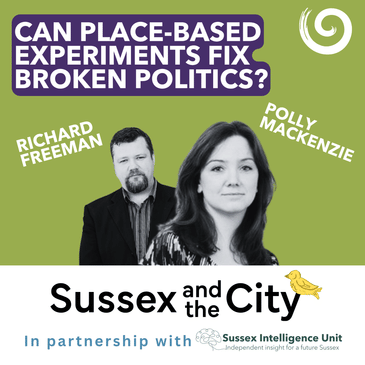
Can Place-Based Experiments Fix Broken Politics?Host: Richard Freeman Guest: Polly Mackenzie – public policy thinker, former senior government adviser
🔍 Episode summaryCan devolution do more than simply move power around? Could it fundamentally change how Britain solves problems?
In this episode, Richard Freeman speaks with one of Britain's leading public policy thinkers, Polly Mackenzie, about why many of today's biggest challenges cannot be solved by traditional government structures alone.
Drawing on experience inside Whitehall, think tanks, universities and social innovation, Polly argues that Britain's institutions have become too slow, too fragmented and too risk-averse to deal with modern challenges. Instead, she makes the case for a new culture of place-based experimentation, where local leaders are trusted to test ideas, learn quickly and build stronger collaboration across public services.
Against the backdrop of Sussex's emerging devolution settlement, the conversation explores whether a future mayoral authority could become a laboratory for more agile government, bringing together health, housing, education, policing and economic development around shared local outcomes rather than departmental silos.
Along the way they discuss democratic frustration, state capacity, local leadership, innovation, public sector culture and why solving complex problems often depends less on finding new ideas than creating better conditions for people to work together.
---
This episode is brought to you in partnership with the Sussex Intelligence Unit, a new independent research platform from the team behind Sussex And The City.
Sussex is changing.
Devolution is reshaping how major decisions and major investment get made, but without the right evidence, how can it deliver what our communities need? The Sussex Intelligence Unit answers that challenge.
It's the first independent cross-sector platform to look at growth, infrastructure, governance, and belonging across East Sussex, West Sussex, Brighton & Hove.
New data, fresh analysis, evidence-led insight designed to put businesses, voluntary sector organisations, and policy makers ahead of what's next, because the decisions made today will shape Sussex for a generation.
For the intelligence you need, visit www.sussexintelligence.com
---
🎯 In this episode- Why frustration has become Britain's defining political emotion
- What Polly means by being a 'policy entrepreneur'
- Why many public problems cut across government departments
- How devolution could strengthen state capacity
- The leadership skills modern public services increasingly need
- Why collaboration matters more than organisational structures
- Fiscal devolution and the future of English mayors
- Why experimentation should become part of public service culture
- The role of 'Test, Learn and Grow' in government reform
- Whether Sussex could become a national model for place-based innovation
Challenges including housing, chronic health conditions, youth unemployment and public safety span multiple organisations, making traditional departmental structures increasingly ineffective.
Devolution is about more than governanceDone well, devolution creates opportunities for places to coordinate services, build stronger partnerships and make decisions closer to the communities they affect.
Leadership is becoming more relationalFuture public leaders will need to convene organisations, build trust and create space for collaboration, rather than simply manage hierarchical systems.
Innovation depends on experimentationPublic institutions often reward certainty over curiosity. Polly argues that genuine improvement requires permission to test ideas, learn from failure and continuously adapt.
Place creates better policyLocal government can become a platform for solving complex problems because people, services and institutions are physically closer together and better able to collaborate.
Sussex has an unusual opportunityWith a new strategic authority being created alongside local government reorganisation, Sussex has a chance not simply to redesign governance, but to rethink how public services innovate and work together.
💬 What Polly says"The dominant emotion of our time is frustration."
"There are very rarely new ideas. It's the patient, diligent work of getting things done that matters."
"Freedom to succeed is the same as freedom to fail."
"If everybody is constantly trying to make things five per cent better, that's transformative."
"Entrepreneurial tinkering never gets too tidy."
🧠 Why this matters for SussexAs Sussex prepares for an elected mayor and a new Strategic Authority, there is an opportunity to think differently about how public services are designed.
Rather than simply creating another layer of governance, Polly argues that devolution should enable places to become more experimental, bringing together organisations around shared local challenges, giving leaders permission to innovate and creating cultures where learning is valued as highly as certainty.
For Sussex, success may depend less on constitutional reform than on whether local institutions are prepared to collaborate, experiment and embrace a more entrepreneurial approach to public leadership.
👤 About Polly MackenziePolly Mackenzie is one of Britain's best-known public policy thinkers.
She served as Director of Policy to Deputy Prime Minister Nick Clegg during the 2010-2015 UK Coalition Government, playing a significant role during the first wave of English devolution. She later became Chief Executive of the think tank Demos, co-founded the Women's Equality Party, helped establish Martin Lewis's Money and Mental Health Policy Institute, and served as Chief Social Purpose Officer at the University of the Arts London.
Today she writes the influential How To Run A Country blog and is a regular commentator on British politics, democracy, public sector reform and institutional change.
🎧 Production creditsHost: Richard Freeman Guest: Polly Mackenzie Sound design / editing / original music: Chris Thorpe-Tracey Production management: Letitia McConalogue
📣 Get involved👉 https://sussexandthecity.info — episodes, resources and events
👉 https://sussexintelligence.com — research, insight and analysis on Sussex's future
[00:00:00] This episode is brought to you in partnership with the Sussex Intelligence Unit, a new independent research platform from the team behind Sussex and The City. Sussex is changing. Devolution is reshaping how major decisions and major investment gets made. But without the right evidence, how can it deliver what our communities need? The Sussex Intelligence Unit answers that challenge. It's the first independent cross-sector platform to look at growth, infrastructure,
[00:00:25] governance and belonging across East Sussex, West Sussex, Brighton and Hove. New data, fresh analysis, evidence-led insight designed to put businesses, voluntary sector organisations and policy makers ahead of what's next. Because the decisions made today will shape Sussex for a generation. For the intelligence you need, visit Sussex Intelligence. One quick thing before this episode of Sussex and The City. I'm Chris Thorpe-Tracey. You
[00:00:54] can do this as well as a podcast series. I'd produce and edit this podcast. And I want to quickly plug me. If you or your organisation has a project where a podcast series might be useful or fun, I can help. I can do as much or as little as you need, take on all the heavy lifting or simply tidy up your creative work, bit of editing and sound design to deliver smooth and professional, listenable shows that you're proud of. Or I can teach you and your team to
[00:01:20] do it all yourself. Just in the past two years, technology has made it ten times easier and cheaper to make excellent broadcast quality audio. You don't need to pay through the nose for a big production company or a recording studio. Those days are gone. So if you're interested and fancy chatting about your ideas, please email me. Chris at ChrisTT.com. No punctuation. So that's Chris at ChrisTT.com. Thanks for listening. Right, let's roll the show.
[00:01:50] This podcast is brought to you by Always Possible. AlwaysPossible.co.uk. You're listening to Sussex And The City with Richard Freeman. Hello. Good. You're here. You're in the right place. This is the Sussex and The City podcast. Right, I'm going to jump to it. No fluffy preamble. We need to talk about this episode's guest
[00:02:17] because it's an exciting one and somebody that I've wanted to engage in this conversation about devolution for some time. And it's part of a few episodes that I'm going to be talking to national voices, people who are working on a kind of UK or England wide set of thinking, policymaking, curiosity about the future of politics and democracy. And to kind of ask them where they think
[00:02:43] Sussex might fit into that and this sort of experiment that's happening down in our patch off the south coast. So my guest in this episode is Polly McKenzie. Polly is one of the most influential public policy thinkers in Britain and someone who's spent the last two decades working at the heart of politics, government, civic society and social change. She began her career as a business journalist
[00:03:08] before moving into politics, first as a policy advisor to Ed Davey and then Nick Clegg, who was then leader of the Liberal Democrats. And her influence was particularly acute during the coalition government where she served as director of policy to the then deputy prime minister, working on, you know, this strange collaboration at the heart of Whitehall during one of the most significant periods
[00:03:31] of constitutional reform and English devolution really as well in recent history. Since leaving government, she helped found the Women's Equality Party, established the Money and Mental Health Policy Institute with Martin Lewis, led the influential think tank Demos as chief executive and then served as chief social purpose officer at the University of Arts in London, becoming a really interesting figure
[00:03:56] looking at the role of universities and education on civic and social reform, to then going on to become one of the country's most respected sort of independent commentators on politics, democracy and institutional change. Many people will know her from the Times podcast How to Win an Election, or if you haven't been reading her new substat which is called How to Run a Country, but I really, really recommend it.
[00:04:20] Absolutely sparkling writing about everything to do with politics, democracy and social reform that we are currently grappling with. This is exactly why I wanted to talk to Polly. She's a great communicator, but I wanted to have a chat that isn't just about party politics, it's about something much bigger. It's about why people feel frustrated with politics full stop, why people are frustrated with public
[00:04:46] services and institutions. And whether she thinks devolution and this new phase of devolution and the new communities and devolution bill that's just passed through parliament maybe offers a genuine opportunity to do things differently, even to how devolution has been done in the past. And so as Sussex gets itself ready for the biggest governance changes in modern history, certainly in its modern history, with a directly elected mayor and new strategic authority,
[00:05:13] Polly brings a combination of both experience from inside government and outside it. She understands how Whitehall thinks. She also spends a lot of her time exploring how communities, organizations and places can solve problems themselves. Talk about why public services often struggle to tackle complex change and how siloed institutions actually end up creating unintended barriers, even when they are trying to do good things. But we also talk about why so many of the issues that people care most about
[00:05:41] from housing and health to unemployment and migration don't fit neatly into a single department or a single budget line. So we look at whether devolution can help overcome some of these problems, what good place-based leadership actually looks like and why the future might depend less on grand national solutions from the centre and more on giving places permission to experiment, collaborate and learn in a
[00:06:06] decentralised manner. So I think this is a fascinating chat about state capacity, political frustration, local government, the future of English devolution and what it might mean if one of devolution's biggest champions, Andy Burnham, eventually finds himself in number 10. It's thoughtful, challenging, optimistic. Here's my conversation with the great Polly McKenzie.
[00:06:44] I'm not going to do a waffly second intro here, I'm going to dive straight in because I've got the privilege of chatting to Polly McKenzie and there is no better voice I think in public discourse right now about politics, place, the changing landscape about democracy, who we are, what we need to do, lots and lots of varied experience that we'll tap into. But before all that, before we get in the weeds of what the hell's going on, Polly, how the devil are you? Polly McKenzie I'm really well. I'm currently
[00:07:13] trying to craft a life for myself as I'm calling it a policy entrepreneur. Interesting. Polly McKenzie I've got several jobs, all of which I'm excited about. But it seems to me that there are so many problems in the world and it is so easy to feel paralysed and overwhelmed by them. And loads of people I encounter are like 60, 40 against really doing anything because they're knackered or they're scared or there's just like their boss will be
[00:07:41] mean or whatever. And actually by pushing people to collaborate, getting them to kind of 60, 40 in favour of doing things is a really exciting place to be because it's actually not that much work, but it means that you can be transformative and getting good things to happen. So that's what I'm, that's where I'm working. I think that's brilliant. And I think just saying that and how you've articulated that will resonate with a huge number of people that listen to this and get in touch with me.
[00:08:08] Kind of wanting a bit of that more in their lives as well, feeling there are things around them sort of making it too hard, but actually themselves have a real energy or a kind of sense of how do we lean into this change? You know, there's time to do something. I've got some knowledge, but maybe not all of it. How do I collaborate with people and stuff, but just feeling a little bit unanchored around how to do that. So I think the way that you talk about that, and certainly if people reach your
[00:08:34] substrate and everybody should, you know, I think articulate actually what that doing could look like with some ideas, I think is really important. Let's start big picture, perhaps. It's a stupidly big question. How we understand the state of politics at the moment, the narratives feel so, you know, unfathomably defeatist and fatalist. Just the sense that everyone's given up on the idea of politics,
[00:09:01] of democracy, of institutions being anything like a possibility of transformational change. Whatever anyone tries in good faith is doomed to fail immediately. No one wants it. No one cares. Why don't we all give up? And that's become the norm. Tell me I'm wrong. So I guess I would characterize the sort of dominant emotion of our time as being one of frustration. That can translate into, I guess, two modes of behavior. One of which is that
[00:09:30] helplessness and apathy and despair that you're describing. And the other is outrage and a desire to actually just sort of smash things up. At the core, we're really struggling with this sense of how how democracy and how state capacity can be more effective and responsive to what it is that people really want. You know, we have gone through economically an unbelievably difficult time in terms
[00:09:59] of stagnant wages and rising living costs on so many of the things that just fundamental to a decent life like housing and food. I think you'd have to be a millionaire to not wince at the checkout these days. There's something about feeling overwhelmed that you either hunker down or you lash out. And the problem is that neither of those things actually fix things. But we've got these kind
[00:10:25] of creaking institutions and bureaucracies that are just not adapted for, not adapted for two things. One, they're not adapted for the pace of change. In my main job, kind of innovation consultancy, we need to hire someone new. We're recording on a Friday. We'll get the job out on Monday. Done. And then we're going to have to be a little bit of a job out on. When I was working in a university, it would have taken me eight weeks from the decision through the bureaucracy to be able to even put out a job ad from thinking of an idea to having somebody in post could easily take you six
[00:10:54] months. Actually, our civil service, local government for kind of sensible reasons around financial control are often that slow. And then you get something like AI that comes along and how can we possibly respond? Or, you know, somebody invades another country and the oil price changes. We we can't restructure teams. We can't reorganize contracts quickly. Everything is slow. So no wonder
[00:11:19] the politicians get get frustrated. But the other way, so it's not just pace though, it's also coordination or a horizontality is that so many of the problems that people deeply care about and that need to be fixed sit across boundaries and silos are structures of departmental organizing
[00:11:45] around accounting budgets and reporting lines just can't really respond to that. So let me give you the example of pain, which is something I'm working on and working to establish a national pain institute to kind of accelerate change, improve outcomes for people experiencing chronic pain. Pain is a health problem, but it's also a labor market problem. It's about social care as well as
[00:12:11] health. And nobody holds the budget for pain or for the economic consequences of pain. And as a result, it's really hard to organize and mobilize. And you could just carry on. So heat, we've been living through a heat wave. Who's responsible for the health costs of poor housing? And who's responsible for fixing the housing to reduce the health costs that people
[00:12:33] just stand on silos? And that's where devolution and place become really exciting if we're going to actually crack through this frustration with something other than anger or helplessness. It's because actually in a place, it's so much easier to have the police who talk to the health team, who talk to the housing team, who talk to the people reorganizing the roads and the cycle routes.
[00:13:00] Right? Like you just, when you think about problems in a place, you end up dealing with those silos in radically different ways. And I think it's the way we rebuild state capacity. That's really interesting. And I think people are cottoning onto that, that that sense of a holistic view of systems, you know, just this week talking a lot around the youth unemployment crisis with Alan Milburn's report coming out, et cetera, et cetera, and how that's largely been seen up to now as a
[00:13:28] purely kind of economic or sort of labor market challenge. But actually, just as you described there, there is so many other implications that, you know, people I know who run the community safety teams are saying actually having lots and lots of unemployed young adults and teenagers with no support and no provision. It's a safety issue. It is a health issue. It is a productivity issue. It is an issue for families, you know, all sorts of things like that, which DWP can't sort out.
[00:13:56] And so that sense of being able to channel it in a more manageable space and look at it holistically is exactly what I'm excited about in terms of possibility of devolution. What we've got at the moment is lots and lots of small place-based authorities. You know, it's a hundred miles long, but it has 15 local authorities, some of them geographically very small, some of them really big. You know, they would argue, well, they've been looking at deep place-based
[00:14:23] kind of design and services for a long time. The problem is they don't talk to the neighbors very well. It is quite fragmented and they haven't really been able to do anything at scale. I don't think the imagination's there. All they see is, well, we've just had silos not talking to each other, authorities not talking to each other, services not talking to each other for so long. I don't know what good looks like. I think that's really fair. There are always good reasons, right? And they often come down to
[00:14:53] budget. Sometimes it's about ego or career protection, but more often I think really it just comes down to budget. A massive thing will be to do with housing, right? Every place in the country needs more supported housing for young people, more supported housing for elderly and disabled people. It probably also needs more kind of stopping points for the gypsy and Roma people,
[00:15:18] kind of smaller provision, but actually really important. Everybody wants it to be somebody else who does that because if you have high needs young people or high needs elderly people moving in, and actually there's plenty of places, particularly on the Sussex coast, right, that do have that kind of demographic squeeze already. Every 100 people of over 80 who move into your area are a problem
[00:15:43] financially. So of course you're going to have a little standoff between this town and that town or that place and the other. And politics then comes into it as well. You see certain parts of the country, particularly where you've got a sort of town council or a city council that's surrounded by countryside is the town or city wants to grow, but the countryside authorities really don't think you want any houses and they don't want any urban sprawl. So you get these standoffs.
[00:16:11] And that mirrors what happens between services. You know, the police recently made a big stand about not wanting to be the last resort call for mental health provision. And the police have a role to play, but the police shouldn't be a core part of mental health provision. But if mental health provision gets cut, so there's no one else to call if you are in crisis, if you are experiencing hallucinations, if you're suicidal, then people or their loved ones will call the police. It's a
[00:16:38] logical standoff. The police can't do mental health services jobs for them, but they end up having to. And then schools who end up having to like wash kids clothes because the kids are in temporary accommodation. That shouldn't be their responsibility, but it ends up falling to them. I think what this requires is a really different approach to budgeting. So the government is pushing forward with this program called Total Place that tries to bring budgets together in places. But what you get to,
[00:17:05] Richard, which I think is really important is the different kind of leadership skills that we require of our senior teams. There's a great report that was put out by the Blavatnik School of Government and the White Haaland Industry Group a few years ago called the Collaboration Playbook, which talks about this really and looks at areas where against the odds places had come together and done stuff where they got the
[00:17:33] police and the schools and the charities to work together. And it's such human skills. It almost always happens because there is one leader with all of the EQ and the humility to make space, to give time, to build relationships, and then to hold people and keep drawing people back in. And I think that so much of how
[00:17:58] hierarchies and promotions work, particularly in the public sector, are focused around rigid accountability and performance matters. So the kind of people who rise to the top are the people who will be an absolutely great accounting officer for something, rather than necessarily the people who can hold a room. You've probably got a strategy, a vision, a roadmap, maybe even a post-it note empire on your office wall.
[00:18:26] But has anyone asked the really awkward questions yet? Like, is it actually working? At Always Possible, we help senior leaders challenge the obvious, rethink the possible and deliver the extraordinary, without losing their sanity or their sense of humour. Enabling private and public sector innovators to
[00:18:49] navigate a changing economy. We help complex organisations to humanise data and to translate the big picture into hyper-local engagement, trust and sustainable growth. If you're ready to bring people with you, because your leadership truly inspires, visit alwayspossible.co.uk. That's alwayspossible.co.uk.
[00:19:17] Always possible. We make bold business brilliant. Again, coming back to my sort of the culture in this bit of the country, again, not through anyone's fault, but I think because it's been a lot of people, you know, leaders have had to defend or advocate for a fairly small patch and really go out to bat for that bit. And that has often been, in a sense,
[00:19:43] fighting their neighbours, you know, it's like, well, we've got a higher index of multiple deprivation here. You've got the affluent bit. This is where we need this. So, so we have quite a combative local politics and coalition and collaboration has not been that successful. Lots of minority councils where the opposition's just sought to block and block and block and block, rather than necessarily work together. That's been the sort of history. I think there's some work to try and change that. But now following the local election, we've got pluralism. You know, we've got long held county
[00:20:13] councils that were dominated by one party for decades and decades have now fallen into no overall control. You've got rainbow coalitions. You've got parties like Reform sweeping in really inexperienced councillors, you know, not making a point on that necessarily, but are now suddenly going to need to work with other parties in completely different ways. We don't have a mayor yet, maybe that's interesting. Maybe that's going to lead to a very different way of working to what we've had. And maybe then when the mayor comes in in 2028,
[00:20:43] God help us, they will possess some of those skills you've talked about to be able to kind of cut above and through that and do that convening, do that holding, do that sort of have that EQ. I don't know. I hope so.
[00:20:56] I hope so.
[00:21:24] I hope so. I hope so. I hope so.
[00:22:09] It is a political choice. I think the only way that you can possibly shift it is through media. We don't have enough local and regional media. I hope so. And through diligent, confident assertion by central government that that's not my problem. Speak to the mayor. But our politicians don't like to sound helpless in that way. Hmm. I think it's a terrible shame. The other comes down to a fiscal risk.
[00:22:37] The UK has a particularly centralized tax system. You know, most other jurisdictions allow their large regions, their big cities to raise municipal bonds, to levy a range of different taxes. The UK has got 90 taxes and like basically one and a half of them are local. You know, business rates aren't really local. And then because the taxes aren't really local, we then have to like layer on these formulas to try and create growth incentives.
[00:23:05] There was a housing growth incentive or business rates growth incentives. Well, again, other places, just the city obviously wants to grow its office and warehouse space because they'll get some money. The Treasury's concern is always that if you're adding to public sector debt, they will be asked to foot the bill at some point. And that municipality is going bankrupt, which of course does happen in other countries, is unacceptable. And that's because we don't trust the political accountability.
[00:23:35] We don't recognize that freedom to succeed is the same as freedom to fail. And it's this sort of rescuing tendency. What might shift that is, you know, if we do get a new prime minister and if that is Andy Burnham, who has obviously been himself empowered as a mayor, been successful because of devolution and fought very hard for some big and serious devolution deals.
[00:23:58] I can imagine someone who's been a mayor as their first steps wanting to kind of like turn up the dial to 11 on devolution. The question is, a year later, two years later, when the Manchester police screw up or a council in Sussex goes bankrupt, what happens? You know, does a prime minister who made it to made it to the top seat via strong devolved powers?
[00:24:26] Do they say not my problem? It'll be quite exciting. It feels very untested. You know, the United Kingdom psychologically is this strange sort of coalition of trust. You know, there is no written constitution in the same way that you kind of have, you know, in federal unities or unions in other parts of the world.
[00:24:49] We just about hang together because there's as many unwritten rules about how you, you know, from Scotland, Northern Ireland, Wales to different regions and their relationship with Westminster's, there are written ones. And so a lot of it is personality. A lot of it is testing, case, you know, all sorts of things like that. But we're at a point where, you know, all of the devolved nations of the United Kingdom are now led by nationalist parties. And that wasn't the plan.
[00:25:17] That wasn't what central government did this for. And I think that the kind of uncomfortable truth or maybe just the old grown up truth about devolution is that it sort of bakes in inequality a little bit because you've got every place is championing its place. It wants to level up or it wants to say, actually, this is our strength. This is our thing. We think we should have more attention around this than than somewhere else. This is our character. This is our culture.
[00:25:45] You know, Manchesterism, as Andy Burnham talks about, just calling it that means it's in opposition to anywhere else ism. You know, it is different from anywhere else. It has a different thing. I don't think we've quite wrestled with that. Everything's about trying to create a level playing for West. Devolution sort of acknowledges that it's maybe strength isn't in that. Right. How do we come to terms with that? Do you think we ever can? I think it's the work of a generation, really.
[00:26:12] I question, do we really mean that devolution wasn't supposed to put other people into power? However, the point is to actually have, I guess, confidence in your constitutional theory. Also, your belief in the state and in people. If devolution is to mean something, it has to mean that sometimes the other guys win. Same democracy. And again, lots of people are saying, oh, no, it's on the progressive side of saying, well, it's good that reform are now in charge because people will see that they're rubbish. Now, maybe they will and maybe reform are rubbish.
[00:26:43] That's my expectation. But again, I might be wrong. People haven't voted for reform because they think reform are going to be rubbish. They have voted for reform because they believe in something of, if not all of, the prospectus that has been offered to them. And actually, they are entitled to beliefs that I disagree with and to elect a government that reflects those beliefs. And then if that government fails them, they're entitled to change their beliefs.
[00:27:09] All of us often struggle to get beyond our own tribal preferences when we think about democracy. And I think the same is true around devolution. The SNP being dominant in Scotland, it's meaningful. It's not just, oops. No, for sure. I don't think the South East knows what it is. There are cultural narratives about the South West, about the North West, about the North East.
[00:27:35] I think there's a sense of if you come from the East Midlands, there's a thing. It means something. It means something to people that live there. I think if you come from the South East, it just means the hinterland of London. It's so dominated by this super city state. Therefore, we don't really need to think about the character of that part of the country. If Devo works for everywhere, what do you see places doing differently?
[00:28:03] What does good really look like from your perspective? Well, good looks like divergence rather than everybody doing what I think is right. I think the most important thing, given where we are on frustration with state capacity and the overall tax burden, has to be reducing the costs of an effective state. We probably put taxes up a bit. We can't put up taxes a lot. I don't know.
[00:28:31] Most politicians come in promising to get rid of waste. But the waste isn't what they think it is. It's not mostly, oh, they just overpay for stuff because they're stupid or there's a load of diversity officers around doing pointless things. It's good people working in silos that make it impossible for good things to happen and a system that doubles up.
[00:28:57] You can't resolve that waste by your classic sort of like just saying to the senior leaders, take 5% of efficiency gains out. Because the 5% efficiency gains happens across the margin. So I think that's really important. It's not very politically sexy. But, you know, the initiative that the Cabinet Office is running on Test, Learn and Grow is trying to do that.
[00:29:21] Like using sort of tech theories actually around multidisciplinary agile teams to bring together collaborative services in a place. And particularly for high cost, high needs populations, just fix it. I think that's really important for place. But probably much more important politically is the idea of places being more able to choose.
[00:29:47] I'm passionate against grammar schools, but I also think that places being able to choose has to be okay. I've been talking to a philanthropist who I do some work with recently, who's really, really keen to tackle NEETS in Birmingham, which is where he's from. Looking at work experience and AI skills and a whole range of different things. He's come up with like 10 big ideas. And five of them he could possibly do.
[00:30:16] A bunch of other stuff you can't do. He's not allowed to because you can't change the curriculum in Birmingham because the curriculum is a national thing. And actually now you've got multi-academy trusts, which means you've got like however many different academy trusts in an area. And, you know, they can do what they like. And democracy has no purchase on that. Actually, you know, why can't places pick what they want for their kids? It probably also means that people need to then take more responsibility for like paying for stuff.
[00:30:44] So there are lots of areas that are campaigning against pylons or there is the Chilterns who really wanted HS2 to be in a tunnel at the cost of, you know, 83 squillion pounds. I'm fine with that. But if they want the tunnel, like why not pay some extra tax? You know, London got most of the benefit from the Olympics. London therefore paid extra for the Olympics. That's the right call. If Norfolk doesn't want any pylons and they want the cables put underground, well, great. Norfolk can pay for that.
[00:31:13] Politicians are so scared to say, to counter the belief that there's always somebody else to pay. So my final question comes back to what you've described as kind of policy entrepreneurism. And in Sussex, talking to the new strategic authority leaders, the interim team that have been put in place to sort of build the architecture. They've been really interesting in saying that Sussex is there's something different going on here. There's an opportunity to try things out in different ways.
[00:31:42] You know, in setting up other combined authorities, they've done governance first and then delivery later. Here there's an opportunity more to do get going with some stuff. There's a lot of energy. There's a lot of enterprise. There's a lot of policy entrepreneurs, I think, on the ground that have got really good ideas. How do we get that? I guess it's the kind of Mariana Matsukuto entrepreneurial state sort of model.
[00:32:05] How do we get that real enterprise thinking genuinely transforming and changing complex and big and messy public work? How do we avoid getting that horribly wrong? I know that's quite a big question. There's this really interesting guy called Anton Howes, who is a historian of the Industrial Revolution, who talks about Britain's great strength in that era being a sort of cultural phenomenon of tinkering.
[00:32:34] Right. Of, you know, we like to think of industrial strategy as like the big bets, as maybe it's like the putting in the municipal water and electricity or the trains. And that stuff matters. But what also matters is is an entrepreneurial culture. And I think that the same is true for policy work as it is for for growth and opportunities. And then in the middle for kind of social entrepreneurs is that idea that I just want to make this five percent better.
[00:33:03] But everybody is constantly trying to make things five percent better. And I'll give them permission to do so. Then that that's transformative. Again, I think the place and devolution hopefully enable more of that because you've got more more visibility, more legibility to senior decision makers and potentially, you know, smaller bets. Right. Like, again, test, learn and grow is, I think, a great program, but it started small.
[00:33:32] Well, I mean, one hundred ten million pounds is like quite a lot of money to normal people. But like but in, you know, in the kind of context of of the whole economy, it's not. And it's just a small number of areas and just a small number of teams. And our point is to test and then learn and then grow. What if we had that entrepreneurial culture everywhere? There was a really interesting program at Camden called Camden Imagines, which tried to kind of build imagination practice actually among bureaucrats.
[00:34:02] Because actually people have spent 30 years being told no when they have ideas. They stop having ideas. Right. Like, because why bother? Again, that that same comfort. Right. Is that freedom to succeed is the same as freedom to fail. So you have to then understand that you will try some stuff. And the first thing you will learn is that it was a terrible idea. That has to be OK. It has to be not career ending. In fact, it has to be somebody who's failed entrepreneur twice is a successful entrepreneur the third time.
[00:34:31] Again, how do you build that culture in in public bureaucracies? You have to change accountability, change reward mechanisms, change how the forms get filled out for what gets you promoted and recognize that it will be messy. You know, you write like you're trying to make sense of something for an audience. And we all want that. We want legibility. We want to be able to say the thing like we did some entrepreneurial stuff and then suddenly it all became tidy. But that's actually not how it works. No.
[00:35:01] Entrepreneurial tinkering everywhere never gets to tidy. I really love the work of Jane Jacobs who wrote about cities and that the mess and the chaos and the noise is the city. And so how do you build political space is the thing that I'm not sure about, but it seems to me critical for recognizing that that's what the state needs to be able to do rather than just fill out auditing and accounting forms to make the Treasury or the National Audit Office happy. Yeah. Amen.
[00:35:29] Here's to being less scared and all of those things. It's inspiring as always. Thank you so much, Polly McKenzie, for being my guest on the Sussex and the City podcast. Should I have said thank you for having me? I don't know. Thank you for having me. Yeah, yeah. Not obliged, but it helps close it.
[00:35:58] Thank you very much to this episode's guest and to you for tuning in. Sussex and the City is an independent and non-political project about devolution as it happens, explained in human. It is led by Always Possible. You can find other episodes, resources, events and blogs about change in Sussex and Brighton by visiting sussexandthecity.info.
[00:36:25] That's sussexandthecity.info. This episode was written and presented by Richard Freeman for Always Possible. The editor was me, Chris Thorpe-Tracey, for Lo-Fi Arts. I did the music too. Production management was by Letitia McConnellogue for Always Possible. Talk to you next time. What the thought? What are we looking for?
[00:37:03] Are we making rice意 pie co-co? How. How. How. Deus Possible.