
– Episode #51
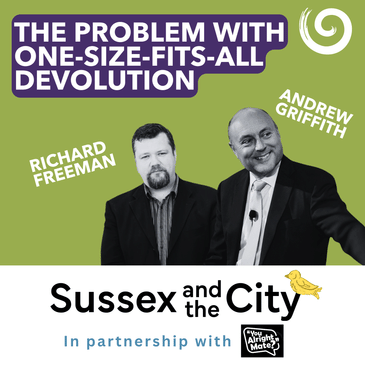
The Problem With One-Size-Fits-All DevolutionHost: Richard Freeman Guest: Andrew Griffith MP – Member of Parliament for Arundel and South Downs; Shadow Secretary of State for Business and Trade
🔍 Episode summaryCan one model of devolution work for every part of England?
In this episode, Richard Freeman speaks with Andrew Griffith MP about what devolution could mean for Sussex, and why he believes Whitehall often underestimates the diversity of places it is trying to reform.
Drawing on experience in both business and government, Andrew reflects on representing one of Sussex's largest rural constituencies, the challenges facing small businesses, infrastructure and planning, and whether a Sussex mayor can genuinely make better decisions than Westminster.
Together they explore the balance between local identity and regional strategy, why transport remains one of Sussex's biggest barriers to growth, and whether devolution risks becoming another layer of government unless accompanied by meaningful powers and funding.
The discussion also examines the importance of rural economies, the future of the South Downs, the county's growing wine industry and why Sussex's distinctive character should shape, rather than be squeezed into, a national model of devolution.
---
This episode is brought to you in partnership with You All Right, Mate?, the workplace programme from Different Hats, helping organisations build healthier, more resilient cultures through honest conversation, connection and psychological safety.
🎯 In this episode- Why Andrew believes Sussex needs devolution with genuine local powers
- Whether a directly elected mayor can make a practical difference
- The economic importance of rural Sussex
- Why transport infrastructure remains a long-standing challenge
- Lessons from Covid for local businesses and communities
- The future of planning inside the South Downs National Park
- How Sussex's wine industry is building an international reputation
- Why Whitehall often struggles with place-based policymaking
- Whether devolution should look different in rural and urban England
- What success could look like for Sussex over the next decade
Andrew supports decisions being made closer to local communities but argues that genuine devolution requires more than new governance structures. Without significant funding and decision-making authority, new institutions risk becoming another administrative layer.
Rural economies deserve greater attentionMuch of Sussex's economy depends on small businesses, farming, tourism, hospitality and specialist rural industries that often receive less policy attention than larger urban economies.
Infrastructure shapes opportunityLong-standing transport issues, particularly along the A27, continue to constrain economic growth, investment and connectivity across Sussex.
National policies rarely fit every placeOne-size-fits-all policymaking often struggles to reflect the realities of places like Sussex, where cities, market towns, villages and protected landscapes exist alongside globally significant businesses.
Identity mattersAndrew argues that successful devolution should strengthen Sussex's identity while respecting the strong local loyalties that already exist across its towns, villages and communities.
Local resilience mattersReflecting on Covid, Andrew highlights the adaptability of Sussex's small businesses and argues that future economic policy should better recognise and support local enterprise.
💬 What Andrew says"The smartest, best decisions are made close to local people."
"Nobody ever came to my surgeries asking for a Sussex mayor."
"One-size-fits-all doesn't work."
"The world is simply a more challenging place than it has been for most of my adult life."
"If there was a greater pride in being from Sussex, that would be a success."
🌿 Why rural Sussex mattersWhile discussions about economic growth often focus on cities, Andrew argues that much of Sussex's long-term prosperity depends on its rural economy. Farming, food production, tourism, vineyards, hospitality and thousands of small independent businesses contribute significantly to the county's identity and economic resilience. Any future mayoral authority, he argues, will need to balance urban investment with the needs of countryside communities and protected landscapes.
👤 About Andrew Griffith MPAndrew Griffith has been Member of Parliament for Arundel and South Downs since 2019.
Before entering politics he spent over two decades at Sky, becoming one of the youngest finance directors in the FTSE 100 before serving as Chief Operating Officer. He also chaired Just Eat during a significant period of its growth.
Since entering Parliament he has held ministerial responsibilities across business, trade, science, innovation and the Treasury, including serving as Director of the Number 10 Policy Unit. He currently serves as Shadow Secretary of State for Business and Trade.
🎧 Production creditsHost: Richard Freeman Guest: Andrew Griffith MP Sound design / editing / original music: Chris Thorpe-Tracey Production management: Letitia McConalogue
📣 Get involved👉 https://sussexandthecity.info — episodes, resources and events
👉 https://sussexintelligence.com — research, insight and analysis on Sussex's future
[00:00:00] This episode is brought to you in partnership with You Alright Mate. You Alright Mate is a workplace programme from Different Hats, designed by Sussex entrepreneur and storyteller Sam Thomas to support men through honest conversation, reflection and connection. Across seven facilitated sessions, Sam helps teens rethink success, build trust, improve emotional wellbeing and create the psychological safety that too many workplaces
[00:00:27] still talk about more than practice. For Sussex this is really important. Productivity, leadership and innovation all depend on people being able to show up properly, not just perform being fine. You Alright Mate helps organisations build healthier, more resilient cultures from the inside out. To find out about this fascinating initiative, visit different-hats.co.uk.
[00:00:53] That's different-hats.co.uk. This podcast is brought to you by Always Possible. Always Possible.co.uk. You're listening to Sussex And The City with Richard Freeman. Hello, it's Richard here. Welcome to the Sussex and the City podcast. One of the things I've
[00:01:22] tried to do throughout this whole series is to bring together voices from right across Sussex, right across public life, business leaders, campaigners, academics, entrepreneurs and yes, politicians. Now, we call this an independent and non-political project. That's because we do not take a stance. We do not say that the success of Sussex devolution means we should get this party
[00:01:49] or this person or this ideology behind it. But that doesn't mean that we can't and shouldn't spend time exploring the motivations, the perspectives, the experience of the elected politicians at all levels from right across Sussex. What we're keen to do is to speak to as many members of parliament from Sussex as possible, from all different stripes, especially as Sussex is
[00:02:17] becoming a much more politically pluralistic and diverse place. So we've had Peter Kylon, we've had Peter Lamb, all the Peters, and we'll be exploring a whole range of members of parliament. And this episode brings our third to the table. And this week's guest is Andrew Griffith, member of parliament for Arundel and South Downs and the shadow secretary of state for business and
[00:02:45] trade. Before entering politics, Andrew spent nearly 20 years at Sky, helping oversee its growth from an ambitious broadcaster into one of Britain's biggest media companies. He became one of the youngest finance directors in the FTSE 100 and later served as Sky's chief operating officer. And also chaired Just Eat during a pivotal period in that company's development. Since entering parliament in 2019, he's held a number of senior ministerial roles covering business,
[00:03:13] trade, the treasury, science and innovation, as well as serving as director of the number 10 policy unit under Boris Johnson, of whom Andrew Griffith was a close ally during his time as prime minister. That mix of commercial leadership, economic policy and representing one of Sussex's largest rural constituency makes for a fascinating conversation. So I talked with Andrew about the opportunities and
[00:03:39] challenges facing rural Sussex and the relationship between countryside and city and town economies, the importance of infrastructure, housing and transport, and what devolution could mean for local decision making. We also explore whether a Sussex mayor can genuinely unlock growth, how Whitehall should work differently with places, and what success might actually look like over the next decade.
[00:04:03] Bear in mind, this was recorded a few months ago, certainly before the likelihood of Andy Burnham becoming the next prime minister. Whether you're interested in business politics or simply where Sussex goes next, this chat is an opportunity to hear from someone who's worked at the highest levels of both business and government, and who now represents a large part of our county as it prepares for one of the biggest changes to local government in a generation. I hope you enjoy my conversation with Andrew Griffith, MP.
[00:04:45] I am delighted to be joined by our second member of parliament to join me in this digital space to discuss all things devolution and the sort of future of Sussex. My guest today is the member of parliament for Arundel and the South Downs, been a member of parliament since 2019. I had a very big role in the last
[00:05:07] conservative government and is now on the opposition front benches. So really keen to speak all about the Sussex story and life, economy, prosperity in this patch of the world, but also to get that national perspective. Andrew Griffith, MP, thank you for joining me. How the devil are you? Delighted to be here, Richard. Thank you so much. I'm excited to speak about one of my favourite topics,
[00:05:33] which is Sussex. We don't get to talk about that. Too much highfalutin politics, not enough good local stories. Well, let's start there then. What's your Sussex story? What brought you to the wilds of the South Downs and representing the good people of Arundel? Like a lot of folk, I think, moving out of the big city. We came as a family to Sussex 20 years ago when the children were really just quite
[00:05:58] young and we wanted the outdoors, the countryside, the experience of having dogs, you know, all of the things that are the best parts of my life now. We found in Sussex then. This sounds like a terrible thing to say, but, you know, I think a lot of folk come to Sussex. We know that because the population's expanded a lot. But once we're here, no one ever wants to leave. So I always say it's a bit ghoulish, but, you know, I'll die with Sussex. It's my home and it's been a great honour to represent
[00:06:27] the people of Arundel and South Downs, living as I do just near Petworth, which is pretty much sort of the middle of my patch. What got you into politics, you know, and what got you into public life? Because you had a business background, is that right? I did. I did. I had a very happy, happy business background. 25 years, you know, I started, you know, training as an accountant because I didn't know what I wanted to do with my life. Most of my career was spent at what was then a smaller
[00:06:56] growing company called Sky, Sky Television. I've heard of it. Expanded into all sorts of things, sports and news, but it ended up doing broadband and mobile. And I did that for 20 years almost to the day. And then age 48, I popped out, not knowing what I wanted to do with the next chapter in my life, but something to put back, you know. And for me, although it's not always the most
[00:07:24] fashionable, you know, standing, representing your community in our parliament is a very important part of public service. You know, it's ultimately, you know, it really does scale. You know, we can all go and sit on a board of a local voluntary organisation and that is wonderful. And we're so lucky to have such good community. But if you really want to try and make a difference to some of the biggest challenges we've faced as a society, then parliament in our democratic system is still
[00:07:53] a really massively important part of that. So, you know, a little bit old fashioned, you know, public service had the ability, still had the energy to do that. And then there was a lot of serendipity, Richard, that the member of parliament for where I live, my predecessor, Nick Herber, stepped down in a bit of a hurry just before an election. And, you know, some folks said, put yourself forward and, you know, in life, you regret the things you don't do. Although I'm
[00:08:21] sure, you know, jury's out on how it all goes. And the best bit is representing my community. I think most MPs would say that as well. Listeners to this will know I try and avoid the big P politics, but I'm sure some of it's inevitable. But in terms of, you know, so you joined in 2019 as part of the big Boris Johnson election. That feels relatively recent in the grand scheme of things.
[00:08:46] But in that six years, you would have been dealing with COVID and the pandemic within just a few months of starting, which I imagine had a profound effect on quite a lot of the rural communities that you represented. So trying to get up to speed and figuring out what support they would have needed. How have the sort of macro and the micro come together in your role as a
[00:09:14] member of parliament serving, you know, geographically quite a big area with sort of dispersed populations? Really good question. Interesting. You're right. So I was elected in December, had a quick break over Christmas, and then we were pretty much into an unprecedented global pandemic lockdown. As I was trying to learn the ropes of being an MP, tens of thousands of people were sort of reaching out and contacting me because their world was melting down, whether it
[00:09:42] was access to healthcare, their kids being excluded from school or the school shutting down, just to bring it to life. You know, in terms of the economy, I discovered, forgive me, the wedding supply chain, you know, and what you discovered was all these informal groups. So they're big guys in life, the businesses and things, and the public sector generally can look after themselves. They've got a debt and a resilience. You know, they've got lawyers and HR people. But you take the other extreme,
[00:10:10] it could be beauty. In this case, it was the wedding sector. They weren't organized, lots of small organizations didn't even have a body, a trade body to speak for them. And you weren't just talking about the weddings, you're talking about the barn that put them on, the furniture hire, the tent or the furniture, the people who arrange the flowers, the caterers. You know, there's a huge, big supply chain in our very rural parts of Sussex that really needed someone to speak for them.
[00:10:38] And it was a very salutary experience about, you know, how government works clearly, or government doesn't work in some cases, but also the very delicate ecosystem that just gets on does its thing. Never asked for any help, by the way, you know, often living a little bit hand to mouth. And then all of a sudden, a big external shock comes along. And there isn't a lot of help there when it's needed. I'll always carry that experience with me. And when I talk as business secretary,
[00:11:08] I'm the shadow business secretary. So my job, if I was ever in government would be to be responsible for all business policy in the UK. You know, I've literally got the sort of metaphor of somebody who owns a shop on Midhurst High Street, you know, maybe a couple of pubs, a catering business, you know, that's where the rubber hits the road. It's wonderful. We do have a really wonderfully, probably one of the most diverse business ecosystems in Sussex. You think we've got a global airport in
[00:11:37] Gatwick, really high end manufacturing companies, we've got some professional services companies, that supporting London, our global capital, but also other cities around the world. But then you have got people who are running a decent business in a, you know, cafe or, you know, a tent marquee business in the, in the, I wouldn't say the rural back or beyonds. And anyone who knows me knows that that's, that's where I'm happiest and where I love, but, but they're very much just tucked away
[00:12:05] in an industrial unit or a barn somewhere. The recovery was, you know, far faster in Midhurst and Petworth than many other equivalent sort of market towns, you know, the occupancy rate of the, the shops on those high streets is very high, you know, so that's a kind of good news story about that resilience in the sort of independent businesses that you're talking about. But I
[00:12:30] guess one of the bigger challenges is ability to keep pace with other change that is sort of happening around us. How do we ensure that the kind of places you represent don't get left behind in big conversations about growth? Two things. One is, I think you put it very well. I mean, there is always the danger they get forgotten. If you're running a small business, the biggest opportunity cost is your time. You know, you're sitting there on Sunday doing the
[00:12:57] payroll, you know, doing the shift rotor for the following week, trying to get on top of your VAT return. So a lot of the forums that understandably have tried to represent businesses in the past, you saw this a bit with C2C, notwithstanding their good intentions, they just end up parroting the voice of bigger organisations. It really is important that any policy we do is designed for small businesses
[00:13:23] as well. They're often the very heartbeat. And secondly, the world is changing. We all know that, you know, I do think the level of volatility that we've seen in the six years I've been a representative is probably the new normal. The world is just a more challenging place than it has been for most of my adult life. So you can't predict everything. So you've then got to be agile in terms of reaction. I mean, again, COVID, what were the good bits in terms of COVID? You know,
[00:13:52] the vaccine task force, things like that wasn't perfect, the furlough scheme. And those were examples of the government being agile, doing things at a far, far greater clock speed than they would in normal time. And then one of the sad things is everything then goes back to normal. You know, I'm not beating up on anybody. But if you want agility, the planning system, you know,
[00:14:17] and the National Park is responsible for planning. I mean, it is just in many cases, tragically slow. Some of that's on them. Quite a lot of that is on us in Westminster, who come up with all of these rules and policies. And, you know, what is always a well-meaning piece of legislation. Let me give you an example. The EPC rating, you know, energy efficiency, all very well-meaning, right? I mean, some people are very seized of the idea that the biggest challenge that, you know, we face is climate.
[00:14:47] But, you know, you go and impose an EPC rating on a flint built property that, you know, comes out of the mud, never had a, you know, an air gap or insulation. There's no amount of money on God's earth that will allow that building to come up to an EPC rating. So what do you do? Do you make it harder for people to live in the park? Do you take that building out of sensible use and let it decay?
[00:15:14] No, right? You come up with age-appropriate, sensible interventions and let people get on with the economic activity that they were doing way before the park was invented, in many cases, way before, you know, Parliament, as we see it, was invented. You've probably got a strategy, a vision, a roadmap, maybe even a post-it note empire on your office
[00:15:41] wall. But has anyone asked the really awkward questions yet? Like, is it actually working? At Always Possible, we help senior leaders challenge the obvious, rethink the possible and deliver the extraordinary without losing their sanity or their sense of humour. Enabling private and public sector
[00:16:03] innovators to navigate a changing economy. We help complex organisations to humanise data and to translate the big picture into hyper-local engagement, trust and sustainable growth. If you're ready to bring people with you because your leadership truly inspires, visit alwayspossible.co.uk. That's
[00:16:29] alwayspossible.co.uk. Always Possible. We make bold business brilliant. And in terms of the conversation about climate, I'm picking up a little lukewarm from you in terms of that as a priority. Alongside and with part of these conversations about prosperity and growth and better jobs and better housing, where do you sit in terms of that, whether it's a tussle or whether
[00:16:58] it's just a nuanced conversation that we need to have better? How do we balance all of that? I try not to be at the extremities of debates. I mean, generally, you know, there's a reasonable position in the middle. I think there's been too much dogma about some aspects that without fully thinking has led us to the insanity of building Chinese solar panels on British farmland made with
[00:17:28] Chinese slaves and powered by with the energy coming from coal in the name of climate. And if you look at the total cost of ownership of that, we are ending up with more carbon atoms emitted into the atmosphere than we would have before and less food security, which means we're flying food around the world to feed ourselves. Right. So I would I would say, you know, that is at one extremity. And, you know, I'll call a
[00:17:55] spade a spade and say that is properly nuts and shame anybody who's, you know, a climate crusader, who's literally, you know, supporting Chinese coal firepower stations. Now, at the other extreme, what are our great assets? Well, the Sussex countryside, which makes a big contribution to us feeding ourselves, the growers on the coastal plain is a really big if you've done your economic
[00:18:20] analysis of Sussex, you know, the horticultural industry down on the southern fringes of the county is a really big UK footprint economic industry. And then tourism and farming and sustainable food growing and natural capital are all burgeoning areas that Sussex has got a really good contribution to play. So don't undermine your own natural strengths, right? If we've got lovely
[00:18:45] countryside, if we've got land that has been under sensible stewardship since the Iron Age, you know, let's not blow all of that up by building on it in a preemptory and unthoughtful fashion. But let's not also say, you know, we're going to all live in a museum. No, a fair point. I guess my first sort of big question to you, you know, are you pro-devo through your parliamentary career? Is it something that you've supported? I know that, you know,
[00:19:12] the Labour Party tend to often own the agenda on it, but I've spoken to many Conservative politicians who are backing it in Sussex. It'd be interesting to know what your take is. Listen, I love devolution. I think that the smartest, bestest decisions are made, you know, close to local people recognising, you know, the very different circumstances and rich tapestry. It's not just on this government, don't get me wrong, but governments don't really do
[00:19:37] devolution, right? What they do is they add extra layers, but they still keep all the purse strings. My only critique of this particular set of proposals is there's a vanishingly small amount of money. I think I worked it out as £1.60 for every resident of Sussex that is allegedly the dividend we get from devolution. And we're not actually getting any more determination over the really big levers that government can pull. So look, I'm also very pragmatic, Richard. So,
[00:20:06] of course, I want the best for my communities and I will work with every layer. One thing that people posit to me, you know, could be a benefit is greater alignment around improving the A27. That long predates me, you know, the challenges of the A27 in the West Sussex bit, the East Sussex bit, it's pretty good these days, but the West Sussex bit long predate me. They take back to the 1950s and
[00:20:31] 60s. And I fear that even though I'll try and move it forward, it'll still be an issue beyond my lifetime, sadly, my political lifetime. But, you know, one of the issues is that we have not spoken with a, you know, clear voice. Every time there was a consensus about something being done, and obviously the bit I'm most closely associated with is the Arundel bypass, then one or other grouping or
[00:20:57] party then goes and breaks that consensus and runs off. So if somebody, if the mayor can broker a consensus on this major East West arterial route that's got huge economic importance, but also if it was done well, would suck rat running traffic out of the park and smaller villages and communities, then that would be a great thing. You know, there is a bit of a suggestion that strategic transport,
[00:21:25] the mayor would have a bit more influence over. So that seems to me a good opportunity. It's never bad, you know, a day that anybody, any public figure is talking about the strengths of Sussex. Is it good for the psychology of Sussex? And do you think the identity of being part of a kind of of a Sussex region would be good for the people of Arendelle and South Down? Do you think they'll feel connected to the rest of the county and feel like they're from Sussex and not necessarily from
[00:21:53] just Arendelle or Petworth or can they be both? Of course they can be both. I think we'll have to just suck it and see it in the best will in the world. You know, there's some fantastic initiatives that already try and join up Sussex from a perspective of say, the tourism brand. There's Sussex Winelands Initiative, which seeks to unite the bits of Sussex that are the very successfully growing, you know, wine and hospitality industry on the back of that. So there are some
[00:22:22] bits that are already quite well joined up. The challenge, it's just going to be the challenge for whoever he or she ends up in this role in the intray is going to be what's additive and what can you do that actually tries to unite without it being a lowest common denominator, right? It's a very different message when you're talking about the accessibility to London and the world through a, you know, big,
[00:22:49] noisy, you know, congested airport, which is a big economic thing, versus if you're trying to sell, you know, the quiet rural stewardship of the land and the nature and the Holbrook Wildbrooks or the winemaking in the Aaron Valdick. I think that's a tough gig. And I do observe that in my six years, no one ever came to my surgeries, you know, I mean, I've been asked for some pretty, you know, weird
[00:23:17] things in my time as Member of Parliament. Actually, nobody really came along and said the thing we need is a Sussex Mayor. And where it has worked well, is it's given a voice to things like, you know, Andy Street in Birmingham, or Andy Burnham in Manchester. But they were, you know, they were urban areas, you know, that there was simultaneously a lot of government money under the levelling up agenda
[00:23:45] that was being tipped into those big urban areas. So even if you're, you know, you're sort of kind and believe in the mayoralties, there's things that mayoralties can do if they happen to go with, you know, a pro-urban development policy in areas that didn't have a strong local identity, that you can't also just simply lift and shift and say, you know, ipso factor, you know, and there will definitely be a good and positive thing.
[00:24:14] I think this I can see things quite interesting, because I'm talking to quite a lot of the people that have been tasked with certainly setting up the statutory instruments and the sort of governance and early infrastructure around the new combined authority. And what I've been struck by is how they sort of agree with that saying it's not Manchester, it's not the West Midlands, Sussex will be a different proposition. And with that come challenges. But also there's an opportunity to
[00:24:43] do it in some ways a bit differently. There's an opportunity to be a little bit more open and experimental about how it can work for a diverse set of communities of some different places. The extremes of the East and West of the county, you know, might not feel they've got as much of a shared cultural or geographical narrative as some other parts of the country. So what do we do with that? And how do we make people feel that they are part of something bigger? So I wondered if,
[00:25:10] given your kind of national role and your role in Parliament as well, do you think that's understood kind of by Whitehall, that de-Olysium is not a one size fix all, that the way that different devolved regions work and operate and test and learn things needs to be supported and championed and maybe space for things to not work immediately and work a bit later? And so look, I'm a massive fan of not having one size fits all, of test and learn, of omitting your humility that you don't know everything and
[00:25:38] that you learn and try and improve things. There are some other emerging mayoralties, obviously Paul Bristow in Cambridge or Peterborough, that'll be an interesting one because that's got some of the the same characteristics. It's got the super science-y beating heart of Cambridge, the more industrial Peterborough and the rural Fenlands. That might be a little bit more of an example for us over time. I hope that Whitehall has the patience. There is something about the bureaucratic mindset.
[00:26:07] It wants to put everything into orderly roles. It does like one size fits all. And that's a lot of what's been the driving force for some of these mayoralties. You know, I go back to our history and heritage in Sussex. Everyone who's ever tried to conquer this country has come through Sussex. You know, we've got a great, you know, history and heritage. And I think people feel very
[00:26:34] strongly connected with that. If you go into the Lockswood Joust or the Arundel Joust, you know, they're celebrating a medievalism in a way that's, you know, goes far beyond any modern institution. And so I hope that the mayoralty, a little bit like the Lord Lieutenant, you know, will do an awful lot of celebrating what's wonderful about Sussex because there's a great deal and maybe lifting some of our
[00:27:01] most things we could be most proud of onto more of a national or a regional stage. That'd be great. We are becoming famous for our winelands. There are many achievements that are personal in Parliament, but one of the things I was proud of doing was getting the protected geographic indicator for Sussex sparkling. So Sussex wine is now up there with Cheshire cheese and, you know, the Mowbray pork and all the rest. Cornish pasties. Exactly.
[00:27:29] So final question. If this works, what in 10, 20 years time do you think would be the biggest marker of success and the biggest sense that this was worth doing? A North Star that people could sort of measure the success against. We always used to say at Sky, you could tell how much the sort of culture was, was how people answer the phone. So if they picked up the phone and say, hi, Sky,
[00:27:56] you know, that was better than if they were saying, oh, hi, Sky News or hi, Sky Sports or, you know, their own individual tribe within a company and anyone who's worked in a big company probably can identify with that. So, so if there was a greater prominence, if this is what the, the, the architects of, of a devolved Sussex are seeking, if, if there was a greater pride and,
[00:28:21] and recognition of people being from Sussex, because at the moment, you know, almost as we started, I think people would typically say, if you say, where, where are you from? People would typically say, well, I'm from Midhurst or, you know, or I'm from Brighton, particularly, you get a lot of that or Lewis. So if there was more of a common pride in Sussex, I think that would, by the adherence of the
[00:28:44] idea of the Sussex mayoralty, that would be, be a success. I'll add one more thing, if you like, which is, you know, if we want real devolution, you know, let's have real devolution. So there's a sense of me as an MP would do less, people would spend less time saying, you know, you need to fix this in Whitehall, because people would go first to Sussex and say, is this something that we've got
[00:29:09] agency to solve ourselves? And on that, I am fearful that just at the same moment that the same people in Whitehall are going to say, we're allowed to have a mayor or not even allowed, they're insisting we have a mayor of Sussex. I think that I fear they're about to merge our police with Surrey, already merged our healthcare with Surrey. And so, you know, let's, if this is a coherent
[00:29:34] agenda, let it be coherent, right? Don't, on the one hand say, you've got to have this particular part of the blueprint. But when it comes to you making your own decisions on policing or healthcare, oh no, you can't be trusted as Sussex, you've got to be merged into some other. Beckiloth and Surrey. Interesting food for thought. Thank you so much, Andrew Griffith, for being my guest on the Sussex
[00:30:00] and the City podcast. Thank you, Richard. It's pleasure to be here. Thank you very much to this episode's guest, and to you for tuning in. Sussex and the City is an independent and non-political project about devolution as it happens, explained in
[00:30:28] human. It is led by Always Possible. You can find other episodes, resources, events, and blogs about change in Sussex and Brighton by visiting sussexandthecity.info. That's sussexandthecity.info. This episode was written and presented by Richard Freeman for Always Possible. The editor was me, Chris Thorpe-Tracey, for Lo-Fi Arts. I did the music too. Production management was by
[00:30:58] Letitia McConnellogue for Always Possible. Talk to you next time. Always Possible.co.uk