
– Episode #53
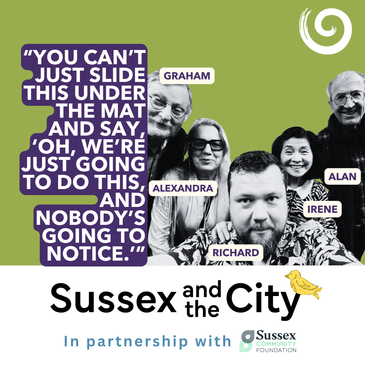
"You Can't Just Slide This Under The Mat And Say, 'Oh, We're Just Going To Do This, And Nobody's Going To Notice.'"Host: Richard Freeman Guests: Irene, Graham, Alan and Alexandra - Members of Hop 50+ at Impact Initiatives
🔍 Episode summaryIn this special community edition of Sussex And The City, Richard Freeman visits the Cornerstone Community Centre in Hove to hear directly from members of the Hop 50+ programme run by Impact Initiatives about the future of Sussex.
Rather than debating constitutional reform, the conversation focuses on buses that don't arrive, community spaces that keep people connected, concerns about mental health services, affordable housing, local identity and whether decision-makers truly understand everyday life.
The discussion reveals widespread support for decisions being made closer to local communities, but also a clear warning. If Sussex is about to undergo its biggest governance change in a generation, residents believe they need to understand it, shape it and feel part of it. Devolution cannot simply happen to people.
Along the way the group reflects on rural isolation, public transport, tourism, local newspapers, Airbnbs, culture, ageing well and what makes Sussex distinctive. Throughout, they return to one central question: can a future Sussex Mayor provide a long-term vision while remaining close enough to the communities they serve?
The result is one of the most grounded conversations in the series; less about political structures and more about what good local leadership should actually feel like.
---
This episode is brought to you in partnership with Sussex Community Foundation; connecting people who care with the communities and causes making a difference across Sussex.
Through grant-making, philanthropy and local partnerships, Sussex Community Foundation helps strengthen communities, reduce inequality and support grassroots organisations throughout the county.
To find out more, visit sussexcommunityfoundation.org.
---
🎯 In this episode- Why many residents have never heard about Sussex devolution
- Community centres as essential public infrastructure
- Mental health, prevention and local wellbeing services
- Rural Sussex and fears of being overlooked
- Public transport, concessionary travel and accessibility
- Housing affordability, second homes and Airbnbs
- The decline of local newspapers and civic engagement
- Arts, tourism and protecting Sussex's character
- What people actually want from a Sussex Mayor
- Building a long-term vision that communities recognise as their own
Participants repeatedly argue that constitutional change cannot simply be announced. Residents need to understand what is happening, why it matters and how they can influence it.
Community is preventative infrastructureFrom mental wellbeing to tackling loneliness, local community organisations provide services that reduce pressure elsewhere in the public sector.
Rural and urban Sussex both matterAny future strategic authority will need to balance the needs of Brighton & Hove, coastal towns, market towns and rural communities rather than allowing one perspective to dominate.
Better communication builds trustMany participants describe feeling disconnected from modern politics. Clear information, visible leadership and meaningful engagement are seen as essential if devolution is to succeed.
Identity should unite rather than divideWhile local loyalties remain strong, contributors believe Sussex needs a clearer shared story that celebrates its coastline, countryside, culture and communities.
Think beyond election cyclesThe group consistently calls for decisions that improve quality of life over decades rather than responding only to short-term political pressures.
👥 About Hop 50+ and Impact InitiativesHop 50+ is a community programme delivered by Impact Initiatives, one of Sussex's largest charities supporting wellbeing, resilience and social connection across the county. Through activities, advice, volunteering and community events, the programme helps older residents remain active, connected and engaged within their local communities.
🎧 Production creditsHost: Richard Freeman Guests: Irene, Graham, Alan and Alexandra Sound design / editing / original music: Chris Thorpe-Tracey Production management: Letitia McConalogue
📣 Get involved👉 https://sussexandthecity.info — episodes, resources and events
👉 https://sussexintelligence.com — research, insight and analysis on Sussex's future
[00:00:00] This episode is brought to you in partnership with Sussex Community Foundation, connecting people who care with the communities and causes making a difference across Sussex. Through grant making, philanthropy and local partnerships, Sussex Community Foundation helps strengthen communities, reduce inequality and support grassroots organisations throughout the county. We hope you enjoy this conversation exploring belonging, wellbeing and the future of communities across Sussex Community Foundation.
[00:00:47] We hope you enjoy this conversation.
[00:01:05] Sussex and The City, I'm Richard Freeman. Lovely to spend some time with you. And I think you'll agree, lovely to spend some time with my guests in this episode this week. It's a slightly different format to usual. I decided that it's really important that I better understand what devolution in Sussex actually means to the people whose lives it is supposed to improve.
[00:01:27] Not the politicians designing new structures, not the policy experts drawing boundaries, and not necessarily the businesses trying to create empires, but the residents living with the everyday consequences of decisions about buses, housing, mental health support, culture and community spaces.
[00:01:46] So for this episode, I was delighted to be invited to the Hop 50 program run by Impact Initiatives in Hove at the Cornerstone Community Centre, somewhere I used to go a lot as a child when I was doing drama and after school activities. It was a real treat to go back 30 years later. And I got to meet Irene, Graham, Alan and Alexandra, who are part of the Hop 50 Plus program.
[00:02:13] Between them, they bring decades of experience of life in Brighton and Hove, West Sussex and beyond, and a healthy scepticism about whether a new mayor will bring meaningful local power or simply another layer of distant bureaucracy. We talk about the community services that keep people connected, but remain chronically vulnerable.
[00:02:33] The risk of rural Sussex being overlooked, disappearing local newspapers and declining trust in politics, the buses that connect communities and those that decidedly don't. This delightful group of retirees have strong views on housing, Airbnbs, arts and culture, mental wellbeing and the importance of protecting free travel for older people. But beneath all of those practical things, there's a bigger challenge they diagnose.
[00:03:00] Whether devolution can produce a coherent long-term vision for the whole of Sussex, while still understanding the places and people within it. I really enjoyed meeting these guys. I hope you do too. Thank you.
[00:03:25] I'm so delighted to be here at the Cornerstone Community Centre in Hove. I've got the real pleasure to be with some very special guests that are part of the Impact Initiatives Over 50s program. And they've agreed to spend a little bit of time with me this afternoon chatting all things devolution. Let's get to know some of them first before we delve into this complex, mad, thorny topic. What's lighting you up at the moment? My name is Irene Humphrey.
[00:03:56] You mean living in Brighton and Hove? Yeah, I like the area. I like the sea and I've been here for 56 years, so I never left Hove. Yeah, it's got everything I wanted. I'm Graham. I'm a retired architect. I've recently come back to the area after 20 years away living in West Sussex, but I've lived in Brighton and Hove for 50 odd years. I like the vibe.
[00:04:25] And whereabouts in West Sussex did you live, Graham? Worthing and Bognor. So I can see a different perspective already living there to coming back here. My name is Alan Rowden. I've got a flat in Hammersmith and I come to Preston Park a lot and I get the best of both worlds and it's interesting the contrast between the sea of Brighton and the Thames, so I like both.
[00:04:52] Hi, my name is Alessandra and I was actually born in Shoreham-by-Sea Hospital, so I'm a sort of Sussex girl born and bred, but I've also lived in South London, South London, as it were, near Bromley and also in Leeds and in Cornwall, which is a very beautiful place.
[00:05:09] When I came through and said hello to Lynn and Nick earlier, it was packed. It was so busy, really bustling. That's good news. Clearly this is a really valued project, but tell me a little bit about it and why you're here today. Well, I have been to this 50 hop before and I find people are very friendly and it helps my mental wellbeing.
[00:05:32] I'm here because my daughter found this community meeting place after I'd lost my wife to cancer and I've moved back and I didn't know anyone. But coming here, you get a broad mix of people, you're interacting with people and there's a lot of exercises and skills that are taught and it's a great place.
[00:05:55] I find the Hop 50 is a very useful community. They have meals, very good cooked meals and I also am involved with the Cornerstone here and I go to a poetry class where there's mainly women, about 90 and there's even a lady of 101 who's still driving and it's just a great use of churches.
[00:06:19] I feel a lot of churches. I feel a lot of churches aren't used enough and I think this is a way that churches should be keep the church bit, but have a community part for them. I think it's a really great use of space. Hi, well, I discovered the Hop 50 through my friends, Cole and June, who run the Knit and Natter class, which I go to as well, although I'm not a very good knitter. But are you a good natter? I mean, that's the question.
[00:06:46] Very good knatter. I think it's a great place, really. We're here to talk about the slightly abstract sort of issue of devolution, which on the surface is that's about transfer of powers and some funding from central government down to Sussex and Brighton as an area.
[00:07:04] But in reality, it's all sorts of things. You know, it's about governance and politics. It's about economics and funding. It's about health. It's about transport. It's about infrastructure. It's about business. And we're trying to figure out what good looks like down here, because it's not really something that we've been talking about for a long time. So I'm really keen to hear a little bit about, first of all, my question is, you know, what do you understand of devolution?
[00:07:30] And there's no absolutely no right or wrong answer here. You know, when you say the word, what does that mean to you? Just giving power to the area we live in. I slightly worry about the rural communities in this set up, because I think the built up areas are already ready for it.
[00:07:50] But it's the rural communities, I think it could miss out. This is not like a normal devolution of power to say Manchester, which is all kind of Asian. But that's my main worry is the rural communities, but possibly the funding that we were discussing. Communities like the centre here. And I don't know lots of things, because the power surely is in these sort of towns, cities.
[00:08:17] It could be a bias without really realising that's what you're doing. But I just feel the rural communities might just miss out, but I can't really define it. I feel that, especially with Sussex, I've always been confused why in this west, east and Brighton, whereas other counties don't seem to be divided. I don't know if it's any bigger than lots of other counties.
[00:08:42] And I never quite know where the boundaries are, and I never quite know if you go from one end to the other. And there's confusion, I feel, about postal areas. I go to Eastbourne sometimes, and it's got a BN Brighton postcode, which I think, well, Eastbourne's not Brighton. But, you know, it's confusions like that, really. And I suppose the thing is, if you have a new mayor, or are they going to be locals?
[00:09:10] Are they going to be elected? How do they get nominated? And will they have power over the other? And not power, but join things together? Or is it just another strata of bureaucracy that feels distant from the public? And is there a model, Alan, that you would prefer? You know, is there something new that you think could be really beneficial to what we've already got?
[00:09:37] Politics is very negative at the moment, I feel, in some ways. And Scotland's been devolved, and Wales has been devolved. And then you see a lot of bickering or things happening in Scotland, and you think that hasn't worked or something. But I suppose you only hear the bad rather than the good, you know, which I think that's a lot the problem with the world at the moment, in a way.
[00:10:04] I think it's finding out if people say, well, this is going to help everybody. You're going to know who your local councillors are. I think that's the problem. I often say in Hammersmith, there was like, in the 70s, you knew who your local councillor was, you knew who your MP was. If they walked locally, 10 people would stop them.
[00:10:27] But now I doubt if many people know who their local councillor is or hardly who their MP is sometimes. So devolution or no devolution, the kind of attitude and engagement with politics generally has become, you know, it's changed as you've seen it. Exactly. I think that's the problem, really. I think I've often said, really, that I don't listen to friends who attack unless they've got a better offer.
[00:10:56] They can offer something positive because it's very easy to be negative. But it's very hard to say, well, these would be really good and make things better. And I think that's what the world needs. I think it needs a bit more humour and it needs a bit more what makes good rather than drags people down or whatever, really. Well, can I just bring up something?
[00:11:20] Well, recently, actually now, the South Deng had tried to close the wellbeing hub, which is for the mental wellbeing place people go to. But they are sent from doctors and been assessed in this building, which is near Preston Park. So we've been putting petition to the council. But council is not the one who made the decision. It's the South Deng.
[00:11:48] I don't understand a place like this. It's a lot of people have mental wellbeing. So I'm one of them going there. And I just want to know how Brighton is trying to close down a place when now mental wellbeing people is increasing. They are supposed to be cared, but this doesn't show the caring bit.
[00:12:14] Should devolution, in your eyes, make those sorts of decisions clearer, you know, more transparent? Yes. At the moment, none of us, Steve and I, went to a meeting, right, to sell the chief to be there to listen because he doesn't normally turn up. Because they have so many petitions, they realise what they want to change is not quite right. So now they're slowly changing their plans.
[00:12:43] But I don't understand you are a country supposed to care about the mental wellbeing people. Why would they want to cut the one place that people can go? Because there are people never seen anybody. That's the only place they can go to and they become comfortable. Brighton is such a big place. How can they do that to people who are in need?
[00:13:10] Well, I think it's quite important if we are going to have more decisions made by a mayor. It's more important that the whole population of East and West Sussex and Brighton Hove understand that. And they get more involved in the election process because obviously this is going to be very important for them. And I don't think many people know, even have heard what's going on. And I certainly haven't before. So this is the first I've heard of it. And I should think a lot of people in Brighton Hove and the surrounding areas have got no idea this is going on.
[00:13:39] So it needs to be publicised, widely publicised, so that people can get involved in the election. Because they know their MP is important, but they don't know that the mayor is, which used to just be in figurehead. They don't know that the mayor is going to be more important. And do you have any ideas what could be done around that engagement? What would you like to see more of? I can hear the arguments of the people in charge of this saying, you know, where do we start?
[00:14:05] But I also recognise how so many people are saying exactly the same thing as you are, Alex, that this has got to come from nowhere and nobody knows what's going on. So do you have any tips? What do you think would have sparked your interest earlier? Well, I think, as you were saying, you know, radio, leaflets, going out to community hubs like this one and talking to people. You know, even if it does take a bit of money, I think it's very important. You can't just slide this under the mat, you know, slide this under the door and say,
[00:14:32] oh, we're just going to do this and nobody's going to notice because this is a really important devolution action. So it needs to come from the people, really. And at least the people need to be informed of it. We're from a generation where we had local papers which gave us all the news and we saw the councillors and, you know, those pictures. And I feel that power's gone, although the Argus is still being printed. And I think a lot of people read that.
[00:15:00] And also Preston Park has got an area like a booklet, which is about every month. And that's helpful because it tells you who your councillors are or an information about local. I think if there was an article about this devolution explaining what it was about, because I think there's a confusion. And I think the whole thing a lot about is people knowing what strategy means and what tactics mean. And I think we're seeing that in world events now.
[00:15:29] I think it's doing the short term and knowing what the big term is, really. I think that's the big issue, really, the long term, because I think in politics we vote our MPs in for a certain period. But things have got to last longer. That's the thing, isn't it, really, I think. If we're thinking about devolution as a combined county strategic authority, you know, lots is changing at council level as well.
[00:15:57] Ultimately everything, all the services, the operations, the tactics, as you're talking about. But the thing that's new will be this more strategic thinking. I'm interested to know what your priorities would be. What's a vision for Sussex? What is the next 10, 20, 30 years? A mayor having a lot more power to actually do things like, I would really like to see improvements in public transport, trains, especially buses.
[00:16:25] It's been decimated over the years. Health, social services, all those things under, maybe the mayor can knock heads together and he will make the final decision if he has to. Oh, shit, I beg your pardon. East to west is awful. Well, I've lived in Bognor and West Sussex. It isn't so good, especially buses. There's a famous bus to the 700s. I got on it today.
[00:16:54] Linked on different stops you can get to Portsmouth. But I went on it and Bill Bryson wrote a book about travelling England and he said he'd never seen so many bungalows in his life. And it was like people waiting for mainly pensioners or living in bungalows and waiting for the Boston Morrisons.
[00:17:15] And it always sounds good, but it's actually and I'm very fortunate because I can get to Hammersmith from Feston Park in about an hour and a half door to door, you know, which Thameslink and all that. So I find it efficient unless it breaks down. But, you know, I often say it's lovely going into the countryside, but actually it's nice to visit, but not to live for me anyway, because I don't drive.
[00:17:42] I mean, trying to make everybody not drive. I mean, there's all this building going on in front of the pavilion at the moment, which is another issue. I think a lot of people saying, oh, well, they're making it for the bikes rather than for cars and how much is being spent. I think that's a big issue at the moment, I find, because the buses are, you've got to travel further to get a bus now.
[00:18:09] I do anyway, but I mean, it's things like that. People want to know why or I think it'd be a riot if they took away our Freedom Pass or bus passes, because, you know, it's very, not a day when I don't think, well, it's a big saving for me. And in fact, I was staggered when I had to use it on period when you have to pay and I was expecting it to be 50p and it was about three pound.
[00:18:36] And I thought, what, you know, you forget what a perk it is and how it's a real blessing, really, you know, that you can use it. And especially in London as well, because you can use it all the whole of London and the tube. But it's the thing people forget when they moan. You've probably got a strategy, a vision, a roadmap, maybe even a post-it note empire on your office wall.
[00:19:05] But has anyone asked the really awkward questions yet? Like, is it actually working? At Always Possible, we help senior leaders challenge the obvious, rethink the possible and deliver the extraordinary without losing their sanity or their sense of humour. Enabling private and public sector innovators to navigate a changing economy.
[00:19:31] We help complex organisations to humanise data and to translate the big picture into hyper-local engagement, trust and sustainable growth. If you're ready to bring people with you because your leadership truly inspires, visit alwayspossible.co.uk. That's alwayspossible.co.uk. Always Possible. We make bold business brilliant.
[00:20:04] Obviously, living in Brighton and Hove, we forget that not everywhere has services because we're a unitary authority. When you go out into West Sussex or East Sussex, this is the problem. It's nowhere near the facilities that we have. A mayor with that one county perspective? Yes, I think. You will then have the vision to fund where it's needed.
[00:20:29] You know, as I say, bus transport has been decimated over the years and it's privatised and it's all about profit. Although councils do subsidise certain routes. But, as I say, when you get out of Runnin-Hove, where I used to live, there was a parish council, a town council, a district council and a county council. So how are you going to coordinate all that?
[00:20:52] So I'm all for devolution, despite the problems I see between rural and the common pensions. Just one small point. I mean, the Brighton Festival is great. They do fund that a lot. But I think more funding for street theatre. And there's quite a lot of people who actually do street theatre and don't get any funding for it. And it brings the place alive. It makes the tourists all stop and watch. It's a really good tourist draw.
[00:21:21] In France, they actually have a system of funding their street performers, which could be beneficial for the city. And housing and the police and all that kind of stuff. Brighton is really dependent on tourism. And so there's a lot of London. And so anything that tourists will think, oh, isn't that wonderful? It's so typically British and all this kind of stuff. And it's quaint and all that kind of thing. They love that.
[00:21:48] But I think it's keeping a character, keeping a place alive. So it's not just it's all every single city looks the same, which is to be avoided at all costs, I think. I think I will give children have a good meal and a warm home, right? And I would say health hospital and that give the best. Sussex Hospital is very good in Brighton.
[00:22:18] And they got the best surgeon. So that is one thing I can comment on that for Brighton, Sussex County. And, well, as you said about the transport, if you take away the free passport, the elderly will cut down to going out. And that will cause more problems because if they suddenly have to pay that ticket, they won't go out.
[00:22:46] So I think that is right to have that for Brighton and Hose. I mean, any other part of the country. And housing. I think the housing has gone up far too much from what I remember 50 odd years ago. To have, you know, to rent somewhere. I mean, used to St. James Street, right, would be a, you know, a poor area, I call it. Well, let's say that.
[00:23:15] I mean, 50 years ago, I won't walk up that St. James Street. But now become one of the sought after place to buy. So I think they've got to do something about the housing part of it. Because this is not right for the young people that cannot afford somewhere to live. I know London is most expensive, but Brighton is not far off as close.
[00:23:43] No, my daughter lives in London. She pays very highly rent. But look at health and Brighton. There are no difference. Though they shouldn't be. I think the council should, or the government and the council should look at restricting the amount of Airbnbs that they allow in a city. Which I think some places like San Francisco have done. And other cities. Because it just guts the city until all you've got left is Airbnbs. And very, you know, rich people who can afford to live here. Very few.
[00:24:13] We need a city that's alive. And, you know, a city that's just full of Airbnbs isn't really alive at all. What do they come to see? The tourists can see nothing. It's just other tourists. So, you know, you have to keep the city alive, really. And what do you think about the idea? It's a new power that is being talked about only being given to mayors, mayor authorities and metro mayors, which is this idea of a tourist tax. You know, so particularly in areas like Brighton and Eastbourne and Worthing, you know, the mayors
[00:24:43] would be able to essentially put a levy on overnight stays with the condition that that money had to be re-spent on and invested in the year-round, you know, look and feel of a place or security or those sorts of things. Yeah, but you've got to have people living there as well, you know, no matter how much money you get out of the tourists. If there's just tourists there, what are they looking at? You know, the same thing happens in Cornwall in that, you know, you've got all the way around the coast.
[00:25:10] You've got places that are dark in the winter. There's no schools. There's no post office. There's no nothing because they're all second homes or Airbnbs. And you've got to restrict that. Maybe just say 30%, you know, or just put a number on it and say, you know, do something about it. I mean, I feel that Brighton is London by the sea now. The only people moving into where I'm living are from Islington or they can afford it.
[00:25:37] And I don't know how people in minimum wage find and they must sofa surf or something because in our day in the 60s, 70s, there was squats or there was cheaper. But accommodation rooms now, it's just prohibitive. I don't know. I think they said the average rental in London now is £1,000 a month, which must be in Brighton, I think, you know.
[00:26:06] I think that's probably very much the cheaper end, yeah. I want to come back to your point, Irene, about health. I think that was really, you said some interesting things there. Yeah. So the mayor, even the councils, you know, don't have much to do with primary health. That's the integrated care boards, the NHS. It's all the different trusts. But public health, you know, you talked about mental health and prevention work, things linked to homelessness, you know, where community cohesion and some of the particular issues that people are facing.
[00:26:36] You know, the mayor will have responsibility to try and come up with a prosperity plan. They will be judged about how the quality of life in Sussex is improved by the decisions they make and the funding that they spend. You know, what things do you think could improve with a strategic hat on? I think if this well-being have been pressing in part, if they have that, they already cut down the NHS service.
[00:27:05] Because without them, the people who go there are getting more depressed, got more mental well-being. At the end, they will be bothered by the doctor more. They will end up going to the hospital. So, by cutting down, it is not a shortcut. It is not helping. In fact, it makes it worse.
[00:27:27] So, I think they should have that sort of place people can go to, but instead of cutting it down or not be there for them. So, at least each place, like Hove should have one or Brighton have one, that in order the cutting down on the NHS service and the doctor's time. That's why I think the mayor should look into that.
[00:27:56] You know, a big part of this is about the Sussex story. The mayor will be another figure going out to bat for the region, you know, trying to kind of sell it to the rest of the country, maybe even the rest of the world. What do you think other people think of Sussex? I think for me, and I was born in Leicester, the furthest from the sea. So, I always think Sussex by the sea, that's my feeling.
[00:28:21] And I find the beauty of Brighton is you've got the Downs, Stammer Park and all that, and you've also got the sea. So, you get the best of both worlds from me. That's what attracts me. I mean, the other thing that I feel, will it be the mayor of Sussex or will it be the mayor of Brighton? Or, you know, will it? So, the mayor of Sussex and Brighton will be the title. Is that what I'm saying? Right.
[00:28:48] But rural communities as a host of the towns and cities on the coast, that's the trouble. You just said it. Well, how do they feel? Even upfields and Cronvara. It's totally different. So, what do you think is a unifying Sussex story that they feel included in? I can't think of one. That's a bit difficult because my family came for a holiday.
[00:29:16] At first, they thought, what's Sussex supposed to look like? And whoever's been, my brother and my nephew, I mean, they all thought this is the best place. Some of my nephews said, I want to bring my future life here. I just couldn't believe it. When we were walking along to see from Shoshu, how much this part, Brighton Hope, means so many people from other country.
[00:29:45] You know, Shoshu is actually quite amazing. So, we should do the best to promote this place. Show people you are the leader of, you know, of the country or other county. I think it would be interesting to know the history of why it split. I mean, why did it become West and East? I think, I mean, I've got a friend who had a pub in Brunswick.
[00:30:11] And he was saying at one time, Brunswick had its own town hall. And it was, and I never even knew that. But so, you know, and you think, well, why did that happen? Or why did Brunswick separate? Or why did, I mean, we have that phrase, Hove, actually, which means Hove looked down on the rest of the world a bit. But, you know, I think there's that kind of, why things happen.
[00:30:40] Whereas the thing that's never changed is the external boundary of Sussex. You know, East, West and Brighton and Hove, you know, bordering Surrey and Kent and Hampshire. That's always been the same for thousands of years. Would it be interesting to know if the government allocate, counters, different monies, like Leicestershire, you get that amount or whatever. And I don't know whether West Sussex will get something and Brighton get something and East Sussex.
[00:31:08] And I don't know what the allocations are. I think that's what happened in Scotland and Wales. Alex, what do you think everybody thinks of Sussex? I don't know. I mean, it's not cream teas, is it? That's Devon. So what do we have that's particularly Sussex? The Viking landings? Is there any around here? A Roman. A Norman landing. Oh, yeah. Lots of Normans and Romans. They're still here.
[00:31:34] And we may not cream teas, but the banoffee pie was obviously invented in the village of Jevington in East Sussex. Hungry Mount. That's the restaurant. It's not there anymore, sadly. I know. Probably that was, I would say, that was the first Mission Star restaurant I would call. I'm talking about over 40 years ago, I used to go, and it's quite disappointing that actually closed. I think Brian, rock's still important, isn't it?
[00:32:02] I mean, the novel Graham Greene. And actually they still sell Brighton Rock. Oh, yeah. Tourists buy that and take it home with them and whatever. I think that's part of it. And the pier, really. I think that's a big issue that I remember as a kid and growing on it. And the murmuration, I think that's a big feature of tourism now, watching all the birds, starlings landing.
[00:32:32] I think that's a big tourist. There's still some big core images, aren't there, that we see on the calendars and even stretch across. We're only talking Bryce and Hove. I know I keep going on about rural communities, but somehow the mayor, mayoress, will have to somehow balance it all. What does the rest of Sussex offer? Battle of Hastings, the castles. That's going to be the problem.
[00:33:02] A problem or an opportunity, Graham? A problem or an opportunity. Okay. So this is my final question now. You've been so delightful in your contributions. If this works, we meet again in 15, 20 years' time. I'd love to know what you would, at that point, would love to be kind of looking back and going, this thing now is so much better because we got the evolution right. You know, what would you love to be able to say at that point?
[00:33:31] I think if it brings people in and they kind of respect and like Sussex, I think that might make it a bit more knowledgeable to tourism. And I think really, and hopefully it'll work and it'll be a positive thing for the system, really, because I think a lot of people think London is the centre and everybody's talking about devolving.
[00:34:00] The BBC are going to Manchester and so I think it might be a good thing to keep things a bit more local. I think it could be a good thing if we have a total vision for Sussex and we don't get piecemeal things. I think the i360 was a bit of a disaster. And don't get me started on the bike lane along the seafront, which I used to so enjoy cycling on. And now they've been split and one side has to go along the road. Totally unnecessary, totally.
[00:34:28] But if we can get rid of silly decisions and have a big vision, as you were saying, and it's cohesive and it's looking into the future and it has a long term plan, not a short term plan. Not, you know, not just for votes or whatever it is they want. I think that could work really well. Hopefully less cars on the roads and we'll have a much better public transport system to get to places not in Brighton and Home. Well, hopefully.
[00:34:59] Well, I talked earlier on about the mental well-being and they all can sort it and people are a lot happier. If only you four are in charge. I think this would all be so much easier. What a brilliant conversation. I've really enjoyed it. Thank you so much to Irene, to Graham, to Alan, to Alex for being my guest on the Sussex and the City podcast. Thanks.
[00:35:31] Thank you very much to this episode's guest and to you for tuning in. Sussex and the City is an independent and non-political project about devolution as it happens, explained in human. It is led by Always Possible. You can find other episodes, resources, events and blogs about change in Sussex and Brighton by visiting sussexandthecity.info.
[00:35:58] That's sussexandthecity.info. This episode was written and presented by Richard Freeman for Always Possible. The editor was me, Chris Thorpe Tracy, for Lo-Fi Arts. I did the music too. Production management was by Letitia McConnellogue for Always Possible. Talk to you next time.
[00:36:33] Always Possible. Always Possible. Always Possible. .co.uk . .co.uk .co.uk