
– Episode #54
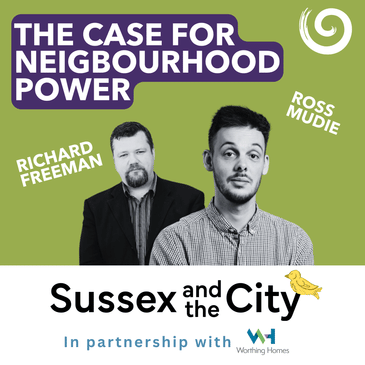
The Case For Neighbourhood PowerHost: Richard Freeman Guest: Ross Mudie – Independent Commission on Neighbourhoods (ICON)
🔍 Episode summaryIn this episode, Richard Freeman speaks with Ross Mudie from the Independent Commission on Neighbourhoods (ICON) about some of the biggest questions facing Sussex as local government is reorganised and a new mayoral authority begins to take shape.
ICON, chaired by former Cabinet Minister Baroness Hilary Armstrong, is examining why some neighbourhoods continue to experience poor health, low opportunity and entrenched disadvantage despite decades of regeneration programmes and public investment. Its work argues that neighbourhood renewal depends not only on funding, but on rebuilding the relationships, institutions and community capacity that allow places to thrive.
Richard and Ross explore the idea of 'double disadvantage', and communities experiencing economic hardship while also lacking the social infrastructure, local organisations and civic confidence needed to influence decisions and improve everyday life.
The conversation examines why deprivation in Sussex remains persistent in places such as Hastings, how transport, housing, health and employment reinforce one another, and whether Sussex's new governance arrangements can strengthen neighbourhood action rather than unintentionally weakening it.
This is a conversation about power beyond simply where it sits, but how communities can genuinely share it.
---
This episode is brought to you in partnership with Worthing Homes, providing affordable homes and supporting thriving communities across the Sussex coast.
Worthing Homes believes that creating a good home is only the beginning. Working alongside residents, local organisations and public sector partners, they invest in neighbourhoods where people can feel secure, connected and able to fulfil their potential. From improving homes and supporting health and wellbeing to helping communities become stronger and more resilient, Worthing Homes is committed to building places where people don't just live, but belong. To find out more, visit worthinghomes.org.uk.
🎯 In this episode- What the Independent Commission on Neighbourhoods is investigating
- Why some neighbourhoods remain disadvantaged for decades
- The meaning of 'double disadvantage'
- Why community organisations matter as much as physical regeneration
- Lessons from Hastings and other coastal communities
- The relationship between housing, health, transport and employment
- How local government reorganisation could affect neighbourhoods
- Why communities need more than consultation
- Whether devolution can strengthen neighbourhood power
- What long-term neighbourhood renewal really requires
ICON argues that lasting regeneration requires communities to have the confidence, institutions and influence to shape decisions—not simply receive funding programmes.
Deprivation is interconnectedPoor health, unemployment, housing quality, transport and public safety reinforce one another. Improving neighbourhoods requires joined-up action rather than isolated interventions.
Social infrastructure matters more than everCommunity centres, local partnerships, trusted organisations and informal networks create the foundations that enable neighbourhoods to become more resilient.
Bigger institutions need stronger local relationshipsAs Sussex moves towards larger unitary councils and a strategic mayoral authority, maintaining local knowledge and neighbourhood voice will become increasingly important.
Community organising is unequalWealthier communities often have greater capacity to organise, campaign and influence decisions. More disadvantaged neighbourhoods may require active support to build the same level of civic power.
Leadership is about what you doRoss argues that successful devolution will depend less on constitutional structures and more on how local leaders use their powers to improve people's everyday lives.
💬 What Ross says"Deprivation is sticky."
"There are always people with ideas who want to improve their community."
"Businesses won't invest where the social foundations aren't strong."
"If you simply hope communities organise themselves, don't be surprised when they don't."
"It's less about the model and more about what you do with it."
🏘️ Why neighbourhood power mattersRoss argues that successful places are built from the neighbourhood up. Communities with trusted organisations, active residents and strong local relationships are better able to respond to change, attract investment and improve quality of life. As Sussex develops new regional institutions, the challenge will be ensuring neighbourhoods become more influential, not more distant from decision-making.
👤 About Ross MudieRoss Mudie is Head of Research Analysis at the ICON, where he leads research into the social and economic challenges facing England's most disadvantaged communities. Before joining ICON, he was a Senior Research Analyst at the Centre for Progressive Policy, specialising in regional economics and place-based policy. He has also worked at United Nations University–MERIT and in local government policy. His work focuses on neighbourhood regeneration, economic opportunity, social infrastructure and how national and local policy can tackle entrenched disadvantage.
🎧 Production creditsHost: Richard Freeman Guest: Ross Mudie Sound design / editing / original music: Chris Thorpe-Tracey Production management: Letitia McConalogue
📣 Get involved👉 https://sussexandthecity.info — episodes, resources and events
👉 https://sussexintelligence.com — research, insight and analysis on Sussex's future