
– Episode #56
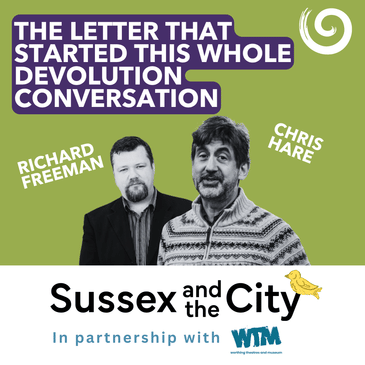
The Letter That Started This Whole Devolution ConversationHost: Richard Freeman Guest: Chris Hare – historian, writer, community educator
🔍 Episode summaryThis episode goes back to where Sussex And The City effectively began.
Well over a year before this episode was released, Worthing historian Chris Hare distributed an open letter to thousands of local households questioning the rapidly emerging plans for Sussex devolution and local government reorganisation. One of those letters landed on Richard Freeman's doormat, and helped prompt the conversations that eventually became this podcast.
Much has changed since Richard and Chris recorded this conversation. At the time, Sussex appeared to be heading towards a mayoral election in May 2026. That election has since been postponed until 2028; the government has confirmed its preferred structure for East Sussex and Brighton & Hove, subject to approval; and the final decision for West Sussex has been delayed until October 2026.
But that makes this conversation more interesting rather than less.
Chris questions whether what Sussex is experiencing is really devolution at all. If power is genuinely being transferred closer to communities, he asks, why do so many important decisions and resources remain concentrated in Whitehall? And why reorganise councils before addressing the financial pressures that have left many local services struggling?
Richard asks whether larger authorities could eventually have the scale to take on more responsibility? Could a Sussex mayor build the strategic capacity needed to tackle transport, infrastructure, economic development and perhaps eventually issues such as water? And could reconnecting Sussex as a political geography create a stronger regional identity?
The result is a deliberately sceptical conversation about something often missing from the technical discussion of devolution: democratic legitimacy.
Because reorganising institutions is relatively straightforward. Persuading people that the institutions belong to them is much harder.
---
This episode is brought to you in partnership with Worthing Theatres and Museum, Worthing's home for live entertainment, heritage, cinema, exhibitions and cultural experiences. Across venues including the Connaught Theatre and Cinema, Pavilion Theatre, Assembly Hall and Worthing Museum, WTM plays an important role in the cultural and civic life of the town – making it a particularly fitting partner for a conversation about local identity, heritage and belonging. Find out more at wtm.uk.
🎯 In this episode- The letter that helped inspire Sussex And The City
- Why Chris Hare became concerned about devolution
- Whether people actually asked for local government reorganisation
- The difference between institutional reform and genuine devolution
- Why council finances matter more than council boundaries
- Whether a Sussex mayor will have enough meaningful power
- Water, public services and the limits of local control
- The tension between efficiency and genuinely local government
- Why Greater Manchester may not be an easy model for Sussex
- Public consultation, political cynicism and democratic trust
- Whether Sussex still has a meaningful shared identity
- The risks of concentrating power in a directly elected mayor
- Whether independents could reshape politics in the new unitary councils
Chris's central challenge is that changing boundaries and institutions does not automatically move meaningful power towards communities. His test is about who controls the money, who controls essential services, and who can actually make decisions?
The legitimacy question has not disappearedThe timetable may have changed since this conversation was recorded, but Chris's underlying challenge remains about whether residents understand why these reforms are happening, and do they believe they have meaningfully influenced them?
Scale creates a democratic trade-offLarger authorities may be able to coordinate services and infrastructure more effectively. But the bigger the geography, the greater the risk that government feels remote. The debate is therefore not simply about the right-sized council, but about how strategic scale and neighbourhood power coexist.
Sussex identity could become more importantChris recognises Sussex as an unusually ancient political geography, while also acknowledging that today's county bears little resemblance to historic Sussex. Devolution could nevertheless provide a new reason for people to reconsider what Sussex means as a contemporary place.
A mayor needs more than powersThe discussion highlights an overlooked element of mayoral government - personality and leadership. Formal powers matter, but so do the ability to convene, persuade, build public trust and make a new institution feel relevant.
Political apathy is an outcome, not an explanationChris draws on historically much higher election turnouts to challenge the idea that people simply aren't interested in local democracy. His argument is that people participate when they believe institutions matter and their involvement can change something.
💬 What Chris says"Why bring about changes that no one's asked for?"
"Democracy depends, one, on people being informed and, two, on people being engaged."
"To me, devolution is about giving power to the people."
"Whatever you create, the first thing you've got to do is convince people that it's a thing and that they relate to it."
"Creating new elected posts, if they haven't got the real power and they haven't got the real resources, won't cut the mustard."
✉️ The letter that started the conversationChris distributed around 3,000–3,500 copies of his open letter across different parts of Worthing, deliberately trying to reach different neighbourhoods, ages and economic circumstances.
Some residents shared his concerns; others essentially told him there was little point objecting because the changes would happen anyway.
That second response becomes one of the most important threads in the episode. If people assume political decisions are inevitable regardless of their involvement, the problem facing devolution is much deeper than choosing the right council boundaries. It is about rebuilding the belief that participation itself matters.
👤 About Chris HareChris Hare is a Worthing-born historian, writer, oral historian and community educator whose work explores the relationship between Sussex's history, local identity and contemporary community life.
He has researched and written about local history since his teenage years and has led community history projects across Sussex through History People UK. Chris also brings direct experience of local politics: he served as a West Sussex County Councillor from 1989 to 1997 and stood for Parliament in Worthing West at the 1997 general election. Although he subsequently stepped away from party politics, he has remained closely involved in Worthing's civic life.
🎧 Production creditsHost: Richard Freeman Guest: Chris Hare Sound design / editing / original music: Chris Thorpe-Tracey Production management: Letitia McConalogue
📣 Get involved👉 sussexandthecity.info — episodes, resources and events
👉 sussexintelligence.com — research, insight and analysis on Sussex's future