
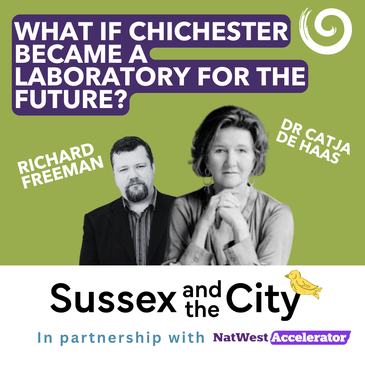
The Sussex And The City Podcast
– Episode #58
Can Chichester Become A Laboratory For The Future?Host: Richard Freeman Guest: Dr Catja de Haas – architect, urbanist and co-founder of Chichester Laboratory
🔍 Episode summarySussex is being encouraged to think bigger. One strategic authority. Sussex-wide approaches to growth, housing, transport and prosperity. Decisions that previously sat within individual councils will increasingly need to make sense across a region stretching from Chichester to Hastings.
But where does that leave the small, local and experimental?
Dr Catja de Haas thinks Chichester might provide part of the answer.
An architect and urbanist who grew up near Amsterdam, studied in Delft and Barcelona, worked in Japan and later studied housing and urbanism in London, Catja has spent much of her career thinking about places facing change: particularly smaller coastal cities trying to grow without losing what makes them distinctive.
She is now one of the people behind Chichester Laboratory, an experiment in bringing architects, planners, academics, universities, residents, campaigners and other local voices together around real problems facing the city.
And the problems can be very specific.
What should happen to old fibreglass boats? How could polluted waterways be tackled? What would make cycling genuinely viable? Could underused land within the city provide better housing? How do you build new homes without creating developments where everyone remains dependent on a car?
Rather than starting with another grand strategy, Chichester Laboratory starts with the problem and tries to connect it with people who might be able to do something about it. Catja describes it almost as a dating platform for civic problem-solving: a local issue might find a university researcher, an architect, a community group or a professional with relevant expertise, with the Laboratory helping an idea move towards research, testing and eventually a real project.
That also leads Catja to an interesting challenge to conventional thinking about community engagement.
Listening to people matters, but communities cannot be expected to arrive with all the answers. Sometimes good engagement also means bringing expertise into the room, showing people what has worked elsewhere and helping them visualise possibilities they may never previously have encountered. As Catja puts it: "You don't know what you don't know."
Her native Netherlands provides an obvious example. Amsterdam's cycling culture can appear inevitable from the outside, but it was created through political choices and changes that were themselves contested. Showing how another place made that transition can expand the range of things a community believes might be possible.
And this is where a relatively small experiment in Chichester connects with the much bigger Sussex devolution story.
A strategic authority needs to operate at scale. But Chichester has its own geography, economy, history and problems. Catja's argument is that strong local capacity to research, experiment and organise can sit alongside regional scale – generating ideas and evidence that can then feed upwards and, where something works, potentially be replicated elsewhere.
Her ambition is for Chichester to become a small pioneering city; somewhere that tests better approaches to housing, water pollution, climate adaptation, transport and sustainable urban life, while retaining the character that makes it Chichester.
Perhaps Sussex doesn't need to choose between thinking bigger and thinking smaller.
---
This episode is brought to you in partnership with the NatWest Accelerator Hub at the University of Brighton. Designed particularly for ambitious founders and early-stage businesses, including those with four or fewer employees, the Hub provides free workshops, expert coaching and practical support around finance, sales, funding and leadership, alongside a dedicated app and business community.
🎯 In this episode- Why Catja de Haas chose to make the Chichester area her home
- What Chichester can learn from cities in the Netherlands and elsewhere
- Why smaller cities can be useful places for experimentation
- What the Chichester Laboratory actually is
- Bringing academics, professionals and communities together around real problems
- The Laboratory's research festivals
- How universities could become more directly involved in solving local challenges
- Why old fibreglass boats have become an urban research question
- The potential for researchers-in-residence, hackathons and design charrettes
- Why Catja wants the Laboratory to remain small and lightweight
- Moving from research and conversation into real developments
- Housing as the issue that connects almost everything else
- Why apparently sustainable housing can still create unsustainable places
- Infill, density and alternatives to car-dependent development
- Water pollution and Chichester's environmental challenges
- What Amsterdam's cycling history can teach Sussex
- Why community engagement needs expertise as well as listening
- How local experimentation could influence Sussex-wide plans
- Catja's ambition for Chichester to become a model sustainable city
Catja doesn't envisage the Chichester Laboratory becoming another large institution with its own bureaucracy.
She describes something deliberately light, more like a platform that connects problems, people, research and potential solutions.
The longer-term ambition includes a database of research about Chichester, relationships with UK and international universities, researchers-in-residence and focused charrettes or hackathons around particular urban problems.
Success ultimately means ideas becoming projects rather than accumulating as reports.
Housing connects almost everythingFor Catja, housing is perhaps Chichester's most important challenge because it intersects with so many others.
A house can be highly insulated, fitted with solar panels and technically efficient while still being part of an unsustainable development if its location means every resident needs a car.
She is interested instead in questions of density, infill, connectivity and how Chichester can provide good housing within a compact city – including homes for people such as hospital workers and teachers.
Communities shouldn't have to invent every solution themselvesCommunity engagement is vital, but Catja questions the assumption that lived experience means residents should also be expected to know every possible solution.
People know their place and their experiences. Architects, researchers and specialists may know what has been tried elsewhere.
Bringing those forms of knowledge together can be considerably more productive than repeatedly asking a community what it wants without expanding the possibilities available to it.
"You don't know what you don't know"Cycling provides Katja's clearest example.
The Netherlands is now so closely associated with cycling that it can seem culturally inevitable. But Katja remembers a process of change in which reducing the dominance of cars was itself controversial.
For Chichester, international examples can therefore do more than provide technical answers. They can demonstrate that apparently unrealistic change has happened elsewhere – and help shift expectations about what might be possible locally.
Devolution mustn't make everywhere the sameKatja is cautious about predicting whether devolution will necessarily be good for Chichester. Much will depend on the quality of the eventual plans and the people making the decisions.
Her concern is that the city's particular character and challenges should not disappear inside something too generic.
The opportunity is for strong local networks to generate ideas and evidence that can feed into the wider Sussex system while retaining Chichester's distinctive identity.
🧪 What would a Chichester Laboratory actually do?The model Catja describes is somewhere between a research network, civic laboratory and matchmaking service.
A resident or local organisation might identify a problem. A university could research it. Architects or planners might explore possible interventions. Campaigners and communities could contribute their experience. Researchers from other countries might show how similar problems have been tackled elsewhere.
The Laboratory can then help connect those people.
Its early 'research festivals' have deliberately mixed professional and community perspectives, with contributions ranging from architecture and urban planning to citizen research and environmental campaigns.
Catja would eventually like to see a searchable body of research about Chichester, more formal relationships with universities, researchers spending time in the city and short, intensive hackathons or design charrettes focused on particular problems.
But the crucial test comes afterwards.
Can research turn into an intervention? Can an idea attract investment? Can professionals take it forward? Can something actually get built or changed?
For Catja, the Laboratory succeeds when it helps move from talking about a place to doing something in it.
🏘️ What could Chichester experiment with?Several practical challenges emerge from the conversation.
Better housing
Explore infill, density and new forms of development that provide genuinely useful housing without automatically creating further car dependency.
A cycling city
Learn from places such as Amsterdam about the infrastructure and behavioural change needed to make cycling an ordinary means of getting around rather than a marginal alternative.
Cleaner water
Connect campaigners, researchers, policymakers and specialists around sewage and pollution rather than allowing the issue to become only a source of anger between different sides.
Fibreglass and abandoned boats
Explore the environmental impact of ageing fibreglass vessels and whether universities, designers and researchers can develop practical approaches to reuse or recycling.
Climate adaptation
Use Chichester's manageable scale as a place to test practical responses to climate change and sustainable urban living.
The individual projects may be small. The interesting question for devolution is whether successful experiments could then inform investment and policy elsewhere in Sussex.
👤 About Dr Catja de HaasDr Catja de Haas is an architect and urbanist and one of the directors of the Chichester Laboratory.
Originally from the Netherlands, she studied architecture at Delft University of Technology, including study in Barcelona, where her thesis explored the pressures tourism placed on the identity of a coastal town.
She subsequently worked with architectural practices in Japan before moving to the UK, initially intending to stay for two years. Three decades later, she remains here.
Katja completed a PhD by design at UCL examining the idea of home and also studied housing and urbanism at the Architectural Association. Her work has repeatedly returned to questions of housing, coastal places, tourism, identity and how cities adapt to change.
She now combines her architectural practice in London with her work in and around Chichester, where the Chichester Laboratory is developing new connections between local challenges, professional expertise, academic research and community knowledge.
🎧 Production creditsHost: Richard Freeman Guest: Dr Catja de Haas Sound design, editing and original music: Chris Thorpe-Tracey Production management: Letitia McConalogue
📣 Get involved👉 sussexandthecity.info — episodes, resources, events and more about devolution and change across Sussex
👉 sussexintelligence.com — independent research and evidence-led insight into growth, infrastructure, governance and belonging across Sussex
[00:00:00] This episode is brought to you in partnership with the NatWest Accelerator Hub at the University of Brighton. If you're an ambitious founder or running an early stage business with four or fewer employees, you may be too early for many established business support programmes. The new NatWest Accelerator Hub at the University of Brighton is designed for businesses at every stage of growth. Through free workshops, expert coaching and practical support covering finance,
[00:00:29] sales, funding and leadership alongside a dedicated app and business community, it helps founders build the confidence and skills to grow sustainably. To find out more, search NatWest Accelerator Brighton or visit natwest.com forward slash business forward slash accelerator. That's natwest.com forward slash business forward slash accelerator.
[00:00:58] NatWest Accelerator This podcast is brought to you by Always Possible. Always possible.co.uk You're listening to Sussex And The City with Richard Freeman. Richard Freeman Sussex is starting to think much bigger. One housing plan, one transport plan, one growth strategy, one prosperity plan, one new strategic authority with its thinking covering
[00:01:27] places as different as Hastings, Brighton, Crawley, Worthing, Crowborough, Erridge, Horsham, Midhurst, Chichester. But perhaps one of the really interesting questions is where does the small and the experimental and the hyperlocal test and learn sit within the bigger, bigger, bigger? When individual towns and cities
[00:01:53] become laboratories for solving very particular problems, housing, transport, pollution, sustainability, public spaces, and then are able to share what works from that at scale to the whole region, you get something quite unusual and you get something perhaps different to what Sussex is used to. I'm Richard. Hello. This is the Sussex and the City podcast. Delighted to have you with me.
[00:02:18] And my guest today is Dr. Katja de Haas, an architect, urbanist, and one of the people behind the Chichester Laboratory. Katja grew up near Amsterdam, studied architecture in Delft and Barcelona and worked in Japan before studying housing and urbanism in London. And across all of that work, she's continually been asking the same question, how do places change without losing what makes them
[00:02:43] distinctive? And the Chichester Laboratory is attempting to do that and to answer that question in a very practical way. It brings together architects, planners, academics, universities, residents, campaigners, and other local voices around specific challenges facing Chichester, from housing and cycling to polluted waterways and what happens to old fiberglass boats. Very, very specific problem to Chichester, but with learning that could perhaps be shared wider.
[00:03:12] And the idea is to not have another talking shop and an introspective space to just moan about what's wrong. It's to connect problems with people who might actually be able to solve them, bringing international ideas into a very local setting, testing things, building evidence, and then turning some of these ideas into real projects. Katja also has an important challenge to the way we often talk about community engagement. Listening to people matters enormously,
[00:03:40] but endlessly asking communities what they want without bringing expertise, visualising what good might look like, showing possibilities, testing different solutions when ideas are brought to the table, then you can end up with its own kind of failure where people have been engaged but there's no result. So as Sussex prepares for devolution, could places like Chichester build their own local
[00:04:06] capacity to experiment, organise, and shape what comes next? Could this extraordinary cathedral city, nestled between the downs and the sea, become somewhere that pioneers better housing, cleaner water, easier cycling, and a different approach to sustainable urban life? And crucially, could these local experiments influence the much bigger decisions that will soon be made across the
[00:04:32] whole of Sussex? This is Sussex in the City, and this, my friends, is Dr Katja de Haas. We are recording this in the height of the searing heat. It feels like Spain, but it's worthing,
[00:04:58] so who knows? Delightfully joined, though, by somebody who I've only met very, very, very briefly at an event in Chichester at the beginning of the year. I was on a panel for the Chichester Chamber of Commerce talking about devolution. And this lady came and spoke to me at the end, and I thought I had a really interesting proposition around place and innovation in Chichester, and I was really keen to get her on the pod at some point. So I'm really glad that she
[00:05:24] said yes, and I'm really glad we're speaking today. So I'd love to introduce you to Katja de Haas, an architect, and a kind of urban planning expert who's doing really exciting things in Chichester, which we're going to explore. So before we get into all of that, how are you today, Katja? Very well. Bit hot, like you just mentioned. But yes, it is a beautiful place to be, Chichester.
[00:05:48] Let's start with you first and your story. Your name and accent would suggest you're not a Sussex native, or certainly not a Chichester native, perhaps. So tell me a little bit about your roots and your journey and how you've landed here. I'm from the Netherlands, and I studied at Delft University, which is quite a practical university with a lot of emphasis on housing. And we ended up in England, and we were going to stay
[00:06:17] for two years, but that's 30 years ago. And then we found the Chichester area, which reminded us a lot of the Netherlands, funny enough, with the water, the city, the old city, and all its possibilities. I studied in Delft, and half in Barcelona. My thesis project was in Barcelona. The site was in Barcelona on the Costa Brava, again, a coastal city where a lot of tourism
[00:06:46] was threatening the identity of the town, where the local population didn't know what to do. So we looked at all those issues that coastal towns face. Then I worked in Japan for three years with architecture firms, and then I came to London, where I did a PhD by design at UCL on the idea of the home. I also did an extra master's in housing and urbanism at the Architects Association, where
[00:07:15] we again looked at a rural coastal town, Viareggio in Italy, where again, it was very touristy. The city was looking for identity. It had a very long tradition, but they didn't know how to deal with hotels, the local population, how to give it a sense for the future. And an expertise that I think Sussex would really, truly benefit from right now, which we'll get into.
[00:07:41] So Chichester is your home now, and you speak of it very fondly. What is it about the sort of Chichester character, topography, Chichester people that you like so much? I have my practice in London, a small practice, so I've both. But what I like about Chichester is that everything is relatively small, so it's relatively easy to bring different groups and specialties
[00:08:06] together around specific issues. And that's what I've liked. And then I, of course, love that it's a compact city, an old cathedral city, beautiful. I love that it's the downs and the sea. It has everything. It's probably at a juncture where a lot of things need to happen in order to get enough housing for
[00:08:30] the people who live there and to explore its potential more. It has Palland House, it has Chichester Festival Theatre. It has all the things a city should have, but it's still manageable and small. And obviously it's had a very important part to play in the West Sussex story, being the sort of the county town and the seat of the county council, and obviously there's Roman history as well.
[00:08:56] But it's going to be interesting to see how it plays a bigger role within the Sussex region, you know, the Sussex county as a whole. And I think probably culturally looks a little bit more west to Portsmouth or to Hampshire than it does perhaps feel linked to the far east end of East Sussex. I think it's going to be an interesting journey sort of culturally as things start to get explored or realigned. Tell me a little bit about your, the more experimental work that you're
[00:09:26] doing in Chichester then, the Chichester laboratory, how you're bringing your skills as an architect to to some of the new questions that Chichester perhaps needs to be asking. What we're trying to do with Chichester Laboratory, until now we've organized a series of events, is try to bring as many people and subjects together around Chichester. So we try to almost be like a dating platform between academics, professionals, often architects, planners,
[00:09:55] and also hopefully counselors, local protest groups, local groups, and see how people can sort of get together around real issues. Around cycling for example. Every subject has ramifications and actually is at a cross section of different disciplines. So if you make the housing better,
[00:10:22] you can sort of make design them in such a way that people can cycle everywhere, which will relieve the roads. The other issue is for example, fiberglass boats. In Brighton, Karina Chung has done a lot of research in the polluting aspects of fiberglass and she's been building a group of people around that.
[00:10:44] People are not that keen on recycling fiberglass in general, but it might be a possibility. So maybe then invite architect university to see if they can come up with ideas about recycling boats. There needs to be awareness raising about recycling boats. So just these fiberglass boats can bring together lots of disciplines. This can be the
[00:11:09] same for housing because housing brings together so many people. And involving universities on specific topics is also good. So then a lot of the research or information does not get lost, but it goes directly to the people who need it. We're also trying to involve more international universities and we're talking to quite a few at the moment.
[00:11:32] I can't disclose yet, but it's also really good to see how other cities, for example, Amsterdam and Venice have addressed these issues. So again, to see how we can bring someone from Venice or from Amsterdam. We've had an architect from Holland who's done work with housing on farms.
[00:11:51] She explains how it works in Holland and then hopefully it's an example for people here. So we just try to bring together any experts on issues that are potentially relevant for Chichester and then hopefully other people latch onto it and can work with it. It feels quite focused and targeted rather than sort of big, broad conversations, which is what happens a lot of the time, I think, in Sussex.
[00:12:16] But actually you've got some quite specific challenge areas there. So who decides that and who is the laboratory and how a democratic system or is it sort of whoever turns up? How does it work? We have now, we have three directors. John Peck, who's a landscape and urban planner. He's teaching at Portsmouth. Lottie John, who's doing the Harbour Oyster Project and me.
[00:12:45] And then we have 12 advisors who range from an urban planner with a PhD in coastal cities, Rudina Alcani to Jay Morton, who's an architect and then 12 others who all have a specialty. And it's been anyone who's been interested has been able to join or to talk about.
[00:13:09] On the one hand, the projects are very targeted, like I said as an example. On the other hand, we try to keep it very open and see who will be interested in joining around specific projects. But we're all at the beginning of setting it up. So I think that's a very good question to see how democratic and how we can sort of make sure that as many people can profit from this. We've organized a series of research festivals, which are accessible to anyone.
[00:13:36] There we have lots of people presenting from SOSCA, Safer South Coast Alliance, to Bill, who presented a citizens research project. But we also had an architect, Antonio Moore, who presented his work with Ramd Earth. We had someone from France, Angie Davis, who has been setting up a citizens research project into looking at abandoned boats and how fiberglass is in Oyster.
[00:14:05] So on the one hand, it's very, very wide. And we try to get as many people who want to present as possible. And you don't need a lot of qualifications as long as we deem it relevant for Chichester. And because it's been the first two festivals, I think it's been quite easy to choose. But I think the next step will probably be to see how we can keep it open while also making it targeted.
[00:14:32] You've probably got a strategy, a vision, a roadmap, maybe even a post-it note empire on your office wall. But has anyone asked the really awkward questions yet? Like, is it actually working? At Always Possible, we help senior leaders challenge the obvious, rethink the possible and deliver the extraordinary without losing their sanity or their sense of humor.
[00:15:01] Enabling private and public sector innovators to navigate a changing economy. We help complex organisations to humanise data and to translate the big picture into hyper-local engagement, trust and sustainable growth. If you're ready to bring people with you because your leadership truly inspires, visit alwayspossible.co.uk.
[00:15:29] That's alwayspossible.co.uk. Always possible. We make bold business brilliant. I think there are big questions around the role of local authorities to drive forward big change, innovation, to have the capacity and the skills to do some of this thinking.
[00:15:54] And, you know, frankly, many local authorities have not had the capacity and skills to do a lot of this thinking. So who does? And I think what you're talking about is a really good example of that, you know, kind of civic engagement meets, you know, real research and academic expertise and can bring some different sort of views to it. And I think it's beginning to happen across the Sussex coast. Actually, you know, we've got the Sussex Bay project that we've talked about on this podcast before.
[00:16:21] I've been invited to join a task force in Worthing that's looking at sort of master planning and how to redesign the town, you know, sort of taking some of that away from the council so that they can be a partner rather than have it all on their shoulders. When actually getting other voices in the room are going to be quite key for unlocking some design innovation. The Seafront Restoration Task Force in Brighton as well, which, again, the council are a partner on, but they definitely don't own.
[00:16:48] And that's got lots and lots of different national as well as local expertise looking at how do you, you know, completely redefine what a city beachfront can be and who it's for. So it feels like quite an exciting time.
[00:17:03] And not just that devolution is asking us to think about these different questions about who controls spaces and where does civic organizing coming from, but how different groups are starting to do it with some teeth and with some heft and with some clarity, perhaps. What does success look like for you? You know, what does good look like? You said you're at very early stages, but what about in a year, two years, three years, five years?
[00:17:29] And how would you like the Chichester Laboratory to interact with and have a sort of dialogue with the new strategic mayoral authority that needs to have Chichester prosperity in its site as much as it does anywhere else in the county? I think we're looking at almost like a platform where we facilitate projects to happen in the area and which has a focus in this area.
[00:17:54] Almost like a dating platform at the moment where we have a good functioning website and where people like a local maybe put a problem on the website. A university will pick it up, maybe professional will pick it up and we can facilitate the project growing.
[00:18:10] So I don't think, I think what we want to do is make it very place-based and very light because another organization with another vision and everything is that there are quite a few and I'm not sure if we can do it. But I think we will also, because we're working at the moment, for example, in Portsmouth, the students are working on Chichester and they have a unit that works on Chichester under John.
[00:18:37] And they've proposed lots of urban interventions and everything, which will be shown at their next research festival. So I think we'll create a database of all the research done on Chichester. So we can maybe also advise on the basis of that. In two years, we will hopefully get researchers in residence. So someone who's really interested in Chichester can get a grant for a two-month research and then exhibit what he's researched.
[00:19:05] The other thing we've been thinking about is doing maybe small hackathons or charrettes, as they call, where we invite people to think about specific problems. So it's cool. Yeah, it's like an urban laboratory. So we try to engage as many people on local issues. And maybe it can be replicated if it's successful, but I don't think it's a big organisation. We want to keep it light and very location-specific. I guess where I'm quite excited about it is how there may be small findings.
[00:19:35] There may be very specific bits of research. There might be some interesting ideas that get piloted and tested and some work and some don't. But actually how that starts to build a bigger picture.
[00:19:46] If we're looking at Sussex as one county or one strategic region for the first time, when we have the opportunity to leverage in tens of millions of pounds from central government, where there's opportunities to do innovation, both hyper-local but also at scale by having some different kind of attention and some levers. It's really important that that place-based work is done and really focused, but also gets noticed and recognised and is part of a wider story, perhaps.
[00:20:15] Yes, no, and of course. And I think the research, I mean, we have a lot of architects and planners, so hopefully through all the students, whatever, a good urban plan with good housing will form and we get investors around specific projects. And hopefully then they become like example projects and can be replicated elsewhere. But I think it's very important to get a group on the ground and I think it needs to be translated into action. And I think that has been the most difficult.
[00:20:44] Like you say, they are exciting times and we're all looking at the future, but it is where you clinch it into something, into real developments. Some projects maybe we can help with regenerating an area through bringing students together and different disciplines together around an area through research and through practical solutions, see what's possible.
[00:21:09] And then hopefully the next step is we will find investors and then get professionals to get in it. A lot of it is also trying to see how you can get the community behind it. Yeah, because we are at the beginning, we are still, yeah, we're still at the beginning. But I think we will maybe mostly get informed on the urban planning and on what's possible for planning.
[00:21:35] So hopefully through a lot of research, research festivals, charrettes, real issues, planning issues will be addressed, which then hopefully can also be implemented. To counter some of the polarisation that we're seeing, to rebuild trust for all sorts of reasons and complex reasons. You know, people feel a little bit unanchored, I think, away from perhaps, you know, the sort of the system, as it were, in inverted commas, that is there to support them, but they don't feel that it is.
[00:22:04] So I think the more and more grassroots up, problem-solving movements that, as you say, demonstrate the doing, as well as just the talking and the thinking, will be the route to how we engage people much, much more in that sense of place and a sense of hope about their place.
[00:22:25] Are there any other things emerging through the festivals that you've had and the conversations that you've had that you would like to see sort of workshops into something practical that hasn't happened yet? I mean, I think housing is the most important and it brings everything together.
[00:22:40] And we've had recently a development outside Chichester with housing, which are not necessarily needed, the size of the houses and the location where they are and the way they're built are just not sustainable. Even though they may be insulated well and have solar panels, a lot of the housing at the moment is maybe not. Everybody still needs a car.
[00:23:04] So if we can get a solution to getting housing and in Inville, for example, there's been a lot of research in London as well on parking spaces, some of the parking spaces that can be converted into housing and how to densify the city. So how you can get good housing in the city for also people who work at the hospital, teachers or whatever. The other issue is, of course, is the sewage.
[00:23:32] I mean, that's been a huge issue and widely reported. But again, it's better to see how we can connect people and see how we can find solutions rather than everybody getting really cross with each other. That I would like to see. I'm also interested in really getting to see what is possible because, for example, I'm from Amsterdam where everybody cycles.
[00:23:57] But in the 70s, that was definitely not something everybody did. People were actually quite angry when they moved to cycling and when the cars couldn't go certain ways. And here still people say, well, yeah, but in Holland, everybody cycles, but that will never happen here. So I think it's maybe slowly also getting the mindset of people to see, well, it has happened elsewhere. It's not that difficult. It's not that complicated. Maybe we can do things.
[00:24:26] Changing that mindset is maybe what needs to happen first. But also with international expertise. Because I think the community, you can ask the community. It's also not always clear who the community is. But you don't want to keep asking the community things without offering them solutions. I think that's a really good point. And I hear that a lot in a lot of my work, which is around community engagement and this kind of idea of lived experience.
[00:24:52] And sometimes it can go too far one way and sort of say, well, only the people that live in this space can have the expertise and the answers and the solutions. They'll know what they need and they'll know what doesn't work. But actually, that's quite a big responsibility to put on someone's shoulders to suggest that they've got all of the answers because that rarely is the case.
[00:25:12] And so the idea of just being seen and recognized and having some attention from people that really do have that expertise, that can listen and work with you and co-design things. Now, that's transformational. Exactly. And I think also you need to show people what has been done and what does work because you don't know what you don't know. Yeah.
[00:25:33] Do you think Chichester is going to benefit from devolution, from this new Sussex and Brighton county region? I don't know. And I'm not going to talk on behalf of people. I don't know. Okay. For the first time ever, there will be a prosperity plan, a growth plan, a transport plan, a housing plan that covers all of Sussex. Those new plans have got to sort of contain multitudes.
[00:26:02] They've got to show opportunity and new investment that everybody feels the ripple effect of. But I think projects like what you're doing, which demonstrate and show and are visible about what Chichester needs, how it's thinking, how some of the organizations are coming together to solve problems. You know, that is a real challenge to that sort of worst case scenario, right? I think so.
[00:26:26] And I think whatever happens, it also depends on how good the prosperity and growth plans are and who are the people going to be in charge. And I think if people don't want to be decided on over their heads. So I think it's good to have, like you say, to have a local think tank almost where we have all the possibilities and then we can feed into other things. And I think this idea can easily be, I mean, it exists in other places.
[00:26:53] But I think it is important to have a Chichester local interest group and to show what can happen. I'm sure it can fit into wider plans. But Chichester is still quite a unique city as it is with its own issues. So I think in definition you don't want that to get lost in too generic. So I think that the two can exist next to each other. What are you hopeful for?
[00:27:21] You know, what for you would be a thriving Chichester in 10, 15, 20 years time? What would you like to see more of? Well, I think Chichester Harbor was the first harbor for the Romans, wasn't it? And then King Canute set in both. And then the Bayo tapestry is in Bosom. So I think Chichester has this idea of, in history, that it's been the first. So maybe it will be like the first thriving city where people live together,
[00:27:47] where a lot of climate change things are being tackled in innovative ways. So where you can get all the new things, where a lot of the new things happen, where there's good housing for everybody, where there's no... Yeah, I mean, I think maybe if the housing gets sorted for old people and where young people can set up businesses and thriving, because there's two universities...
[00:28:16] There's a university, Chichester University, which is very active. And a big and successful further education college as well. So, you know, there's a big offer in Chichester versus some other parts of the county. It's well connected to London for other businesses. So I think Chichester can be a model for the future where they deal with climate change, water pollution and housing in innovative ways.
[00:28:46] So where the newest ideas can be implemented. I think that would be the greatest. And that would be sort of maybe in the history of Chichester, a continuation. So, yeah, but at the moment, it's just getting all the information together and seeing what is innovative and what will work and get as many people as possible to work on it. Yeah. And universities. Well, that feels like a good microcosm of what the whole of Sussex is trying to do.
[00:29:15] But actually, you've really articulated some of the unique sort of proposition that I think Chichester is offering. And I think, yeah, if it can really lean into that sort of sense as a, you know, a small pioneering city of sustainable action and thinking, you know, I think that could be a real and even bigger assets to Sussex and the southeast and the south coast than it already is. Yeah.
[00:29:41] I think every town should still think about itself and the wider picture. Wonderful. Thank you so much for your insight and expertise. Dr. Katja de Haas, thank you for being my guest on the Sussex and the City podcast. Thank you very much for having me. And it was really interesting. Thank you. Thank you.
[00:30:16] Thank you very much to this episode's guest and to you for tuning in. Sussex and the City is an independent and non-political project about devolution as it happens, explained in human. It is led by Always Possible. You can find other episodes, resources, events and blogs about change in Sussex and Brighton by visiting sussexandthecity.info.
[00:30:43] That's sussexandthecity.info. This episode was written and presented by Richard Freeman for Always Possible. The editor was me, Chris Thorpe-Tracey for Lo-Fi Arts. I did the music too. Production management was by Letitia McConnellogue for Always Possible. Talk to you next time.
[00:31:07] Always Possible.co.uk