
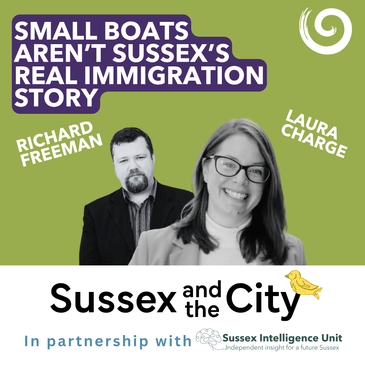

– Episode #58
Small Boats Aren't Sussex's Real Immigration StoryHost: Richard Freeman Guest: Laura Charge – Immigration Consultant and former Home Office immigration specialist
🔍 Episode summaryFor all the heat around immigration, the national debate has become remarkably narrow. Small boats, asylum hotels and border control dominate the conversation. But look at immigration from Sussex rather than Westminster and there is a different picture.
International workers are staffing care services, hospitals, hotels and restaurants. Farms and horticultural businesses rely on overseas labour. Schools recruit internationally. Technology and gaming companies compete globally for specialist talent. Crawley is home to a significant Chagossian community, while Brighton & Hove has been shaped by successive waves of people choosing to make the city their home.
Laura Charge has spent her career seeing this system from both sides. She joined the immigration service at 17, worked within the Home Office system and now runs an immigration consultancy from Horsham, helping businesses, schools and individuals navigate rules that can be bewilderingly complex.
Her conversation with Richard Freeman starts with the fact that asylum is only one small part of immigration. Laura describes around 40 lawful routes into the UK, covering work, study, family, settlement and other circumstances. For Sussex employers trying to fill vacancies or recruit specialist expertise, those routes are not an abstract political issue. They can determine whether a business can find the people it needs.
That presents an intriguing problem for devolution. A future Sussex mayor will have considerably more responsibility for skills, employment and economic growth, but virtually no control over immigration. What happens when Sussex knows it needs nurses, care workers, engineers, programmers or hospitality staff, but the policies governing who can come here are designed nationally?
And if devolution encourages Sussex to think of itself more consciously as a region, who gets included in that story? Someone whose family has lived here for generations? A Chagossian family in Crawley? An international student who stays after graduating? Someone who moved down from London? Or, as Laura points out, someone who crossed the border from Kent?
This conversation attempts to get beyond a debate dominated by crisis and look instead at immigration as it is actually experienced by a place: through businesses, jobs, families, skills, communities and the continual movement of people.
---
This episode is brought to you in partnership with the Sussex Intelligence Unit, the independent research platform from the team behind Sussex and the City, providing evidence-led insight into growth, infrastructure, governance and belonging across Sussex.
🎯 In this episode- Why the national immigration debate tells only a small part of the Sussex story
- The difference between asylum and the UK's many other immigration routes
- Laura's experience working inside the Home Office immigration system
- How businesses navigate sponsorship and immigration rules
- Why smaller employers can find the system particularly difficult
- Sussex's reliance on international workers and specialist skills
- Recruitment pressures in health, care, hospitality and agriculture
- International talent within Sussex's technology and gaming industries
- The Chagossian community in Crawley
- Why immigration can be less visible in Sussex than in some other parts of Britain
- The relationship between immigration, economic growth and skills policy
- What a future Sussex mayor could – and could not – influence
- How devolution raises questions about identity and belonging
- Why Sussex cannot simply assume people will always want to come here
The Sussex economy needs people. Some skills can and should be developed locally, but employers also recruit nationally and internationally. Immigration policy therefore has direct consequences for businesses, public services and the region's capacity to grow.
The immigration system is much bigger than small boatsLaura describes around 40 lawful routes through which people can come to the UK. Work, study, family and settlement are all significant parts of the system, but are frequently overshadowed by the political and media focus on irregular Channel crossings.
Devolution creates an unusual mismatch of powersA future Sussex mayor will have greater influence over skills, employment and economic strategy without controlling immigration policy. Sussex could therefore become better at understanding exactly which workers and skills it needs while remaining dependent on decisions made in Westminster about who can come to Britain.
Smaller businesses face particular frictionLarge employers can afford specialist HR teams, lawyers and immigration support. Smaller organisations may have exactly the same need for international expertise but face a disproportionately complicated process when trying to recruit it.
Belonging is more complicated than birthplaceCreating a stronger political identity around Sussex inevitably raises questions about who belongs within it. The county's communities have always been shaped by movement – both international migration and people arriving from elsewhere in Britain.
Sussex cannot take its attractiveness for grantedThe county has powerful advantages: its coast, countryside, culture, universities and proximity to London among them. But attracting and retaining people also requires good jobs, housing, infrastructure, education and communities in which people can see a future for themselves.
🧭 What does this have to do with devolution?Immigration itself is not being devolved. Decisions about visas, asylum, settlement and citizenship remain matters for national government.
But many of the consequences of migration – and many of the reasons people move – intersect directly with the responsibilities of the emerging Sussex strategic authority.
Skills shortages affect economic growth. Migrant workers support important sectors of the economy. Housing and transport affect whether people can take available jobs. International talent can determine whether specialist businesses choose to invest and expand here. And questions of identity and community cohesion matter to the wider sense of belonging that accompanies the creation of a stronger Sussex-wide political geography.
The challenge for a future mayor is therefore not to devise a Sussex immigration policy, but to understand how national immigration policy interacts with the economic and social reality of Sussex – and to represent that reality intelligently to Westminster.
👤 About Laura ChargeLaura Charge is an immigration consultant based in Horsham, West Sussex, with extensive experience of the UK immigration system.
She began her career with the immigration service at just 17, initially working at the Port of Dover, before going on to work across the Home Office immigration system.
Today, Laura runs her own consultancy, supporting individuals, employers and educational institutions to understand and comply with UK immigration requirements. Her work includes helping businesses navigate sponsorship and recruitment, supporting independent schools with international students and specialist staff, and helping individuals understand lawful routes to remain and settle in the UK.
Her perspective combines experience from inside the national immigration system with the everyday reality of helping employers and individuals navigate it at local level.
🎧 Production creditsHost: Richard Freeman Guest: Laura Charge Sound design / editing / original music: Chris Thorpe-Tracey Production management: Letitia McConalogue
📣 Get involved👉 https://sussexandthecity.info — episodes, resources and events
👉 https://sussexintelligence.com — research, insight and analysis on Sussex's future
[00:00:00] This episode is brought to you in partnership with the Sussex Intelligence Unit, a new independent research platform from the team behind Sussex and The City. Sussex is changing. Devolution is reshaping how major decisions and major investment gets made. But without the right evidence, how can it deliver what our communities need? The Sussex Intelligence Unit answers that challenge. It's the first independent cross-sector platform to look at growth, infrastructure, governance and belonging across East Sussex,
[00:00:29] West Sussex, Brighton and Hove. New data, fresh analysis, evidence-led insight designed to put businesses, voluntary sector organisations and policy makers ahead of what's next. Because the decisions made today will shape Sussex for a generation. For the intelligence you need, visit Sussex Intelligence. This podcast is brought to you by Always Possible. AlwaysPossible.co.uk
[00:01:01] You're listening to Sussex And The City with Richard Freeman. Hello, I'm Richard Freeman and this is Sussex and The City podcast. Welcome to you and thank you for joining. Before we get into today's conversation, I want to acknowledge something that has happened very close to home this week. On the Tuesday before this episode is released, three members of the same family very sadly died after getting into difficulty in the sea
[00:01:26] near Shoreham Fort. Hassan El-Kawaz, his partner Zayna Alain and their 14-year-old daughter Sarah all lost their lives. A younger girl from the same family remains at time of recording critically ill in hospital. They travel down from their home in London for a sunny holiday visit to Shoreham. And the Sussex Police View, having reviewed all of the evidence and the CCTV and the major emergency
[00:01:53] services operation that tried to save them concluded that this was a very tragic accident. It's an absolutely awful family tragedy and for those of us that live around here and know this stretch of Sussex coast really well, it does feel particularly close. There's another reason why I wanted to mention it at the beginning of this episode, because as more information has emerged about this very ordinary family coming down
[00:02:20] for a seaside trip. Some of the attention has focused on the fact that Hassan was originally a Palestinian refugee, although his family have been based in the UK for 20 years. But what happened is that some of the conversation online stopped being about a family who'd suffered an unimaginable tragedy and therefore, for the grace of God, go I, you know, could have happened to any of us.
[00:02:45] But instead it's become a conversation about immigration. And as tends to happen on social media, this has brought out the very best and the very, very worst in people. Of course, and rightly and encouragingly, there has been an enormous amount of sympathy, sadness and humanity, especially from communities in Shoreham and across West Sussex. But there's also been speculation,
[00:03:11] assumption and some very, very grim commentary based on the questions around who this family were, where they'd come from and why they were in Sussex in the first place. Even some people spreading huge misinformation that they'd been camping locally and applying for asylum. As I said, this family had been here for 20 years. They were on a day out to the seaside, like so many people.
[00:03:36] This accident should not be a political talking point. It is about a family that has had a tragedy. But it does tell us about something on the atmosphere in which we are trying to have serious conversations about topics like immigration. And that is what this episode was always going to be about before I recorded this intro and before this horrible news of this week.
[00:04:02] But I felt it adds a particular poignancy and a demonstration of the sort of febrile online battle for space to have a grown up conversation about immigration. My guest in this episode is Laura Charge. Laura is a former home office immigration specialist who now runs her own immigration consultancy from Horsham. Laura spent much of her career in the machinery of the immigration system. She started
[00:04:31] incredibly young working at the port of Dover and she went on to work across the immigration system and now helps individuals, schools and businesses navigate what is frankly an extraordinarily complicated set of rules. This conversation is not about whether anyone is for or against immigration. That very framing is obviously a big part of the problem.
[00:04:54] What we discuss is about what immigration actually looks like when you move away from the politics and look at the real impact on a place and an economy. And Sussex is a really interesting place in which to focus that conversation and devolution adds another layer. We're going to talk about the migrant communities that already make up parts of Sussex and many that go completely under the radar like the large Chagos Island community
[00:05:19] and Crawley. Some of the less obvious international communities that have built homes around Brighton and Hove and broad communities. We talk about why Sussex perhaps doesn't always look like a county shaped by immigration despite it being woven through its economy and its community for centuries. And then there is the economy itself. Care, health, hospitality, tourism, agriculture, horticulture, education, technology, the game sector, advanced engineering. These are all important parts of the
[00:05:49] Sussex economy and nearly all of them depend on people and skills coming from outside the county and often outside the country. Laura talks about businesses struggling to recruit particular skills, schools bringing in specialist teachers, international students, small employers trying to understand sponsorship rules and highly specialised businesses needing access to global talent. And we get into something extraordinary. Laura says there are 40 different lawful immigration routes
[00:06:18] into the UK right now, 40, which seems to contrast with a national immigration conversation that can sometimes make it sound like there is only one route into Britain and that involves a small boat. So what's that got to do with devolution? Well, immigration policy of course itself is not being devolved to Sussex and a Sussex mayor isn't going to start issuing visas from an office in Crawley. But the strategic authority and the eventual new mayor will have responsibilities around economic growth,
[00:06:45] skills, investment, the labour market, public health, police and crime. And so there's an interesting tension here. Sussex could become much better at understanding exactly what skills its economy needs, where the shortages are, which industries could grow, which businesses could invest here, and which people we need to attract and retain. Many of the levers determining whether those people can actually come here, feel safe here, build homes here, will remain in Westminster.
[00:07:15] But underneath all of this is a bigger conversation about place, about who gets to belong in Sussex, who gets to belong to Sussex, and who decides. Is somebody more Sussex because their families lived here for generations? What about people who moved from London 20 years ago, the DFLs? What about people who've come from Germany to work in quantum technology from Brazil, because they once watched a Fatboy Slim concert and wanted to join the diaspora in Hove?
[00:07:45] Sussex has always been a place that people move to. So we start talking about Sussex identity and how our future mayor, who's going to represent nearly 2 million people who have all sorts of different stories, needs to have a really grown-up conversation about who these people actually are. So we have a pragmatic conversation about immigration skills, business growth, and communities, and we don't see them as separate conversations.
[00:08:12] They collide in real people's lives and in real Sussex businesses every day. And after what happened in Shoreham this week, this feels like a moment, maybe a slightly more sombre moment, but a really important one, to have that conversation with some facts, humanity, a lot less shouting, and, you know, a holistic sense of what sort of society we want to build. So this is my conversation with Laura Charge.
[00:08:53] We're going to be talking about immigration and place, who is in Sussex and why they're in Sussex, and who makes up Sussex, what that means for businesses, and what that means when we're looking at through the lens of devolution. And I'm really, really excited to do that. And I have no better expert to do that with than Laura Charge, former immigration expert with the Home Office, now running her own business from Sunny Horsham in West Sussex. Lots and lots to talk about here, Laura, because it's such a big topic
[00:09:22] and one I've got lots to learn about. But my usual question to kick off with is, how the devil are you? I'm really well, actually. Quite excited to be on a podcast and to be given the floor to have a natter about all things, well, Sussex and immigration, both things like me. And I think I said to you before I restarted this, that I'm a migrant to Horsham and West Sussex myself, hailing originally from Kent.
[00:09:50] So kind of wanted to get that out there. It's a long and perilous journey. It is indeed. It is indeed. And very happy to be here, both in lovely Sussex and on the podcast. So thank you. Well, thank you for joining. What brought you here? You know, how does the kind of Kent character compare to the Sussex character? You know, are we all kindred spirits? We are all kindred spirits, yes. I came along a circuitous route to sunny Sussex.
[00:10:18] Well, initially I was working in Dover, in Kent, working with people who turned up in lorries instead of boats. That was a long time ago. Young age of 17. You were 17 when you started working? Yeah. I started working at 17. People always think I exaggerate this, but this is dead true. My first night shift, I was down in the port of Dover. I was required to go under a lorry to search it. And I found myself a fully grown woman with a baby strapped to her stomach, clinging onto the bottom of a lorry.
[00:10:48] So that's when my career started with the immigration service. And I've ended up in Horsham because I needed to commute into London or Croydon to get to work. And Horsham was the last place on the line that I could really reasonably afford to live. And I'm not going anywhere now. I've been happily living here for about six, seven years now. We don't talk about Horsham enough. We don't. And it's a beautiful place. It's somewhere I'm absolutely passionate about.
[00:11:17] I meet lots of people actually at networking events who talk about having their business set in Horsham, but they don't necessarily come from Horsham. So there's definitely a draw here for businesses and people. But I don't think people like to be from here. They don't necessarily tell me about their history in Horsham or that they're passionate Horshamites or that they're passionate even for this part of the world. Whereas if you spoke to anyone from Kent, they, you know, I'm from Kent. I love it. It's my home.
[00:11:47] So there is a difference, definitely. But there's so much more that comes from being here for me, Richard, because I've got access to everything. I've got access to the beach. I've got Brighton. I've got Worthing like a stone's throw away from where I am. I've got lovely towns. I've got beautiful places to walk. I've got amazing forests. I've got amazing hills. And I can still go into London and meet clients. And I can still go into London and do nice things there too.
[00:12:15] So location-wise, it's a really perfect part of the world for me. So tell me about your world then. You're no longer at the Home Office, but you are still working in the world of immigration. So kind of set the scene. And what an area to be specializing in right now. I hear it's a contentious topic and some people have got some views on it. I don't know. It gives you that idea. I must admit, I was a bit concerned when I decided to list my business on Google because
[00:12:44] it's also kind of where I live. But I've got past that fear now. But initially, I was a bit concerned that that contentious kind of flag culture might find its way to me. I very much work now on the positives and helping people with their either get themselves out of difficulty if they found themselves up a funny creek without a paddle, because it's really difficult to translate the immigration rules.
[00:13:13] They are meant to be useful for everybody and businesses and institutions alike. They are not. So I spend a lot of time translating, really, for other people now. And I help people make sure that they're secure in the UK, helping them regularize their stay. So if they've got a visa with work or something and then they decide, no, I really want to stay. I help them do that. I help them secure it through lawful routes.
[00:13:42] I do it for everybody. I work with schools. I work with independent schools. Helping them with their staff recruitment. So staffing in terms of specialists who they need to kind of bring in. But I also support them with their students. So a lot of independent schools, they take on international students. And so I support them with getting the students the right visas so that they're lawfully in the UK. And I also help them maintain what they have to hold as a sponsor license.
[00:14:10] They have to kind of remain compliant with UK immigration. And they do that through their licensing. And I help them stay on the right side of the law, really. And I do that with businesses as well. I spend quite a lot of time where all of that confusing policy meets real people. So employers who are desperately trying to either fill positions from the UK or expand their businesses. And I know that's quite contentious because there's a lot of talk about resident labour
[00:14:40] markets and making sure that we're employing locally. Yeah, we have an awful lot of people who are economically inactive or unemployed. But everyone's got a different take on it. And it doesn't feel that, from my perspective, anyone's sort of standing back and going, actually, what do we really need that is grown up here? Yeah. There's a lot of local growth strategies that are going on that often prioritise certain sectors like healthcare. And again, you'll see that in the media all the time.
[00:15:09] Issues around getting people to work in healthcare and getting the right people into healthcare and to maintain our elderly and growing elderly population. And other areas like construction and hospitality, that's always in and out of the media too. And employers definitely feel pressure, like skill shortages. They need to go to the immigration system to fill those gaps. But yeah, my job really nowadays is all about making sure they do that lawfully and that
[00:15:39] they're supported and that they understand all of this talk in the media again about £60,000 fines per person. It's true. It can happen if people are employing people and they're not maintaining their records properly. And that's kind of what I work to avoid is them ending up on the wrong end of the stick. You know, we have a strong knowledge economy. We have strong tech and manufacturing, but actually that's not generally where the bulk of the jobs are. They are in the industries you've talked about. It's in care.
[00:16:09] It's in health. It's in public sector services. It's in hospitality. It's in retail. We have a huge, obviously, tourism and visitor economy. We have agriculture, horticulture, you know, the land-based industries that are traditionally also brought in labour, seasonal labour from overseas. So we've got to have a conversation about what the future of that looks like. And that's really important and particularly important in devolution. But we've also got to recognise what we have right now. And it is an economy that's absolutely built on labour coming from all over the world.
[00:16:37] Yeah, and it's often tied to an abstract kind of national policy where it feels like, I don't know whether that's true, it feels like no one's looking at the local labour needs on a Sussex level, on a West Sussex, East Sussex level, on a district level. And that devolution obviously has a big part in that. One metric of growth is going to be around headcount and around the workforce. And that's always a tricky one at the moment. On the one hand, businesses are told the most productive businesses are those making lots
[00:17:07] of money with actually not many people. Yet a sign of success is to hire lots of people. But it's not just about volume, it is also about talent and skills. What's that giving to the local economy? You know, even those big companies making huge international links and investments. To me, I also see that the smaller employers, you know, the small businesses that are, again, vital to the local economy are struggling with the concepts and understanding how to get sponsorship,
[00:17:36] how to get their employees that they need, how to get talent that they need, how to support them. And those, like you said, those big bits of policy and the comms that are supposed to be there don't seem to exist. Yeah. So can you explain, you know, some of the terms that get bandied about and often conflated? You know, talk about kind of safe routes for asylum versus illegal routes. You know, small boats, small boats, small boats. Goodness me, have we had enough of that being sort of the icon of everything?
[00:18:06] About visas, leave to remain. You've got lots of the right language there. Yeah, it's words. It's words, Laura. I'm just words and I don't understand them. And I think that's my plea to you. Actually, that's kind of what I want to get out and do is more education. And so being on this with you is really helpful for me because not only do I let you know some information, I let some of your listeners know, which is great. Do you know what? There are 40 different legal routes for people to come to the UK.
[00:18:34] This is very exciting for me because it puts a real positive spin on the fact that the UK hasn't closed its doors. It's not kicking everybody out. It's not annoyed that people are coming to visit or to stay. People don't know they're there or they don't know that they qualify for them or that they're eligible. Under those routes are all sorts of things like you just said. So there's visas for people to stay in the UK under settlement.
[00:19:00] There are visas for people to come into the UK and stay as sponsored workers, which links back to businesses getting licenses to support those workers. Routes for families to reunite, for families to support one another, for dependents to join individuals already in the UK. So it's all there. It's just we don't hear about those nice lawful routes so much.
[00:19:24] And there's also the option of people who found themselves in a really sticky situation, be that arriving by boat or back in my day in the back of lorries, that they would need to regularize their stay. And there are options to do that. And there are people out there like myself who can assist with that. And there are options through UK business and immigration and the Home Office that people can explore. And actually that information, whilst it's really complicated, is out there.
[00:19:53] It's accessible through the Internet. It's just then can you understand it, which is what I do a lot of work on. No, it's not easily understood, but it is there. So if you're feeling lost, there are resources out there that you can read and will point you in the right direction. But, you know, it's not always at the forefront of everybody's minds, is it, Richard?
[00:20:14] You've probably got a strategy, a vision, a roadmap, maybe even a post-it note empire on your office wall. But has anyone asked the really awkward questions yet? Like, is it actually working? At Always Possible, we help senior leaders challenge the obvious, rethink the possible and deliver the extraordinary without losing their sanity or their sense of humour.
[00:20:43] Enabling private and public sector innovators to navigate a changing economy. We help complex organisations to humanise data and to translate the big picture into hyper-local engagement, trust and sustainable growth. If you're ready to bring people with you because your leadership truly inspires, visit alwayspossible.co.uk.
[00:21:12] That's alwayspossible.co.uk. Always possible. We make bold business brilliant. For both supply and demand side of all of this, there's a lot of friction. Yeah, there is. And I kind of do a lot of work now to sort of clear that, demystify it all, and get rid of that friction and make, help people through lawful routes to figure out how to stay,
[00:21:39] how to contribute to the society within Sussex and wider afield. You know, I'm not an agent. I'm not finding work for people in the UK. I'm not recruiting from overseas. I'm trying to help individuals that already contribute. There are a number of companies in and around just where I am who often have to bring in talent from overseas, but that talent then trains talent in the resident labour market too.
[00:22:06] And ultimately, you know, whilst there's a lot of talk about five years and ten years for people who want to stay in the UK and whether the government's extending that, they're not currently. You know, there are options for people to stay and regularise it and then eventually, should they want to, naturalise and get British passports if that's the route they want to go down. And Horsham as well as rural economy in the hinterlands, you know, there is quite a strong games industry sector. That's really interesting actually.
[00:22:35] I work with one company who has a base in Bulgaria. Yeah, I was going to say, East and Europe is where so much of the talent is. More often than not, the people I work with, they will bring people over to train, people already resident in the UK. Not necessarily British individuals, those who've got a spouse visa to stay with their partner or a residence permit and are already here in the UK. But more often than not, the games industry will bring talent to train.
[00:23:05] And the UK government provides that. It's just knowing that you can get access to it, which is kind of that. Myths that I'd like to clear for small and big businesses, absolutely locally more than anywhere else, because I want my city to be fantastic. So why wouldn't I want to encourage and help people make it fantastic? Of course. And what is the immigration picture across Sussex? I find that it's really visible in certain areas.
[00:23:34] So I come from Kent originally, and actually, I find it's much more visible. You're saying it's visible in Kent? Yeah, I think it's really visible in Kent. So you can see a diverse population. And it's talked about more. The schools are more diverse as you go through society and life. Whereas here in Sussex, we're not very diverse from the get-go.
[00:24:00] And I also think there are pockets rather than it being widespread. So people will be aware of a large community of Chagossians, for example, in Crawley. Crawley, yeah. The fact that you can kind of pinpoint a pocket of immigration into the UK in an area of West Sussex, I find really quite unusual in comparison to living in Kent.
[00:24:27] I think in other parts of the UK, you've got movements and waves of cultural history where people, you know, kind of resettling whole communities and then that sort of built neighbourhoods. You know, it's clear to see how, you know, whole parts of a town or a city become a really welcoming place to a particular community from around the world. And so that develops. And obviously, even in places like London, you get, you know, districts in any big city in the world. Of course, yes. Yeah, yeah.
[00:24:58] But I think what's interesting in Sussex, and again, I'm not, this isn't from a sort of a solid ethnographic scientific basis is more observation. Those pockets do come following cultural trends, but it's much smaller and much more really concentrated. I'm going to name drop here like an absolute horror show. But through podcasts and saying, I've got to know Norman Cook reasonably well.
[00:25:25] You know, he told me a fascinating story about, you know, his big beach parties. Well, the ones in the early 2000s where you had, you know, 250,000 people on Brighton Beach. The DVDs of that went sort of viral, particularly in other cities or other countries around the world where they have big beach carnival culture. So Brazil and Rio de Janeiro, there were bootlegs of his beach parties. And a whole lot of young people in Brazil were watching it on repeat, you know, on DVD.
[00:25:54] And when leaving Brazil to sort of build, you know, a kind of life, they came to Hove because they just thought it was, well, this guy's got non-stop beach parties. So there's a whole sort of South American diaspora sort of living in Hove seafront because of one bootleg. Yeah. And it's like, you know, you talk about the Jogossians in Crawley. That's because of proximity to Gatwick Airport. There's some policy there as well.
[00:26:21] Sure. But it always seems kind of incidental sort of quirky reasons as to what might bring a community over rather than the sort of cultural history we have in other parts of the country, you know, for good or bad. You know, a lot of it is linked to slavery and industry movements. And a lot of it is linked to, you know, rebuilding the country after the war and the kind of labor. In Sussex, it's quirkier and weirder and in a way, you know, more interesting.
[00:26:49] But as you say, really hard to see. Yes. I cannot rightly explain why it's hard to see. It doesn't feel visible like it is elsewhere in the UK, but it's there. So thinking through the lens of devolution, immigration is not a devolved policy and it's not going to be. However, what's really important are questions around identity and are questions around belonging. And I think as we've talked about a lot in this project, you know, Sussex is quite transitory place.
[00:27:18] It's quite migratory place. It attracts a lot of people here. But we can't avoid the fact that the mayor is going to be a political role. We've got a couple of years before the elections. You know, we've no idea what mayor we're going to get. And there'll be other candidates that put themselves forward, I'm sure, before. Not to put this sort of indelicately or to make any political point. But there's a chasm between the sort of policy platforms that some of the parties stand on at the moment, particularly around immigration, which is a hot button issue.
[00:27:47] So, you know, if we get a reform mayor, then their whole policy standing is around closed borders and deportation. And immigration is a key touchstone in a very, very different way to, say, the Liberal Democrats or the Greens, which, you know, are much more focused on rejoining the European Union and freedom of movement or becoming, you know, areas of sanctuary and becoming much more proactive around asylum
[00:28:14] for people displaced through war or climate change, all sorts of things like that. So we could have a figurehead who may not have lots of policy levers to pull, but could really, really set a sort of a political vision for what they think, you know, Sussex should stand for. And whoever does that is going to upset a lot of people, right? Yeah, definitely. But I do think that that creates something joyous as well,
[00:28:40] insofar as it really opens conversations and contextualizes things for people about Sussex being a place that matters more, surely. For me, my work is all about working with real people and real areas and making real differences and avoiding kind of very real confusion.
[00:29:05] And I think that's going to be the important part for me, in my opinion, on someone being the mayor, that they need to cut through that real confusion as well and present everything as an opportunity rather than as a negative. The strategic authority, when they're putting together their growth plan, their prosperity plan, both of which will have quite a lot to say about the labor market and will have quite a lot to say about cohesion and identity
[00:29:33] and who's here and who's working and what opportunity looks like. Are you saying then that getting some clarity around immigration, getting some common sense, clear language so that people understand the facts around it, the benefits of it, as well as some of the challenges with it, and that become part of that planning rather than pandering to any of the kind of the politics around it or ignoring it completely? Yes.
[00:30:02] Devolution doesn't change the immigration rules. It means that there's an opportunity to think about the economic ambition ahead of the national immigration flexibility and how it works for Sussex. So, yes. Yeah. I don't have stats on here, but, you know, places like Lincolnshire, which has got a reform mayor, not to just bring back to the politics, but Lincolnshire is a huge growing county, you know,
[00:30:28] very, very strong economy based on land-based. And so I think just by the nature of that reality, the area has had to have a pragmatic approach to the labour needs. You can't separate them. You can't separate the two as much as it feels like politicians like to separate the two on either immigration or growth or the benefit of an area. It all runs together. It's all intrinsically linked.
[00:30:58] You keep coming back to, and you keep challenging me to kind of say, no, it's optimistic. There's opportunities here. I do. Yeah. You know, there's good stuff, positive stuff. And bless you for doing that. I think that's really important. So I guess my last question then is, what does good look like? You know, and I ask guests to dream with me and be utopian and think, you know, what if 20, 30 years time that devolution has strengthened the Sussex economy?
[00:31:25] It has strengthened Sussex's sense of belonging, identity and community. It's come up with some pragmatic asks of central government that are in the best interests of what people and businesses in Sussex need. Let's imagine that's all happened. Yeah. What does it look like for you? That's a huge question. Sorry. What is happening? Small, medium and large businesses are growing.
[00:31:52] And that benefits Sussex in terms of economy, in terms of education, in terms of its attraction. You know, people won't just want to come because there was a gig by Fatboy Slim. You know, they'll want to come because there's great opportunities. Be that with concerts or be that with international musicians, be that with the local schools being supported in the right way. It all needs to align together.
[00:32:22] How any one person does that, I don't know. But in a utopian dream. I mean, it's not. It's a collaborative system that should bring together all of the. It should always be brightest and best in the right places. And if that can be managed, then anywhere can grow. And that can grow in all of the areas that make up Sussex.
[00:32:44] Be it the agricultural businesses, be it the vineyards, be it the concerts on the beach, whatever it is. It can all grow as long as it's got the right people in the right places. And you can only do that by being open to having that talent and supporting that talent to be here. And that could be from any area in the UK as well, Richard. That doesn't have to be from further afield. You know, we want to be making sure that there are businesses in Sussex that people want to be here for.
[00:33:13] People want to move here to work here. We want to grow it if we're in this lovely utopian dream. We want it to be big and beautiful. Well, yes. I mean, on that internal migration, I mean, we made the point earlier, Sussex is a magnet. You know, it's a place where people come to. I'm here. I'm not originally from here. And I'm really, you know, I was drawn here. I came here and I was hooked on the beauty and hooked on what it had to offer. And I'm not going anywhere now.
[00:33:41] And it would be lovely if we could share it with other people. So we've got to stop taking for granted that people want to be here just because it's... We need to make it attractive. Yeah. So the utopia needs to be made. It can't just be expected. Laura, it's been great to meet you. And it's been great to chat with you and to tap into your expertise. It's a complicated subject that we've barely scratched even the tip of the iceberg on.
[00:34:08] But it's been really, really helpful to think about it in a Sussex context. Thank you, Laura Charge, for being my guest on the Sussex and the City podcast. Thank you for having me. Thank you very much to this episode's guest and to you for tuning in.
[00:34:35] Sussex and the City is an independent and non-political project about devolution as it happens, explained in human. It is led by Always Possible. You can find other episodes, resources, events and blogs about change in Sussex and Brighton by visiting sussexandthecity.info. That's sussexandthecity.info.
[00:35:01] This episode was written and presented by Richard Freeman for Always Possible. The editor was me, Chris Thorpe Tracy, for Lo-Fi Arts. I did the music too. Production management was by Letitia McConnellogue for Always Possible. Talk to you next time.
[00:35:31] Always Possible.co.uk Don't fly.