
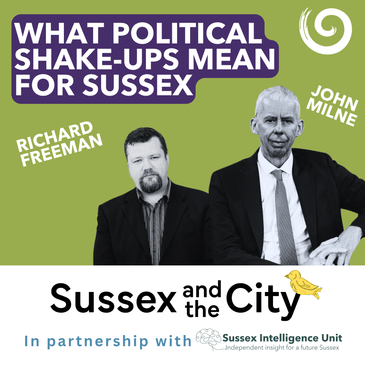
– Episode #61
What Political Shake-ups Mean For SussexHost: Richard Freeman Guest: John Milne MP – Liberal Democrat MP for Horsham
🔍 Episode summaryThis conversation was recorded when the argument about local government reorganisation in Sussex was mostly about what shape the new councils would take.
Since then, the argument has changed.
The Government has paused the process and put proposals back under review, including plans affecting East Sussex, Brighton & Hove and West Sussex. That makes this conversation with John Milne, Liberal Democrat MP for Horsham, unexpectedly timely – because he was already asking some pretty fundamental questions about whether local government reorganisation was a good idea in the first place.
John makes an important distinction between two changes that are often bundled together.
Devolution? He's in favour. Local government reorganisation? He wishes it wasn't happening.
He can see a strong case for Sussex thinking at a bigger level about transport, economic development and environmental challenges. A directly elected mayor gives the region a recognisable figurehead and potentially greater influence with central government. A river doesn't stop at a council boundary; neither does a transport network or an economy.
But John worries that creating much larger councils could take everyday democracy in precisely the opposite direction.
Fewer councillors representing many more people means, in his view, less local accountability. And he worries about what happens to the things that matter enormously to individual places – theatres, parks, museums and community facilities – when they become relatively small items on the balance sheet of a much larger organisation.
His example is Horsham's Capitol Theatre. John believes its survival owes something to decisions about it being made close to a town that understands its value. Had it belonged to a much larger authority facing major financial pressures, he wonders whether it would still be there.
Then there is housing.
Horsham is prosperous, well connected and largely rural. It sits within London's economic orbit, close to Gatwick and within reach of Brighton, Guildford and Croydon. Unlike neighbouring areas constrained by the South Downs or a shortage of available land, it is also under enormous pressure to accommodate new development.
John is unequivocal that Sussex needs more homes, particularly genuinely affordable ones. But he is equally frustrated by a system that can approve thousands of houses without guaranteeing the schools, healthcare and transport infrastructure needed alongside them – while homes officially described as "affordable" remain far beyond the means of many local people.
The question isn't simply whether Horsham should grow. It's what kind of growth creates a better place.
John sees real potential in Sussex-wide transport. Rural bus services are particularly important to him: not simply as a public service but as part of the economy. If people in villages cannot get to work and businesses cannot reach potential employees, poor transport becomes a brake on productivity as well as a threat to rural life.
There is, however, a bigger challenge in importing mayoral models from elsewhere. Greater Manchester has a recognisable centre. Sussex doesn't. There is no single commercial, cultural or transport hub around which everything else revolves. Horsham itself often looks north towards Gatwick, Croydon and London as much as it looks south towards the Sussex coast.
So how does one mayor represent a place that is simultaneously urban, coastal, rural, prosperous, deprived, Conservative, Labour, Liberal Democrat, Green – and everything in between?
If devolution succeeds, John wants good local jobs for local people. He doesn't want Horsham to become simply a comfortable dormitory town whose residents commute somewhere else to create prosperity.
With the future of local government reorganisation once again uncertain, that question has become rather less theoretical than when we recorded it.
--
This episode is brought to you in partnership with the Sussex Intelligence Unit, the independent research platform from the team behind Sussex and the City. It brings together new data, research and evidence-led analysis on growth, infrastructure, governance and belonging across East Sussex, West Sussex and Brighton & Hove – helping businesses, voluntary sector organisations and policymakers understand the decisions shaping Sussex. www.sussexintelligence.com
---
🎯 In this episode- John Milne's unlikely journey from advertising creative director to Parliament
- How he overturned a large Conservative majority in Horsham in 2024
- What being a new opposition MP actually involves
- Why planning and housing have been central to John's politics
- The unexpected businesses and economic strengths hiding in Horsham
- Why Horsham's economic pull often points north rather than towards the coast
- The extraordinary pressure on Horsham to accommodate new housing
- Why building more houses doesn't automatically create affordable homes
- The disconnect between housing development and infrastructure
- Why John wishes local government reorganisation wasn't happening
- His fear of "institutional paralysis" while councils wait to discover their future
- Why bigger councils could mean weaker local democracy
- What could happen to theatres, parks and other local assets
- Why Horsham is establishing a town council
- John's much more positive view of Sussex devolution
- Why a mayor could provide Sussex with a useful political figurehead
- The challenge of representing a county without a single obvious centre
- Why transport makes much more sense at Sussex scale
- The importance of rural buses to productivity and village life
- What Horsham can learn – and can't simply copy – from Greater Manchester
- John's ultimate test for devolution: good local jobs for local people
👤 About John Milne MP
John Milne is the Liberal Democrat Member of Parliament for Horsham, elected at the 2024 General Election.
Before politics, John spent much of his professional career in advertising, working as a creative director in London and Dublin. He later became a councillor in West Sussex, serving on Horsham District Council, including as a cabinet member, and West Sussex County Council.
He did not initially expect to become an MP. He stepped in as the Liberal Democrat parliamentary candidate at relatively short notice and went on to overturn a substantial Conservative majority to win Horsham.
Planning and housing have been significant interests throughout his local and national political career. Since entering Parliament, he has also become particularly concerned with special educational needs and has supported constituent-led national campaigns.
🎧 Production creditsHost: Richard Freeman Guest: John Milne MP Sound design, editing and original music: Chris Thorpe-Tracey Production management: Letitia McConalogue
📣 Get involved👉 sussexandthecity.info — episodes, resources, events and more about devolution and change across Sussex
👉 sussexintelligence.com — independent research and evidence-led insight into growth, infrastructure, governance and belonging across Sussex
[00:00:00] This episode is brought to you in partnership with the Sussex Intelligence Unit, a new independent research platform from the team behind Sussex and The City. Sussex is changing. Devolution is reshaping how major decisions and major investment gets made. But without the right evidence, how can it deliver what our communities need? The Sussex Intelligence Unit answers that challenge. It's the first independent cross-sector platform to look at growth, infrastructure,
[00:00:26] governance and belonging across East Sussex, West Sussex, Brighton and Hove. New data, fresh analysis, evidence-led insight designed to put businesses, voluntary sector organisations and policy makers ahead of what's next. Because the decisions made today will shape Sussex for a generation. For the intelligence you need, visit Sussex Intelligence. This podcast is brought to you by Always Possible. Always possible.co.uk
[00:01:00] You're listening to Sussex And The City with Richard Freeman. Well, as is often the case, a conversation I recorded a while ago has become somewhat more topical. Today's episode of Sussex and The City podcast, Welcome, was recorded at a point earlier in the year when local government reorganisation in Sussex was more a question of what shape new
[00:01:27] councils would be rather than whether the entire process of deciding was legitimate or not. And then last week some of that changed. On Monday, 7th of September, I happened to be in the House of Commons because I was... well I knew that the government were going to be making some announcements about local government reorganisation or devolution. I was in London anyway for a meeting and so I,
[00:01:54] as political nerds like me sometimes do, go and spend some time in the public gallery in the Commons chamber. If it's not a busy day, it's quite easy to get in once you get past security and it's always fascinating to watch the politicians and their sort of strange performance. So I was there when Angela Rayner, the Secretary of State for Housing, Local Government and Communities,
[00:02:18] announced a rapid review of its local government reorganisation programme. What does this mean? Well it means decisions already made and several parts of England are being withdrawn while plans across other groups of areas including East Sussex, Brighton & Hove and West Sussex are being paused and put back under review. Now East Sussex and Brighton & Hove, a decision had been made,
[00:02:44] West Sussex, it hadn't but all of it is going back to the drawing board. The government says it wants to make sure the process is legally robust and fits with its wider plans to, in inverted commas, rewire the state which is the coding under which Andy Burnham's pro-devolution on steroids agenda is sitting. So lots and lots of recalibration actually of where devolution underpins probably all of
[00:03:12] domestic government policy going forward. So West Sussex councils are frustrated, understandably, the districts, boroughs and the county council that after more than 18 months of work they still don't know what the future structure of local government here will actually be. In fact they never knew and will have to wait for longer. Now focusing on West Sussex because my conversation in this episode
[00:03:38] is with John Milne MP, MP for Horsham. And what's interesting about this conversation is that John was already asking some fairly fundamental questions about the legitimacy of local government reorganisation. John is the Liberal Democrat MP for Horsham and before entering parliament he was a district and county councillor in West Sussex and before that he spent much of his career as an
[00:04:04] advertising creative director. And his position's interesting because he makes the distinction between the two things that many people get confused about. Devolution, he welcomes. Local government reorganisation, he really doesn't. And I think that distinction and perhaps the different ways these two things are manifesting themselves has become quite acute this week because of the government's announcement. John says that he can see the argument for Sussex thinking at a much bigger
[00:04:32] level about transport, economic development, housing and the environment and for having a directly elected mayor who can speak for the region and negotiate with government. But he worries that creating much larger councils will take everyday democracy in the opposite direction. Fewer councils, bigger patches, decisions further away from the places they affect in John's eyes. And he is worried that local assets such as theatres, parks, community facilities and other things that matter enormously
[00:05:01] to individual towns will become small items on a balance sheet of a much bigger organisation. A lot of this is why some of the arguments against the decisions that have been made are out there and potentially why government is having to take stock. He gives the example of the Capital Theatre in Horsham, which John thinks survived because decisions about its future were being made close enough to a town that
[00:05:25] understands its value. And there's another big theme in our conversation which is housing. Horsham, frankly, is quite prosperous, largely rural, well connected to London and Gatwick and home to some genuinely innovative businesses. It's under huge pressure to grow because it sits outside of the National Park and because of that sort of well positioned location. John is very clear that Sussex needs more affordable homes but he challenges a planning system which can deliver thousands of houses without necessarily
[00:05:52] delivering the infrastructure around it. Schools, health system, transport and can end up sometimes with a development where people don't actually want to live. And again, government is looking at how it does planning and how it does consultation and how it does decision making. And I'm not sure that government is necessarily thinking about how it does more of that. I'm thinking how it gets rid of some of
[00:06:15] that so that its rapid growth plans can be less hindered. We've got a complex thing going on at the moment about government giving away control in a way that some consider to be quite controlling and I think that's key to my conversation with John Milne. So how do we get the benefits of thinking bigger without losing the value of thinking locally? How do we create genuinely affordable homes without simply just hitting
[00:06:42] housing numbers? And how does someone like Horsham avoid becoming a comfortable dormitory town for London and no longer a key part of Sussex identity and economy? And what will people actually notice in a place like Horsham if devolution works for them? Horsham often gets overlooked and discounted when we're talking about coastal communities, we're talking about rural places, we're talking about Gatwick Airport.
[00:07:08] Horsham not always in the conversation and really should be. So this conversation was recorded before this last 10 days of extraordinary political weather but quite a lot of what John Milne has to say I think sounds rather prescient and maybe slightly ahead of its time. I'll be very interested to hear what you think. This is Sussex And The City and this is my conversation with John Milne MP for Horsham.
[00:07:46] We'll dive straight in. I'm joined by a great guest this episode, somebody I've only met once before but have been following their work as I do of all Sussex politicians. I think it's an interesting place to represent and very politically disparate so anyone who wants the job of being a member of parliament or a council leader I think walks into something fascinating and probably really really difficult.
[00:08:14] So I'm always open and interested in how people are approaching it. And my guest today is John Milne, the MP for Horsham. I think Horsham is underrepresented in conversations about Sussex. Certainly in this Sussex in the City project I don't think it's had quite the airtime, there's some other part so I'm really interested to chat about all things Horsham and how Horsham will benefit slash what it might be worried
[00:08:40] about in terms of devolution and local government reorganisation. But before we get into all of that, John, how are you? I'm very well and very happy to be here. Thank you so much for inviting me. Not at all, thank you for giving me your time. So you are a Liberal Democrat member of parliament and in the 2024 intake. What was life before that? What led you to this and here? Well, directly prior to that, like many Lib Dem MPs, I was a local councillor on the
[00:09:07] History Council which Lib Dems took over quite recently so I was a cabinet member on that. And then also I was with Sussex County Council. But prior to that, in the great majority of my life, since I've not been sitting around waiting to be an MP, I worked in advertising as a creative director in London and Dublin. That's not an obvious path. Not many people leave the heady world of probably considerably more money and direct power in the world of advertising to then
[00:09:36] go into the heady world of being a backbench MP for the third biggest party. What were the choices you made and why, if that makes sense? Yeah. In all honesty, I didn't expect to be an MP at this stage and I kind of filled in because our candidate had to withdraw. So I became the candidate with fairly short notice. I realised I'd always been interested in politics. I did do a politics A-level way back, but I just never thought or knew how to be an MP. Got into advertising, really enjoyed it.
[00:10:07] For some similar reasons, in advertising you do different client, different business every week. I love that. And politics is a bit like that. As an MP, you have to cover an amazing ground or all kinds of different things to get your head around. So I do like that. But yeah, there reaches a kind of time with any profession where you've done it and you feel like you're repeating yourself. So I'm a very curious person. I like contrast. This is about as contrasting as you possibly can with any.
[00:10:35] And Horsham, I don't want to be glib to say probably a safe seat. Maybe it was, but in my mind, it was always very true blue. I associate it with, particularly with Francis Maud, who was there for a long time and obviously chairman of the Conservative Party and so on. You said you didn't expect to become an MP. I don't know if anyone expected it to go Lib Dem, did they? No, no, they didn't. And then in all honesty, Horsham was not on the Lib Dem strike list. So it was 144 years
[00:11:04] it was the longest single, single, single, single. Right. So when I, so, so I've right to say safe seat. That wasn't, that wasn't being flippant. Okay. No, no, no, it's clear enough. 21k majority. I think everyone knew, I knew it was going to be closer, but I don't think anybody expected me to actually win it. And logically, statistically, you wouldn't think so. But by the time it got up to the election, I felt it was 50, 50. You could just, you know, you're knocking on doors, you're talking
[00:11:30] to people. So I thought, well, this, this is, this is actually possible. And then it actually happened. So no, I'm, I'm, I'm very honored. And like I say, it's a privilege I didn't, I didn't expect to have. And I'm now thoroughly enjoying it. Pretty tough first six months. I've got to say, when you're an MP taking from a different party in a seat, you've got immediate task. You have to find an office, previous office was owned by the Conservative Party in Horsham. So that wasn't
[00:11:58] suitable. And most importantly of all, hire a team of people, you've got a budget. So you get maybe like half a dozen people. Until that point, you are absolutely useless. Because you're day one, open up a laptop, 300 emails on it, and it carried on like that. You can't even open them, let alone act on them. David Miller Difficult first six months, for sure. And I'm, I, you know, I couldn't imagine it's such an odd job, isn't it? You're sort of self-employed, but also employed within this strange,
[00:12:26] different structures and layers. Yeah, you, you are, as you say, in charge of a team. There's the kind of balance between party and place. Not for me, thank you, but grateful for those like yourself who do it. More broadly, in terms of the first sort of nearly two years since that election, how have you found that? Have you found a rhythm? Have you found your feet? Have you got a kind of sense of now what you can and can't do and where power lies and who you need to talk to and, and how your constituents, what they need from you?
[00:12:54] Yeah, just simply finding a way around the Palace of Westminster takes a little bit. It's a notoriously complicated building. But yes, the leaves are pan. Obviously, I'm in opposition, I'm not in government. But in some ways, at this point, I think I'm quite grateful for that. If I was a Labour backbencher, you are forced to vote for things by the party whip that you don't necessarily agree with. It could be the opposite of what you said you were going to do on the campaign trail. I imagine that's pretty tough. So I don't have to go through that. On the other hand,
[00:13:21] because I'm not in government, you could argue it's harder for me to really get to the top guys. So you, you can look at it one way or the other. But Parliament is quite accessible. We have this arcane voting procedure, as I'm sure you're aware, where we vote through the lobbies, we walk around, walk around in circles for hours on end, because it takes about 15 minutes per vote. The one good thing about that is that you can buttonhole a minister in the lobby, you know, because you're
[00:13:45] all stuff all up together. It's a chance to go and speak directly to a minister and get what you will get what you want out of the paper for your inter-meeting or whatever. A lot of MPs have a particular interest or a cause, or, you know, certainly those on the back benches will have an issue whether that's a local thing or a, you know, social justice thing or something like that. You know, if someone were to look at your contributions and voting
[00:14:13] record or interest, would there be a particular theme, a thing that you've really kind of gravitated towards? Yeah. So if you looked at both my previous experience and to a large extent what got me elected, it's to do with planning and housing. Very controversial issue in an area like ours, which is where there's a great deal of pressure on housing, but it's really more affordable and too fine sites for it. So that was what I went in with. But since my election, special educational
[00:14:42] needs has actually shot up my agenda. I've been around all the schools and it's the stippening crisis. There's a white paper out right now, so that's going to be a big issue. But also, it's funny things you pick up on. So there's a couple of local campaigns I've got heavily involved with that were run by constituents before me. So there's LOPs Child Trust Funds, which is these child trust funds that were set up under the Blair government. And if the child grew up to be
[00:15:08] mentally incapacitated, so they can't access the money, neither can the family. So at the moment there's this legal battle, we can't get past it. Then there's also Lobular Moonshot Project. This is invasive lobular breast cancer, second most common for breast cancer, but they don't understand it. There's no particular treatment for it. It's often not recognized. So this is a campaign to try and get some money to understand the biology of it. So they're brilliant campaigners,
[00:15:34] local campaigners, and I've really joined in with those. So it's a real mixture of local stuff. Often local stuff becomes national stuff and finding. David Tell me about Horsham then. So you just said housing and planning, you know, particularly sticky issue in Horsham and many people will be aware of that, I think. Obviously you're in the kind of shadow of Gatwick Airport. So there's a relationship there and with the plan expansion. But I guess there's a lot of people, certainly on the coast or in the
[00:16:03] eastern side of Sussex that might not know much about Horsham. You know, it's a beautiful market town. I love Horsham very much, but it's fascinating when you sort of scratch under the surface and the gaming industry has a sort of big footprint in Horsham and, you know, the kind of Horsham-Gilford corridor, you know, it's maybe looking north more than it's looking south in terms of the sort of economic footprint and so on. And I think it's always really interesting when you start to be
[00:16:32] more curious about how a town is sort of developing. So give us a bit of an overview of Horsham at the moment. David It's half rural, half urban. And the rural half is really very rural. It's quite surprising how swiftly it becomes like that. So obviously we're in the general arc of London, which has such a big impact, but we're still far enough away to have our own identity. I think Horsham town is a
[00:16:57] lovely town. And I think it's just pretty enough. If it was any prettier, it would be chocolate boxy and you get millions of tourists. David So is this your campaign? Keep it no prettier, please. I mean, that's an interesting slogan. David Yeah, maybe it's not much of a slogan, but thanks for the suggestion. David So it is lovely. And the countryside too, it's lovely, but it's not, you know, national park stuff. So it's mainly farmland. So it's that interesting. So I feel it's really
[00:17:27] lived in place, really. It's about a place where you live, not that you stick in a box and admire from a distance. But yeah, we've got a thriving high street in Horsham. And there's not many places that can say that. We've been heavily involved in various ways to try and keep that going, or, you know, encourage it. And we've got lots of success around. We've got some very interesting businesses. You wouldn't know they were there, some very high tech stuff. And so there's some, you know, dynamic good jobs there, but you're also right to say that
[00:17:57] economically, we tend to look northwards. So it feels quite a long way to Brighton, or the South Downs is a sort of psychological barrier, if you like. So, and of course, many people here also work further up, either in London or Croydon or Gatwick. So the pull is more that direction. Yeah. But we're talking about 80,000? Or is it where we have to go? Yes. Yeah, yeah, yeah. Yeah, about that. Yeah, yeah. There are very few restrictions on house
[00:18:25] building here in the sense of constraints. So Crawley and Brighton, you can't build there very easily because there's no space. Mid Sussex, you can't build on 40% of that because it's area of natural beauty. So that's got restrictions on it. The Horsham, there's just no restrictions on anything. So the only thing that's stopping you is the houses that are already there. The rest of it is up for grabs. So we can be and under a pressure to be to sort of have to take
[00:18:52] everybody else's excess housing that they can't build. That's the way the system has worked in the past. You just operate, you have to do it. And what's the pragmatic way through that? Because of course, you know, I don't live in Horsham. And if I did, then I probably wouldn't want thousands and thousands of houses built next to mine simply because, as you said, they can be. But on the other hand, we need more houses. And if you step back a bit, a place like Horsham might seem absolutely ideal. You know, as you say, it's sort of some beautiful natural assets,
[00:19:22] but it is also urbanized. It's not that far from London. It's not that far from Brighton and Worthing and Guildford. And, you know, location-wise, it could potentially afford to get a little bit bigger. But of course, with that comes huge challenges around infrastructure and transport, sustainability. What are the kind of two sides of the argument at the moment? And who are making those arguments? And where is that sort of argument at? David Morgan Yep. You're right. It's a controversial issue. And I'm never sure when I'm talking to someone
[00:19:51] which way it's going to have to talk. But basically, we absolutely need more housing. I think that lack of affordable housing is one of the great issues. Margaret Thatcher is the cause of it by selling off all the council houses. And we're reaping the whirlwind of 40 years of not building any social housing. But we are where we are. So the problem is that we're, so yes, we're building these houses or permitting these houses. But they're not cheap. They're not affordable. They have a
[00:20:18] technical government definition that calls them affordable, but you go and try and buy one. And I think you'll find they're not. So it's just extraordinary. Even for a deposit in Horsham now, you need an entire average, more than an entire average salary, one year salary. So it's very out of reach. And that's what frustrates people. They would accept the houses, the land goods houses more if they believe that they were affordable, if they believe that they came with the necessary
[00:20:44] infrastructure. The clinics, the schools, which is the other big bugbear. The system does not allow us to deliver that through the planning system. It didn't under the conservatives and it doesn't under labor either. They're not, they have not fixed that problem. So it is the local authority, they hand out a bank commission, but they don't control whether a school or a clinic is going to get built. They can, they can agree with the developer, but if the Department of Education reneges on the
[00:21:11] deal later and they do, then it won't get built. Why would they renege on it? Because it's cheaper for them to push kids into an existing school than it is to build a new one. So the system doesn't fit together. The developers, they don't, they often don't build the houses that they've got permission for. There are 1.4 million unbuilt permissions across the country. That is, that is entire government's five year target. They're not being land banked as people think. They don't build them because they can't sell them at a price that justifies the amount they paid for the land.
[00:21:41] They're private developers, they want profit. I have no problem with that. What do you expect? So the underlying issue is how do you get that land at a cheaper value? You've probably got a strategy, a vision, a road map, maybe even a post-it note empire on your office wall. But has anyone asked the really awkward questions yet? Like, is it actually working?
[00:22:07] At Always Possible, we help senior leaders challenge the obvious, rethink the possible and deliver the extraordinary without losing their sanity or sense of humour. Enabling private and public sector innovators to navigate a changing economy. We help complex organisations to humanise data and to translate
[00:22:31] the big picture into hyper-local engagement, trust and sustainable growth. If you're ready to bring people with you because your leadership truly inspires, visit alwayspossible.co.uk. That's alwayspossible.co.uk. Always Possible. We make bold business brilliant.
[00:22:59] The focus of this conversation is around potential changes to some things like that through devolution and the kind of planning and the spatial development strategy sort of powers that an elected mayor will have. So, you know, I'm interested on your perspective on whether that will potentially improve or add more complexity to that situation. But also with local government reorganisation, you know, Horsham District Council, according to all the current plans and
[00:23:27] timetables will not exist come the 2nd of April, 2028, and it will be replaced by either one single West Sussex unitary or two or three or however, you know, whatever the proposals are chosen at the time of recording, we don't know yet, who decides around planning and how planning is integrated with other things like growth and infrastructure and all that sort of stuff is going to be quite radically sort of put through the tumble dryer over the next couple of years.
[00:23:53] Do you think that is ultimately going to be a good thing for Horsham and trying to lay some of that challenge? Or do you think it's going to potentially make things worse? David Morgan So in terms of local government reorganisation, I wish it was not happening, is the truth of it. So now there are already, lots of the country already has university councils and mayors and they say it's working, so I accept that, you know, I believe that. But in the very,
[00:24:19] in the short term, at least, it's a bad thing and I'm an MP right now. So one of my pitches in the election was I'm going to work hand in glove with Horsham District Council, where which I came from, to work with community. And it's a real problem for me that it's going to cease to exist in a couple of years. Because what you're going to get is institutional paralysis, so over the next, for a several year period. HTC, you know, who starts on a project, lots of projects, you can't start on them because they're going to take longer than two years. You can't get the staff
[00:24:48] because who's going to join a company that's not going to be there. It's going to be very hard to take any sort of decision that has any sort of time scale on it. So that's one problem. But more broadly, you know, the trouble with the unitaries is that they, as a councillor, you end up representing or having to represent far more people per head. There is a fundamental decrease in democracy. There are fewer councillors to more people. That's, that is just the flat
[00:25:17] statistic, several times more. So, so you cannot do the same job for three times as many people as a councillor. And you've got more responsibilities as well. You just can't do the same job as well. I don't believe it. So you get the danger of, you lose that real local collection, which is the connection, which is the best thing about, say, Horsham District Council. Most of those people, the councils all live in the town and most of the workers there too. It's very, you know,
[00:25:44] they're very close to the people. Some people don't like what you do. You find out pretty quick. Whereas even if you take the current situation, county councils in Chichester, the long way away, it feels very remote. They take decisions. We don't see that many, just find out about them virtually in the press. So, so I think that loss of local accountability is a big problem. A compensation, compensatory factor has to be that the Irish councils need to step up
[00:26:09] and we're encouraging them to do so, to take on more of the, fill that gap a bit, you know, so they, and that, that's difficult because they're, they're full of volunteers. They're very erratic in their, in their quality. There has to be some really good ones and there's some not so good ones. So, but they need to step up and fill that gap. But in the end, you think if we've got to do that, then maybe we should have just left it as it was. And one of the things we are doing or the HTC is doing before it goes, is setting up a town council for Horsham because it's not, never had one.
[00:26:39] It's setting one up. Yes, because there is, the central Horsham is an unparished area. Yeah. There's the council's where it started actually. They've got no money and no... Yeah. So really... And that's quite common in Sussex. I live in Worthing and it's the same, I think it's the same. Yeah. It was, it was fine back in the day, but it isn't now because, because it affects only Horsham down as run by HCC directly. When it becomes unitary wherever it is, Chichester, that is
[00:27:06] one enormous, you've got no control at all. So if you look at the local asset, let's say the capital theatre, which I absolutely love, that, that, if that had been part of county council, they would have sold it off years ago because they had budget deficits to fill. Because it was owned and run by the district council, it was protected. You've got Ocean Park, you've got the museum, you've got these wonderful assets. And had they been part of a larger institution, you would have lost them. That's what it looks like.
[00:27:32] Okay. Well, that feels unequivocal in terms of your, your perspective on that. And it's interestingly, one of the things that seems to be a cross-party agreement in the MPs I'm talking to. There aren't many hugely in favour of LGR. Some, some very, very angry about it, even, even, even more, uh, uh, cross about it than you are from, from what I hear. Yes. I'm, I'm very cross, but I don't like to be cross on your programme, but you know, I can't stop these things. So I just, I have to just, I just want to make the best of them if you can't stop it. Indeed.
[00:28:03] LGR was not in the manifest. There's one change that was not even there and they've done it a breakneck pace, which is to some extent rebound. Indeed. I mean, there are many, many close to and in government going, why, why have we done this in the first parliament? It feels a little ambitious, but, uh, as you say, um, we are where we are. Um, so in terms of the mayoral, the county, um, strategic authority, where, where actually a lot of this planning strategy will, will start to sit, are you more positive about that?
[00:28:33] I'd say I am. So, um, so the mayoral, the mayoral side of it, I mean, and obviously there's a deglution bill alongside this, so it's, it's quite there. The things overlap like crazy, but, uh, but, uh, and so as in devolution, I, I'm a liberal Democrat. We're really in favor of devolution. We're pushing as much power as possible to the local level. Absolutely. Um, and, uh, as, as, as a state, uh, UK, we're very centralized compared to other countries. There's more power held up, held up Westminster than, than pretty much anywhere else. So all in favor of that
[00:29:02] bit. Um, so, and so the mayoral, the mayor is an interesting, is an interesting concept, um, because, because really it gives you a name and a figurehead besides anything else. Uh, and, and I can see the benefit of that. Um, so obviously there are some very famously successful mayors like Andy Burnham. So I think it helps, I think maybe it helps people in democracy to have, to have somebody they can identify as opposed to a committee or whatever, which seems a bit faceless. So I get that. Uh, on the
[00:29:31] other hand, one could say the trouble is that that one person for the whole of Sussex is she will come from a party, whereas Sussex has got all kind of, you know, this, Liveden's a stronger here, somebody there, later there, wherever there are greens, you know, it's a, it's a patchwork, a very diverse patchwork. Yeah. Like in Horsham, we've never had a labor, uh, labor member of, uh, the district council, but Crawley is heavily labor. So we're only three miles apart. You know, so that's, are you going to lose that, um, the identity of that, that separate identity
[00:30:00] or diversity rather with a single mayor having to represent it all? But again, on the positive side, I think the things, the things that are a mineral authority could do really well are transport and the economy. Those things I think really benefit from a whole of Sussex viewpoint and a bigger viewpoint. Also to some extent, probably large scale eco projects as well. Like if you want to clean up a river, you need to clean up the whole river, not just a bit of it that runs through my constituency.
[00:30:27] So never been a liberal Democrat mayor in England yet. You've had money on Ben Dempsey, uh, winning, had it been in, in May 26? No, it'd be very complicated obviously because there are such diverse areas, but, um, uh, but I think in the end it would have been between a live demo and a, and, uh, reform. And in that context with, on a single transferable vote system, we've got, we would have got a hell of a lot of
[00:30:55] second choices, uh, in comparison. So that I think, okay. That is reform's great challenge that, that, uh, loads of people really don't want them. So they'll, if they understand who to vote for, then it's... What you haven't said there is that that will also be the same in, in 2028. Are you waiting to see what happens? Well, I agree. I know probably the place which our politics changes right now. I don't know. It's just, it's just crazy. So I don't bother to think any gist.
[00:31:26] It does feel like a fool's game to, to have too high expectation in any way. But I guess in principle, if anywhere is going to elect its, its first Lib Dem mayor, despite the, the, the, the pluralism and the, and the diversity of thought. And, and, uh, and as you say that the challenge in having one unified political figure, you think there's a bit of you that think maybe, maybe, maybe Sussex can be it. Yes. Yeah. I'm, I'm certainly prepared to give it a go. It could be good. Then you get down to the
[00:31:53] individual really as well. You know, like you got a good mayor and a bad mayor. So Andy Burnham, obviously he is a leading example of a successful, successful mayor. I do think there's a bit of differences. So Manchester is a clear identity, you know, that all roads lead to Manchester, as it were. Sussex is not where we, where is the center of Sussex? There is no center. There's neither a commercial nor transport hub, nor, nor, nor anything. So that is a totally different proposition to the range. You can really see why single, you know, why would Manchester be split up,
[00:32:21] as it were, or London was, you know, split up. So again, you get terrific benefits in transport as London has, as, as Manchester has. It's much more of a challenge across a rural county. Um, so, so we will, we'll see how it goes, but I will say again to praise Andy, uh, Manchester, Manchester has been growing at a very fast pace. It is closing the gap productivity per head on London. That's amazing. No, no other city is anywhere near it. The second city is the second, they're not
[00:32:50] doing anything like as well as the main city. That is completely different from say Germany. You know, the narrative from greater Manchester, you know, it's actually one of the fastest growing economies in Europe, let alone in the UK. There are very clear successes that can be put at Andy Burnham's, uh, feet. Also it's, it's, it's a compelling story, but as you've said, Sussex is very different. Um, there's loads and loads we can learn from all of the sort of 14 odd existing
[00:33:16] combined mayoral authorities. And we're one of several in, in different ways and at different times going through a new process, um, talking to the people in charge of setting up the new combined authority. I think they're quite keen that Sussex is also an opportunity to do things a little bit differently. So we can start to be a bit clearer about long-term planning. You know, what does the North Star look like perhaps rather than what they would have been, which is just sort of getting it up and running?
[00:33:45] Sam's point is one of the areas where I think there is a clear possibility. So, so the rural bus service, declining rural bus service is one of the issues I've fought quite heavily. And it is a huge challenge to keep it going without subsidy or with a minimal subsidy. So there is no doubt that it helps if you take a holistic view of it. Well, I was defending the, um, the number 17 bus service was up through Partridge Green. Yeah. But it's partly because it runs, uh, cross boundary into Brighton. You know,
[00:34:10] it was difficult to, to find solutions. Um, and, uh, the, the government is also giving local authorities the power to franchise or to take over, run their own bus services again for the first time since the 1980s. So there are big possibilities there. Um, it's a few years down the line, that's for sure. But, but we, we really need to fix that. Why is the countryside less productive than the city? Transport is one big part of it. They, you've got these people in
[00:34:37] the villages that can't get to work, but the companies can't hire them. It really holds us. I mean, you say it's a few years down the line, but from my understanding, a briefing I attended is that they are quite keen to set up a sort of Sussex transport company to, to start to bring certainly buses, bus franchises in, in, in, in more of a strategic alignment. I mean, we know that the trains, um, Govia Thameslink that becomes in public ownership, I think later this year as well. So
[00:35:05] there's all sorts of, I think they're going to try and build the, uh, the pathway even before the mayor's elected in 2028. So, uh, I think some, some, some of the mechanics of, of starting to do this will, will be in place quite quickly, potentially. I'd love, love to see that. You know, it's an absolute priority if we're, if we're to spread prosperity, but also on the other side, just to protect the life of the villages where they become, they said, you can only live
[00:35:34] with the, or it's destroying the villages. Let's say we were talking again in, in 15 years time, 20 years time and, and bear with me here, everything's been a success, right? Uh, we've all overcome our differences and we found that unifying figure that is batting for, for Sussex and Brighton and is, and has been a success. What do you think would be one kind of really defining, uh, metric of,
[00:36:00] of success for the people of Horsham? What might be a really, really good indicator that we'd got this right? Good local jobs for local people that, that, uh, like in Horsham in particular, I don't want to see us becoming a dormitory town for other areas. You know, um, it's, it's about helping businesses, driving business success locally, because that is just good all the way around. It's better for your lifestyle. You use better for your planet because you're not driving
[00:36:25] up and down or whatever. Um, but, um, that's what I'd like. That's what I like to see that. That's what keeps the health in all, in all our high streets, all our villages. Um, I like to see Sussex be, be, you know, uh, an economic hub, uh, even though we're mainly a rural area. Uh, lots of really interesting insight and, uh, and thought there. Um, thank you so much, John Milne MP for being my guest on the Sussex and the city podcast.
[00:36:53] Thank you very much indeed. It's a pleasure to be here. Thank you very much to this episode's guest and to you for tuning in. Sussex and the city is an independent and non-political project about devolution as it happens, explained in human.
[00:37:19] It is led by always possible. You can find other episodes, resources, events, and blogs about change in Sussex and Brighton by visiting sussexandthecity.info. That's sussexandthecity.info. This episode was written and presented by Richard Freeman for always possible. The editor was me, Chris Thorpe Tracy for lo-fi arts. I did the music too. Production
[00:37:47] management was by Letitia McConnellogue for always possible. Talk to you next time. Always possible.co.uk