

– Episode #62
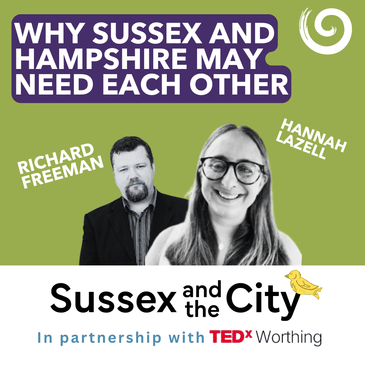
Why Sussex And Hampshire May Need Each OtherHost: Richard Freeman Guest: Hannah Lazell – political and public affairs consultant and former Local Government Association adviser
🔍 Episode summaryFor someone growing up in Havant in Hampshire, as Hannah Lazell did, Portsmouth (Hampshire) and Chichester (West Sussex) were simply two nearby places you went to. Jobs cross the border. Businesses cross it. The defence and aerospace economy around Portsmouth spills into West Sussex. The South Downs crosses it. And anyone who has attempted the A27 through Chichester and Arundel knows that transport problems are indifferent to local government boundaries.
Yet Sussex and Hampshire have generally been expected to think about their economic futures separately.
Devolution might start to change that.
Hannah is a political and public affairs consultant who has worked in Parliament, advised the Labour team in the House of Lords and spent seven years at the Local Government Association. She now lives in Portsmouth, which makes her well placed to compare two neighbouring areas going through similar upheavals at similar times.
And this is actually our second attempt at this conversation. We first interviewed Hannah last year. Politics moved so quickly that the episode became obsolete before we could use it. We tried again in July. Inevitably, things changed again.
Since this recording, the Government has put local government reorganisation under review, including pausing the process in West Sussex and Hampshire. Devolution itself, however, continues. Sussex and Brighton has its strategic authority; Hampshire and the Solent now has one too. Both are currently heading towards mayoral elections in 2028.
That leaves Hannah broadly optimistic about devolution, but with an important warning: most people still don't really know what any of this means.
Even among politically engaged people, she encounters uncertainty about what a strategic authority is and what a mayor will actually do. We are creating new democratic identities while many people are still working out what the existing layers of local government are responsible for.
But perhaps the more interesting opportunity begins once those mayors exist.
Hannah points north, where mayoral authorities that might reasonably be expected to compete are increasingly collaborating. Northern mayors have come together around investment, infrastructure and a bigger story about the North of England. Greater Manchester and Liverpool City Region cooperate where their interests align while retaining their own identities and priorities.
Why couldn't Sussex and Hampshire do something similar?
There is no shortage of shared problems. The rail journey between Portsmouth and Brighton is painfully slow for the distance involved. The A27 contains notorious bottlenecks. Connections from the South Coast to Heathrow are awkward. Both regions want investment, better infrastructure, productive businesses and stronger economies.
And both suffer from being bundled into the rather misleading national shorthand of London and the South East.
Being relatively close to London doesn't mean the South Coast has seamless infrastructure, uniformly high productivity or an economy that needs no investment. Hannah argues that Sussex and Hampshire could start articulating a different story that identifies the things they can achieve together and gives the South Coast a more coherent voice with government and investors.
That doesn't mean inventing a new super-region or pretending Portsmouth, Brighton, Southampton, Chichester, Basingstoke and the Isle of Wight are all the same place.
In fact, much of the conversation is about how slippery geographical identity really is. Portsmouth has a strong identity. So does Southampton. Sussex has East and West. Hampshire's northern M3 corridor can feel remarkably distant from its southern coastal cities. And people often identify much more strongly with a town, city or neighbourhood than with an administrative county.
Perhaps that's why collaboration can work.
The new structures don't need to erase those identities. They might instead give neighbouring places permission to ignore boundaries when the problem they are trying to solve ignores them too.
So this isn't an episode about Hampshire. And it isn't really about maps.
It's about whether devolution could help create a different political and economic geography of the South Coast – one based less on inherited administrative boundaries and more on the places, connections and challenges that actually exist.
---
This episode is brought to you in partnership with TEDx Worthing
Tedx Worthing returns to Worthing Pavilion Theatre on 5 October 2026 This year's theme is We Begin Here, exploring how local change starts and what each of us can do to be part of it, with talks, performances and interactive installations bringing more than 700 people together. Sussex and the City listeners can save 20% on tickets using the code SUSSEXCITY20.
Book now at www.tedxworthing.com
🎯 In this episode- Why we had to interview Hannah twice
- What years of working around local government have taught her about local politics
- Why local elections increasingly reflect national political frustration
- The growing importance of hyper-local campaigns and identities
- What years of financial pressure have done to councils
- How aware people in Hampshire actually are of devolution
- Why explaining what a new mayor does may be harder than politicians expect
- The similarities between the Sussex and Hampshire devolution journeys
- Why devolution and local government reorganisation need to be understood separately
- The political upheaval happening across Hampshire
- Whether local government structures designed in the 1970s still make sense
- Portsmouth's relationship with Chichester and West Sussex
- Why county boundaries often make little sense in everyday life
- The very different identities within Hampshire itself
- Whether Sussex and Hampshire could form a stronger strategic alliance
- What the South Coast could learn from collaboration between northern mayors
- The painfully slow Portsmouth-to-Brighton connection
- Why the A27 is an obvious shared priority
- Connections to Heathrow and other infrastructure challenges
- How neighbouring mayors could cooperate while still competing for investment
- Whether the South Coast needs a stronger collective economic story
- Why "London and the South East" conceals as much as it explains
"Local politics has always been a vessel for protest at the national government."
"They've got very low awareness that it's happening and low awareness of what it could mean."
"To me and my family, Portsmouth and Chichester were two places that we went to. It was irrelevant which county they were in."
"We do need our structures of government as a whole to reflect how we live and work now rather than 1972."
"What we're missing down here, we don't have that coherent voice and that working together."
"The narrative is like London and the South East. If you live here, you know that it's far more complex than that."
"There are a lot of opportunities, and it just requires people to want to work together."
👤 About Hannah LazellHannah Lazell is a political and public affairs consultant with extensive experience across national and local government.
Her involvement in politics began while studying in Birmingham, where she volunteered on Gisela Stuart's 2010 General Election campaign in Birmingham Edgbaston.
She subsequently worked in Parliament for MPs including Shabana Mahmood and Harriet Harman, and as an adviser to Labour's House of Lords team.
Hannah later spent seven years at the Local Government Association, working closely with councils and political leaders across the country.
She now works independently across strategy, policy and public affairs, with local government and devolution continuing to form an important part of her work.
Originally from Havant and now based in Portsmouth, Hannah also brings a particularly useful perspective to Sussex and the City: that of someone watching almost exactly the same devolution process unfold immediately across the county boundary.
🎧 Production creditsHost: Richard Freeman Guest: Hannah Lazell Sound design, editing and original music: Chris Thorpe-Tracey Production management: Letitia McConalogue
📣 Get involved👉 sussexandthecity.info — episodes, resources, events and more about devolution and change across Sussex
👉 sussexintelligence.com — independent research and evidence-led insight into growth, infrastructure, governance and belonging across Sussex
[00:00:01] This episode is brought to you in partnership with TEDxWorthing, returning to the Worthing Pavilion Theatre on Monday 5th October. This year's theme is We Begin Here, an evening exploring how local change starts and what each of us can do to be part of it. Expect eight or more talks and performances, interactive installations and more than 700 people coming together to hear ideas from entrepreneurs, artists, campaigners, educators and community leaders.
[00:00:31] Sussex And The City listeners can save 20% on tickets by using the discount code SUSSEXCITY20. That's capital letters, all one word, SUSSEXCITY20 when booking. That's TEDxWorthing. We Begin Here, on Monday 5th October at Worthing Pavilion Theatre at 6pm. Book now at TEDxWorthing.com. TEDxWorthing.com This podcast is brought to you by Always Possible.
[00:01:01] Always Possible.co.uk You're listening to Sussex And The City with Richard Freeman. Hello and welcome to Sussex And The City, the podcast. I'm Richard Freeman and you are whoever you are and I'm really glad that you are. Keep on going.
[00:01:24] Now, there's a big occupational hazard when making a podcast about devolution and local government at the moment and trying to do it in sort of real time. You record an episode, five minutes later, it's completely redundant and a lot has changed. And that's kind of been the curse of my series of chats with this week's guest. My guest is Hannah Lozell, a political and public affairs consultant with a long background in local government, national politics and devolution.
[00:01:54] Hannah is based just along the coast in Sussex's glorious neighbour Hampshire in Portsmouth where she lives. And this is actually the second time that we recorded an interview because the first one that we did late last year became absolutely obsolete for both what was happening in Hampshire, but also what's been happening in Sussex. So we recorded this second attempt in July.
[00:02:19] Now, since then, the government has put local government reorganisation under review and paused the process in West Sussex and in Hampshire. But devolution itself is still moving ahead and the Sussex and Brighton strategic authorities up and running. Hampshire and the Solent have now launched their own strategic authority a little bit later. Well done to them. And both are currently heading, as at the time of recording, towards mayor elections in May 2028. Who knows?
[00:02:49] So this is still a really important conversation about neighbourliness and particularly as Hampshire and the Solent, which includes the Isle of Wight, are going through the same thing that Sussex and Brighton is going through.
[00:03:04] And this episode is about what happens when you stop looking at a place or a region in isolation and really think about how it connects to and has a relationship with the other counties, the other regional approaches to economy and infrastructure and identity around it. Hannah grew up in Havant, now lives in Portsmouth. And if you live in the west of West Sussex, you'll know Hampshire really well.
[00:03:31] It is not a separate place. It is many shared parts of an economy, community jobs. Boundaries don't make sense when you live at the edge of one. And for me, originally I was a Dorset boy and much of my family are in Dorset, so Hampshire and the New Forest and that sort of Southampton, Portsmouth, Gosport coast is a really beautiful part of the country and a really important part to my journeys back to the motherland.
[00:03:57] So I think the question that Hannah and I look at is what would happen if the new political structures on either side of the West Sussex, Hampshire boundary worked together? We know that getting from Portsmouth to Brighton can take an absurdly long time. The A27 or the A259 or even by railway can sometimes feel like a slog. We talk about connections to airports, investment, whether Sussex and Hampshire could eventually develop the sort of strategic relationship we see between mayoral regions elsewhere.
[00:04:28] Greater Manchester and the Liverpool city region are often jointly developing a sort of northwest prospectus. We know that the Yorkshire authorities are very closely aligned. We can see east and west midlands forming lots of regional alliances. So what have we got down here on the south coast? Well, we don't have devolution yet in the southeast certainly. So what might that look like? Hannah makes the case that northern mayors are collaborating on investment and infrastructure.
[00:04:58] Even where there's healthy competition, there are ways to collaborate. So could Sussex and Hampshire tell a much bigger regional story together? And we also talk about the health of local democracy after years of financial pressure on councils. Why local elections are increasingly becoming vehicles for national political frustration. And whether people really understand what a new regional mayor will do. We hear a little bit what she's hearing on the ground in Hampshire.
[00:05:27] And of course the slightly awkward truth that we are creating entirely new layers of democratic identity. While many people are still trying to figure out what the existing ones are for. So although we're talking about boundaries, it's not about maps. We're talking about whether devolution gives us permission to start ignoring old structures and rivalries. Maybe point towards new future collaborations.
[00:05:54] I hope you enjoy my conversation with Hannah Lizell. Now my guest today is someone I actually did an interview with for this podcast months and months and months and months ago.
[00:06:19] I think she's got an incredible brain on all things local government and regional politics. And thinking about the future of democracy at different levels of the country. But the conversation we had back then is completely out of date and redundant. Because so much has changed and happened. So we're going to have a go again. My guest is Hannah Lizell. And I'm so grateful Hannah for you for coming back and redoing this chat with me. Because I think it's so important. Let's start first with how are you? How are you doing? Thank you, Richard. I am good.
[00:06:48] Thank you. As you said, we last spoke, I think it was October. Which feels, I guess in politics these days, everything moves very, very quickly. So it feels like a lifetime ago. So not only have we seen, I guess, delays in the Metro mayor elections, we've also seen quite a lot of political change in the places we live now. So it's certainly interesting times. You've been working in politics for a long time, advisory consultancy roles. So I'd love to hear, you know, a little bit more about your journey.
[00:07:15] But significantly, you are based in our neighboring county of Hampshire. Hampshire and the Solent are themselves going through the same rapid change that we are both local government reorganization and devolution with the election of a mayor in 2028. Before we pull all that apart, you know, tell me a little bit more about your world, your story, and why on earth you spent so much time thinking about local politics? Fun story.
[00:07:44] So my first involvement in politics really was back in, it was pre 2010 general election. I lived in Birmingham at the time. I was a student up there. I was very involved in Birmingham labor students. I volunteered on Gisela Stewart's campaign. She was the labor MP for Birmingham, Edge of Aston. It was a bellwether seat. We pulled out of the stops, got her reelected despite labor nationally losing power. And then a few weeks later, I was interviewed by The Guardian kind of about the campaign.
[00:08:13] And I was quoted saying people just really care. They do really care about the local issues, you know, kind of what's happening in London just feels really different. So I guess I started myself off kind of, yes, me in my mid 20s talking a lot about local things. Since then, I've worked in parliament for various MPs, so Shabana Mahmood, Harriet Harman. I worked in the labor lords team as an advisor in opposition. I've done various public affairs roles.
[00:08:41] And then I spent seven years working at the LGA local government association. And then the last year I've been a freelance consultant doing mixture of sort of strategy, public affairs, policy stuff in a fairly general space. But also, given my background, talking quite a bit about kind of local government and devolution. So it is just something I think about a lot. I've worked in the past with some brilliant counselors, council leaders who are really passionate about their communities.
[00:09:10] And I believe when it works, it works really well. And I think it's a really positive thing. But yeah, part of that is to say I'm based in Portsmouth. I grew up in Havent. I moved away for sort of 20 years or so, kind of, yeah, Birmingham, London and kind of abroad for a bit as well. And then now come back to where I grew up and kind of looking at things in a different lens and kind of, I'm still excited about what devolution could do for our respective counties and wider region.
[00:09:39] I guess that's the right way of putting it, isn't it? You know, what's your take on the sort of health of local government and local politics and people's relationship with it? I mean, there's probably never more been in the spotlight, not just because of the fast track devolution program and local government reorganization sort of happening all over the place. But also, you know, is local politics working or is it becoming something else?
[00:10:07] It's a big question, which I could probably spend about half an hour answering. But in the interest of time, I won't. I think local politics has always been a vessel for protest at the national government. And we've always seen that. You know what? I don't even want to talk about this from a political lens. Community campaigners are campaigning on a particular cause. It's become more important as people become a lot more aware of their communities around them and kind of what works, what doesn't work,
[00:10:36] what they identify with, what they don't identify with. Local government itself, I mean, it's, you know, funding wise had a very challenging sort of 15, 16 years. I think anyone would sort of admit that and it's having to deliver more. You know, there's more demands on statutory services such as social care now. And there's kind of, I think, a lot more scrutiny on how councils perform and what they do.
[00:11:03] Certainly my experience was, and this wasn't just with Labour councils, this was a bit of other councils as well. I think a lot of councils do great things under a lot of pressure, financial and otherwise. If you'd said in May 2024 that Labour's going to win a massive landslide in July in the general election and then under two years later reform are going to leapfrog and kind of be a close third essentially behind Labour as having the most councillors,
[00:11:30] I think everyone would have said, what are you on about? Well, and like, you know, and we've seen the success of the Greens. So, yeah, local politics being a vessel for kind of protesting national politics. But also you now do have a lot more campaigners, kind of political campaigners coming in championing hyper-local issues. Some of them might be party aligned. Some of them might not be. They might be standing as independents. And I think it is just making people more aware.
[00:11:56] And I think it's probably going to get more and more locally focused, kind of both nationally and obviously locally. Yeah. I focus on Sussex. That's what this project is all about. And occasionally we bring in some national voices and expertise. We've done a little bit of looking at some other existing combined authorities up in the north.
[00:12:17] But I think there's a different perspective to have chatting with you that we haven't had on here yet, which is, you know, another area going through the same thing at the same time and especially one so close by. So what's going on in Hampshire? What's the vibe? How are people feeling? Is there an equivalent project, a comms project like this happening that's getting people talking? If not, why not? So no, as far as I know, there's not an equivalent project.
[00:12:45] It's a shame in some ways because I think the conversation would be useful. So if I talk to any of my, dare I say it, normal friends who don't live and breathe politics like I and others do, I don't want to say they're not aware. They've got very low awareness and they've got very kind of low awareness of that it's happening and low awareness of what it could mean.
[00:13:08] And when I was prepping for this earlier and thinking about it, there's, I think, a bit of a struggle that's going to fall on. Everybody involved in Hampshire and the Solent and Sussex and Brighton, you know, there's a big responsibility there because to us, what does it actually mean to our daily lives? Like I've been up, you know, recently I've been in Manchester, I've been in Liverpool, I've been in Leeds, all places where they've got fairly established metro mares, combined authorities.
[00:13:36] I kind of seen some of the things, you know, the, you know, the improvements in transport are absolutely phenomenal. But how do you communicate that to people here who they've not been to those places recently? And for example, you know, as a Labour Party member, I was chatting to a fellow Labour Party member was saying, well, I don't know what this means. And you're kind of like, okay, so there is that sort of perception issue. So in terms of what's happening in Hampshire, so we had our local elections in May.
[00:14:06] Hampshire County Council that has been historically conservative run, fell into no overall control, still has a conservative leader. My understanding is that they've said they're going to judicial review the plans for LGR, which obviously is separate to devolution, but it could have implications. And I think my reading of the situation is because of the political changes and the different dynamics we now have at play. So Southampton's fallen into no overall control.
[00:14:36] I think Isle of Wight is, but now with a reform instead of independent leaders. So we've had a lot of changes. No longer is it kind of a conservative Lib Dem and Labour running councils. It's that it's it's different now. Yeah. So I think opposition parties are now having to be a lot more kind of combative on this to show that they're kind of taking the fight. And as I say, LGR and Devo are two different things, but they all are also happening in tandem with one another.
[00:15:06] Our combined authority, I think, is up and running. I know we're slightly behind Sussex and Brighton on that, but I think it's at its like formal establishment now. It can technically start taking decisions, which is great. You know, ahead of a Metro mayor being elected in May 2028. So similar in terms of your political dynamics of change, too, which might affect things. But we're kind of just slightly behind on our journey.
[00:15:35] I'm sure listeners will be familiar with Hampshire to a degree. And as I said earlier, especially those living in West Sussex, as we share a long border. But be useful to know a little bit about what's been the kind of historical relationship between the cities and the rest of the county. Obviously, similar to Sussex in the element that we've got coastal. We've got, you know, this national park. We share South Downs National Park. There's also the new forest in Hampshire.
[00:16:05] You've got the northern more urban and industrial focused bit sort of Basingstoke and the sort of M3 corridor. Historical places like Winchester, et cetera, et cetera. You know, in a big rural community. But I wonder what the differences are. And I wonder how all of this change has either exacerbated existing fractious relationships between the different parts of it or where maybe it's brought together. I mean, from my perspective, it definitely feels like there's a kind of southern Hampshire.
[00:16:33] Portsmouth, Southampton, Isle of Wight, New Forest has a sort of identity. And then the northern bit, Wightester, Basingstoke, Alton, Fleet, the kind of M3, almost feel like two different places. But I'm not from there. I passed through it. So who am I to say? It's again, a really good question because we grew up in Havent, which is right on the border of West Sussex and Hampshire. To me and my family and my friends, Portsmouth and Chichester were two places that we went to.
[00:17:01] It was irrelevant which county they were in. Both Chichester and Portsmouth have probably benefited from one another's success. So Portsmouth, the home of the Royal Navy. So we've got a kind of big defense and aerospace engineering sort of sector around here that supports a lot of jobs, which does spill over into that kind of that west side of West Sussex.
[00:17:23] Certainly, I never really think about the north bit of Hampshire kind of being in my sphere of orbit, so to speak. Whereas Portsmouth, Southampton, the Isle of Wight is a completely separate thing. And I can come on to that a little bit. But like Portsmouth, Southampton, Winchester, that's kind of like my sphere of orbit when I feel like leaving Portsea Island, which isn't very often.
[00:17:50] You've probably got a strategy, a vision, a roadmap, maybe even a post-it note empire on your office wall. But has anyone asked the really awkward questions yet? Like, is it actually working? At Always Possible, we help senior leaders challenge the obvious, rethink the possible and deliver the extraordinary without losing their sanity or their sense of humor.
[00:18:18] Enabling private and public sector innovators to navigate a changing economy. We help complex organizations to humanize data and to translate the big picture into hyper-local engagement, trust and sustainable growth. If you're ready to bring people with you because your leadership truly inspires, visit alwayspossible.co.uk.
[00:18:47] That's alwayspossible.co.uk. Always possible. We make bold business brilliant. Identity-wise, two of my former colleagues, one was from Lancashire, one was from Yorkshire, and anyone who knows the dynamics between the two, they're like, you know, one has to be better than the other. Yeah, it goes back quite a long time. Well, yeah, exactly. Exactly. So I would sit there and just be like, will you shut up? I just don't get it.
[00:19:16] Because we've never had that, except when then a colleague started who was from Southampton and I was from Portsmouth. I was like, all right then. So we created our own friendly rivalry because of the rivalry from Portsmouth and Southampton. And that's a very long-winded saying is I don't think county and sub-regional identity is as strong for people in the south of England. I probably would have someone like from Cornwall shouting at me for that. So let me clarify from kind of the south central bit of England. Yeah.
[00:19:46] Certainly being from Portsmouth is a strong identity. That's very different to being from Hampshire. So I think, and again, it depends who you ask. Like if you ask a Portsmouth football fan, like they've got this really strong identity, whereas someone who's not as into it doesn't. So in some ways, that's a good thing. You know, it's good for kind of, you know, it's not like Hampshire and Sussex are kind of deathly rivals, for example, like Lancashire and Yorkshire. So maybe that's a good thing for harmonious future working.
[00:20:15] People, and we're finding this a lot, tend to identify more with the town or the city or the neighborhood that they come from or the bit. But obviously Sussex is more consciously sort of segmented. You know, you have east and you have west. And I think that the district and boroughs are themselves have more of a distinct sort of boundary and cultural identity than perhaps I think in Hampshire, you know, that you have sort of East Hampshire district is quite big.
[00:20:44] Well, that's actually quite an interesting thing because I know LGR, as we said, is different to this. But kind of in the LGR process, there's been people going, oh, but this town that whatever council is named after is a really strong part of our identity. And I'm sitting there thinking, I've never heard you talk about this before. Like, this isn't, this is not something that, so you kind of don't know whether it's just like stirred something in people or whether they're just making it up. I genuinely don't know. Yeah, probably a bit of both. You know, there's no right answer. Yeah, it's probably a bit of both.
[00:21:13] But I was kind of like, I've never heard you talk about this sort of identity before. But anyway. And in terms of, you know, is the buy-in, you know, the challenge we're seeing, you know, I do a lot of work in Essex, we're seeing it in Suffolk and Norfolk as well. There's a sort of a broad support, I think, for the benefits that devolution bring, you know, and people are going, more power, more money. Yes, please.
[00:21:40] But a huge amount of anxiety and anguish about the restructuring of local government. And, you know, with that comes lots of trade-offs. And with that comes, as you say, the sort of bit of protectionism, bit of fear versus others going, well, this is going to save money. It's going to streamline services. We can do this much more efficiently, et cetera. So in Sussex, there are kind of two tiers of that conversation, I think, and one is more supported than perhaps the other. How's that sort of manifesting in Hampshire?
[00:22:09] Again, it's really interesting because the English Devolution White Paper, I was having a little skim of it before this, was introduced in December 2024. And it was all quite quick, I think, which is fine. Like, governments want to come in and they want to do stuff quickly. Obviously, the local political landscape has changed so much since then. And you know what? If you're an opposition party, of course, you're going to criticise the government. It was one of your jobs, you know, is to do that.
[00:22:38] So I see the Lib Dems in Portsmouth and around here saying, hands off Portsmouth about the LGR stuff. I'd worry if they weren't doing that because that's what their job is there to do. I mean, there's this whole discussion about the current structures of local government in most of England, where there are two tier areas. That system of local government is like 11 years older than I am. And the world has changed so much, how we work, how we live.
[00:23:08] Everything has changed. Populations have boomed in some places and haven't others. We've got a massive need for investment in infrastructure, in housing. Is the two tier system of local government equipped to deliver this? Now, some people go absolutely yes. Some people say absolutely not. The reality is probably somewhere in the middle, but it's that discussion.
[00:23:29] And I think to have those discussions with their own local politicians is easier than when you've got opposition politicians kind of wanting to do their job and oppose what the government's doing. So I've done various bits of work on LGR and why it's happening. What is the same between 1972 and 2026? It's not a lot, is it? Do we need our local government structures to catch up with it? It's just kind of such a geeky thing to say.
[00:23:58] But then if you look at Scotland, Wales and Northern Ireland, they all have a single tier system of local government and they've reviewed their systems of local government. Can't say exactly for each one, but at least once in that time. And they've changed boundaries and they've changed functions. And what councils do because the world has moved on. We haven't here. There's obviously been that kind of Southampton and Ports with becoming unitaries in 1997 and other places as well.
[00:24:25] But it's kind of, is it just more simpler to have everybody the same? Again, I'm not saying there's a right answer to that, but I think it's this kind of big question of we do need our structures of government as a whole to reflect how we live and work and enjoy ourselves now rather than 1972, for example. Yeah. But I think like Sussex, this hasn't been a hot burning topic in Hampshire for the last few decades.
[00:24:52] There's not been a big public conversation about evolution. There's not been this sort of visible acrimony, antipathy, whatever, towards London. It's a different conversation down here, isn't it? Let's be frank, than in the Northeast, the Northwest and even the Midlands. We don't know what's going to happen down here because we've not done it yet. What we do know is that there are talks around merging police forces so that they're a bit bigger, you know, Sussex and Surrey potentially.
[00:25:20] We know that the NHS and integrated care boards are looking and are bigger than one sort of county area. So there's already moves to sort of create new kind of regions of public services. I don't think that's going to slow down. What are your thoughts on whether, you know, basically do Sussex and Hampshire form a bit of an alliance? So, for example, last month, UK Reef happened in Lees.
[00:25:49] It started out like four years ago as this kind of small property conference. And it's now kind of one of the UK's biggest real estate conferences that's turned into something kind of a lot bigger than it was. Reef's got lots of vowels in it, isn't it? So it's like real estate infrastructure investment forum or something. Forum, yeah. The conference runs from Tuesday, Thursday, the Monday and the Monday night. There was, it was the Great North Investment Summit.
[00:26:14] So it was, don't quote me on which mayors it was, but I think it was pretty much all the northern mayors coming together, holding an investment summit in Leeds on the eve of all these, you know, big property developers and investors and all sorts of people being there saying, this is the north, we're open for business. Here's what we can do well. Here's what we need you to come and help, you know, work in partnership with. They're doing that to create jobs, to stimulate growth, to make their regions more prosperous.
[00:26:44] And, you know, historically they have, you know, they've fared worse than regions in the south have. They did that and there was like a big dinner and I think Rachel Reeves was there, you know, it was a big thing. All of that was spearheaded by this new, it's called like the Great North Partnership that Kim McGuinness, who's the mayor of the northeast, has essentially set up. Again, I'm not 100% sure which of the mayors are signed up to it, but I know that it covers most of the 15 million people living in the north of England.
[00:27:13] So it's a big deal. It's got clout. They're working on things like that. They have got the government to agree to a feasibility study into hosting, basically putting together an Olympic bid for like the north of England. I don't know which year it would be. But again, you know, they've got this massive ambition and vision for what they want to be happening in their region. And, you know, it's a vast area that you've got brilliant big cities and a lot of beautiful rural areas.
[00:27:42] So it's not like it's a one size fits all type thing. I think what we're missing down here, we don't have that coherent voice and that working together. So the narrative is like London and the southeast. If you live here, you know that it's far more complex than that because, yes, we can get to London quite easily. But for me to get to Brighton from Portsmouth, you're looking at least an hour and a half to travel, what, 42 miles? It's not that far, but it takes a very long time.
[00:28:11] We know that the reality of living here, there are a lot of opportunities, but there's also a lot of barriers to kind of unlocking the growth, getting that investment. Like, why do I from Portsmouth to Heathrow? I have to drive there or I have to get a train and then change to a bus and it takes absolutely ages. Again, it's one of the world's biggest airports and I live, what, 50 miles away and yet it's not easy for me to get there. It's things like that, you know, it's really kind of how we can unlock productivity.
[00:28:42] So there's a lot of areas where you can work together. You know, for example, Andy Burnham, Steve Rotherham have done a lot of work on kind of trade and relationship building with Ireland because there's a large Irish population in the northwest of England. So it's about recognising where we've got our shared interests and strengths and opportunities, working together on those other things where you'll kind of, you know, the mayors will get on with their own thing.
[00:29:08] For example, I imagine the Hampshire and Solent mayor, whoever it may be, will be quite invested in improving transport links between the Isle of Wight and the mainland because at the moment it's literally just a boat. Whereas it's already popping up in what some of the candidates are saying in terms of we need to look at how we better connect. So, you know, why that's a good thing. Two areas are working, I can think on the top of my head. Postal rail links, because again, why does it take so long to get from Portsmouth, Southampton to Brighton? It's ridiculous.
[00:29:37] Secondly, the A27, anyone who's driven around Chichester, Arundel, you know, it's a bottleneck. You've got two mayors with, you know, hopefully clout and influence will be able to kind of, you know, lobby for that. There are a lot of opportunities and it just requires people to want to work together. Gatwick Airport have built what they call an airport economic zone. They've led the delegation to UK Reef. They've had these economic summits. But, you know, in a sense, they're stepping into where there's been a vacuum.
[00:30:08] Now, I don't think you can knock them for doing that, but you also have to understand they've got a very commercial reason for doing that. Yeah. You know, and Gatwick Airport can invest in that and they can then choose not to. But that's different to, you know, it's been interesting. They've invited all the local authorities to be part of their story. What I imagine from what you're saying is that might be flipped a little bit. And actually what you have is these two potentially quite strong mayors who can work together.
[00:30:35] And then once whatever happens with Surrey in the future, whatever happens with Kent in the future, to have a narrative that is accountable to the people about that joint working in the way that we've seen in the north. Absolutely. Yeah, completely agree. Fascinating. So are you hopeful for Devo in Hampshire? Do you think it's going to do all the wonderful things that it promises? I hope so. The election is, you know, the mayor is still a long way off.
[00:31:02] So the closer you get to the election, we'll get a better sense of kind of what the different candidates are saying and what their visions are. I just hope whoever it is uses it well. But I hope that they can kind of sell what it is to voters. And, you know, the first election in May 2028 will be quite a weird one because a lot of people won't really have a concept of what they're voting for. Or maybe after that kind of people, when they see sort of what's being done in action, then they will. But I know I'm optimistic.
[00:31:32] I've got no reason not to be. Some people might call me naive. There's a lot of potential, you know, in Hampshire as there is in Sussex as well. And I think it would be a good thing for the regions. Well, here's to a strengthened relationship between the two areas. Now, yeah, I think that precedent set by some of the northern areas.
[00:31:55] And if we can have it so that it's not just London in the southeast, but London and then these southern counties have a different story as well. Yeah. Be interesting. Absolutely. Yeah. Brilliant. Well, thank you so much for being my guest twice. But I really appreciate your expertise and time. Not at all. Thank you. Thank you for having me. No, thanks for being my guest on the Sussex and the City podcast.
[00:32:29] Thank you very much to this episode's guest and to you for tuning in. Sussex and the City is an independent and non-political project about devolution as it happens, explained in human. It is led by Always Possible. You can find other episodes, resources, events and blogs about change in Sussex and Brighton by visiting sussexandthecity.info.
[00:32:56] That's sussexandthecity.info. This episode was written and presented by Richard Freeman for Always Possible. The editor was me, Chris Thorpe-Tracy for Lo-Fi Arts. I did the music too. Production management was by Letitia McConnellogue for Always Possible. Talk to you next time.