
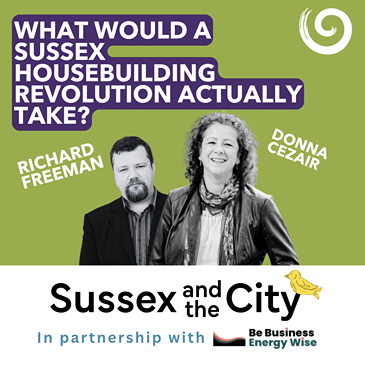
– Episode #64
What Would A Sussex Housebuilding Revolution Actually Take?Host: Richard Freeman Guest: Donna Cezair – Chief Executive, Worthing Homes
🔍 Episode summarySussex has a housing crisis. That is easy to agree on.
Thousands of households are waiting for social housing, living in temporary accommodation or trying to survive in a private housing market that has become unaffordable to people on perfectly ordinary incomes. At the same time, Sussex is under pressure to build substantially more homes while protecting some of the most valuable landscapes in the country.
The difficult bit starts when you ask how.
Who actually builds social housing? What is a housing association? Where does its money come from? Why is "affordable rent" sometimes 80% of the market rate? Why did councils transfer thousands of homes to housing associations? And if the need is so obvious, why can't we simply build a great many more?
Donna Cezair has spent nearly 40 years working in social housing and is now Chief Executive of Worthing Homes, which owns around 4,000 properties and serves approximately 10,000 customers.
Her starting point is that a good home is the cornerstone of a healthy and productive life.
But housing doesn't exist in isolation.
Building another estate on the edge of a town achieves rather less if residents can't reach jobs, there aren't enough schools or GPs, public transport is poor and the neighbourhood itself has no real sense of place.
So what for devolution?
The emerging Sussex and Brighton Strategic Authority will increasingly think across housing, transport, infrastructure, skills and economic growth at a scale Sussex has rarely used before. Eventually, a mayor will operate within that system too.
Donna sees an opportunity for housing to stop being treated as a separate policy silo and instead become part of the county's essential infrastructure - connected to employment, health, education, transport, public space and community.
But before that can happen, the social housing sector itself may need to get more organised.
Donna estimates that more than 70 social housing providers operate across Sussex, ranging from major national housing associations to tiny specialist providers. Her previous experience in Greater Manchester showed her what can happen when those organisations speak collectively, work strategically with a mayor and make a clear proposition about what they can deliver.
Sussex hasn't traditionally done that.
So Donna is beginning to bring providers together – not simply to ask a future mayor for money, but to make an offer: land, development expertise, investment, community relationships and the ability to turn strategic plans into actual homes.
And this isn't merely a question of finding enough planning sites.
A major housebuilding programme will need construction workers, surveyors, materials, investment and infrastructure. Donna describes long-standing shortages in construction skills and difficulties recruiting professionals such as quantity surveyors and building surveyors. Major projects such as Gatwick's expansion could create further competition for labour and materials.
Then there is public consent.
People may recognise that Sussex desperately needs housing while simultaneously worrying about what new development will do to the place where they live. Donna's response is not that those concerns should be brushed aside. Housing associations need to use brownfield land, regeneration opportunities and infill intelligently – and development itself needs to produce places people genuinely want to live in.
Because this conversation ultimately isn't about hitting a housing number.
It is about whether Sussex can use devolution to start answering a much more useful question:
Where do we want people to live – and what else needs to exist around them for those places to work?
--
This episode is brought to you by Be Business Energy Wise, a fully funded programme helping East Sussex businesses understand and reduce their energy costs while making more informed sustainability decisions.
Businesses can access free practical one-to-one support, detailed on-site energy assessments where eligible, and workshops covering subjects including energy efficiency, sustainability marketing and reducing waste through the circular economy. You don't need an existing sustainability strategy or specialist knowledge – the programme is designed to help businesses in East Sussex to understand where they are now, where energy may be being wasted and which actions are genuinely worth taking next.
Be Business Energy Wise is funded by the Sussex & Brighton Strategic Authority and East Sussex County Council, managed by East Sussex County Council and delivered by Always Possible. Find out more at www.alwayspossible.co.uk/be-business-energy-wise.
🎯 In this episode- Why Donna has spent nearly 40 years working in social housing
- What a housing association actually is
- The difference between social rent and "affordable" rent
- How housing associations finance new homes
- What Section 106 agreements contribute to social housing
- Why Worthing Borough Council transferred its housing stock in 1999
- How Worthing Homes became a 4,000-home community-based landlord
- Why there are more than 70 social housing providers across Sussex
- What Sussex can learn from Greater Manchester's housing providers
- Why the sector needs a stronger collective voice
- Whether councils or housing associations should lead new social housebuilding
- The scale of homelessness and housing waiting lists in Sussex
- Misconceptions about who can access social housing
- Why low turnover means existing stock can never meet current demand
- Brownfield sites, infill and finding development land in Sussex
- Shortages of construction workers and professional skills
- The effect major infrastructure projects could have on building materials
- Why housing needs to be planned alongside transport, jobs, schools and healthcare
- What housing associations mean when they call themselves "place shapers"
- How housing can support health, employment and local economies
- Why collaboration could make public investment go further
- What a future Sussex Housing Alliance might offer a mayor
Housing associations are independent, not-for-dividend organisations providing homes at below-market costs.
They are governed by boards and raise much of their finance privately rather than borrowing directly through government.
New affordable housing can be supported through grants from Homes England or through planning requirements such as Section 106 agreements, under which private developments provide a proportion of affordable housing.
Housing associations then offer different forms of tenure.
Social rent
Typically significantly below market rent – Donna describes it as around 60% of the local market rate.
Affordable rent
Despite the slightly awkward name, this can be up to around 80% of market rent.
Shared ownership
Residents purchase part of a home and pay rent on the remainder, offering another route for households unable to buy outright.
Worthing Homes itself was created through a large-scale voluntary transfer in 1999, when tenants voted for Worthing Borough Council's housing to transfer to the new housing association.
A major reason councils transferred homes in this way was finance: housing associations could access private investment and raise money to improve existing stock and build more homes.
👤 About Donna CezairDonna Cezair is Chief Executive of Worthing Homes and has worked in social housing for nearly four decades.
She began her housing career in 1987 and moved into her first executive role six years later. Since then, she has worked with housing associations, local authorities and national organisations across the UK.
Before joining Worthing Homes in January 2023, Donna was Chief Executive of First Choice Homes in Oldham, giving her direct experience of operating within the Greater Manchester devolved system and the collective approach developed by housing providers there.
At Worthing Homes she leads a community-based housing association responsible for approximately 4,000 homes and 10,000 customers.
Donna is also Chair of the Board of ForHousing.
🎧 Production credits
Host: Richard Freeman Guest: Donna Cezair Sound design, editing and original music: Chris Thorpe-Tracey Production management: Letitia McConalogue
📣 Get involved👉 sussexandthecity.info — episodes, resources, events and more about devolution and change across Sussex
👉 sussexintelligence.com — independent research and evidence-led insight into growth, infrastructure, governance and belonging across Sussex
[00:00:00] This episode is brought to you by Be Business Energy Wise, a fully funded programme helping East Sussex businesses take control of energy costs and make smarter sustainability decisions. If your business has high or unpredictable energy bills, you're not quite sure where energy is being wasted, or you know you could make improvements but don't know where to start, Be Business Energy Wise can help.
[00:00:24] There's free, practical one-to-one support, detailed on-site energy assessments for eligible businesses and workshops covering everything from cutting energy costs to credible sustainability marketing and reducing waste through the circular economy. You don't need to be an energy expert or already have a sustainability plan. The idea is to help you understand where you are now, what could make a difference, and what's actually worth doing next.
[00:00:52] Find out more and register your interest at alwayspossible.co.uk forward slash be hyphen business hyphen energy hyphen wise. Be Business Energy Wise is funded by the Sussex and Brighton Strategic Authority and East Sussex County Council. It is managed by East Sussex County Council and delivered by Always Possible.
[00:01:17] This podcast is brought to you by Always Possible. Always Possible. Always Possible.co.uk. You're listening to Sussex and the City with Richard Freeman. Welcome to Sussex and the City podcast. It's Richard Freeman here. Who else did you expect? Sorry, yes, it's always me.
[00:01:41] This episode is about something which is simultaneously one of the biggest political, economic and social questions facing Sussex. Hell, facing the whole of the UK. But it's something that, unless you directly work in it, can be surprisingly difficult to understand. Housing. Not just whether we build enough homes, but who builds them, who owns them, who can afford to live in them, where they go, and what makes a home genuinely affordable, in quotation marks.
[00:02:11] And increasingly, how all of that fits into the much bigger question of what sort of Sussex we actually want to create. One of the staggering things about Sussex, one of the most beautiful things about Sussex, is how much of the land is protected, right? It's our wonderful natural environment. But that leaves sort of less than about 15% that you can actually build new homes on. So what are we going to do about it? My guest is Donna Cezare, Chief Executive of Worthing Homes.
[00:02:38] Donna's been working in social housing for nearly 40 years. She started as a housing advisor in 1987, reached her first executive role just six years later, and has worked ever since for housing associations, councils and national organisations across the UK. Before coming to Worthing, she was Chief Exec of First Choice Homes Oldham, so has first-hand experience of working within the much more established Greater Manchester Devolved System.
[00:03:04] She joined Worthing Homes at the beginning of 2023 and is also Chair of the Board of For Housing. That mix of experience makes this a really interesting moment to have a chat with Donna, because Sussex has a housing crisis. There are thousands of households across the county waiting for social housing who are living in temporary accommodation or simply unable to find somewhere secure and affordable to live.
[00:03:27] And at the same time, we're creating a new strategic authority and we'll soon have a mayor which will increasingly be expected to think about housing, transport, skills, infrastructure and economic growth as one holistic challenge slash opportunity. This sounds obvious, sounds exciting, we can finally get this all right. The problem is just how fragmented the system actually is.
[00:03:52] Worthing Homes itself, which is an arm's length social housing provider that was a spin-out of Worthing Borough Council, owns around 4,000 homes and serves around 10,000 customers. Donna tells me there are more than 70 social housing providers operating across Sussex, including large national housing associations to tiny specialist providers. And unlike places like Greater Manchester, those organisations have not spoken in Sussex with one strong collective voice.
[00:04:22] Donna is using the catalyst of devolution to try and change that. In this chat, we get right back to basics. What is a housing association? Where does its money come from? What's the difference between social rent and, inverted commas, affordable rent? Why did councils transfer thousands of homes to housing associations in the first place? And why, when the demand is so enormous, can we not just simply build a load more? We get into some of the myths around social housing, including who's actually eligible for it,
[00:04:50] and the uncomfortable reality that even a huge national house building programme will need to contend with shortages of land, construction materials, skilled workers and infrastructure. And the bigger question here in Sussex is about place. Donna talks about housing associations as place shapers rather than simply landlords. Because building another few thousand homes isn't much use if people can't get to work from them, or there aren't enough schools, GPs or buses.
[00:05:15] Or they're just horrible places to live, and we've just simply produced identikit estate after identikit estate sitting on the edge of a town with no sense of community attached to it. The opportunity that we've got, presented by devolution, is to start joining these things up. Right? Maybe. Housing alongside transport, housing alongside health, housing alongside jobs, education, public space, culture, community, yada yada. And so Donna wants Sussex's housing associations to come together and make a collective offer.
[00:05:42] And eventually, when there's a mayor, not just asking them for money, but showing them what could be achieved if land, expertise, investment and relationships brought together properly. By the end of this really enjoyable conversation, in which I learnt loads, you may hear we may have even accidentally launched a Sussex Housing Alliance. Don't say that this project doesn't create change. You heard it here first. This is my conversation with Donna Césaire.
[00:06:21] Let's dive in. This is a conversation about housing, about social housing. The reason I want to have this conversation, we touched on it early in the project, but I really wanted to return to it because it's coming up again and again and again and again as one of the most important things that we need to get right nationally, particularly in Sussex, where we have very acute housing needs.
[00:06:46] We have too many people, thousands of people on the housing register who are in terrible housing conditions or none at all. So there's no one better, I think, to have a deep dive for their local knowledge, but also having worked nationally or in other areas around this issue as well. It's Donna Césaire, the chief executive of Worthing Homes. How are you, Donna? I'm really well. Feeling a bit hot, but ready for a good chat.
[00:07:12] Yeah, we've only got to know each other over the past couple of months or so and I'm really grateful for having sort of met your team and got to understand your work a bit better. Housing is something I'm obsessed about at the moment, but very much has a Johnny come lately. So before we look at the nuts and bolts of what we mean by social housing, give me a little overview of your work and your career and what led you to leading Worthing Homes first. I've actually been in social housing for nearly 40 years.
[00:07:42] So you could say that it's not only my career, but obviously my passion. For me, the cornerstone of a healthy and productive life is a good home. And so I think that's always driven, always wanted to do something to try and tackle the housing crisis, which sadly has just grown over the length of my career.
[00:08:02] So I've worked for all sorts of organisations around the country, large and small housing associations and local authorities at the beginning of my career and also national charities. More recently, I've come to Worthing Homes, joined the organisation in January 2023. And that was really driven by, I think, the attraction of being able to lead what's a small housing association. So 4,000 homes and around 10,000 customers.
[00:08:32] But really what attracted me is the fact that we're a community-based organisation. We call ourselves a place shaper. In fact, we're part of the National Place Shapers organisation. And that's very much about being able to contribute to the local communities, to be here for the long term, but to work alongside other partners, alongside the local authority and really genuinely try and make a difference to people's lives on a local scale. What is a housing association?
[00:09:02] How does it work? How are they governed? Who pays for them? What do they do? I think the first thing to say is that housing associations are not for profit or not for dividend might be a better way to describe it. So we have a governing body. We're overseen by our non-executive directors. In some organisations, they're paid and others, they aren't. It's more of a stipend than a salary. They oversee the way that the organisation operates, make sure that it meets its duties, etc.
[00:09:30] And really, we're set up to challenge homelessness and housing need across the country and to work with people who find themselves unable to access perhaps the private market, whether that be the private rented sector or home ownership.
[00:09:45] And so we offer accommodation that is at sub-market rents, either what we call a social rent, which is around 60% of the market rent, or an affordable rent, which is an ironic term because it's around 80% of the market rent. And that's to do with a funding regime that we've more recently worked with. We raise money on the private money markets and we sit outside of the public sector borrow requirement.
[00:10:14] So we don't add to the national debt, if you like. So we raise money privately. And when we build a development, we either get grants from Homes England so we can provide those subsidised rents in effect, or we take what's called the Section 106. So on a large development, the developer will be required to produce a percentage, depending on the local planning guidelines, for what's called Section 106.
[00:10:40] And that will be a proportion of properties that are sold to housing associations for, say, 80% of the open market value. So again, we can offer those lower rents. So we're really here to fill that gap for people, as I say, who can't access the private rented sector, can't access the home ownership market. So we provide those lower rents and also something called the low cost home ownership products, which are things like shared ownership.
[00:11:09] So we're part of the wider housing system, but we're here for people who are under perhaps more difficult circumstances. You're called Worthing Home, so you're named after a Sussex town. But what is your patch? You know, what does that mean? And what's your relationship with local authorities like Worthing Borough Council? Yes, so we were set up in 1999 when the tenants of Worthing Borough Council voted to become a housing association.
[00:11:37] So we're what's known as a large scale voluntary transfer, an LSVT. Some housing associations, and they're called traditionals, they've been set up by church groups or philanthropists like Peabody or Octavia Hill. So 26 years ago, we took over all of the stock from Worthing Borough Council. And that was because, as I say, that puts us outside the public sector requirements so that we can actually raise money to invest in our properties.
[00:12:07] And this has really been the driver for councils transferring their stock to housing associations, because it gives an opportunity for us to raise finance to invest in our properties. Across the country, there is something that I believe there's something like two and a half thousand housing associations. Some are very large, large nationals that own sort of 130,000 units. Whereas Worthing, as I say, we own 4,000 homes.
[00:12:33] And we've chosen to keep it geographically tight because we don't want to do developments that are now two hours away because we don't think we can provide the level of service that we want to. So we prefer to have a small patch. But interestingly, within Sussex, there are around, well, there's over 70 social housing providers. You told me that the other day. It blew my mind. I think I could name about five. I know.
[00:13:00] And they range, I would say, within Sussex, we're probably medium-sized, interestingly. So we have some very large nationals that own stock across Sussex that are bigger than us. And then in Sussex, we have a lot of very small providers, many of which are very niche in terms of they work with specific needs groups, work in supported housing. So there's a very mixed bag in Sussex.
[00:13:29] A common theme and thread through this whole project is getting to grips with how fragmented, driven by a kind of patchwork or network economy. So many systems within Sussex, it seems lots of small rather than a few of big tends to be the case. So it feels like that's what's mirrored a little bit in the social housing supply as well. But with all those different types of providers and all those different sizes and shapes of providers, I guess you've got choice.
[00:13:59] You've got people that can expand or flex to need in different ways. And so therefore, we get all bases covered. Or on the other end, there might be people saying, this is nuts. People don't talk to each other. There's duplication. It's confusing. What's your honest appraisal? I mean, my appraisal is that in Sussex, we're a very disparate group. So prior to coming to Worthing, I was actually working in Oldham.
[00:14:25] So I was actually the chief exec of First Choice Homes in Oldham, which was part of the Greater Manchester Housing Providers tribe. And it was a very, very different experience. And I think across Sussex, across the southeast, but if we're thinking specifically around Sussex, we're very disjointed. And the challenge was really thrown down to me probably about a year ago by Dr. Becky Cooper, the MP for Worthing West,
[00:14:51] who said to me in the lead up to thinking about a mayor for Sussex and get ourselves ready for that and thinking about devolution. Her challenge to me was other sectors were hearing their consolidated voice, but we're not hearing that from social housing. So I've liaised with our national trade body, the National Housing Federation, and started to get a group together open to every housing, social housing provider across Sussex
[00:15:21] to come together to start thinking about what devolution will mean for us and to start to make sure that we have a place at the table as the strategic authority takes shape and obviously as we start to work towards getting a mayor. And my experience in Manchester, which is obviously very well established, is that by doing that, obviously working with Mr. Burnham, they were able to, I think, through that consolidation,
[00:15:49] get a really good result in terms of the amount of resources they were able to bring into social housing for new developments. And also how they've been able to coordinate their work across things like homelessness. I was just in Manchester last week and heard about a scheme where within new developments, they have two or three units which they work with adult social care who rent the units
[00:16:17] to then provide somewhere for people coming out of hospital to go to, to work with district nurses, and then obviously to get home. So clearly that sort of model is so much better for the tenant and so much better to get someone out of hospital where they're bed blocking and get them on their way to getting back to independent living. So I think when we come together, there can be lots of opportunities. And I'm really, really keen that in Sussex, the social housing providers,
[00:16:46] the housing associations in particular, that we come together, we find ways to collaborate and we find ways to really have a seat at the table with the new mayor and make sure that we get as much resource into Sussex, which we can then work with the mayor to make sure that it funds the right developments, the right homes in the right places. You've probably got a strategy, a vision, a roadmap,
[00:17:14] maybe even a post-it note empire on your office wall. But has anyone asked the really awkward questions yet? Like, is it actually working? At Always Possible, we help senior leaders challenge the obvious, rethink the possible and deliver the extraordinary without losing their sanity or their sense of humour. Enabling private and public sector innovators to navigate a changing economy.
[00:17:42] We help complex organisations to humanise data and to translate the big picture into hyper-local engagement, trust and sustainable growth. If you're ready to bring people with you because your leadership truly inspires, visit alwayspossible.co.uk. That's alwayspossible.co.uk. Always possible.
[00:18:11] We make bold business brilliant. Staying maybe zoomed out a little. You know, this government has talked a lot about social housing, perhaps more than the last few. There'll be a state-led or social housing-led sort of building revolution like we've not seen since post-war period. You know, from your perspective, is this rhetoric? Is this positioning? Is this sort of politics?
[00:18:40] Or is this a genuine call for and a likely deliverable revolution in the social housing stock in the UK? I mean, it's great to start with ambition, isn't it? Is it deliverable? I mean, at the moment we've got a lot of schemes and because some of this is sort of funded towards the back end of the 10-year government term, there's a concern that housing associations are really gearing up and some sites will stall unless we can get the money flowing.
[00:19:09] So the mechanics of it need to be very carefully determined. And, of course, there's a lot of pressure on the Treasury, isn't there, for all different sorts of reasons. I mean, one of the things that Andy Burnham promotes is that councils should start building again. I'm personally not a fan of that and it's not because of self-interest. I just think the housing associations have spent years putting together development teams and expertise
[00:19:36] to bring these schemes to market. And I just worry that it's an ideology around councils building again and the time that it would take for them to gear up. I mean, some have their own private house building subsidiaries already, but many, many don't. And it just seems, I don't know, for me it just seems a bit bonkers when you've got all of the expertise sitting in your local housing associations
[00:20:03] why you would want to pass the baton over to the councils. But I feel we should work in partnership, form JVs and use our talents and resources to the best effect. So I think it's got more to play out. But I think personally, I'm very hopeful and very excited that this may be an opportunity. I mean, it may shock people to know, and I found it shocking when I came here, that between Ada and Worthing,
[00:20:31] there are over 500 households, whether that's single people or families, that have been accepted as homeless that the council has a duty towards. And that's just obviously in our small towns. You amplify that across the country. It's really quite shocking. So clearly, as a society, we need to do something. It is appalling, isn't it? Yeah, 500 in Ada and Worthing, just under 2,000 at the moment on the list in Brighton and Hove.
[00:20:59] We're talking thousands of people who have no security or a permanent place to live. You know, what's the public mood on this? There's so many terrible narratives or just mixed narratives or misinformation. I think broadly, people are in support of more public housing. There feels to be a kind of national recognition that, you know, following Thatcher's right to buy movement in the 70s and 80s, we did not replace the housing stock
[00:21:29] so that people on low incomes or for whatever reason did not have access to places to live. And the market rate, certainly the southeast of England, has gone mad. It is not that it's not affordable for people on low incomes. It is not affordable for anyone not on a really high income. And so young people need to leave the southeast if they want to be able to get on the property ladder or they want to even rent somewhere unless they've got a high paying job,
[00:21:57] which we don't have in the southeast in many sectors. If we're going to build 1.5 million houses, we're going to have to build them in places where people already live and those people are going to have to get behind that. Are they? Well, I think they are. I mean, I think the first thing I'd want to say and you're right is it's a political hot potato, isn't it, in terms of immigration, it's obviously very high in the conscious of most people. So I think it's probably just important to say
[00:22:25] that you can't be offered a social housing tenancy unless you have a legal right to remain. So I think that's the first thing to say. And in Ada and Worthing, so certainly in our bit of Sussex, you have to have a local connection. So you have to have lived in the area for some substantial time. And sadly, people who are waiting can be waiting a very, very long time because if you think about Worthing Homes, 4,000 properties,
[00:22:55] we're a good landlord. You know, we repair our homes, we respond to people and support them with all different sorts of advice and services. So the turnover is very low. You know, I think our churn at the moment is around 5%. Well, that's just nowhere near what the demand is. So I think that's the other, you know, so building new properties has to be one of the ways forward because the current stock is just not,
[00:23:24] it's just not turning over sufficiently to provide anywhere near what's required. And it does get tricky, doesn't it? Because you can understand people feel very defensive, particularly in Sussex. We have obviously very, very many beautiful areas. The Greenbelt is protected. We know that. So I think it's incumbent on housing associations. We're always looking for ways to build on brownfield sites, for infill sites, small associations like Worthing Homes
[00:23:54] really do fill the gaps. And that's, you know, that's literally as well as metaphorically. So we're always looking for ways to use unused areas, unused pieces of land, regenerate areas and be as creative as we can to create opportunities for development. There's some practical implications. You know, I was told not that long ago, once the Gatwick Northern Runway build goes ahead,
[00:24:22] you know, huge, major infrastructure project, the likes that we haven't seen in Sussex for quite a long time. And I was talking to an organisation that imports lots of the sort of aggregate building materials, things like that. They said, it's all going to go there. It's going to be very, very hard to get a hold of the amount of steel and cement and things like that in the South East unless we really get ahead of any major building programmes for housing. And then you've got the skills issue. And maybe you'll have a view on this because I know that you build,
[00:24:50] but lots of the larger construction companies are very worried about having access to the amount of labour to build 1.5 million houses across the country in quite a small space of time. So it might not even be just the planning or the sites that block stuff. You know, we've got to do an awful lot of work to ensure that we can meet this opportunity, right? Absolutely. And I mean, just picking up on your point, Rich, around skills. I mean, the construction industry, certainly for the whole of my career,
[00:25:19] there have been concerns voiced about the numbers of young people coming into the construction industry and there just not being enough investment into training people and creating that flow of young people into the industry. And I think that just becomes worse and worse, you know, and particularly as young people might not find it attractive to be out in all weathers, you know, doing manual labour. So it is a real worry. And even the office-based skills,
[00:25:48] if you like, more around, say, quantity surveyors and building surveyors, we find it very difficult when we have vacancies to sometimes find that talent. And so we've been looking at ways that we can invest in our own people, ways that we can open pathways into different careers. And I think social housing, we have a real job to do to make it known that housing offers so many different careers. You know, we've certainly been working
[00:26:17] with the local colleges, local charities, but it is very difficult. And I think there is a real skill shortage coming. The new strategic authority in Sussex and Brighton, eventually the new mayor, will have huge amounts of convening and strategic and commissioning powers around house building. And that will be determined by what they're calling a strategic spatial plan. So that's really mapping out the whole of Sussex
[00:26:47] and beginning to think about long-term housing development, commercial real estate infrastructure. But what the leadership of the strategic authority at the moment are very keen to talk about when they think about things publicly, you know, is inclusive growth of spatial development being explicitly linked to the prosperity plan. You know, where housing is built must be completely congruent with where jobs are created,
[00:27:15] where hospitals and schools are able to meet demand, where transport is able to get people around. And you talked about place shaping, you know, so it's even more than all of that sort of physical infrastructure. It's about identity. It's about community, how people feel that they belong somewhere. And all of that adds layers of complexity, but also gives us a real, you know, an amazing opportunity
[00:27:42] to shape future Sussex. Totally. And I personally see this as a really exciting opportunity. And I think to connect the transport, the other infrastructure planning is really important because as you say, I think there have been mistakes in the past. We build housing where we can and then people are trapped with no transport, with a lack of schools locally. There's then real pressure on the local areas.
[00:28:12] So I think the Halcyon position would be for us to work together. I think the work that you're doing, the work the strategic authorities doing to try and build, bring people together to connect their thoughts, their aspirations, their ambitions is the right way forward. And I think if we can then mindfully look at how we bring new projects to fruition, but connect them in with the local infrastructure and seeing, I mean, people like me would argue
[00:28:41] that housing should be seen as part of the local infrastructure alongside transport and education. And I think, you know, new housing developments can bring so much prosperity as well. You know, that it's part of building the local economy and building the local job opportunities. So I see housing as a fundamental part of the countywide conversation. And as I agree with you, I think it's a really exciting opportunity
[00:29:11] to galvanize people, to hopefully create a new awareness in what's happening around us and taking the opportunity to be part of that conversation. I think it is really important that people get involved. You know, 39 billion is a lot of money to invest in one thing. You know, this strategic authority brings money into Sussex that wasn't already there and then that is a tool to leverage other investment.
[00:29:40] I was chairing a conference this week called The Power of Place with the Gatwick Diamond. And it's the first of its kind really to have a sort of business network actually convening a conversation about place, about regeneration through economic growth and how, you know, things like house building can also support cultural investment, can support recreation, can support public realm, can improve common ways and parks and beaches
[00:30:10] and, you know, things that we've struggled to invest in because that's been down to sort of local authorities that have been only statutarily responsible for adult social care, education and collecting the bins and have very little money to do anything else. So it's all been sort of goodwill, bit of philanthropy here and there, the odd small grant. You know, this could be transformational if we join this up and just think about where do we want to live
[00:30:40] and how do we join this up to create that space? I mean, I totally agree and I think housing associations are unusual because we're way, way more than just a landlord. You know, the way that we galvanize our communities, work with people, try to create opportunities, work with lots of different partners, I think is really important and I do think it is a real opportunity for Sussex to, I just think, to make our resources go further by not duplicating, by not working in silos,
[00:31:10] by making sure that we absolutely maximize everything that we do. I mean, for example, yesterday I was talking to colleagues at the local authority about how we could work together between the GPs and social prescribers and customers living in our homes to really support people to have better health opportunities, to live better in their homes and then, of course, they can then go to work potentially, they can contribute more.
[00:31:40] How do you think this new way of working can best have dialogue with new political structure? So, as well as the strategic authority, of course, you know, you are Worthing Homes spun out of Worthing Council, which will not exist in two years' time. It will be part of a larger unitary, so you've got a whole new load of relationships and partnerships to build, which I'm sure will be top of mind. It's going to sound flippant, but you know, a grown-up conversation about actually we need to cede some power here.
[00:32:09] This is about trade-offs, it's about compromise, it's also about imagination and thinking bigger than what any of us can do on our own and then being able to translate that in a simple, effective, credible, costed ask to new leaders. A lot of that feels quite new to Sussex, I think. Yes, it does, but listen, I'm really, really optimistic because I know that the Housing Association movement is one that is collaborative and that we have a common
[00:32:38] and shared vision to tackle the housing crisis and so I'm absolutely sort of convinced and optimistic that we will come together and we've got lots of great models, you know, I mentioned Manchester earlier because that's been the longest established, but there are lots of other really good models, West Midlands, up in the Northeast, around Yorkshire where housing associations have come together and the sum of the parts has really
[00:33:07] given a lot of pace and energy to much better, you know, the kind of coming together as being able to produce so much more than working disparately and I'm really confident that in Sussex we can do that. You know, talking with my colleagues across other housing providers, I can see there's real energy, a real intention to make the most of this opportunity so I'm really confident that we can galvanise that momentum
[00:33:35] and by the time as we get closer to the mayor and the elections, I think we can really hone an offer from the housing association providers for Sussex, you know, how we can come together collectively, how we can offer more by that collaboration and how we can link that, how we can be a fundamental part of the spatial strategy and how we can link our offer in with transport and education and health
[00:34:04] and I feel very optimistic that over the next few months we'll be able to hone that and you mentioned could we call it an alliance so maybe that's the start of the Sussex Housing Alliance and you heard it here first. Oh, Scoop, goodness me, don't usually get those. Brilliant, thank you so much. You've been a wonderful guest and really it's a really interesting topic that I think I'm certainly learning more about every day, every week but I also think it's something that most people
[00:34:34] don't particularly unless you are a social housing tenant or unless you are working at the coalface with an association or in development or with a local authority which frankly most people aren't and look at the linear private market, really don't understand how any of this works and it just feels like a sort of complicated mess of narratives but actually if we did understand it all a little bit better, if we learn a
[00:35:03] bit more about this at school, if there was more public education on this, what a massive force for place and community this could genuinely be. So thank you, thank you so much for sharing that and being my guest, Donna Césaire, on the Sussex and the City podcast. Very welcome. Thank you very much to this
[00:35:33] episode's guest and to you for tuning in. Sussex and the City is an independent and non-political project about devolution as it happens, explained in human. It is led by Always Possible. You can find other episodes, resources, events and blogs about change in Sussex and Brighton by visiting sussexandthecity.info That's sussexandthecity.info
[00:36:03] This episode was written and presented by Richard Freeman for Always Possible. The editor was me, Chris Thorpe Tracy for Lo-Fi Arts. I did the music too. Production management was by Letitia McConnell for Always Possible. Talk to you next time.
[00:36:34] Always Possible. .co.uk . . .