
Episode #65
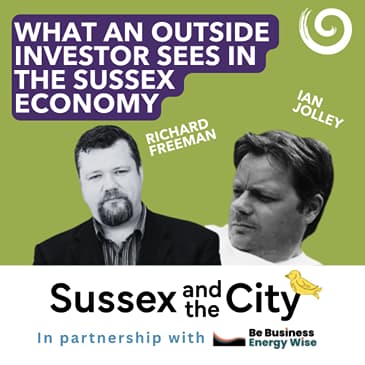
What An Outside Investor Sees In The Sussex EconomyHost: Richard Freeman Guest: Ian Jolley – entrepreneur, investor and owner of Agricom
🔍 Episode summaryWhat does Sussex look like to somebody who doesn't already live here, work here or know how the local economy operates?
We spend an enormous amount of time talking about how Sussex should present itself to the outside world. We want to attract investment, develop a stronger economic identity, champion our businesses and persuade people that this is somewhere they should come to build things.
But how often do we ask somebody who has actually made that decision what they found when they arrived?
Ian Jolley wasn't particularly looking to invest in Sussex.
He lives in Cheshire, has spent around 30 years working in transport and logistics, and is building a growing group of businesses specialising in commercial vehicle repairs and truck building. His operations already included P Leake Commercial Repairs in Telford and Collins Truck Builders in Essex when an opportunity arose to acquire Agricom, a long-established commercial and agricultural vehicle repair business near Petworth, West Sussex.
The previous owners were retiring, the business fitted Ian's expansion strategy, and Sussex became the location of his third acquisition almost by accident.
Then something unexpected happened.
Ian began spending time in rural West Sussex and discovered a business culture that felt quite different from the one he knew elsewhere.
Not necessarily less ambitious. Not unproductive. Just a different pace.
Where his businesses further north could feel relentlessly focused on doing more, faster, Ian found that people in Sussex sometimes approached decisions more deliberately. They still wanted to grow, but seemed to spend more time thinking about whether an idea was right before rushing into it.
And rather than importing his existing management culture into Sussex, Ian has started taking some of that Sussex approach back to his other businesses.
Sussex is dominated by smaller businesses, independent enterprises and specialist suppliers. We often discuss this as a weakness, particularly when comparing ourselves with regions dominated by major corporate headquarters or large industrial employers.
But Ian sees something else.
He describes Sussex as an untapped pool of talent, where larger businesses could find specialist expertise, suppliers and people capable of supporting their growth.
Perhaps Sussex doesn't need to become a miniature version of Birmingham, Manchester or London to attract investment. Perhaps it needs to get better at explaining the economic value of what already makes it distinctive.
There is, however, another side to Ian's experience.
He works in transport, logistics and commercial vehicles – industries that rarely feature prominently in the stories we tell about the Sussex economy, despite being essential to practically everything else.
We have Gatwick Airport, the ports at Shoreham and Newhaven, agricultural businesses, food producers, manufacturers and thousands of enterprises that depend on getting people, products and materials from one place to another.
But Sussex is not always an easy place to move things around.
The South Downs, the A27, rural roads and fragmented infrastructure create practical problems for businesses such as Agricom. Ian describes having to spend two hours travelling to and from facilities needed for truck MOTs.
His argument isn't that Sussex needs motorways carved through its countryside.
Instead, he asks whether we could think more strategically about the roads we already have, where industrial facilities are located and how shared distribution hubs might support rural businesses without damaging the places that make Sussex attractive.
And then there is the experience of arriving here as an investor.
Ian is already considering another workshop in Sussex. But identifying the right location, understanding the local business landscape, finding relevant networks, accessing skills and discovering what support or funding might exist is surprisingly difficult when you don't know the area.
That matters as the Sussex & Brighton Strategic Authority begins to develop a more coherent approach to inward investment and economic growth.
Attracting an investor is only the beginning. Making it easy for them to stay, expand, employ people and build relationships is just as important.
This is a conversation about trucks and tractors, certainly. But it is also about the character of the Sussex economy, the economic importance of logistics, the advantages of smaller businesses and what somebody arriving from outside can see that the rest of us might have stopped noticing.
And perhaps the most interesting finding is that Sussex's different pace of business might be something worth protecting, rather than apologising for.
This episode is brought to you by Be Business Energy Wise, a fully funded programme helping East Sussex businesses take control of energy costs and make smarter sustainability decisions.
Businesses can access free practical one-to-one support, detailed on-site energy assessments where eligible, and workshops covering energy efficiency, sustainability marketing and reducing waste through the circular economy.
You don't need an existing sustainability strategy or specialist knowledge. The programme helps businesses understand where they are now, what could make a difference and what's worth doing next.
Be Business Energy Wise is funded by the Sussex and Brighton Strategic Authority and East Sussex County Council, managed by East Sussex County Council and delivered by Always Possible.
Find out more at alwayspossible.co.uk/be-business-energy-wise.
🎯 In this episode- Why Ian Jolly unexpectedly became an investor in rural West Sussex
- His ambition to build a national network of commercial vehicle repair businesses
- The story behind his acquisition of Agricom near Petworth
- How Sussex's business culture compares with the Midlands and the North
- Why a different pace doesn't necessarily mean lower ambition
- What Ian is taking from Sussex back into his other businesses
- Whether Sussex undersells the value of its smaller-business economy
- Why specialist suppliers and independent enterprises could attract larger investors
- The importance of transport and logistics to economic growth
- What COVID revealed about the essential role of commercial transport
- The difficulties of operating commercial vehicles in rural Sussex
- Why better roads don't necessarily mean building new motorways
- How strategically located industrial and distribution hubs could help
- The potential for shared logistics infrastructure serving Sussex food producers
- What an outside investor needs from local business networks
- Why Ian is already considering further investment in Sussex
- The skills needed to maintain the next generation of electric commercial vehicles
- Why business grants and support can be difficult to navigate
- What a more investor-friendly Sussex might look like
🎧 Production credits
Host: Richard Freeman Guest: Ian Jolley Sound design, editing and original music: Chris Thorpe-Tracey Production management: Letitia McConalogue
📣 Get involvedsussexandthecity.info — episodes, resources, events and more about devolution and change across Sussex.
sussexintelligence.com — independent research and evidence-led insight into growth, infrastructure, governance and belonging across Sussex.
[00:00:00] This episode is brought to you by Be Business Energy Wise, a fully funded programme helping East Sussex businesses take control of energy costs and make smarter sustainability decisions. If your business has high or unpredictable energy bills, you're not quite sure where energy is being wasted, or you know you could make improvements but don't know where to start, Be Business Energy Wise can help.
[00:00:23] There's free practical one-to-one support, detailed on-site energy assessments for eligible businesses and workshops covering everything from cutting energy costs to credible sustainability marketing and reducing waste through the circular economy. You don't need to be an energy expert or already have a sustainability plan. The idea is to help you understand where you are now, what could make a difference and what's actually worth doing next.
[00:00:52] Find out more and register your interest at alwayspossible.co.uk forward slash be hyphen business hyphen energy hyphen wise. Be Business Energy Wise is funded by the Sussex and Brighton Strategic Authority and East Sussex County Council. It is managed by East Sussex County Council and delivered by Always Possible.
[00:01:17] This podcast is brought to you by Always Possible. Always Possible.co.uk. You're listening to Sussex and the City with Richard Freeman. Hello and welcome to the Sussex and the City podcast. I'm Richard Freeman.
[00:01:39] Now, a lot of what we're talking about in this project is how Sussex needs to look out to the rest of the world, how it needs to grow in confidence and create narratives about a place that's open for business, that's open for investment, that's open for tourism and visitors and people to move to. But maybe we aren't finding out to. But maybe we aren't finding out enough whether that's working.
[00:02:04] What does Sussex look like to somebody coming in from the outside? We talk a lot about our economy, our infrastructure, our strengths and frustrations. But sometimes you learn a lot by talking to someone who isn't in the thick of all those conversations, who maybe is just feeling it for themselves as they experience Sussex for the first time. So I'm delighted that my guest this week is Ian Jolly.
[00:02:32] Ian spent around 30 years working in transport and logistics and he owns a fast-growing group of businesses involved in commercial vehicle repairs and truck building. He owns Pealeak Commercial Repairs in Telford, Shropshire, and he owns Collins Truck Builders in Essex.
[00:02:51] But more recently he acquired AgriCom near, drumroll, Petworth in Chichester District, a long-established business working across commercial and agricultural vehicle repairs. As Ian was taking over this business in rural West Sussex, he's been on a journey trying to find out a bit more about this curious new landscape in which he's trying to build a bit of an enterprise.
[00:03:19] And he discovered Sussex and the City and the podcast and he got in touch. And he told me that he lives in Cheshire. And he's never really had a grand strategy to invest in Sussex. He's never really had any connection with Sussex at all. And so Petworth, of all places, arrived in his life because the owners of AgriCom were looking to retire. And this particular business fitted his ambition to build a national network of independent commercial repair companies. But then something maybe a little unexpected happened.
[00:03:50] Ian started spending more and more time here and began to notice that business in Sussex feels a little bit different. Not necessarily slower in a pejorative sense, but less relentlessly frantic. He thinks it's maybe more thoughtful, more connected to place. Ian told me that he's interested in taking some of that Sussex mentality back to his businesses elsewhere. Maybe challenging some of the sort of harder, faster ways of working in other places being a bit more deliberate.
[00:04:18] So that gave us a really interesting jumping off point for a conversation about whether Sussex undersells what is distinctive about its business culture. Could an economy dominated by smaller businesses, specialist suppliers and highly skilled companies be a strength rather than something we sort of constantly apologise for?
[00:04:37] The fact that we have no major corporate infrastructure here or that the kind of the hustle and the grind of the bigger cities is not something that particularly chimes down in bucolic coastal laid back Sussex. Ian described Sussex as an untapped pool of talent where larger businesses could really come and find their supply chains, the expertise and the people they need, without necessarily turning the county into a landscape of giant shiny headquarters. This is music to my ears.
[00:05:06] We also get into something that's maybe not getting that much attention in regional economic strategies, and that's around the power of logistics. You can have thriving creative industries, advanced manufacturing, food and drink, life sciences and tech, but unless people are able to move the products, the equipment, the materials and the people around, stuff doesn't get done. Ian, you know, given his line of work, describes transport as the blood running through the veins of an economy. And Sussex is a really interesting place to look at that.
[00:05:36] We have Gatwick Airport, Shoreham and New Haven Ports. We have thousands of food producers, manufacturers, rural businesses. Yet for many people trying to move something large across the county, whether it's by rail or road or other, will know that transport infrastructure can be challenging, to put it politely. And that's particularly stark around Petworth, where Ian has built in his new enterprise, where Ian's business supports large agriculture and commercial vehicles right in the middle of the South Downs National Park.
[00:06:04] So we talk about what a smarter infrastructure might look like if simply carving new motorways through the countryside is off the table. What about other better arterial routes, strategic distribution hubs, facilities that allow rural businesses to grow without destroying the places that make Sussex attractive in the first place? So there is the experience of somebody actually arriving here as an investor with big plans. He wants to expand. He's already looking at further sites in Sussex.
[00:06:31] But he's talking quite plainly about how difficult it is when you don't understand the local business ecosystem, when it's not clear who to speak to, where the skills are, what funding exists and what part of Sussex makes sense for the next investment. That narrative is not that clear to people from outside. So that matters, I think, as the strategic authority in Sussex and Brighton begins to think about inward investment and economic development at a countywide level.
[00:06:56] A new mayor will be very concerned about how we attract people here. But the attraction is only the beginning. If we want them to invest more, employ more people, stay longer, we probably need to make Sussex easier to navigate once they've already arrived. So yes, this is a conversation about trucks and tractors, but it's also about entrepreneurship, rural Sussex infrastructure, business support, and whether somebody coming here from outside can see an economic opportunity
[00:07:23] that those of us that live here have maybe stopped noticing. Here's my conversation with Ian Jolly. I'm joined by a really interesting guest who I've never met before. And that isn't often the case. We've literally started talking about five minutes ago.
[00:07:52] So I'm really excited to pick his brains and to kind of get a perspective that I think we haven't had on here before. And we're going to be talking about all things business and enterprise, and particularly looking at the growing agro-tech sector in parts of rural Sussex. And this is a man that has acquired a business from outside of Sussex and is now embarking on a journey of trying to build that to join his bigger empire. And I think we'll have a really interesting perspective on what growth,
[00:08:22] what economy, what opportunities look like in Sussex. So I'm really glad he reached out to me and I'm glad to have him on here. So I'd like to introduce Ian Jolly. Ian, how the devil are you today? Yeah, we're okay, Richard. You so? You been busy? I'm always busy. So there's good busy and bad busy. You know, I try and have an eight-and-20 split, but, you know, not always successful. So many questions for you, Ian. I guess the first one is the biggest one. Why here and why now? Yeah, what brings you to Sussex?
[00:08:51] Sussex came up by accident, really. The previous owners of Agricom decided that they wanted to move on and have an ambition to own multiple independent commercial repair outfits. So essentially, I'd like to be able to offer a nationwide service to the commercial vehicle and agricultural sector. So that's what piqued my interest initially. And as I got to know the previous owners, they're fantastic people.
[00:09:21] I came down to meet them. And really, I've just kind of absorbed myself into the downs. It's a very nice, relaxing place to be, if I'm absolutely honest. And when you spend most of your time in the bedroom of other businesses, actually coming down here is very refreshing. I own a company called Peely Commercial Repairs, which is based in Telford. We look after hundreds of commercial customers up in that area.
[00:09:49] I also own a company called Colleen's Truck Builders in Essex. And we actually produce the trucks. The customer comes to us and we want a certain body, whether it be a current insider or a tipper or whatever it may be. And then we build it for them. All of my businesses revolve around trucks, essentially. However, I want to concentrate more on the commercial repairs. I think there's a long way to go in that for me. But essentially, I'm going into this industry.
[00:10:17] My background is transport and logistics, an area that I'd managed for about 30 years or so, working for other people and having my own businesses as well. Because after COVID, I decided I was going to buy some companies. Generally, transport and logistics, the profit margins are quite low. So some are as low as 1%, maybe as high as 3%. But there was very little you could do with them. And by the time you've actually funded a business, you've literally got nothing left.
[00:10:48] So I decided to start looking into support services and margins were more favorable. And that's when I got into it. The plan was that I was going to buy Peely. I was going to let that settle in. I'd probably give myself a year, maybe two years. Now I'd look at buying something else. Next month is actually two years since I bought Peely. And I own three companies now. So I've kind of got a little bit carried away. There's quite a lot in a short space of time. You're on a mission. Well, when I started this, I was actually 53 years old.
[00:11:17] It's never a quick thing to buy a business. It's not finding the right ones. I'm getting a bit later in life. I don't want to be hanging around. So I've decided I want at least 10 to 12 companies within the next five years at least. And so I'm going for it. I'm going to make it happen. I did get carried away though, to be sure. Yeah. So fast forward to your third company, Agricom, part of this sort of wider investment and expansion strategy. What was it about it that was appealing? What made it the right business to do?
[00:11:47] Well, Agricom itself has been in existence around about 20 years or so. It was set up by Yvette and Park Park. They've operated the business. They actually started it from home. They'd really do mobile repairs, whether it be in agriculture mainly. You need to be mobile. There's very little work for workshops. But as the years progressed, they just built the business and built the business to the point where they wanted to retire. My attraction was the workshop repair element.
[00:12:15] It wasn't necessarily the agriculture, but it was interesting anyway. I'm always keen to learn new things. So to me, if we have a mix of what you would consider just commercial traffic and the agriculture, well, it's something new and it's something interesting to learn and develop. But again, I've actually been caught off guard a little bit by the area. It's at such a different pace, I think is the right way to put it, where everything is just go, go, go constantly. And it has been like that really, for me anyway, for the last three years.
[00:12:45] It's the kind of place where you can actually come and work, oddly, and you can relax while you're doing it a little bit. You know, it's not full on. But the more it keeps catching me off guard, the more it interests me and the more time I want to spend there as well. Oh, that's really fascinating. I'm trying to read between the lines there and interpret whether you're saying, goodness me, Sussex is a bit slow and I wish it would sort of get a bit more momentum and a bit more productivity or whether you're saying actually that better balance or a different balance.
[00:13:15] And certainly it's a landscape that a lot of people find themselves a little bit more reflective in or the lifestyle offer is a very, very big part of the topic of sell. Whether that's something that actually is good for business or different for business. I think I'm saying it's good, in all honesty. I've got two businesses, very similar to an all-based, very similar sized businesses. One of them is constantly, let's push this work out, let's do, let's do, let's do. And where Agricorn, I mean, don't get me wrong, everyone still wants to work at Agricorn.
[00:13:44] I'm not suggesting they sit there with their feet up and they're very chilled about everything, but they still work. But the more relaxed atmosphere, the different pace, you know, is something that I'm actually taking with me back north, if you like, rather than try and bring the hectic speediness of the north and bringing it down here. I'm finding I'm actually doing it the other way around. That's the positive. Well, that's really interesting to hear. I've been in politics for 30 years
[00:14:14] and we've never not been having a conversation about, you know, what is the USP here? What is the story that cuts across sector, that cuts across the sort of geography? And actually, the one thing that people tend to come back to quite frequently is for the well-being. You know, in order to have thriving businesses and thriving communities, you see and recognize the people that are there and that those people are a bit more connected to place, perhaps, than in other parts of the country, where it is, you know,
[00:14:43] very industrialized, very urban, trying to compete with global markets and all that sort of stuff. But the other side of that coin is that Sussex is a small business economy. You know, we don't have a big corporate culture here. Probably for exactly that reason, is that it doesn't quite fit. Yeah, it's a very interesting point though, because what I'm finding is, is sort of in the North, I have people that are ambitious, because again, there's cuts and thrust. We want to do this. We want to expand the business. We want to do this.
[00:15:13] And I'm all for that, but you have to take a stop and think about what you're doing. You've got to say, well, is this feasible? Can we fund this? Is it the right direction we need to be going in? And what I found coming down towards the domes is that the people, and one in particular, I'm not going to say the name because if they ever hear this, they'll just get a big head, but they don't have that cut and thrust, which is what I'm getting at. You know, they are, you know, they are, they are of a different pace, but the ambition is still there.
[00:15:42] But I know that when that person actually wants to consult with me about something, and it may be the same thing. Let's, let's look at expanding. Let's look at doing something differently. I know there's a lot of thoughts actually gone into it prior to that conversation. Up north, it's very, as I said, cut and thrust dynamic. Whereas there's more thought goes into it. And it's, it's almost more worthy of listening to as well, in some ways. I need to be careful what I say, because I'm going to upset some colleagues at this rate. Well,
[00:16:11] I do genuinely believe that the outcomes of both areas will predominantly be the same. So do you think Sussex undersells itself then? You know, if it's something you're beginning to get your head around now, but presumably it will be putting off a lot of investors and a lot of people looking to buy businesses in Sussex because they, that alienness is a risk rather than something to sort of get behind. And if you were to advise some of those, you know, the growth boards or whatever,
[00:16:40] what would you say we should be saying? I think there's a balance that you need to strike. You know, it's the most beautiful place. You know, you can come and relax, you can unwind. And there's a certain service sector that operates there. And that works great in the, in the summer months, but you need, you need industry as well. I think you mentioned that, you know, it's a small business economy, but larger businesses need those smaller businesses in order to function fully as well in Sussex. I think you can get done what,
[00:17:10] what you can't do anywhere else. I do genuinely, but it's almost as if there's a pool of talent there that's untapped. But you also have to be mindful that you don't want, well, you don't want to come fully, but you don't want too many larger companies with the head office environments coming and destroying what, what beauty you have around you as well. You really have to be careful. But having said that the talent's there. If there's a potential to move into the area, move into the area. That's my thinking.
[00:17:39] I've not been put up by anything or any person that I've seen so far and met. Wow. Well, I could introduce Jeff you. I'm sure. We're both going to get into trouble. You've probably got a strategy, a vision, a roadmap, maybe even a post-it note empire on your office wall. But has anyone asked the really awkward questions yet? Like, is it actually working? At Always Possible,
[00:18:07] we help senior leaders challenge the obvious, rethink the possible, and deliver the extraordinary without losing their sanity or their sense of humour. enabling private and public sector innovators to navigate a changing economy. We help complex organisations to humanise data and to translate the big picture into hyper-local engagement, trust and sustainable growth.
[00:18:36] If you're ready to bring people with you because your leadership truly inspires, visit alwayspossible.co.uk. That's alwayspossible.co.uk. Always possible. We make bold business brilliant. So, I'm doing some work with a group with a mix of consultancies, innovation experts, accountancies, and, you know, other professional services.
[00:19:05] I'm trying to shackle this question of how do you bottle up to sort of encourage a bit more of a scale-up culture or a bit more of a relationship between these small businesses and bigger businesses. And something we've kind of arrived on is whether Sussex is almost like an enabler economy. There's a really rich body of expertise that sort of understands how to fix things, to solve problems, to generate growth without necessarily having down here the really big companies that those businesses need to sell to. So,
[00:19:34] in terms of the logistics and transport industry, yeah, I think it's quite a big part of the Sussex economy. We've obviously got Gatwick Air Force and quite a big logistics hub there. New Haven, Shoreham that are dealing with freight and aggregates. You know, we're on the South Coast, so we're kind of a gateway to Europe, the New Haven to Dieppe Ferry line, as well as Gatwick and stuff. But it's really not talked about. It doesn't come up in the sort of economic strategies. It's not something that, you know, you hear lots of chambers of commerce sort of championing.
[00:20:04] Do you see big opportunity there? Do you see it as a big driver of jobs? Do you see it as a UK growth story? And should Sussex be paying more attention to it? Absolutely should. What we experienced when COVID happened, for example, if it wasn't for the trucks, for the drivers, for all the teams that make that happen, I don't think we'd have been anywhere. We'd never got through COVID. Once we kind of left that COVID period, the drivers, the industry itself, I think it's fair to say, were brushed aside.
[00:20:33] They were so essential when lives mattered, I suppose. And then we took that away. Once they were no longer needed. My view of the UK is, all of our air roads, all of our motorways, they're the veins of the country. The transport is the blood that runs through those veins. You can't ignore it. But if you're saying to me that, you know, the feeling generally is that maybe, maybe Sussex to some degree ignores or doesn't participate as much as they should, then they should.
[00:21:03] And you are right. You know, you have all those entry points into and out of the country. They're fundamental to the success. Absolutely are. I can't emphasize to you, and I know I'm slightly biased, but I can't emphasize how important that industry is. It is absolutely crucial. And we don't focus on enough. And there's a practical reality about Sussex. There is no motorway running from east to west. And even the dual carriageway, the A27, becomes a very narrow single track road.
[00:21:33] Then there's a huge political hot potato. And we have the South Downs National Park, which restricts, you know, a lot of that road expansion. And we have an awkward topography that sort of goes through all sorts of different landscapes and stuff. So we're not going to have a big motorway infrastructure. And that's the case. But transport is going to be one of the very, very key priorities for a new strategic authority and a new mayor. How should, in your mind, you know,
[00:22:03] a new strategic long-term authority that's looking at transport in the round work with the National Park, work with all ears, work with logistics. What are the kind of conversations that your sector, you know, would like to have with some of the policymakers and politicians? I think, I understand from the point of view that you don't want to destroy the countryside. Well, we already have roads running through our countryside. And sometimes we're not talking about
[00:22:32] building new roads, though. We can upgrade what we currently have. I mean, we do a lot of MOTs on trucks and we have to drive an hour just to be able to do that. And then now we're back, you know, so it is costly and time-consuming. However, it's more about upgrading the roads that you've got. This is my personal opinion is that you don't want to be upgrading every road, but certainly, you know, your main arterial roads that are used by a large demographic
[00:23:01] of the area. And I think you should always plan with caution, but you can't ignore the fact that we do need that progress. You know, for example, you know, we're already in a place where the future's going electric. Now, I don't believe the government's targets are ever going to happen, but I do believe in due course, trucks on the roads, they're going to be electric. They can't maneuver around small lanes. With all the technology in the world,
[00:23:30] that's just a complication that they don't need. So, we do need to upgrade to give future vehicles even access into those areas. Now, again, we're not talking about necessarily dual carriageways or motorways, but at least some of our roads that we do have, we can look at upgrading those and, you know, making them usable and suitable for slightly larger vehicles. I think the other thing from a personal point of view, again, is that we tend to look at, let's use Petworth as the example. So, we look at going
[00:24:00] into Petworth, like, let's say, for argument's sake, just distributing into Petworth, just that one area. But what we don't do is look at it strategically and say, well, let's build the facilities so that we can base ourselves outside that area within a reasonable distance, whether that be an industrial estate or, for example, whatever it may be. We don't look at it strategically. If we're going to build an industrial estate, it's all based on either a commercial or a financial
[00:24:28] viability basis. We don't actually look at it to say that is in the perfect place to service that entire area and maybe even more. I think if you look at it strategically, you can increase or improve the roadways going to that facility and then the rest of the roads can just stay as they are and the entire area can maintain its peaceful happiness as it currently has. But you have to look at it creatively. I don't think you can just look at it and say, let's put a dual courage way, let's put a motorway there.
[00:24:58] I think that's really interesting and I think Sussex has been a victim of just the way that the politics and the sort of geographical boundaries have been set that a lot of that thinking has been, you know, whatever investment we make has to serve the immediate area. You know, I've got lots and lots of local food producers that would love to have a kind of central distribution depot and it's something that's kind of jointly owned where Sussex produce can go and then be redistributed around to retailers and stockists or for export. You know,
[00:25:28] have much more efficient ways of getting things around whereas at the moment what you've got is hundreds of small trucks trying to take, you know, one thing from A to B and B to C and B to D and so on plugging up already congested roads without that sort of central point of being able to coordinate that. Sorry to interrupt there but as you say that central point is almost a hub for the area. You know, from a distribution point of view that one hub serves an area for example, in my example anyway in my pink and fluffy world
[00:25:57] as I call it. Any development of the hub and growth of the hub is separate to the actual area whether you want to confine it in signs whether you want to increase it as long as that doesn't impact the area and doesn't impact the towns and villages around it then at least you've got something to build on. A big priority of the new strategic authority is going to be economic development. What would work for you? What would encourage you to I'll put it crudely you know invest more
[00:26:27] stay longer build bigger you know the area needs more people like you to come and choose us. For someone like me who I mean I tend to shy away from the network generally but when it comes to my businesses I don't mind it as much but moving into an area that you're completely unfamiliar with so for example I live in Cheshire to move and have a business in the Telford area in the Midlands there's no great distance people have a similar mentality oddly
[00:26:57] and it's not something I really expected coming down to Pertworth is very alien in a lot of respects so having a network that you can actually join however that looks I don't think you should ever when you're up to develop a network you should ever just have like-minded people because I don't think that helps you to develop anything or grow in any way or maybe find you know is there a different niche you can try and fit into but definitely network absolutely without a doubt so you know
[00:27:27] in the case of Andricom we have landowners we have hotels we have guest houses Airbnbs there's such a rich diverse amount of people and businesses that it would be nice to network and communicate with them properly you know there's probably some useful shared intelligence and your perspective from coming into the area and what you've observed and so on I think it would be really fascinating from my perspective as an advocate for a more joined up Sussex then hopefully that would be a win
[00:27:56] I do agree with you on that point already I'm actively looking at potentially opening another workshop geographically in the north I'm comfortable with all that obviously I need to make sure it's in the right place I need to understand you know the businesses that operate in these areas it's difficult when you're not familiar with the area having a network of people of various sizes of business would be a fantastic opportunity What are you optimistic about? Let's hope you're still here
[00:28:26] in five years ten years let's hope you see a Sussex that is confident and that is ambitious actually has a real offer for small business for entrepreneurs around skills around infrastructure and transport and so on let's paint a utopia let's say all of that we're really into our stride you know what would good look like for your business? Skills definitely the future at some point whether that be twenty years thirty years from now is going to be electric there are no
[00:28:56] direct ways of teaching our teams the skills that they're going to need to step into that a truck is a truck you know there's certain elements of a truck that are standard whether they're electric or not unfortunately it's got a completely different engine in it and a completely different drivetrain so we need people with those skills to be able to step up in the future for me and I say this as a country not so much just Sussex but we've got no way of upscaling at the moment it's very very difficult
[00:29:25] very very expensive so the skills are very important you know as you say we do have a we can have a utopian view of how we want things but I don't think realistically anything ever is a hundred percent the way we would like it I think in the area as well if I can just touch on it I think we just need access to funds as well I see very little and again I'm still very green in the area but I see very little in the way of available grants or information
[00:29:53] for small businesses because I think the biggest challenge for small businesses especially in Sussex is where you know a lot of places you can build a business and you can grow quite quickly because you know you have a large demographic there but Sussex is very different you know you can you can have a good week in Sussex and if it rains the next week you can have a bad week as a small business owner it's a very very different thing and I think people that need the support they need the training they need the knowledge
[00:30:23] and access to funds if they need it I think it's harder in that environment Not making a political point but it's definitely true since Brexit that there's been a lot less sort of growth funding for areas like Petworth for the kind of rural economy you know there was a lot more ERDS funded sort of grants programs for small businesses so I think that's definitely been an impact and because Sussex is so fragmented you know there's 15 different local authorities at the moment two county councils
[00:30:52] and a city council and all of that is going to change again in the next sort of 18 months it means that a lot of the grants and the business support is very postcode it's boundaried getting your head around that so people are just like I'm not going to waste my time it's just it's not worth it it's not clear you know so there's a literal kind of supply and demand issue but also the complexity of a lot of business support and who it's aimed at and so on I think has been a real challenge down here for me it would be a dream if there's you know one grant program
[00:31:22] that everybody could apply into and of course there's going to be different emphases on different areas and different sectors but if there was you know sort of one application form and one gate to get through before you then found out what could be helpful to you wouldn't that be great for everybody but yeah we've not had that before so yeah that's again from my point of view that's exactly what you need it's complicated enough and it's difficult enough so to now be getting your way around that for someone like me who's green to an area you need it as straightforward
[00:31:52] as you can possibly get it brilliant what an interesting perspective and yeah really appreciate you you know tuning into the pod and being engaged in this conversation and then reaching out and kind of saying you know I might have something to say on this it takes some guts to do that I think actually but it's such a valuable conversation we've had I've really enjoyed it and I think it's really great to hear what brought you here what you like about the area but also that sense of some of the challenges that we're all collectively trying to overcome
[00:32:22] so yeah Ian Johnny thank you so much for being my guest on the Sussex and the City podcast oh thank you very much for your time it's been a pleasure speaking to you thank you very much to this episode's guest and to you for tuning in Sussex and the City is an independent and non-political project about devolution
[00:32:51] as it happens explained in human it is led by always possible you can find other episodes resources events and blogs about change in Sussex and Brighton by visiting sussexandthecity.info that's sussexandthecity.info this episode was written and presented by Richard Freeman for Always Possible the editor was me Chris Thorpe Tracy for Lo-Fi Arts I did the music too
[00:33:20] production management was by Letitia McConnell for Always Possible talk to you next time alwayspossible.co.uk