
Episode # 66
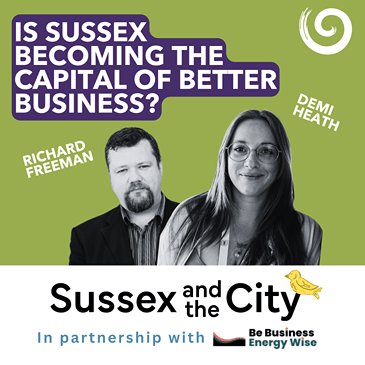
Is Sussex Becoming The Capital Of Better Business?Host: Richard Freeman Guest: Demi Heath – Founder of Hearth Sustainability, B Corp consultant and Co-Chair of Brighton B Local
🔍 Episode summaryWhat if the thing that makes Sussex economically distinctive isn't simply what our businesses produce, but how they choose to operate?
We spend a great deal of time talking about growth. How to attract investment, create jobs, increase productivity, support entrepreneurs and make Sussex more competitive. These are central questions for the emerging Sussex and Brighton Strategic Authority, which is developing a long-term approach to prosperity across the region.
What sort of businesses do we actually want to grow?
And could Sussex become somewhere recognised not just for successful businesses, but for businesses that take their responsibilities to people, communities and the environment seriously?
Demi Heath thinks it could.
Born and raised in Portslade, with several years spent living and working in New Zealand, Demi is the founder of Hearth Sustainability, a certified B Corp consultancy helping businesses become more sustainable, resilient and socially responsible.
She is also a registered B Consultant with B Lab UK, Co-Chair of Brighton B Local, co-founder of the Sussex Impact Pathway and a member of the Brighton & Hove Economic Growth Board.
Demi has helped more than 30 businesses through the B Corp process and works with organisations of different sizes to understand how environmental, social and governance considerations can become part of everyday business decisions.
And Sussex is proving to be fertile ground.
There are around 90 certified B Corps across Sussex, representing everything from independent businesses to professional services firms and larger organisations. Brighton & Hove has one of the UK's largest concentrations outside London, while the South Downs National Park has approximately 18 B Corps – understood to be more than any other UK national park.
That seems a particularly interesting coincidence in a region with such a strong independent business culture, where the landscape and coast are central to its identity, and where many businesses are closely connected to their communities.
But what exactly is a B Corp?
The certification is sometimes mistaken for an environmental badge. In reality, it considers a much wider set of questions about how businesses operate: how they treat workers, their supply chains, their environmental impact, their relationship with communities and the way decisions are governed.
Underlying it is the idea of stakeholder capitalism.
Rather than treating financial returns to shareholders as the overriding measure of success, businesses consider the interests of everyone affected by their activities, including employees, customers, suppliers, communities and the natural environment.
That doesn't mean abandoning profit or ambition.
Demi argues that responsible business can be a route to stronger, more resilient growth precisely because it encourages companies to think beyond the next quarter or financial year.
What happens if your business depends on resources that are becoming scarce? What if your workforce doesn't feel valued? What if the suppliers you rely upon are vulnerable? What if decisions that improve short-term margins create much bigger costs in the future?
These aren't simply ethical questions. They are questions about whether a business will still be successful in 10, 20 or 30 years.
And that brings us back to devolution.
The Sussex and Brighton Strategic Authority is developing its own definition of prosperity. Demi and Richard have both been involved in conversations about whether that definition should go beyond conventional economic measures to include people, place, communities and nature.
Could some of the principles used by B Corps help Sussex think differently about economic development?
Should public procurement reward businesses demonstrating strong social and environmental practice? Could local government make it easier for small businesses to develop sustainability skills? Could funding help employees learn how to embed responsible practices across their organisations, rather than simply subsidising another certification?
And should sustainability become a normal part of professional competence, rather than something delegated to whoever happens to have "green" in their job title?
The conversation also explores a practical example of devolution funding already beginning to take shape.
Be Business Energy Wise, funded by the Sussex and Brighton Strategic Authority and East Sussex County Council, is providing free support to businesses to understand their energy use, reduce costs and make more informed sustainability decisions.
For Demi, programmes like this are an encouraging start. But an energy audit or sustainability plan is only the beginning. The bigger challenge is helping businesses understand why change matters and giving them the knowledge, confidence and resources to put it into practice.
Her long-term ambition is strikingly simple.
She wants sustainable business to become the norm.
Not a niche, not an alternative and not something businesses pursue only when they have spare time or money.
Something that is simply part of running a competent, successful business.
Because at the moment, as Demi points out, it can be difficult to operate sustainably.
What would Sussex look like if, ten years from now, it was difficult to operate any other way?
That's the question at the heart of this conversation.
This episode is brought to you by Be Business Energy Wise, a fully funded programme helping East Sussex businesses take control of energy costs and make smarter sustainability decisions.
Businesses can access free practical one-to-one support, detailed on-site energy assessments where eligible, and workshops covering energy efficiency, sustainability marketing and reducing waste through the circular economy.
You don't need an existing sustainability strategy or specialist knowledge. The programme helps businesses understand where they are now, what could make a difference and what's worth doing next.
Be Business Energy Wise is funded by the Sussex and Brighton Strategic Authority and East Sussex County Council, managed by East Sussex County Council and delivered by Always Possible.
Find out more at alwayspossible.co.uk/be-business-energy-wise.
🎯 In this episode- Demi's journey from Portslade to New Zealand and back to Brighton
- What Hearth Sustainability does and why Demi founded it
- What B Corp certification actually means
- The difference between shareholder and stakeholder capitalism
- Why B Corp is about much more than environmental performance
- The growth of the B Corp movement in Sussex
- Why the South Downs National Park has an unusually high concentration of B Corps
- How professional services firms are embracing responsible business
- Whether Sussex's independent business culture makes it particularly suited to this approach
- Why sustainable business doesn't have to mean small business
- The relationship between responsible business and long-term profitability
- What B Corp principles could contribute to Sussex's definition of prosperity
- Why businesses should consider the interests of workers, communities, suppliers and nature
- Whether local government should reward businesses demonstrating better practices
- The potential role of public procurement and business rates
- Why funding sustainability training may be more useful than funding certification
- How Be Business Energy Wise is supporting East Sussex businesses
- Why sustainability needs to become part of everyday professional skills
- The importance of collaboration between businesses and sectors
- How young people can be introduced to alternative business models
- What a more sustainable Sussex economy could look like in ten years
Host: Richard Freeman Guest: Demi Heath Sound design, editing and original music: Chris Thorpe-Tracey Production management: Letitia McConalogue
📣 Get involvedsussexandthecity.info — episodes, resources, events and more about devolution and change across Sussex.
sussexintelligence.com — independent research and evidence-led insight into growth, infrastructure, governance and belonging across Sussex.
[00:00:00] This episode is brought to you by Be Business Energy Wise, a fully funded programme helping East Sussex businesses take control of energy costs and make smarter sustainability decisions. If your business has high or unpredictable energy bills, you're not quite sure where energy is being wasted, or you know you could make improvements but don't know where to start, Be Business Energy Wise can help. There's free practical one-to-one support, detailed on-site energy assessments for
[00:00:29] eligible businesses and workshops covering everything from cutting energy costs to credible sustainability marketing and reducing waste through the circular economy. You don't need to be an energy expert or already have a sustainability plan. The idea is to help you understand where you are now, what could make a difference and what's actually worth doing next. Find out more and register your interest at alwayspossible.co.uk
[00:01:04] Be Business Energy Wise is funded by the Sussex and Brighton Strategic Authority and East Sussex County Council. It is managed by East Sussex County Council and delivered by Always Possible. This podcast is brought to you by Always Possible. Always Possible.co.uk You're listening to Sussex and the City with Richard Freeman.
[00:01:34] Hello, welcome to the Sussex and the City podcast. I'm Richard Freeman. Maybe one of you are too, I don't know, but probably not. Lovely to be with you. This episode, like many of the episodes, is exploring growth and sustainability. Two major reasons why devolution is coming to Sussex and Brighton in the first place. But what we're exploring is whether these are separate things or the same thing. My guest is Demi Heath.
[00:02:02] Demi, Brighton born and bred, originally from Portslade, although spent many years living and working in New Zealand, is the founder of Hearth Sustainability, a certified B Corp, come back to that in a minute, and an officially registered B consultant with B Lab UK. And she has helped more than 30 businesses through the B Corp process and works with organisations on wider resilience, sustainability, ESG, social value, lots and lots of things sort of bucketed in the field of responsible business.
[00:02:32] She also co-founded Sussex Impact Pathway, which helps groups of smaller businesses work through assessments and criteria such as B Corp. And she sits on the Brighton & Hove Economic Growth Board. So I've said BBB quite a lot already. So what's the obvious question? Well, what on earth is a B Corp? You will have definitely seen packaging, logos, advertising from companies using the little
[00:03:00] circled B that appears on products, websites, shop windows. And some people think it's simply an environmental badge. It is not. A certified B Corp is a company that has been independently assessed against global standards covering social, environmental and governance performance. This means looking at things like how it treats its staff, what happens in its supply chain, environmental impact, relationship with communities and how transparent it is about how decisions are made.
[00:03:30] Yes, the principle underneath all of it is that a business should not exist solely to maximise value for shareholders, but that actually exists in what we're calling stakeholder capitalism. And so that the people who work for it, the communities around it, suppliers, customers and the natural world and the planet upon which it depends are also stakeholders, shareholders, et cetera, in the returns of the company. And Sussex is quite an interesting place to be having this conversation.
[00:03:59] It's reckoned that there are about 90 B Corps across Sussex. And there's some even more weirdly interesting statistics beneath that. South Downs National Park has about 18 certified B Corps within it, which is the highest number of any UK national park by a mile. And Brighton Hove itself is about the third largest concentration of B Corps in the UK outside
[00:04:25] of London. So only surpassed, I think, by Bristol and Oxford. So the question is, could responsible business be a big part of our economic identity? Something, again, we've explored in previous episodes from different lenses. But I think it's becoming an even bigger part of how people are looking at differentiators in the Sussex economy. When devolution needs to have an inward investment story. We are overwhelmingly a small business region. We have a strong independent culture.
[00:04:55] And many businesses here are rooted in the places and communities around them. So therefore, you know, things like what B Corp are trying to do are not peripheral to an economic story or on the fringe. You know, some would argue it is the economic story. And that's particularly relevant now because the Sussex and Brighton Strategic Authority is developing its own long-term approach to prosperity. So Demi and I talk about whether there are useful parallels between definitions of prosperity
[00:05:23] for a sort of devolved region and what the B Corp model is trying to engineer through business growth. Start with purpose and sort of all the different stakeholders involved and impacted by something. And then how do you leverage that for profit, for investment, for community wealth building? You work out who your stakeholders are. You think beyond just the next quarter and then judge investment and growth against things
[00:05:50] that are bigger than simply whether a bottom line number has grown. And we get into a conversation about what governments should do about all of this. Now, could, should councils and strategic authorities reward business that demonstrate better environmental and social practice helping to meet local or regional targets? Could procurement be used more deliberately? Could targeted funding and economic development grants help small business develop sustainability skills?
[00:06:17] Something being looked at, and I'm looking at personally through the Sussex Local Skills Improvement Plan with quite a lot of depth. Rather than sustainability being a specialist thing done by the person with green somewhere in a job type, what if it's something that's generally about being competent at your job, just like health and safety is? Whether you're a builder, an accountant, a photographer, a manufacturer, or running a vineyard in Sussex, sustainability, resilience, and a kind of understanding of how to build businesses that have wider
[00:06:46] positive impact is just part of being in a business. And Demi's vision of success is quite simple. She wants sustainable business, responsible business, to become the norm, to become how business operates, particularly in Sussex and Brighton. Not the interesting, quirky alternative, not the progressive niche, not something to do when you've only got enough money to do it. The thing, the norm. But she recognises right now it's very, very hard to operate sustainably.
[00:07:15] The economics are not particularly kind to small business growth at the moment. But if Sussex really does have a disproportionate cluster of businesses already thinking like this, then maybe that is something worth paying more attention to. And maybe that is something that redefines what growth, sustainability, and success means. Wherever you stand on this issue, this conversation has plenty of insights and starters for 10 from
[00:07:45] someone who's right in the thick of trying to make this happen. And I'll introduce you to Demi Heath. Hello, we're all here. Good. And I'm joined by the brilliant Demi Heath. Only got to know Demi fairly recently, but been very impressed with her work on a number of levels.
[00:08:12] We're going to explore small business, sustainability, better business, B Corp, Sussex economy. Before all that, my only fixed question in these interviews is, how are you? Hi, Richard. Thank you so much for having me. I'm very good. Thank you. I have had a fantastic summer. Taken a little bit of time off recently, which is hard to do as a business owner. Definitely need some downtime as well as working hard. So let's start with your world. Where are you based?
[00:08:42] And how long have you been doing what you're doing at the moment? I am based in Settle Brighton. I'm born and bred from Port Slade. So I have lived here for the majority of my life, but I moved over to Wellington, New Zealand for several years. And I came back a few years ago. And I love my home city so, so much. I have a creative background. I studied photography at university and was in that industry for a little while.
[00:09:10] But I've been doing B Corp and sustainability work for the past seven years now, which feels kind of wild to say. I don't know where the time goes. B Corps are certified businesses that are showcasing that they are undertaking more sustainable practices. It's kind of at the gold standard end of environmental, social and governance practices.
[00:09:35] Primarily what B Corp businesses are trying to do is move away from shareholder capitalism to stakeholder capitalism. So business as usual puts a lot of primacy on the shareholder as the person or the group of people that you are working to satisfy.
[00:09:54] And what B Corps do is they recognize the value that shareholders bring in, but they recognize the value of all other stakeholders who go in to make that business what it is. They look at what different stakeholders value in the business. So it could be workers. It could be the environment itself. It could be the community that they're operating in, the supply chains that they're working with.
[00:10:21] And taking all of those considerations into account when making business decisions. The B Corp movement has been around for a couple of decades. It's been in the UK for 10 years. We celebrated our 10-year B Corp UK anniversary last November. I also am the Brightonby local co-chair. So I represent all of the B Corp businesses in and around Sussex.
[00:10:47] We've got about 90 at the moment and we're looking to obviously increase that. The more businesses that are working ethically and caring about their supply chains and the environment and their workers, the better. So my job within B Corp outside of my voluntary B local co-chair role is I'm a B Corp consultant primarily. So I work with broader sustainability frameworks, but B Corp is my real bread and butter.
[00:11:17] It's the framework that I believe in the most because I don't see really any other framework or certification out there that looks at the interconnectedness of all three of the ESG pillars of the environment, social and governance aspects. I work with businesses to help them achieve certification or work towards it.
[00:11:41] Using the B Corp framework gives people really tangible ways of working towards being a better business and being a more purpose-driven business. So I've been doing that in Brighton running my own businesses for the last two and a half years. I do that both in one-on-one consultancy and also by running B Corp courses and group facilitation so that businesses can learn from one another. Thank you. Really comprehensive overview there.
[00:12:09] And I think fair to say, you know, some of the earlier B Corp adoptees sort of played into a little bit of a kind of stereotype of progressive, you know, vegetarian food manufacturer or the DNA of the very core of the business was already going to be a bit more on that sort of cause-driven side than maybe your more traditional nuts and bolts service or goods business.
[00:12:37] I think what's really exciting is how that's shifted. You know, the B Corp within your 90 in Sussex include, you know, really big law firms like Mayer Wynne Baxter. They include accountancy firms like Creston Reeves and Plus.
[00:12:52] It includes PR firms like Midnight that have come to the B Corp movement as a way to think about how they behave and how they show up and their sort of governance structures rather than that was always how they set out to begin with. I think it's a really big part of the Sussex sort of identity. It sort of makes sense that that's growing down here quite fast. What do you think? Yeah, I completely agree with all of that.
[00:13:17] I think Brighton and Sussex have such a unique identity and we really, really value kind of unique businesses, unique small businesses kind of carving their own path. That's what makes Brighton in particular, but the rest of Sussex incredibly special. I think we don't actually really have a massive standard high street. What we have is the lanes. That's our kind of big shopping hub like within the city.
[00:13:42] And so for me, it makes so much sense that sustainable business and like different ways of doing business and being very conscious of being between the sea and the South Downs kind of does end up seeping into businesses DNA. So I also only heard a few months ago about having 18 businesses in the South Downs National Park.
[00:14:05] My understanding is that that's the largest concentration of B Corps in any national park in the UK, which is very exciting. And yeah, I think definitely speaks to that link between the natural environment and business people wanting to protect that and recognising how much we depend on it. I feel like that's quite unique to the B locals, especially that high concentration. Yeah.
[00:14:33] Sustainable business, responsible business, stakeholder rather than shareholder focused business doesn't have to be small. You know, it doesn't have to be niche and boutique kind of solo sites. It can also be scalable. It can also, you know, be something that, you know, investors might choose to back.
[00:14:54] Now, I don't think the kind of work that you do and the kind of businesses you support, and I don't think I'm out of line saying, probably wouldn't have been considered to be represented on a city growth board. Only a few years ago, I think people would have dismissed it as a sort of niche interest that's not going to drive, you know, an economic growth story.
[00:15:15] You know, I think the fact you're challenging that through being on there, and I think the board thinking differently about how to do this speaks volumes at the moment. And I'm really excited about that. So thinking about it through that lens of growth, and we're going to talk about devolution in a minute, you know, whether you're a donor economics evangelist or a cutthroat capitalist, the conversation about growth is important. And we need to think about growth having many sort of ways.
[00:15:42] But the reality is, Brighton as a city and Sussex as a region, you know, devolution is going to try and support levelling up. So there will be a focus on and continue to be a focus on economic growth as a priority.
[00:15:57] So from your perspective, how can the sort of B Corp mindset, let's put it like that, get behind that growth story, be part of that growth story, but also offering a different kind of growth to what, you know, we might be used to? How can more traditionalists become comfortable with what B Corps are representing? Oh, there's a lot in there. Sorry. That's what I do. Big questions.
[00:16:23] The previous understanding of B Corp's sustainable business is having to be small, and the recognition of the growth of the B Corp movement, representing medium and large and extra large and corporates as well, is a really important one, because the B Corp movement is made up of all sizes from all over the globe. You know, there's 10,000 plus businesses globally, everything from myself as a solo business operator, right up to multinationals like Danone. For example.
[00:16:53] I think what the B Corp movement is good at doing is recognizing nuance within business. What is required of a small business is not that of an extra large. In our modern age, we lose nuance quite a bit. So I think bringing that back in and like shaping the requirements and the conversation around the type of business that it specifically is, is really important.
[00:17:18] But I think a lot of people assume that by operating sustainably, that somehow you're going to lose growth, lose revenue. And the numbers are the opposite to that. It's just not true. Whilst there might be some, some upfront costs, say, if you want to put solar panels on your roof of your business. Absolutely, there might be some upfront costs. Well, I'm not denying that at all.
[00:17:43] But what we're looking at here is long-term thinking, not short-term thinking. This is what the shift from shareholder primacy to stakeholder primacy really does, is it brings people out of short-termism into long-termism. And that's what we need so much more of right now. Like collectively, economically, we have not done ourselves a lot of favours by thinking very short-term about the returns the next quarter or the next year.
[00:18:14] What Beacorp is trying to do is to get us to think about the sustainability of the business over long periods of time. So 10, 20, 30, 50 years into the future. When I use the word sustainability, I'm using it in an all-encompassing way, not just the environmental sustainability, not just the carbon footprint.
[00:18:35] I'm thinking about what do we do to ensure that the business is thriving, not only today and tomorrow, but 20 years in the future. When we start looking at that more long-term mindset, then we can start thinking about growth in a completely different way, right? We can think about growth steadily over a longer period of time in a way that kind of sits within that donor economic model, right?
[00:19:02] Of making sure that all of the stakeholders who are involved have their basic needs met to ensure that they bring their best selves to work, to ensure that the supply chain is as robust as possible. And that we are not depleting our environmental resources to the point that in five years' time, we've run out of that resource and therefore your business cannot operate because it needs that resource. And so the Beacorp movement is really good at doing that.
[00:19:29] You've probably got a strategy, a vision, a roadmap, maybe even a post-it note empire on your office wall. But has anyone asked the really awkward questions yet? Like, is it actually working? At Always Possible, we help senior leaders challenge the obvious, rethink the possible and deliver the extraordinary without losing their sanity or their sense of humour.
[00:19:58] Enabling private and public sector innovators to navigate a changing economy. We help complex organisations to humanise data and to translate the big picture into hyper-local engagement, trust and sustainable growth. If you're ready to bring people with you because your leadership truly inspires, visit alwayspossible.co.uk
[00:20:26] That's alwayspossible.co.uk Always Possible. We make bold business brilliant. A bit of a thought experiment. How could a new plan for prosperity and growth in a whole region like Sussex use some things like the Beacorp checklist or some of the best practice that's been formed over the last decade?
[00:20:56] You know, is there anything there that you think that's inherent to the Beacorp model that actually could underpin the way we think about growth in the round, not just business by business? Yeah, that's so interesting. Like, there are so many parallels between both, definitely. For me, the two core things for the Beacorp movement that could be carried over, and I think are to a large extent in the thinking about devolution. One is, what is the purpose here?
[00:21:25] Like, what is the core thing that we're coming back to, to make sure that we are prosperous, that we are successful in what we're trying to achieve outside of money making, outside of growth for growth's sake? Like, the Beacorp movement asks individual businesses, the kind of first question in the assessment is, what is your business's purpose from a social and environmental perspective?
[00:21:48] You and I were both part of a working group that was working to address a missing piece, defining prosperity in this kind of broader social and economic lens of what thriving actually means. And then the second piece for me is around the look to the stakeholders, right? Moving away from growth for growth's sake, just bringing investment in because the region, we just want to say that we've, you know, we've got a lot of money and therefore we can do a lot of things with that.
[00:22:16] What is it that that investment is going towards and what is it from the different stakeholder groups that means that definition of prosperity is correct for all of those stakeholders involved? From what I've seen so far, there has been some good work done around talking to all areas of the region, thinking about the environment as a stakeholder as well.
[00:22:42] So there's definitely principles that I think have been carried over. I would just like to see more, always more conversation, always more collaboration, always hearing more directly from local residents, local businesses, because I think we could do really exciting things joined up together under this one umbrella, right? When I think about evolution, I automatically come back to two organisations, Sussex Bay and the South Downs National Park.
[00:23:12] They do this really well. Even though Sussex Bay has only been in existence for a couple of years, I think they're recognising that the best work is done when you bring people who are already doing fantastic things. And we're so lucky in the region that we have so many people doing so many fantastic things.
[00:23:32] And it's kind of breaking down the silos and bringing those different stakeholders together to create a shared understanding and a shared approach. Lots of businesses will say, well, if you want us to grow and you want us to be prosperous and you want us to create jobs and you want us to pay tax and you want us to innovate and invest, then get out of our way. You know, sort of don't keep regulating us too hard. Don't keep demanding that we must do X, Y, Z.
[00:24:02] So it's always a bit of a hot potato. You know, the traditional free market thinking is sort of just let business do what business does and it will always find the best way. But the whole point of government handing down some powers and economic development funding is to try and intervene in the economy in a way that stimulates and supports innovation and investment and growth and jobs.
[00:24:28] But again, it feels like the B Corp framework is maybe somewhere that has come from the private sector, but it's a form of voluntary regulation in a sense that helps businesses to work with each other, to be accountable, to think hard about where growth kind of comes from and to set some parameters and rules.
[00:24:49] So if one of the aims of devolution is to grow more businesses and it's to find the mechanisms to help businesses to grow, clearly B Corp is becoming popular in Sussex. You know, we've gone from not many to a few dozen to 90 in quite a short space of time. Do you think the kind of B Corp framework as accreditation should be far more embedded within the kind of business support, economic development infrastructure coming out of councils, coming out of the local authority?
[00:25:17] Do you think there should be more support for businesses to become B Corp? You know, it's quite an expensive process to go through. So to help businesses get access to grants to be able to become B Corp. Is that in your sort of vision? It's a very interesting question. And just to caveat, I'm not paid by B Labs. So anything that I say is entirely my own opinion on this. From everything that you've been saying, I've been thinking about the carrot and the stick, right?
[00:25:45] Right. It's important for us to be looking at the carrot and the stick. And what I've been thinking about recently, especially since joining the Economic Growth Board, I went out and did a survey of my community of kind of where the council could be helping more, what they're already doing really well. And overwhelmingly, what came back is that businesses feel like they need more support from council
[00:26:10] and more reward from council and local government for doing better because these things are costly. So, you know, things were mentioned around kind of reduction in local taxes. If you have not just B Corp, but some sort of sustainability certification in which you can honestly showcase that you are working towards becoming more sustainable, which ultimately in the long term is better for the growth of the region
[00:26:36] because investors can count on that, then that should be rewarded rather than rewarding businesses who aren't considering the environment at all, who aren't considering their workers, who aren't looking at their supply chains. It's something that the community definitely wants. And also in procurement from local government, prioritising local businesses who are B Corp or who have used a sustainable framework. I think that would help everyone massively.
[00:27:05] The B Corp assessment and platform is free to access. So what I would really love to see is not necessarily grants for certification. It's grants for small businesses in particular to invest time for their employees to come along to B Corp courses or to go directly onto the B Corp platform or any other sustainable framework to do learning.
[00:27:36] So supporting small businesses so that they can, you know, hire someone else if someone's going to go off part-time and do that professional development. Because ultimately it's going to upskill a person massively in understanding what sustainable business is and what that looks like and what the requirements are so that then they can implement changes within the business itself without necessarily getting outside help in.
[00:28:04] I think there's a big skills and knowledge gap around sustainable business frameworks and practices that go beyond carbon footprinting. So I'll declare a little bit of an interest here. So my team, at Always Possible, we've recently been awarded a contract to work in partnership with East Sussex County Council. And we're working with BESCO, the Brighton Hove Energy Services Cooperative,
[00:28:33] and an organisation called World's Better, who are the kind of specialists, they're a big corp, I think, in the sustainable events sector. So we, until March 2027, been tasked with supporting a number of businesses in East Sussex, it's not in Brighton, but it'll be the rest of East Sussex, Hastings, Eastbourne, Lewis, etc. around, it'll be their energy footprint, really, you know, sort of how their relationship with energy and waste is sort of understood within the organisation.
[00:29:01] Where can they be more conscious of that? Where can they make efficiencies? How can they have a plan? But also with some wider support around circular economy frameworks and thinking about how to better tell their story if they are doing really interesting things with sustainability. The reason I mention this, not to plug what project I'm doing, but actually, do you know who's funding this? It's the Sussex and Brighton Strategic Authority.
[00:29:27] And it's one of the very, very first economic development projects that they are funding. There's a few others happening in East Sussex, one around the creative sector and one focused on scaling up. But this one, I was particularly interested in being a part of because I've never seen anything quite like this before. There have been other council-sponsored programmes. West Sussex has something called Let's Go Net Zero, but it was much more around awareness and it was much more around,
[00:29:55] you know, linking people together and understanding some of these frameworks. But actually paying for, you know, we're going to be helping business get a full energy audit. You know, really kind of really understanding and spending time and coming out with a practical plan. I don't think that would have happened without devolution necessarily being on the cards. Interesting. It's small, but part of it is us signposting. We'll be signposting people to where do you go with this? Where next?
[00:30:25] And so absolutely, the B Corp assessment and the B Corp framework will be a really obvious thing for us to say. You've got a bit of a kickstart here to put your toe in the water. There's loads of other support out there. And obviously your services and your business will be part of that. Even in this very early stages, there are signs that economic development and growth investment is starting to take a little bit of a different flavour. It definitely sounds like it's leading more clean energy, more green. Yeah.
[00:30:54] Taking the environment into consideration. Brighton and Sussex as a whole has done fairly well on this stuff anyway. So it's really reassuring. Obviously the region and the councils have net zero targets that have been put on from national. So it's interesting to kind of see these different priorities and pushes from many sectors kind of coming to fruition in this way.
[00:31:21] I'm thinking about when I go in and work on B Corp stuff with businesses, the key thing or the biggest barrier and challenge that I face is helping them embed this thinking throughout the business and to help them share with their colleagues why this is important and why people should be helping to put these things in place. Right.
[00:31:46] So I guess my plea would be to the SPSA is broadening this pilot out to encourage and enable upskilling and like deeper knowledge and understanding around sustainable business practice and getting people to buy into the why. Because an energy audit and getting a plan in place is the first step, right?
[00:32:10] They then need to execute that, make those changes and put those things into play so that we can all get down to net zero, all work towards a circular economy together. I have a question for you. Is there like criteria set for the businesses who can access that program? So it's for SMEs. So they have to be under 250 employees and they need to be commercially trading.
[00:32:40] It only excludes charities if they don't have a commercial trading operation as well. So we could be working with charities or art centres and things like that as long as they've got a cafe or a shop or whatever. But otherwise, no. To get the most out of it, it will be businesses that have a premises, organisations that have a bit of a physical footprint. But other than that, no, it's fairly open, but they have to be in East Sussex. So this is the challenge yet.
[00:33:08] We don't have a full, I don't think we've ever had a kind of Sussex-wide business support programme. It's always been quite fragmented or postcoded or, you know, because it's still very much driven by the councils as they have been. So to be fair to the SBSA, they will have allocated a pot of money, but the programme have probably been, and some directions of travel, but it's still the councils that are designing it.
[00:33:36] Yeah, because I tried to do some research around like what resources were kind of available online. And it is currently very, very limited, right? So it's really exciting to hear that like you're involved in that, pushing it forward. And there's like all this thinking going on for too long. Sustainability has been like an add-on. It's been this like separate entity that is added on to curriculum or when you're thinking about business practice,
[00:34:00] whereas actually it needs to be embedded throughout the practices that already exist and the work that's already going on. Like whether you are, I don't know, a builder or a hairdresser or you work in digital PR, there are sustainable ways of doing the work that you do. I think it's an interesting time. And I think the work that you're doing to raise the visibility of this is really, really important.
[00:34:29] But yeah, it's just, it's a long game to normalise it, isn't it? And to move from the short term to the long term, we've got a very long journey to do that. But it does feel like devolution is one way of potentially rethinking that, that the mechanisms by which we can stand back and think a bit longer term. There's an organisation called Meaningful Futures within Sussex, showcasing to school leavers and college leavers,
[00:34:58] different ways of entering into the workforce and doing business. Because at the moment, work experience opportunities are generally set by either going into a large organisation that has been doing business as usual, it's just a big corporate, or through people that they know, whether that's a family member or a friend of a family member. Your uncle's garage, you know, that's the sort of thing. Yeah, exactly.
[00:35:24] Because SMEs in particular would love to help kind of young people come into their workplace and, you know, to showcase to them, this is what a B Corp looks like, this is what a CIC looks like, this is what, you know, a community project looks like. But we just don't have the time or the resources to necessarily do that in a standard work experience model.
[00:35:48] So Meaningful Futures is looking at a different setup for work experience to enable that a bit more. It's definitely a really exciting time to be looking at alternative business models. And I think it's something that Sussex does really well already. I kind of feel like whenever I step outside of like Sussex business region, I realise how competitive businesses and business folk are outside of Sussex.
[00:36:16] But within Sussex, I generally find that we're already really collaborative. And we're looking for different ways of working together to help build each other up. I only imagine devolution is going to help with that. Final question, really, really quick. If all this works, right? If devolution really is one of a few epoch-changing things, what would good look like? You know, if there's one thing in 10 years time that you're like, that's so much better because dot, dot, dot, dot, dot.
[00:36:46] Good to me looks like there being a much higher proportion of sustainable businesses in the business ecosystem and that sustainable business frameworks are actually the norm. Any business that isn't operating in that way is transitioning to that and it is outside of the norm.
[00:37:09] And that it actually becomes difficult to operate in a non-sustainable way because at the moment it's difficult to operate in a sustainable way. So I think the good is the opposite of that landscape. Demi Heath, thank you so much for being my guest on the Sussex and the City podcast. Thanks so much, Richard.
[00:37:38] Thank you very much to this episode's guest and to you for tuning in. Sussex and the City is an independent and non-political project about devolution as it happens, explained in human. It is led by Always Possible. You can find other episodes, resources, events and blogs about change in Sussex and Brighton by visiting sussexandthecity.info.
[00:38:05] That's sussexandthecity.info. This episode was written and presented by Richard Freeman for Always Possible. The editor was me, Chris Thorpe-Tracy for Lo-Fi Arts. I did the music too. Production management was by Letitia McConnellogue for Always Possible. Talk to you next time.