
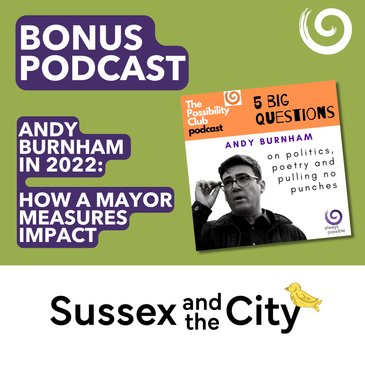
– Bonus episode
Andy Burnham in 2022: How A Mayor Measures ImpactHost: Richard Freeman Guest: Andy Burnham – Mayor of Greater Manchester
🔍 Episode summary
This special bonus episode goes back into the archive, sharing Richard Freeman's January 2022 interview with Andy Burnham, originally recorded for The Possibility Club.
At the time, Burnham was already one of the most prominent voices in English devolution. Today, his arguments about Westminster centralisation, regional power, transport, homelessness, young people, skills and public trust feel directly relevant to Sussex as it begins its own devolution journey.
The conversation explores what it means to lead a region with visibility, convening power and a clear story of place. Burnham argues that devolution should start with people's lives, not abstract structures, and that impact should be measured through "names, not numbers".
For Sussex, the episode offers some perspective. If a future mayor is to mean anything, they will need to do more than manage structures. They will need to build trust, connect councils, businesses, charities and communities, and make regional leadership feel human.
🎯 In this episode
Why Andy Burnham believes England is too centralised What Greater Manchester can teach Sussex about devolution Why regional leaders need power, visibility and a clear story How Burnham measures impact through human stories, not just statistics Why young people, transport, skills and homelessness became mayoral priorities How creativity and culture shape civic leadership Why collaboration has to start from the grassroots How a mayor can use convening power to bring people together
🧠 Key themes
Devolution is not just about structures. Burnham argues that real devolution should give places the power to act on the issues affecting people's lives.
Impact needs to be human. Data matters, but Burnham makes the case for measuring change through lived experience and real stories.
Young people need a stronger place in regional policy. The conversation covers life readiness, mental health, skills and whether education is preparing young people for the world they are actually entering.
Collaboration works best when it starts from place. Burnham describes how Greater Manchester brought councils, charities, businesses, faith groups and communities together around shared missions.
Sussex should pay attention. The episode raises useful questions about what kind of mayoral leadership Sussex might need: visible, practical, collaborative and rooted in local identity.
💬 What Andy says
"Politics lives too much in the world of numbers and statistics."
"It should all be about names, not numbers."
"To build resilience, you need to take power out and enable places and people and organisations to do much more for themselves."
"Devolution creates that possibility."
"Collaboration starts with where you are."
"If you build collaboration from the bottom up, that actually is the way to make more impactful, meaningful change."
🎧 Production credits
Host: Richard Freeman Guest: Andy Burnham Original podcast: The Possibility Club Producer / editor: Chris Thorpe-Tracey Produced by: always possible
📣 Get involved
👉 sussexandthecity.info — episodes, resources and events
[00:00:00] Hello, I've got a little treat for you. This is a little bonus, a little sneaky bonus episode for subscribers of the Sussex And The City podcast. I'm Richard, hello. So yeah, this isn't the usual fare. I've been rooting around a little bit in the archives of one of my past podcast projects called The Possibility Club.
[00:00:25] And I am going to release here an interview in full that I did in January 2022. And you'll see in a minute, I think why it might be relevant. You'll have seen pretty much wall to wall coverage on the news at the moment that there is some changes afoot in terms of politics, stability, leadership, and a big challenge to the Prime Minister Keir Starmer.
[00:00:54] from, you know, a former colleague of his, Andy Burnham. Andy Burnham, the current Mayor of Greater Manchester, an architect and an advocate for English devolution. And many polls seem to suggest that he has a pretty good chance of becoming the UK Prime Minister within a matter of months.
[00:01:16] There's a few hurdles to clear, but it's looking like that is a very real possibility. And this will be quite an interesting turn of events to have somebody so passionately and vociferously anti-Whitehall, really, and anti-Westminster in his rhetoric, talking about regionality,
[00:01:34] talking about Manchesterism, and this idea that a hyper-centralised parliament has failed regions of the country, and his work in Manchester has been trying to redress that. Well, how does that work when that person becomes the leader of a hyper-centralised Westminster and Whitehall system? We don't know. And if it happens, then we shall see.
[00:02:00] But I wanted to share with you a conversation I had with Mayor Andy Burnham a few years ago, because we do talk about quite a few of the things that are core to his vision and approach as a regional mayor. He'd been in post for a little while by the time that we spoke, so there was a sense that he was sort of in his stride.
[00:02:28] And I think there's quite a lot there that we can reflect on when we are exploring Sussex devolution. So you'll hear in the interview that Burnham was very, very plain and clear that he sees the UK as too centralised, and that English regions need real power, not just consultation. That devolution should start with people's lives, not with structures or abstract metrics.
[00:02:54] We talk about his work on transport, homelessness, skills, health and young people. And he talks a lot about the idea of names, not numbers, and how he measures impact. It's through human stories as well as the data. He talks about creativity, culture and sport as being civic infrastructure, and how a mayor must be collaborative between councils, businesses, charities, communities, universities, and also rival parties.
[00:03:24] He says that regional leaders need visibility, convening power, and a clear story of place. And so it feels like there's quite a lot we can learn. There's quite a lot that resonates with other conversations that I've been having now about Sussex through the Sussex and the City project. But I thought it might be nice, even though we're going back in time, just to hear directly from a man who many see as a trailblazer in all of this,
[00:03:52] but also could be the man in charge when Sussex actually starts to accelerate its own devolution journey. I'd love to hear what you think. And apologies for the sound quality. Our podcasting game has got a bit better over the last few years. But yeah, enjoy. This is The Possibility Club, asking five big questions. This is The Possibility Club podcast. Thank you for tuning in.
[00:04:22] In this series, Richard Freeman is asking the same five big questions of interesting people from across public life, business and society. Exploring how different leaders measure impact, plan for the future, support the next generation workforce, use creativity and embrace radical collaboration. These conversations are brought to you by Always Possible, the company that doesn't just help business and charities dream about changing the world, but gives them the tools to do it.
[00:04:53] For a full biography of this week's guest, further information and useful links to today's show, check out the accompanying notes. It's a very warm welcome to The Possibility Club podcast. Again, we're looking at five big questions and I'm going to cut to the chase. I'm thrilled to be joined by my very special guest today, the mayor for Greater Manchester, former cabinet minister and as many would style, the king of the north.
[00:05:21] Andy Burnham, how are you? I'm fine, Richard. Great to be with you. And we're talking at the very start of January, so happy new year to you. And is your 2022 turning out to be better than your 2021 so far? What's it looking like? Not just yet, actually. It's been a tough start to the year because obviously we have the NHS and public services under quite considerable pressure in Greater Manchester.
[00:05:47] We have a concern growing about a clean air zone we're introducing this year. And this week we've seen the screening of Anne on ITV, which is a story I've been personally quite involved in, the fight of Hillsborough campaigner Anne Williams. So the new year has started with a bang, Richard. I thought it couldn't be any more busy than 2021, but already it feels like it is. I don't know how you hold it all in your head and how you keep across all those briefs.
[00:06:15] It's something we'll chat about in a minute. I wouldn't say I don't, of course, but I'll leave that for others to judge. We'll leave that for others. But no, I saw the trailer for Anne yesterday and I didn't know whether to ask you about it or not. Because obviously there's somebody portraying you and the shot of you in the middle of the stadium as, you know, reaching the crowd, that very famous moment. But before I get on to the questions, you know, how does that feel to be portrayed in a drama like that? Have you seen it yet? Yeah, I've watched it.
[00:06:44] If I'm honest, I've been shedding the odd tear myself because it's quite an intense thing for me to look back on that whole period when we went through the 20th anniversary. So odd really to watch myself being played. But to be fair, I think my mum thinks it's a fairly good likeness. So she was pleased. So that's, I guess, what matters. But no, it's been a hard watch.
[00:07:10] I think for everybody, brutal really, what the Hillsborough families went through. And, you know, Kevin Samson, the screenwriter, has really amazingly brought that over. And really, you know, a performance from Maxine Peake, I think the likes of which you'll wait a long time to see again. Sure. And as you say, you know, one's mum is always the best critic. Always. That's probably a good point then to launch into my first question, which is all about impact.
[00:07:39] And as any listener to this podcast knows, I ask the same questions of everybody, whatever walk of life they're treading. But I think, you know, I'm particularly interested to ask you as one of the metro mayors, also with your government experience. But as you've mentioned, your particular interest in some of these campaigns from Hillsborough to healthcare scandal inquiries to all of the work around COVID support, which some would say, you know, is above and beyond, you know, what other mayors are doing.
[00:08:08] How do you measure success or how do you measure the impact you have? Statistics do one thing, but the rest of it is probably quite intangible. What's your kind of yardstick? Yeah, well, I don't measure it through opinion polls or statistics, as you say, with regard to, you know, percentages or the number of people being treated in this way or that.
[00:08:29] I measure it in stories through what real people's experiences, whether we can change people's lives. So that's the way I kind of like to work. So I'll give you an example, Richard. When I came in, I said I wanted to make young people a priority because I'd seen over time that they'd been made a target for cuts by Westminster.
[00:08:54] I brought in a free bus pass for 16 to 18 year olds to change lives, basically. And what I listened to is the evidence of people saying, yes, it has changed my life. I mean, politics lives too much, in my view, in the in the world of numbers and statistics. It should all be about names, not numbers and capturing the real difference that we make for identifiable people in the areas where we live. So, you know, it sounds, I guess, a slightly woolly worthy answer, but that's true.
[00:09:24] You know, I kind of I think it's all about that tangible, practical difference that we make in people's lives. And sometimes that's not that's not easily measured in spreadsheets, but it's it's what matters to me. Yeah. My second question follows on from that, you know, a little just around the sort of the pulls and pushes, the pressures that so many individuals and businesses and organizations are really finding themselves under.
[00:09:50] You talk about these stories, you know, I think that the media has been quite interesting in how it has personalized and humanized a lot of our current crises, for a better word, whether it's covid or Brexit or climate change or either tech revolutions that are leaving people behind. It does feel like we're in a real time of flux where we're not all running the same race at the same speed. So I'm really interested to know how should communities and how should maybe organizations,
[00:10:17] whether that's businesses or public services, better prepare for the future, you know, to feel more resilient, more confident and maybe better equipped because so many had the rug pulled from under them recently. Do you think we should be doing things differently in the way that we plan? I do. And I think that's obviously it's a macro level in terms of the need to take power out of Westminster.
[00:10:38] I think what we've seen as we've lived through this this period is the limitations of a highly centralized approach to running the country and the idea that you can run everything out of one postcode in Westminster if it ever was true. Well, it's certainly not true now. To build resilience, you need to take power out and enable places and people and organizations to do much more for themselves.
[00:11:07] You know, I felt the frustration certainly in 2020 of sitting there with colleagues in Greater Manchester and knowing what we felt we needed to do to manage the wide ranging pressures of the pandemic and then seeing the opposite decision coming out of Whitehall. And that I just think it's a very 20th century notion, isn't it? The nation state running everything and telling everybody what has to be done.
[00:11:32] As I say, I don't think it ever worked particularly well, perhaps a bit better in the in the sort of post-war period. But it just certainly isn't right for now. I think you have to allow people to collaborate from the bottom up, empower them to do more for themselves. And that moment's been coming and the pandemic has absolutely really brought it brought it to the fore. Drawing on what you said a minute ago about your sort of mission around young people, because I think this is particularly pertinent,
[00:12:01] also about the sort of centralization of opportunity and power. What skills should we be building on and how should we be supporting young people into careers wherever they are? Maybe avoiding the brain drain that we see that happens in London and in some of the big cities. You know, you're mayor of Greater Manchester, so there'll be lots of people who live outside of the centre of the city that maybe don't feel they've got the same opportunities as those in the middle of it.
[00:12:28] And whether that's part of that mission that you talked about. Oh, it's absolutely part of our mission. I think digital skills, green economy skills are, you know, are a very specific example of what we need to equip people with. But I think there's a bigger, deeper answer. And that is we have to give people qualities of resourcefulness, resilience, I think,
[00:12:53] because the 21st century experience of the economy is very different, I think, to what's gone before. And my judgment is, and I speak as a former Shadow Education Secretary, just when I think we needed to modernize the curriculum to prioritize some of the things that I'm talking about, the life skills that I often hear young people in Greater Manchester calling for. You know, they call for a curriculum for life. I think the curriculum went in precisely the opposite direction, very backward looking,
[00:13:22] where the English baccalaureate prioritized a set of fairly elitist subjects, I would say, you know, highly academic, elitist subjects. Ancient languages and, you know, a very kings and queens approach to history. And then didn't prioritize some of the creative subjects, ICT, engineering, and took away some of that wider life preparation from schools. You know, that is what I hear from young people that I speak to.
[00:13:52] Yes, they want skills that are relevant to the economy now. So definitely digital skills. And as I say, skills that might prepare them for the green economy. But they also call for a wider set of life readiness skills. And I feel schools are really struggling to do that, having been dragged in a backwards looking direction by the English baccalaureate. It's really interesting the phrase you use, the life readiness.
[00:14:20] I actually ran a conference a couple of years ago called Life Readiness in Education, tried to bring together obviously teachers and headteachers and people who design curriculum, but also people from business, people from the voluntary sector, people from the arts, to try and look at what life readiness means rather than just exam readiness. We have a real focus on that, Richard, in Greater Manchester. That's great. The life readiness of our teenagers. And that's something that we have done using our devolved focus.
[00:14:51] And as part of it, we've done something quite unique, which is a survey which we've instituted of year 10s in Greater Manchester. So 14, 15 year olds, you know, critical age. And it's an interesting piece of work because one of the questions we ask them is quite a blunt one. Do you have hope for your future? And it makes hard reading because not every teenager in Greater Manchester is answering that question in the affirmative.
[00:15:18] And I think if you ask that question of teenagers around the country, the figures that you would see wouldn't reflect when you and I were growing up, I don't think. There's a huge amount more uncertainty out there. The mental well-being of our teenagers is a much bigger issue today than it was even 10 years ago, but certainly 20 years ago. And yet, look at the national level. Who is actually monitoring these things or picking up that kind of information? I don't see it personally. I think they're missed.
[00:15:48] They're a low priority, this group, when it comes to national policy. And we've tried to correct that through what we're doing in Greater Manchester. Life readiness to me means, yes, technical skills, academic qualifications, but it's much, much more than that. Absolutely. It'll be exciting to see how that develops and can maybe lead other parts of the country. This podcast is brought to you by Always Possible. But who are we?
[00:16:17] Always Possible is an energetic team with a proven track record of building ideas that work. We use research, problem solving, design and storytelling to help transform society and to build businesses. We give crucial support to organisations that care about the future. From architects to aerospace companies, puppet theatres to primary schools, business networks to big data analysts. Maybe you want to build your business in challenging times or you want to build opportunities for communities.
[00:16:47] We help leaders work out what's next. Find out more about how we could power up your mission. Visit alwayspossible.co.uk. Alwayspossible.co.uk. That leads me to my fourth question, I think quite nicely, which is simply what value does creativity have in helping you to solve problems?
[00:17:08] So in your day-to-day, you articulated some of the very, very big problems that you're dealing with on a day-to-day basis when we first started talking. But where does creativity have a role in that sort of lateral, sort of out-of-the-box, slightly risk-taking, for want of a better word, that ability to be able to look at things sideways and flip them upside down and do something different with them? Do you feel that you can do that in your role? Well, massively.
[00:17:37] You know, in Manchester, I'm surrounded by creative, risk-taking people, you know, amazing, amazing people. And often, you know, the phrase is that we do things differently here. Well, we kind of do, really. You know, you get perspectives on things that, you know, are so different than the ones I used to get as a government minister in Whitehall. And that's what, you know, I love about Greater Manchester. It really is. That is a spirit that is not, you know, a sort of a marketing invention.
[00:18:07] That is real. It does often come at things from a different direction. And, you know, devolution obviously creates that possibility, Richard. So it, you know, gets us closer to our universities, for instance. And we can tap into the innovative and creative thinking that we have at the University of Manchester or the University of Salford. It's a very different way of working, actually, when you're in the devolved context as opposed to the Whitehall context.
[00:18:36] And I really make the most of that. And I draw on people's contributions from wherever I can take them. And I do believe very much that we need to, in many ways, encourage creativity in the curriculum. I think Ken Robinson was very big on this, wasn't he? You know, that creativity, not just in the sense of arts and music, although that's part of it, but just allowing people to think differently and less, you know, less in a structured fashion.
[00:19:03] I think when I see what my kids are doing these days, when it comes to the exams that they're taking, it seems very formulaic to me and very much, you know, structured. You have to say these things. And if you don't, you won't get the marks. And I worry greatly that we've lost, you know, that creative thinking has been squeezed out of the curriculum. And that actually, as I said before, is taking us in the wrong direction when we're trying to think about building
[00:19:31] well-rounded young people ready for the challenges of now rather than the 20th century. So do you think now that you're working in a devolved administration, you're listening to and collaborating with different people to what you were able to do when you were in government? Well, massively so. I can't begin to tell you how different that is. Because, you know, the nature of national government often means that it has relationships
[00:19:58] with national organisations in the charitable sector or big business. And that gives you a certain perspective, doesn't it? It doesn't give you the grassroots perspective. But in the position I work now, and I can benefit from that. So I've set up something, for instance, called the Greater Manchester Homelessness Action Network, a massive priority for me to get the numbers of people forced to sleep rough on our streets right down.
[00:20:27] And we've done that by networking big and small, you know, there's much more localised organisations with the bigger ones and everybody pulling together, faith organisations. That's the strength of devolution because it starts from the bottom and it builds up, rather than, you know, looking at the country from a telescope through Whitehall. The way I've described the difference between my old job as a cabinet minister and this job as mayor of Greater Manchester is simply this.
[00:20:55] As health secretary, I could see numbers, not names, as I peered out of the Department of Health with my telescope looking at the rest of the country. As mayor of Greater Manchester, I can start with names, not numbers. And there is just a massive world of difference between those two starting points. Do you think, from a personal perspective, being an arts graduate rather than a sort of PPE graduate plays into that a little bit as well?
[00:21:21] I mean, you know, lots of people who make it to those big offices of state have only looked at numbers pretty much all their lives. But, you know, you talk about Ken Robinson and things like that made me think you perhaps had a wider scope in your learning experience. Do you think that played a part or is it not relevant? No, I think it is. I don't think there are many people actually who have English degrees at that level of politics. A couple. I'm one of them.
[00:21:48] And if I look back, you know, I remember when I was going to university in the late 80s or applying to university. And I said to my mum and dad who didn't go to university that, you know, I was thinking of applying to do English. And I remember my dad saying, but what are you going to do with that? And that was perhaps a common perspective, wasn't it? So let's say working class parents in that period. And I just thought, well, I don't know, but I enjoy it. I think I'm quite good at it.
[00:22:13] And I remember saying to my dad, because he eventually was kind of like, you know, getting into it with me and obviously encouraging me. And my English teacher gave me a poem called V by Tony Harrison. I don't know if any of your listeners will know it, but it's a quite famous poem. It was on Channel 4 as a film in the late 1980s. And it's all about a working class upbringing, Tony Harrison. About the graffiti on a wall, right? It certainly is. Absolutely.
[00:22:39] And it's all about that generation in the north trying to reconcile what they were trying to do and their ambitions with what their parents did. And, you know, so it really spoke to me. But I remember saying to my dad, look at this, you know, the epilogue on V. And the epilogue is a quote from none other than Arthur Scargill. And the quote reads as follows. My father read the dictionary every day. He says your life depends upon your power to master words.
[00:23:08] And that stuck with me because I used it as my defence at the time as to why I was doing English. But as I've gone on in life, it's become more and more and more true to me. You know, the creativity that comes with language and understanding language and the emotion behind language and all of that definitely, definitely has served me much better than any qualification in PPE or sociology or anything else would have done. That's fascinating.
[00:23:39] Yeah, Tony Harrison really stuck with me as well at A-level, I think. Book of poems he wrote with lots about his dad and exactly that. The failure of language and how frustrating it is, you know, from a poet's perspective to acknowledge how little language his sort of father had and how that affected their relationship. Oh, definitely. I was so lucky actually to be asked to speak at Tony's 80th birthday recently, a couple of years ago. And it was one of the most amazing things I think I've ever been asked to do because of the impact he had on my life.
[00:24:07] And I remember quoting one of his poems. I don't know if you remember it, where he's sitting in front of a fire with his dad, an ex-minor. And they're talking about what to write on his mum's headstone when she just died. And honestly, I'd just recommend it to anybody. There is not, I don't think there's a more powerful poem in the English language for me because, you know, Tony Harrison's coming up with all of these things.
[00:24:33] And he's talking about his dad's words, misspelled, mawkish, stylistically appalling. But I can't squeeze any more love into her stone. And it's such a powerful poem. I mean, it's amazing, you know, when he's saying about English graduate me stuck for words. And that kind of thing has been a bit of a feature of my life, really, you know, that kind of reconciling the world you've come from to the world that you've gone into, be it Cambridge back then or Parliament more recently or what I do now.
[00:25:03] But I always think that by bridging those two worlds, I've always kind of, that's where I think some of what's kind of kept me steady all the way through is, you know, that understanding of kind of language at every level, if you like, and how, you know, language either separates people or connects people back together. I don't know. I hope I'm making sense.
[00:25:24] But I've really drawn on that experience as an English student, you know, very much actually in my political career in a way that I didn't think I would. I wasn't expecting a knowledge of Tony Harrison or Chaucer to be much use on the doorstep in Greater Manchester. But would you know, it is actually. I bet, yeah. And I didn't think we'd be chatting about Tony Harrison today. So it's an absolute delight to connect on that.
[00:25:50] Final question, and I know you need to go and do far more important things in the chat to me, but it draws on something you said just now, which is handy, about collaboration. And I'm just interested to know, how do you collaborate? Because it's quite hard these days, I think, and trust is not always easy. I imagine trust is not particularly strong between your administration and central government, as you've sort of alluded to.
[00:26:14] And how do you collaborate with all the people you need in order to get things done when sometimes that trust is not always earned? Well, I think you start with where you are, don't you? And it's the collaboration with your own place and people that matters most, doesn't it? Building from the bottom up, as I was saying earlier. So the way I've gone about this is to identify some of those big missions that we all care about as a city region.
[00:26:42] Beyond the party politics and the point scoring, what do we all want to achieve? Well, it is about obviously life readiness of our young people, as I said before, ending rough sleeping, banishing the notion that anyone grows up hungry in Greater Manchester, as Marcus Rashford has encouraged us to do. I could go on, but I have identified some of these missions that we all have as a city region. And what I've then tried to do is unite people, grassroots and bigger organisations behind,
[00:27:10] get people pointing in the same direction. You know, the truth of the matter is, it's not just the private sector where there's a competitiveness. It can be very strong in the community and voluntary sector as well. We've lived through a period in public policy in the 80s, 90s, and the period in which I was in government and then beyond into the coalition years where organisations have been encouraged to bid for funding and compete against each other. And actually it's worked against good collaboration.
[00:27:38] And what we're trying to do is to get back to a whole society approach. So when I came in as mayor, for instance, I said, let's end rough sleeping and let's set up that Greater Manchester Homelessness Action Network to get us all pointing in the same direction, then pulling in the same direction. And I remember at the time, some people say, oh, no, we've got the answer. And we don't, that organisation over there doesn't do it properly. And actually we had to get beyond all of that. I had to say, look, there's no room really for kind of, well, you know, this issue is bigger than all of us.
[00:28:06] We all have to play our bit and not one of, no one of us is going to solve this. And what it's done, Richard, is it's built an incredible collaborative effort across Greater Manchester. And it's made a huge difference. And it's really taught me that if you build collaboration from the bottom up, that actually is the way to make more impactful, meaningful change than any top down government initiative that may come along.
[00:28:34] And actually, when you then go to government to say, well, look, this is what we're doing and we need help. Actually, I think it puts you in a stronger position to secure that help. And on homelessness, we have formed a fairly good relationship with the current government. So that's what I would say. You know, collaboration starts with where you are, what you're trying to do. You lead by example if you can.
[00:28:59] And so I've done something where I've been donating part of my salary to the homelessness effort. You know, you've got to, leaders these days, I think, have stopped leading by example. And I'm not saying I've always been good at it because I haven't necessarily. But I've really learned in the mayoral role that you have to do that. It's really important. And if you do that, then you set the conditions through which other people will follow and buy in as well. So that's the way we've been going about it in Greater Manchester.
[00:29:27] You know, and I just take the view that, you know, if people are kind of wanting to help us and build with us, then I'll collaborate with them, you know, at any level. But if they are trying to work against us, well, then we'll call them out and we won't be frightened about doing that. So if the government are going to impose tier three on us and not fund it properly and potentially create more homelessness, well, they can expect to hear from me in the strongest terms that I'm able to muster. So that's the way I go about things.
[00:29:53] You know, I'll work with anybody if they're prepared to improve the lot of people in Greater Manchester. If they're playing politics with us or doing us down, well, then they'll hear from me in no uncertain terms. Well, it's hard to argue with that. Andy Burnham, absolute joy to talk to you. Thank you so much for your time. Good luck with all of your missions. Oh, well, thanks so much, Richard. Great to speak to you as well. And thank you to all of your listeners. Hello.
[00:30:21] Thank you so much to this week's special guest. And thanks to you for listening in. Do make sure you subscribe to The Possibility Club on your favourite podcast platform, wherever you're listening to this right now, so you don't miss any future episodes. If you like today's conversation, please review and share. The Possibility Club is an always possible podcast. The interviewer was Richard Freeman for Always Possible, and the producer and editor was me, Chris Thorpe Tracy, for Lo-Fi Arts. Have a good week.