
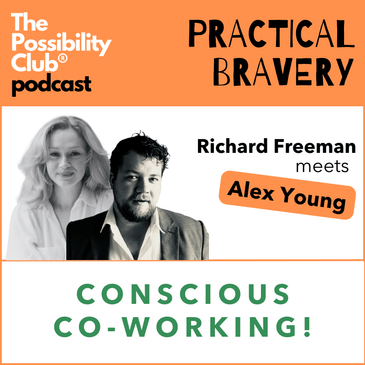
The Possibility Club podcast: Practical Bravery - CONSCIOUS CO-WORKING!
In this episode we explore the transformative world of co-working spaces and the burgeoning professional communities they foster. As the traditional office evolves and the allure of flexible work arrangements grows, the importance of spaces that inspire, include, and innovate becomes increasingly clear.
Our guest is leading an initiative with established roots in Brighton and plans for nationwide expansion, where workspaces not only meet modern needs but also cultivate communities grounded in equity and sustainability. But what broader impact do these spaces hold for local economies and social dynamics? Can the environments we work in become the epicenters of innovation and social change, fostering a new kind of urban and community life?
Are fancy co-working spaces just a modern trend, or do they represent the foundational elements of future cities where collaboration is at the core?
I'm Richard Freeman, this is The Possibility Club, and my special guest this episode is Director at Projects, Alex Young.
---
Alex Young via LinkedIn
https://www.linkedin.com/in/alex-young-74431a135/
"I don't think using the term 'revolution' is incorrect, when it comes to the power that co-working has for the future of business."
"I love to disagree! I love to argue!"
Projects website
https://www.projectsclub.co.uk/
"You can't expect an amazing community to form naturally. You're much better off investing in establishing a community while you are setting up a space, and ideally before."
"Founding members really make a space. You can have a huge impact if you hand-pick a few key people that are going to join you once your space is open."
"We don't just sell workspaces. Because if that's what we did, we'd do that a lot better and we'd make a lot more money, but that's not why we're here."
"We need diverse people in our spaces. We need to problem-solve together and to do that you can't just have people who think the same way, look the same, have the same kind of lived experience."
"I know 'diversity and inclusion' are buzz words, they get used way too much, for us we're creating community spaces, not just selling office space."
Projects — the team
https://www.projectsclub.co.uk/the-team
"We are not just running beautiful buildings, we are helping individuals that come into our space every day feel more support, feel welcome, and ensuring that they're able to show up as their best selves, do their best work."
"I've been back working at Projects for a year and I feel like I'm home again."
"I'm very nosy, I go to co-working spaces all over the world."
Ethos Property Management
B Corp certification
https://www.bcorporation.net/en-us/certification/
"Everybody talks about how hard becoming a B-Corp is. I don't find it hard. It requires a lot of hours, policy changes, data gathering, you have to literally change the legal wording of what your business exists to do. Okay, it's not straightforward, but it's not hard. For us we were doing all these things anyway."
Coworkies https://www.coworkies.com/
Together Co
"We've seen the issues that come about if people don't come into work, and I'm not just talking financially. It's really bad for your health. We need to be around other people."
"When people show up every day and feel that they can contribute to their work in their best way, that's going to make a huge impact, not just on their friends, family but their employers as well."
Alex's page on Favourite Positions podcast
https://www.favouritepositions.com/meet-alex
Imperial College Business School MBA
https://www.imperial.ac.uk/business-school/mba/
------
This episode was recorded in March 2024
Interviewer: Richard Freeman for always possible
Editor: CJ Thorpe-Tracey for Lo Fi Arts
For more visit www.alwayspossible.co.uk
[00:00:00] This podcast is brought to you by Always Possible
[00:00:04] alwayspossible.co.uk
[00:00:13] Well, it is time for The Possibility Club. Hello. How are you doing?
[00:00:17] I hope everything is well in your world. Welcome, welcome, welcome.
[00:00:22] This is The Possibility Club where we're going to explore the transformative
[00:00:25] world of co-working spaces and the burgeoning professional
[00:00:29] communities that they are beginning to foster. As the
[00:00:33] traditional office evolves and the allure of flexible work
[00:00:36] arrangements post pandemic grows and grows, the importance of
[00:00:40] spaces that inspire, include and innovate becomes increasingly
[00:00:46] clear. My guest in this episode is at the vanguard of
[00:00:50] workplace culture and co-working spaces and directs a
[00:00:54] visionary enterprise that is reshaping how professionals in
[00:00:59] business or the self-employed interact and thrive. She's
[00:01:04] leading an initiative with established roots in Brighton,
[00:01:07] with plans for nationwide expansion. She's championing a
[00:01:11] future where workspaces not only meet modern needs, but also
[00:01:14] cultivate communities grounded in equity, sustainability, as
[00:01:19] well as commercial growth. But what broader impact do these
[00:01:24] new and exploding spaces hold for local economies and social
[00:01:29] dynamics? Can the environments we work in become the epicenters
[00:01:33] of innovation and social change, fostering a new kind of
[00:01:36] urban and community life? My guest visits co-working spaces
[00:01:41] around the world. She chairs conferences looking at the future
[00:01:45] of the workspace. And so with her I will be delving into
[00:01:49] some questions that consider the role of these dynamic
[00:01:53] spaces, shaping not just careers, economic growth, but the
[00:01:57] cultural and economic landscapes that make up our towns and
[00:02:01] our cities. Are they just a modern trend? Or do they
[00:02:04] represent some new foundational elements of what future cities
[00:02:08] will look like where collaboration is at the core?
[00:02:12] I'm Richard Freeman. This is The Possibility Club. My very
[00:02:15] special guest in this episode is the director of Projects,
[00:02:20] Alex Young.
[00:02:24] Welcome to The Possibility Club podcast. It's me, Richard. Hello.
[00:02:32] And we're looking at change impact leadership bravery, where
[00:02:38] it comes from in all corners from business culture, society.
[00:02:42] And I've got a wonderful guest. As always, they are
[00:02:45] extraordinary. And I'm really looking forward to a deep dive
[00:02:50] chat about all things co-working and business spaces and
[00:02:55] community building, balancing community building with future
[00:03:00] focused enterprise and how we support small and growing
[00:03:04] businesses in the quirky corners of the UK. And my guest
[00:03:08] this episode is Alex Young. Hello, Alex. How are you?
[00:03:13] Hi, I'm very well. Thank you so much for having me on. I'm
[00:03:15] really excited about this.
[00:03:17] Absolutely pleasure. So loads to talk about really want to look
[00:03:22] at the philosophy of the projects and to talk a little bit
[00:03:26] about your work and journey and vision for this new wave of
[00:03:30] business spaces that I've taken over lots of different towns
[00:03:34] and cities in exciting ways. But before we do that, that you
[00:03:37] were on the telly yesterday on the BBC, but you were talking
[00:03:41] about autism. That's linked to what we're going to talk
[00:03:43] about. But why?
[00:03:45] So yes, I was on the one show yesterday. I was talking about
[00:03:48] neurovergent workspaces and how you can make sure that as an
[00:03:52] employer, you're supporting people who are neurodiverse in
[00:03:55] your workforce. It was because yesterday a report came out
[00:03:59] called the Buckingham Review of Autism. And it was all about
[00:04:03] addressing the challenges faced by autistic individuals in the
[00:04:06] workforce. And the review outlined a really comprehensive
[00:04:09] approach to promote inclusion and improve employment
[00:04:12] outcomes. So we employ people who are neurodivergent, we
[00:04:17] actually put that we are supportive of people with
[00:04:20] neurodiverse needs in our job adverts so that people know that
[00:04:24] they should apply their welcome to apply and will support them
[00:04:26] accordingly. And then we work with an amazing organisation
[00:04:30] called Exceptional Individuals to make sure that we can get
[00:04:33] government grants and put in place the right kind of
[00:04:35] support for people who have lots of different types of
[00:04:39] needs, whether that's autism, ADHD, dyspraxia, dyslexia or
[00:04:45] anything else that falls under the neurodivergent category. We
[00:04:48] also try and make sure that our workplaces are as conducive to
[00:04:52] look ways of working for people that are neurodiverse as
[00:04:54] possible. So we have quiet spaces, clear signs so people
[00:04:59] know what to do in each area, noise cancelling headphones,
[00:05:03] different levels of lighting. So making sure that our
[00:05:06] spaces are really truly inclusive is so important to us.
[00:05:09] And that's what I was chatting about for a lot less time than
[00:05:12] I've just used here now.
[00:05:15] That's the beauty of a podcast, isn't it? You don't have to do
[00:05:18] any of that. You're selling hot desks, office space, square
[00:05:21] footage, you're creating, you know, beautiful real estate for
[00:05:26] entrepreneurs that are growing their businesses and
[00:05:29] building their teams. So all of that stuff that you just
[00:05:31] talked about, which is extraordinary and needed and
[00:05:35] compassionate and useful is not required, is it? There's a
[00:05:38] very conscious decision about the kind of space you want to be
[00:05:42] and the kind of people that you want to be able to bring
[00:05:45] into the space that probably look at other co-working spaces
[00:05:47] and go, I can't thrive there. I can't be myself and I won't
[00:05:51] be able to be productive. So you've changed the
[00:05:55] conversation there slightly. Why? Why is that important
[00:05:59] to you? Why have you just become a B Corp?
[00:06:01] I disagree. I think that it is essential for us.
[00:06:04] I thought you would and I hope so.
[00:06:06] I'm glad. I love to disagree. I have to say I won my
[00:06:10] debate at European Youth Parliament when I was younger
[00:06:13] and that is my biggest claim to fame. I love to argue
[00:06:17] and I'll tell you that we don't just sell workspaces
[00:06:20] because if that's what we did, we would do that a lot
[00:06:23] better and we'd make more money. But that's not why
[00:06:25] we're here. We want to make sure that we are
[00:06:28] actually creating a positive difference in people's
[00:06:30] lives and to do that, we need diverse people in
[00:06:34] our spaces. We need to problem solve together and
[00:06:38] to do that, you can't just have people that think
[00:06:40] the same way, look the same kind of lived experience.
[00:06:44] So for us, it's all about making sure that we are
[00:06:48] truly creating an inclusive and diverse space.
[00:06:52] And I know diversity and inclusion are buzzwords.
[00:06:55] They get used way too much. For us, we're creating
[00:07:00] community spaces, not just selling office space.
[00:07:05] We have recently certified as a B Corp and I'm going
[00:07:08] to say something which I think others might cringe at,
[00:07:11] but everybody talks about how hard becoming a B Corp is.
[00:07:15] For those that don't know about the business
[00:07:17] certification that abbreviated to B Corp,
[00:07:20] it stands for becoming a benefit corporation.
[00:07:22] So as a bit of becoming fair trade, you have to
[00:07:26] pick up points and input a lot of data to prove
[00:07:29] that your organisation has the highest levels
[00:07:31] of social and environmental stewardship.
[00:07:36] I didn't find it hard and that's the thing
[00:07:39] which I think people might hear and just roll their
[00:07:41] eyes at. It requires a lot of hours, a lot of policy
[00:07:46] changes or data gathering.
[00:07:49] You have to change your articles of associate
[00:07:53] and use a lawyer to literally change the legal
[00:07:56] wording of what your business exists to do.
[00:07:58] You have to change it from maximising your shareholder
[00:08:02] returns to benefiting all of your stakeholders
[00:08:04] for the decisions that you make.
[00:08:06] OK, it's not straightforward, but it's not hard.
[00:08:09] For us, we were doing all of these things anyway.
[00:08:11] We just had to find the right Google documents
[00:08:13] and upload them. It took a little bit of time,
[00:08:15] but if we were trying to become a B Corp
[00:08:18] because we wanted to use the B Corp logo,
[00:08:20] that would be inauthentic.
[00:08:22] And I think that's the side of the B Corp movement
[00:08:24] that gets bad press and rightly so,
[00:08:27] because there are so many organisations that can pay
[00:08:29] for a consultant to come on board, reword a few policies
[00:08:33] and fabricate the data and then get the company
[00:08:37] to become a B Corp.
[00:08:39] I do agree that that's wrong and there need to be
[00:08:41] more strict mechanisms in place by B Lab,
[00:08:45] the organisation that certifies B Corp
[00:08:47] to ensure that that isn't how the movement progresses.
[00:08:51] But for us, we were just looking to have an easy way
[00:08:54] of showing people that knew about the B Corp movement
[00:08:57] or wanted to know about it,
[00:08:58] that something which is really important to us.
[00:09:01] So that's why we're a B Corp.
[00:09:03] And there's debate about anything that is
[00:09:05] genuinely good and done for the right reasons,
[00:09:07] but then as it becomes popular,
[00:09:09] those that aren't doing it for the right reasons
[00:09:11] find a way to grab a bit of it.
[00:09:13] So I think how you just outlined your approach to it
[00:09:17] I think is really important.
[00:09:18] So what is projects?
[00:09:19] You've articulated that it's more than space.
[00:09:22] It's more than buildings.
[00:09:24] And currently it's two buildings in Brighton
[00:09:26] on the south coast by the beach,
[00:09:28] but you've got plans to open up spaces
[00:09:31] and other parts of the United Kingdom.
[00:09:34] I imagine most listeners will have used
[00:09:37] or been in some kind of co-working space
[00:09:39] and will understand that it's a, you know,
[00:09:42] all sorts of different rooms, individual desks,
[00:09:45] service offices, cafes, gyms,
[00:09:47] all sorts of things like that.
[00:09:49] But tell me specifically about projects.
[00:09:51] How does it operate?
[00:09:52] What's your role there?
[00:09:53] And what kind of businesses do you have as a resident?
[00:09:56] So you've summarized co-working very nicely.
[00:10:00] And I think anybody could set up a co-working space.
[00:10:03] If you have space, it doesn't take too much to do it.
[00:10:08] It takes a lot to do it well.
[00:10:11] Running a co-working space
[00:10:13] might be relatively straightforward to set up,
[00:10:16] but it's not straightforward to do successfully
[00:10:19] or to do profitability wise
[00:10:21] and ensure that you're able to do it in a sustainable,
[00:10:24] long-term way.
[00:10:25] So much goes into curating a community
[00:10:30] and making sure that it's welcoming
[00:10:32] and that your helping businesses grow.
[00:10:35] And for us, that's what makes projects what it is.
[00:10:38] We are not just running beautiful buildings.
[00:10:41] We are helping individuals that come into our space every day
[00:10:45] feel more support, feel welcome
[00:10:49] and ensuring that they are able to show up
[00:10:53] as their best selves, do their best work.
[00:10:55] So my role at Projects is to direct the organization
[00:10:59] and look after its existing sites,
[00:11:02] but also ensure that we're growing.
[00:11:04] I worked for the organization starting out in my career
[00:11:08] and helped open the first space.
[00:11:10] Then I went and worked for a number of other providers
[00:11:13] and got experience nationally.
[00:11:16] And I've been back working in projects for a year
[00:11:18] and it feels like I'm home again.
[00:11:20] Because for me, my heart's always been
[00:11:23] within the projects community.
[00:11:25] The founder of Projects, he keeps a low profile.
[00:11:30] He just doesn't like the limelight at all.
[00:11:32] But he is a man who has run quite a few companies
[00:11:36] set up and scaled them,
[00:11:38] one of which is a property management company
[00:11:40] called Ethos.
[00:11:41] So you can look him up if you're curious
[00:11:42] and you'll find him.
[00:11:43] He wanted to find a space in the center of the city
[00:11:46] where his team could really enjoy coming to work.
[00:11:49] He wanted them to be able to walk along the beach
[00:11:51] to get here, to have lots of options for lunch,
[00:11:54] to work in a beautiful space.
[00:11:56] And he just knew that if he'd make them really happy
[00:11:59] in their workplace environment, they'd do the best work.
[00:12:02] He couldn't find the right kind of space.
[00:12:04] But he found a beautiful building on Ship Street.
[00:12:07] The one that you mentioned is
[00:12:08] it feels like a little townhouse.
[00:12:11] There's a big vault and the money
[00:12:14] that was used to build the Royal Pavilion
[00:12:16] was stored in the vault in this solicitor's office.
[00:12:19] So it's got a lovely, brightened story.
[00:12:20] So the owner of projects have found this building
[00:12:25] and purchased it knowing he wanted to put his team there
[00:12:29] and he wanted to do it up
[00:12:30] and make it absolutely perfect for them.
[00:12:32] But it was way too big.
[00:12:34] They have a team of about eight people
[00:12:37] and the building can hold a couple of hundreds.
[00:12:39] So he thought, do you know what?
[00:12:41] If I want this for my,
[00:12:42] I'm sure there are loads of other local businesses
[00:12:44] that would love to be here
[00:12:45] and it will benefit my team from being around them.
[00:12:48] So let me open this up and run it as a co-working space.
[00:12:52] So it was the first time that he'd stepped into
[00:12:55] becoming an operator of one of the spaces
[00:12:57] that he looked after.
[00:12:59] And I was so excited
[00:13:00] because I just love bringing people together.
[00:13:03] I'd studied sociology
[00:13:05] and I'd moved around quite a lot as a child
[00:13:08] and I just love people.
[00:13:09] So it was my dream job
[00:13:12] and I am so happy to be back
[00:13:15] because any other space that I worked in or visited
[00:13:17] and I'm very nosy,
[00:13:18] I'll go to co-working spaces all over the world.
[00:13:20] If I'm on holiday,
[00:13:21] I want to go visit the local co-working spaces.
[00:13:24] Obviously I'm biased
[00:13:25] but I feel like there is something very magical
[00:13:27] about projects.
[00:13:28] And I think it comes from the fact
[00:13:30] that its first customer was the person that founded it.
[00:13:34] So he knew exactly what he wanted for his team
[00:13:38] and he created something really special
[00:13:40] and considered and caring.
[00:13:42] And it comes from a place of love
[00:13:44] which I know is really cheesy
[00:13:45] but it is the truth.
[00:13:47] The types of companies that that tracks
[00:13:49] are those that also want a lifestyle
[00:13:51] that is healthy and exciting.
[00:13:56] We don't necessarily have a traditional type of industry
[00:13:59] that work from our spaces.
[00:14:02] We've got a diverse range
[00:14:03] from travel organisations
[00:14:05] that book sustainable visits around the world for people
[00:14:09] to people that run neurodiversity and inclusion training.
[00:14:13] We've got people that run incredible podcasts
[00:14:15] or have skincare brands or matcher companies.
[00:14:19] Like honestly I couldn't tell you
[00:14:20] that there's a generic project member
[00:14:23] but that's again what makes us special.
[00:14:33] This podcast is brought to you by Always Possible
[00:14:36] but who are we?
[00:14:38] Always Possible works with ambitious businesses,
[00:14:40] charities and public services
[00:14:42] that are thinking about what's next.
[00:14:44] From architects to aerospace companies,
[00:14:46] puppet theatres to primary schools,
[00:14:48] business networks to big data analysts.
[00:14:50] If you're wanting to be brave with some big decisions
[00:14:53] or to be clearer about what to prioritise
[00:14:56] then an award-winning workshop from the Always Possible team
[00:14:59] is a brilliant starting point.
[00:15:01] We care about just one thing
[00:15:03] building ideas that work.
[00:15:05] For creative, intuitive and practical expertise
[00:15:09] consider Always Possible as your strategic partner.
[00:15:14] Find out more about how we could power up your mission
[00:15:17] Visit Always Possible dot co dot uk
[00:15:20] Always Possible dot co dot uk
[00:15:30] This is a quick note to say
[00:15:32] that the Brighton Paradox will be back.
[00:15:36] Season two will be a shorter, tighter series
[00:15:38] looking at the energy, impatience
[00:15:41] and opportunity happening in post-pandemic Brighton Hove.
[00:15:45] We're examining the landscape across the city in 2024
[00:15:49] what's changing, what's building
[00:15:51] in economics, culture, community and technology.
[00:15:55] Why are people telling me that they are in fight or flight mode?
[00:15:58] What is the significance of a council with an overall majority?
[00:16:02] How is artificial intelligence
[00:16:04] maybe changing the way people solve problems in the city?
[00:16:07] And of course, how has a podcast
[00:16:09] changed the lives of Brighton's children?
[00:16:12] And it's not this one.
[00:16:14] All new interviewees
[00:16:16] and all new explorations of the city
[00:16:19] but right now we're still gluing the jigsaw together
[00:16:22] so you'll have to wait a little bit longer.
[00:16:24] But we are delighted to announce that we're being supported again
[00:16:27] by Brighton Hove Albion Football Club
[00:16:29] who return as brilliant headline sponsors and partners
[00:16:33] and the University of Brighton's Help to Grow Management programme
[00:16:35] also returns as a really valuable project partner.
[00:16:39] And in addition, we have two new supporters
[00:16:41] the exceptional focus EQ investors
[00:16:44] and the legends at Midnight Communications
[00:16:46] and we couldn't do this without all of these visionary people.
[00:16:50] Brilliant, thank you. Take care. Speak soon.
[00:16:58] And so kind of more broadly,
[00:16:59] it feels like it's kind of not just an offer for small businesses
[00:17:06] but it's sort of shaping work.
[00:17:08] It's sort of asking questions about what work is
[00:17:12] and how we should be working.
[00:17:14] Is that too grand?
[00:17:16] Is that too macro and floaty or is there
[00:17:20] do you think there's something in that in terms of a bit of a revolution?
[00:17:24] And I'm interested in your experience of being nosy
[00:17:27] and seeing spaces around the world.
[00:17:29] I don't think using the term revolution is incorrect
[00:17:33] when it comes to the power that co-working has
[00:17:36] for the future of business, to be honest with you.
[00:17:39] I think there's so much in the fact that bigger organisations
[00:17:43] that come to co-working spaces learn from the startups
[00:17:48] or freelancers that they're around and vice versa.
[00:17:51] They learn about how to be more agile
[00:17:54] or the other way round,
[00:17:55] they learn about how to replace growth mechanisms
[00:17:58] and think about long-term sustainability.
[00:18:02] When it comes to the impact that this industry is having globally,
[00:18:06] I can speak from amazing meetup that I went to in Crete last year
[00:18:11] run by an organisation called Co-Workies.
[00:18:14] Definitely check them out if you haven't heard of them.
[00:18:16] The founder, Pauline, is absolutely amazing
[00:18:18] and she's listed, I think, around 500 co-working spaces
[00:18:21] around the world at this point.
[00:18:23] It's crazy. She's written a book about it.
[00:18:25] So as part of the first cohort where she brought together
[00:18:28] people that are leading in their industry,
[00:18:31] in the sub-workspace environment,
[00:18:33] in their organisation, in their country,
[00:18:38] they met up on an island and workshoped together for four days.
[00:18:42] It was super intense but really amazing
[00:18:44] and I met people from Romania, Bulgaria, Italy
[00:18:50] and I know that co-workers are planning to do this every year
[00:18:54] and it's so important that we talk to each other
[00:18:56] and share best practices
[00:18:58] and find out what's going on in other cities and other countries.
[00:19:02] What we're experiencing here in Brighton or here in the UK
[00:19:06] is not unique to us.
[00:19:09] Around the world, people are discovering the fact
[00:19:11] that if they want to really think about
[00:19:14] how their business can be the best it can be,
[00:19:15] they need to learn from others.
[00:19:17] You can't do that in your own office space.
[00:19:20] You need to be regularly interacting with people
[00:19:23] from different industries, people from different walks of life
[00:19:26] and the best way to do that is in a shared workspace environment
[00:19:29] and that's not just CEOs or C-suite level candidates
[00:19:33] within your team.
[00:19:34] It's everyone that can talk to each other
[00:19:37] and learn about other people's lived experiences
[00:19:41] and what they might be able to do,
[00:19:43] what can inspire them, what can support them
[00:19:46] and co-working with you that platform.
[00:19:49] And do you think that what you're doing in projects
[00:19:52] and having that diversity of business,
[00:19:54] having cleaners, accountants, charities,
[00:19:56] tech organisations, high growth businesses
[00:20:00] all rubbing up against each other
[00:20:02] and the nicest possible way.
[00:20:05] Do you think that is a really important ingredient of it?
[00:20:09] The types of spaces that curate the businesses
[00:20:12] that are within them.
[00:20:15] If they're only looking at a certain segment,
[00:20:17] then I think that there's only a certain amount of time
[00:20:20] that the businesses should stay there.
[00:20:21] So, you might really benefit from being in a similar growth stage
[00:20:27] or working in a similar industry
[00:20:30] being every day surrounded by people
[00:20:33] that are facing the same exact scenarios that you are.
[00:20:38] But I think it gets to a certain point
[00:20:39] where when you feel ready to take your business out
[00:20:41] into the wider world,
[00:20:42] you need to do that physically with your workspace as well.
[00:20:46] I also think there is a time and place for workspaces
[00:20:49] that curate a couple of different types of industries
[00:20:53] and focus on niche areas
[00:20:55] but not just one specific market segment.
[00:21:00] I think that's interesting, especially for incubators.
[00:21:03] Let's say to have for six months one type of tech company,
[00:21:09] one type, one charity, one marketing agency
[00:21:12] because I think they can all learn together.
[00:21:14] I like that.
[00:21:15] But again, it comes to a point where I think
[00:21:17] for long-term growth,
[00:21:20] you need to be around a diverse range of people and businesses
[00:21:24] because that's the real world.
[00:21:26] For us at Projects,
[00:21:27] we learn so much from our charity partners,
[00:21:31] one of which is TogetherCo,
[00:21:33] a charity which is combating loneliness in Brighton and Hove
[00:21:36] through social prescribing and befriending.
[00:21:39] And we work with them to run events and to help fundrais.
[00:21:42] And they always remind us that the CEO
[00:21:45] is absolutely amazing, April Baker.
[00:21:47] She'll say to me, right,
[00:21:49] we'd like to do this event,
[00:21:50] but what can you get out of it?
[00:21:52] Who would you like us to invite
[00:21:54] that would be beneficial to you?
[00:21:55] She's always thinking about how she can support us
[00:21:58] because she knows for her charity to grow,
[00:22:01] she's based at Projects.
[00:22:03] Projects needs to do well.
[00:22:05] She's not just thinking about what can they get
[00:22:07] and that needs to be the case
[00:22:10] for all different types of businesses.
[00:22:11] If you only think about yourself,
[00:22:12] you're going to damage those around you.
[00:22:15] Collaboration is so key when it comes to community growth
[00:22:19] but also business growth and therefore the economy.
[00:22:24] That's a good fit model in Brighton.
[00:22:26] I don't think anyone's going to probably bat an eyelid
[00:22:29] when you think, okay,
[00:22:30] there's a really ambitious charity working
[00:22:32] as part of this interesting co-working space
[00:22:35] and there's kind of mutual benefit.
[00:22:36] Those partnerships are probably slightly easier
[00:22:39] in a city like Brighton
[00:22:41] that kind of wears its activism on its sleeve
[00:22:43] as much as it does its sort of entrepreneurialism.
[00:22:46] But I wonder if what you're doing
[00:22:49] will actually the ripple effect
[00:22:51] and the domino effect will change the way
[00:22:53] all of kind of corporate real estate is imagined.
[00:22:57] Is that likely?
[00:22:58] Is that a thing that can happen?
[00:23:01] I would love to believe so.
[00:23:03] And if that were to be the case,
[00:23:06] the benefits would be immense for wider society.
[00:23:11] And we've seen the issues that come about
[00:23:14] when people don't come into work.
[00:23:16] And I'm not just talking financially on local businesses
[00:23:19] that then really struggle
[00:23:21] if they're not getting their normal trade,
[00:23:23] but also when it comes to people's social health,
[00:23:26] not coming into the workplace,
[00:23:29] even if it's literally just our coffee with someone,
[00:23:32] it's really bad for your health.
[00:23:34] There've been some amazing studies
[00:23:36] about the impact that loneliness has
[00:23:39] and it's comparatively worse
[00:23:42] than smoking quite a large number of cigarettes every day.
[00:23:45] We need to be around other people.
[00:23:47] And that doesn't mean
[00:23:48] you need to sit at your desk next to someone.
[00:23:51] In fact, if you're doing that
[00:23:52] and that person is not someone that you interact with,
[00:23:54] you are gonna feel lonely.
[00:23:56] So you need to find your community.
[00:23:58] You need to find people that want to know about you
[00:24:01] and we'll just wanna give you a hug
[00:24:03] if you've had a tough day or go for a walk with you.
[00:24:07] And they might not even need to exchange any words with you,
[00:24:10] but just someone that's gonna be by your side.
[00:24:12] And I know we're talking about something
[00:24:15] which can seem a little bit wishy-washy.
[00:24:17] However, all of these things have an impact.
[00:24:19] When people show up every day
[00:24:21] and feel like they can contribute to their work
[00:24:25] in their best way,
[00:24:27] then that's gonna make a huge impact
[00:24:29] not just on their friends, their family
[00:24:31] but their employers as well.
[00:24:33] So I think coming back to your point
[00:24:35] about what the future may be,
[00:24:37] I'm hopeful that landlords will see the benefits
[00:24:41] of working with organization like ours
[00:24:43] and whether it's the B Corp stamp
[00:24:45] which just helps them to understand initially
[00:24:49] what the benefits might be to them to work
[00:24:51] with a company like ours
[00:24:52] as opposed to an organization that's just gonna pay
[00:24:54] to rent out one whole floor
[00:24:56] for potentially more money than we're gonna pay.
[00:24:59] We can all think about someone in our lives that's lonely
[00:25:03] or we can think about a time where we showed up at work
[00:25:07] and we just didn't really feel
[00:25:09] like anybody genuinely cared about how we were.
[00:25:11] And I think it's about understanding
[00:25:13] that if we can create spaces where people feel welcome,
[00:25:17] included, safe,
[00:25:20] then the impact is gonna really massively outweigh
[00:25:24] just a few extra pounds each month on rent.
[00:25:26] So I think we've got a long way to go
[00:25:29] but I think there's a possibility
[00:25:31] that there is change that can be very widespread
[00:25:34] and that people that have funds
[00:25:37] to be part of the key decision-making
[00:25:40] might actually start to understand
[00:25:42] the benefits that we're talking about.
[00:25:45] And when a new space is developed,
[00:25:50] and I say this from having witnessed,
[00:25:52] I think some failures in the past
[00:25:55] and I know of projects that have happened
[00:25:58] and actually my team have been asked
[00:26:00] to do some feasibility studies around
[00:26:03] the kind of renovation of existing buildings
[00:26:06] and with an option being
[00:26:08] or could we turn this into a creative industries,
[00:26:11] blah, blah, blah, blah, blah.
[00:26:12] And we've looked at what's around it.
[00:26:15] You know, the building's one thing
[00:26:17] and you could put a million quid in and turn it
[00:26:19] into some shiny interesting space.
[00:26:21] But what we've concluded in some instances,
[00:26:24] well, if you've got no nice places to eat or drink,
[00:26:27] the transport doesn't work.
[00:26:28] The, you know, there's no world around this space.
[00:26:32] It's not as simple as just build it and they will come.
[00:26:36] But that was a few years ago.
[00:26:38] And I wonder what's the decision-making process
[00:26:41] when thinking about a new space?
[00:26:43] Does the, there need to be a bit of a community there already?
[00:26:46] Is it, does there need to be a sort of a spark
[00:26:50] that's already lit so that when you open it and sell
[00:26:53] and invite people in, that feels already quite familiar
[00:26:59] or these days can you take a punt
[00:27:02] and put it somewhere rural or somewhere
[00:27:05] where there is no strong history
[00:27:09] of kind of startup culture
[00:27:11] and then create an extraordinary space
[00:27:13] that people are then willing to travel into.
[00:27:17] I'm fascinated about the sort of the economic planning
[00:27:21] around that and whether that's changing or not,
[00:27:26] you know, do you have any views on that?
[00:27:28] I think you can open a space
[00:27:30] in a place that hasn't had a great community to date
[00:27:33] but you can't do that
[00:27:35] and expect an amazing community to form naturally.
[00:27:39] That might happen by chance
[00:27:41] but you're much better off investing
[00:27:43] in establishing a community
[00:27:45] whilst you're also setting up the space
[00:27:46] and ideally before so that you can invite them there.
[00:27:49] Founding members really make a space
[00:27:52] so you can have a huge impact if you hand pick
[00:27:55] a few key people that are going to join you
[00:27:59] once your space is open
[00:28:01] because they'll be the ones
[00:28:02] that people end up sitting next to.
[00:28:03] Okay, yes, your team can sit around co-workers
[00:28:06] or in whatever scenario you're talking about here.
[00:28:09] You can be around to make sure
[00:28:11] that the people that frequent your space
[00:28:14] are beginning to feel like part of a community
[00:28:16] and they're not sat on their own
[00:28:18] but it's much more effective if you pick people
[00:28:20] that you know are going to be advocates for you
[00:28:25] and celebrate your successes and welcome people in.
[00:28:28] So that's something which is really imperative.
[00:28:31] Also, you talked about food and drink options.
[00:28:34] People do care about having a nice cup of coffee
[00:28:37] or being able to order lunch on delivery or pop out.
[00:28:40] You can do that with a good coffee machine
[00:28:42] and maybe some local lunch partnerships.
[00:28:46] It doesn't necessarily need to be
[00:28:48] that you are in the center of a city
[00:28:51] but you do need to think about
[00:28:52] how people are going to get access to nice food and drink.
[00:28:55] What's your future in all of this?
[00:28:57] What are you excited about where your journey can go?
[00:28:59] I mean, you are director of these two great spaces in Brighton.
[00:29:05] You've got expansion plans to open up new spaces.
[00:29:09] You know, you are incredibly young
[00:29:11] and have the whole world in front of you.
[00:29:14] You could be a real pioneer in this industry
[00:29:16] because you've got such well-formed idea.
[00:29:18] You know, it's really interesting how you approach this.
[00:29:21] Where do you want to go?
[00:29:22] What do you see you doing in 20, 30, 40 years
[00:29:24] in this industry if you're still in it?
[00:29:26] Thank you.
[00:29:27] I am super excited about what the future could entail.
[00:29:32] As I told you before we were recording,
[00:29:35] I'm doing an MBA at Imperial
[00:29:37] and will be learning much more about business
[00:29:41] than I have from trial and error.
[00:29:44] I'll actually be learning the academia
[00:29:46] behind growth plans and acquisitions
[00:29:49] and all that fun stuff.
[00:29:50] I'm doing a lot of algebra at the moment
[00:29:52] which is interesting and I have to say age 27,
[00:29:55] I didn't think I'd be spending my disposable income
[00:29:57] on maths tutoring but here we are
[00:30:00] and I think it's a worthwhile investment.
[00:30:02] So I'm really dedicated to making sure
[00:30:05] that I don't just use what I'm learning as the cap
[00:30:11] on my progression I want to learn from people globally
[00:30:15] and from experts.
[00:30:17] Where I see my future, I haven't thought about 30, 40 years
[00:30:21] but what I would say is for the next few years
[00:30:25] I want to make sure that we're bringing the best of Brighton
[00:30:27] to other parts of the UK
[00:30:29] and the best of the other parts of the UK to Brighton
[00:30:31] and I think that I can play a role in doing that.
[00:30:34] But it's also about ensuring that in Brighton
[00:30:37] we're connecting our businesses with people
[00:30:40] all around the world that can help them grow
[00:30:43] whilst nurturing them in the way
[00:30:45] that they expect from us as well.
[00:30:47] We're not, growth isn't everything
[00:30:49] it doesn't necessarily need to be financial growth
[00:30:51] it can be team development or partnership
[00:30:54] that they're able to establish
[00:30:56] but we want to make sure that our projects
[00:30:57] we're enabling our companies and local community
[00:31:02] to develop in the ways that they want to.
[00:31:06] I don't know if you've heard this stat
[00:31:08] but I've heard that 77% of people say
[00:31:11] that their overall purpose in life
[00:31:13] comes from what they're doing at work.
[00:31:16] So ensuring that you are able to feel
[00:31:19] like you're contributing to a positive impact
[00:31:22] is so important not just between the hours of nine to five
[00:31:24] but just in every second of your life.
[00:31:29] The big conversation that's used the word revolution again
[00:31:32] around what work can be is long overdue
[00:31:36] and really exciting but it's spaces like yours
[00:31:38] I think that are continually challenging
[00:31:40] and asking questions about that in really interesting ways.
[00:31:44] Alex thank you so much for being on The Possibility Club
[00:31:46] it's been a pleasure.
[00:31:48] It's been a pleasure, thank you for having me.
[00:31:52] Thank you for listening to
[00:31:54] The Possibility Club Practical Bravery.
[00:31:57] If you enjoyed this episode do like, share, review
[00:32:00] tell everybody about it look in the show notes
[00:32:02] for all the details of today's guest
[00:32:04] stuff we talked about stuff that's of interest
[00:32:07] new things to read new things to listen to
[00:32:09] and if you are running a business or a charity
[00:32:13] and you are trying to accelerate
[00:32:16] or improve the impact that you have in the world
[00:32:19] if you want to be famous for what you do
[00:32:21] and what you change rather than just what you sell
[00:32:25] then talk to us
[00:32:27] alwayspossible.co.uk
[00:32:29] We wanna hear from you, we wanna talk to you
[00:32:31] we wanna amplify and elevate your ideas
[00:32:33] and who knows we might be able to help you
[00:32:35] feel more confident and clear about what's next
[00:32:39] alwayspossible.co.uk
[00:32:41] We'll be back in a couple of weeks
[00:32:42] with a new special guest
[00:32:44] and a new insight on practical bravery in action.
[00:32:48] The Possibility Club is an always possible podcast
[00:32:52] the interviewer was Richard Freeman for Always Possible
[00:32:55] and the producer and editor was me
[00:32:57] Kristoff Tracey for Lo-Fi Arts
[00:32:59] Have a good week.
[00:33:03] alwayspossible.co.uk