
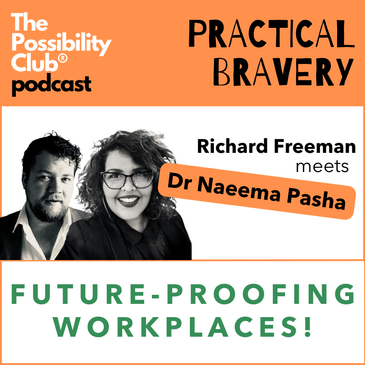
The Possibility Club podcast: Practical Bravery - FUTURE-PROOFING WORKPLACES!
In this episode, we return to the nuanced interplay between machine learning and human ingenuity. Can machines complement our creativity, or will they eclipse the essence of human touch in professions once thought impermeable to automation? As we navigate the digital era's complexities, questions of equity, diversity, and the human experience within the technological landscape become increasingly pressing. How do we harness AI to foster inclusivity and bridge divides, rather than widen them? Amidst the relentless pace of innovation, where does the individual find their footing, and how do we cultivate resilience and adaptability in a workforce facing unprecedented shifts? Our guest this week is work futures and technology expert, Dr Naeema Pasha.
---
Dr Naeema Pasha via LinkedIn
https://www.linkedin.com/in/dr-naeema-pasha-9b23b66/?originalSubdomain=uk
Dr Naeema Pasha on Twitter/X
https://twitter.com/naeema_pasha?lang=en
Futureproof Your Career — Dr Naeema's ebook
co-written with Shaheena Janjuha-Jivraj via Amazon
https://www.amazon.co.uk/Futureproof-Your-Career-Succeed-Changing-ebook/dp/B091Y37WZC/
"There was just a report done recently at Henley about bosses wanting people back in the workplace, having what's called a 'proximity bias', I will trust you more if I can see you visibly."
Henley Business School
"Research shows there are people wanting this identity of us just not being workers, that we are also doing other things, we have families, or commitments, or hobbies, or anything. People expect flexibility."
"People are expecting to have time to take children to school, or wellbeing. All these things seem to be much more in the psyche of workers."
"Looking at the research I did on race equity, and other people in Henley have done further study on this, is that people are biased. And what we found with the A.I. is that it could be less biased in coaching."
"When we talk about skilling, the research I did — and this was my doctorate — is that, rather than the skills of coding and STEM and this kind of thing, what is more important is for us to start understanding ambiguity, work through uncertainty, and therefore what skills are important are how to be focused, how to go through these complexities that we have, and work out where we are and how we progress."
Work of Work Institute
https://www.henley.ac.uk/world-of-work
Henley Business Schools' Leading Edge podcast with Naeema
https://www.henley.ac.uk/leading-edge/future-of-work-how-to-channel-the-spirit-of-gen-z
On job hunting —
"The job hunting experience has been interesting. Having worked in graduate recruitment, where thousands of people go through processes, now myself being part of a pool."
"The most important thing is to humanise the process."
"The 'ghosting' experience is strange. A handful of big organisations are processing everyone. Your data is kept and it's pushed through this funnel, but then you get ghosted at the end. Automated systems should allow for a rejection stage as well."
"There's enough intellect in organisations to be able to think, how do we manage this process? Because it's a decent thing to do and actually it's good for the recruitment brand as well."
"It still feels like 'you should be grateful' and we'll put you through these ridiculous amount of tests and interviews."
"This year has been a real experience of hearing the term 'we're about the hustle', 'we're about the hustle culture', hearing that quite a lot with employers."
'Equality alone won't help you win the war on talent'
article by Dr Naeema Pasha in The HR World
https://www.thehrworld.co.uk/culture-clash/equality-alone-wont-help-win-war-talent/
Wired article on Grindr's demand that workers return to the office
"Being able to collaborate was really important, and being able to collaborate in a way that allowed for diversity to come into place."
"We still want to feel a sense that people care for us. And we can also do the same for other people. And that was the same in physical places, as well as online."
"Caring has come up so often in organisations that people want to know how they can make it more explicit, how they can show that a lot more. Not just to care for others and our teams, but ourselves as well."
"We might even go to shops where it'll say 'no A.I. used here' because we don't want our retinas scanned."
"The rate of change is fast. We have to work with young people to understand you are valuable, you are brilliant, you've got capability, how can we understand your strengths?"
"I think equity and diversity is going to be more important and A.I. will probably enable that to work better."
------
This episode was recorded in November 2023
Interviewer: Richard Freeman for always possible
Editor: CJ Thorpe-Tracey for Lo Fi Arts
For more visit www.alwayspossible.co.uk
[00:00:00] This podcast is brought to you by always possible.
[00:00:13] Greetings fellow travellers of earth, this is the Possibility Club podcast, welcome, welcome, welcome
[00:00:19] And in this episode we're going to return to the nuanced interplay between artificial intelligence
[00:00:25] and human ingenuity. Can machines complement our creativity or will they eclipse the essence
[00:00:31] of human touch in professions once thought impermeable to automation?
[00:00:37] As we navigate the digital era's complexities, questions of equity, diversity at the human
[00:00:42] experience within the tech landscape become increasingly pressing.
[00:00:47] How do we harness AI to foster inclusivity and bridge divides rather than widen them?
[00:00:53] Amidst a relentless pace of innovation, where does the individual find their footing?
[00:00:58] And how do we cultivate resilience and adaptability in a workforce facing unprecedented shifts?
[00:01:05] We're looking at ethical AI again and I think we'll be looking at again and again
[00:01:11] and AI for good and what does that mean? Concepts the champion, the integration of technology with a conscience.
[00:01:19] Yet we know the realization of these ideals is not confined to algorithms, it is about people
[00:01:26] and the teams that craft them. A cultural shift, the organisations putting a mirror up
[00:01:32] to the diversity in ethical world that they aspire to see in of four, the technical creations
[00:01:40] they make. The quest for a tech enabled future that prioritises equity over efficiency,
[00:01:46] humanity over haste, is that what we're heading? These are challenges that make us rethink
[00:01:53] not just how we work but why we work. And in this episode we navigate these
[00:01:59] borders with an expert who's at the intersection of work futures and technology.
[00:02:05] The keen eye on the evolving workplace and the intricate dance between machine learning
[00:02:11] and human talent. My guest offers insights into creating a work environment that cherishes
[00:02:17] creativity, collaboration and caring. Once we think about the role of AI in reshaping what careers
[00:02:24] we might build and the essence of human interaction at work, how might we build a future
[00:02:30] that leverages tech to enhance and not diminish the human experience?
[00:02:35] I'm Richard Freeman, this is the Possibility Club. My very special guest this episode
[00:02:39] is Work Futures and Technology Expert, Dr Neema Pasha.
[00:02:49] So this is the Possibility Club, I'm Richard Freeman and you're very, very welcome.
[00:02:54] Simple format, I chat to someone extraordinary about what they're doing but the focus
[00:02:59] is on bravery and change and impact and what's going on in the world of business
[00:03:04] and learning and communities in the 21st century that might be a sign of what's
[00:03:11] to come. And I'm interested in the people that are rolling up their sleeves and doing it.
[00:03:15] And I'm definitely excited to be talking today to Dr Neema Pasha who is a world
[00:03:21] expert in the world of work, the role of technology and AI on the workforce
[00:03:27] and our evolving conversation about quality diversity inclusion.
[00:03:31] What that means to who we are and how we choose who we hire and how we develop
[00:03:36] people and talent. And I think it's a really pertinent conversation for these times.
[00:03:42] So I'm excited to explore it. First of all, the only standard question I ask
[00:03:48] everybody how the devil are you?
[00:03:50] Thank you, Barrett. I thought you were going to say what did you have breakfast
[00:03:54] or something like this? You can tell we have breakfast.
[00:03:57] No, I'm very well and I had a very nice breakfast of Greek yogurt and papaya
[00:04:02] which is unusual for me. But I bought this for Paya and I thought it was good.
[00:04:09] Thank you for asking.
[00:04:10] Luckily, so I'm sure from the papaya plantations.
[00:04:14] That I have in my garden.
[00:04:16] You until recently you were at Henley Business School weren't you?
[00:04:19] You're working on the Institute for future work, world work, which I do want to hear about.
[00:04:25] You've had a book out recently and you're sort of navigating the world of business
[00:04:30] and how to support different businesses in their journeys.
[00:04:33] So tell me what the things you're talking about, hearing about what's the crux
[00:04:37] of the conversation at the moment in terms of this issue around building work forces
[00:04:42] in a sustainable, sensible and fair way?
[00:04:46] This has been a year I've had so it's really great to talk to you at this time in my career.
[00:04:52] So having had a secure career, but working as you say I was working at Henley Business School University of Reading
[00:04:59] and I started to there of careers as well as diversity, equity and inclusion
[00:05:04] and also set up as you pointed out the world of work institute which we can go back to.
[00:05:09] But it's secure and it was also exciting and I really enjoyed it.
[00:05:12] But then I got headhunted to leave this safe secure environment to go and work in a tech company
[00:05:19] which didn't work out sadly working in that organization.
[00:05:24] And this whole year has been experiencing different tech firms, different organisations
[00:05:31] as a freelancer, as an associate and then working independently, working with other people.
[00:05:37] And I've also been job hunting and as part of my job hunting what I did was to do quite a lot of networking.
[00:05:45] So I've made more people, even more businesses to find out what they're up to and obviously you and I had conversations
[00:05:51] to find out more about your work.
[00:05:54] And actually what's happened this year is I've got probably enough material I think for another book specifically around
[00:06:02] how people are orientating themselves to the shifts in the world of work, the impact of technology,
[00:06:09] how we adapt to culture and how we sort of work with things like sustainability targets, ESG and things.
[00:06:16] So whilst it's been like oh my god what a year did I really want this?
[00:06:21] Did I not want to stay in a secure world?
[00:06:24] And part of me obviously thinks that but the other part of me is I'm actually really incredibly,
[00:06:30] weirdly grateful for having this year of upheaval to make me cut things differently.
[00:06:38] There must be quite a strange useful perspective to both been looking for work but at the same time being
[00:06:44] you know your knowledge about the process of that and what companies shouldn't be doing.
[00:06:49] So there must be quite interesting and probably quite frustrating as well because you're seeing jobs being advertised in ways
[00:06:55] that are bafflingly complicated and full of conscious or unconscious buyers.
[00:07:00] It can sound like a brag, it really isn't, it's only because I was mad enough to set up my own business.
[00:07:05] I haven't had to really apply for a job for about 15 years.
[00:07:10] And I imagine it's massively different now.
[00:07:12] What's the best practice that you can see out there?
[00:07:15] You know in terms of companies that are really on the ball and have leaning into kind of what's needed,
[00:07:24] what's right, how they're using technology, how they're using language,
[00:07:28] how they're thinking about creating the workforce they need rather than just the one they're familiar with.
[00:07:35] It is quite weird to have him worked in the side of graduate recruitment
[00:07:38] where thousands of people go through processes and now myself in the process of applying to jobs,
[00:07:45] you know, being part of a pool.
[00:07:46] Just the job hunting experience has been interesting.
[00:07:50] The most important thing is firms to humanize the process.
[00:07:54] This has come through on forums. This is my own experience.
[00:07:58] And what you know, you push through a automated system and the systems are better now in terms of scanning
[00:08:04] and understanding words and nuances, but you just are in a pipeline
[00:08:10] and you usually don't hear back.
[00:08:12] And so the ghosting experiences is quite strange.
[00:08:15] And I kind of think since the whole process,
[00:08:17] since all these massive systems are set up just in a handful of big organizations are processing these.
[00:08:25] So, you know, because I'll go back on it and it goes,
[00:08:28] oh do you want to use your CV that you used last time?
[00:08:30] No, no, no, that's not adapted to this job.
[00:08:33] So I've done like, you know, don't put that one in.
[00:08:36] So therefore I know that the date your data is kept and then it's pushed through this funnel.
[00:08:41] And then when you get ghosted at the end,
[00:08:43] I kind of think, you see your automotive systems should allow for feedback to go through the whole process
[00:08:52] and they should allow to go through at a rejection stage as well.
[00:08:57] And it's not that many organizations that come back with a rejection.
[00:09:02] And I don't know why.
[00:09:04] So I think, you know, you're all corporate brand coming back to the humanizing process
[00:09:09] is that sometimes occasionally something will come back to say, you know, sorry,
[00:09:15] but we're not going through.
[00:09:17] One of the things that's most frustrating that people talk about is that when people go too far to say,
[00:09:24] you know, we're so grateful, you're fantastic and you came so far.
[00:09:29] You know, one of these things it just feels insincere.
[00:09:32] So I think the balance and there's enough intellect in organizations to be able to go through
[00:09:37] and they think, how do we manage this process?
[00:09:40] Because it's just a decent thing to do.
[00:09:43] And actually it's good for the recruitment brand as well.
[00:09:46] So not to ghost use conversation that's well when you are in contact.
[00:09:50] And the best response I had was it was a rejection, but it was so personalized.
[00:09:56] It was for a diversity post and it was from a big leisure company.
[00:10:01] Their HR director said I make a point of contacting people.
[00:10:06] It's so important, isn't it?
[00:10:08] And I think yeah, once a business gets so big or so hungry for, you know, new staff,
[00:10:15] it's perspective on just what a big deal is for people and what a big ask is for people to put themselves on the line
[00:10:22] to be judged, to be, you know, taking a punt on putting themselves forward into an unknown.
[00:10:29] You know, it's a very vulnerable thing to do to apply for a job.
[00:10:33] And you have very little power in that relationship.
[00:10:36] Oh, exactly.
[00:10:37] I was chairing an event yesterday about AI in particular and its role in small business growth.
[00:10:46] And there's an ethicist on the panel and he was talking very, he was using the Amazon.
[00:10:50] Amazon as a case study, you know, this is a company that all around the world.
[00:10:56] Including the UK needs tens of thousands of staff going through its recruitment system all the time.
[00:11:03] You know, it's the chair is enormous.
[00:11:06] And so they had created AI tools to be able to sift through and filter in their minds, you know,
[00:11:13] use formula to identify the top 10% and then reject the 90%.
[00:11:18] You know, outright without a human being involved in any of that.
[00:11:21] You know, they'd only come involved when they were looking through the 10%.
[00:11:25] But the biases within the algorithms meant that they had a look at it.
[00:11:30] And you know, there were certain key words that were either particularly feminine or from or they were considered to be feminine or, you know, didn't represent a particular sort of way of talk of using language that meant they were being immediately rejected.
[00:11:46] So people were sort of testing to see, you know, highly qualified, very, very smart people.
[00:11:52] You know, we're getting rejected because they'd they'd mentioned that they'd done some volunteering with an animal charity or something like that.
[00:11:58] And so they're immediately gone.
[00:12:00] You know, it's absolutely absurd.
[00:12:02] And from my understanding, Amazon ditched the whole thing, spend millions and millions and millions on this process.
[00:12:07] But have now recognized that it's not for purpose.
[00:12:09] And they don't know how it can be because you just can't replicate the sort of human eye on the nuances at that scale, which is I think it's I think it's really interesting.
[00:12:20] And I'm sure they'll try and get back to it at some point with better technology.
[00:12:24] But it just goes to show that it's not robots hiring robots.
[00:12:29] So the other thing I was just thinking about the processes is the number of interviews that employers are wanting people to go through.
[00:12:35] I had eight for when I joined the company left.
[00:12:39] Why?
[00:12:41] And there are people that talk about having 20 or the processes are taken through and why really I think talent acquisition people are do want to hurry the process on because good candidates will get picked up by other people.
[00:12:54] What I think this links to is employers feeling because the market's quite you know choppy and difficult that they have.
[00:13:02] There's still an idea that people are really grateful to go work for an organization.
[00:13:08] And then you put through that process because you know, you'd be lucky to come here.
[00:13:12] And in the candidate world.
[00:13:15] And all of us, you know, particularly the pandemic, are perhaps looking at work slightly differently and thinking well there are there's more things to life.
[00:13:22] Then purely work or purely your identities is our identities are kind of multi-faceted.
[00:13:29] But I think through the recruitment process.
[00:13:32] It still feels like you should be grateful that we'll put you these ridiculous amount of tests and interviews and then you get a job.
[00:13:40] This was out of date. I mean, I'd be worried that someone would have the time to do 20 interviews regardless of the job or the salary or whatever's on offer.
[00:13:49] That was raised in a flag for me. There's no one else vying for them.
[00:13:53] You know, so what's going on here? Why do they want to be here so much?
[00:13:58] Oh, it's bizarre, isn't it?
[00:14:00] This podcast is brought to you by always possible. But who are we?
[00:14:10] Always possible works with ambitious businesses, charities and public services that are thinking about what's next.
[00:14:17] From architects to aerospace companies, puppet theatres to primary schools, business networks to big data analysts.
[00:14:23] If you're wanting to be brave with some big decisions or to be clearer about what to prioritise, then an award-winning workshop from the always possible team is a brilliant starting point.
[00:14:33] We care about just one thing building ideas that work.
[00:14:38] For creative, intuitive and practical expertise consider always possible as your strategic partner.
[00:14:47] Find out more about how we could power up your mission. Visit alwayspossible.co.uk
[00:14:53] Always possible.co.uk
[00:14:57] This city...
[00:15:03] This is a quick note to say that the Brighton Paradox will be back.
[00:15:08] Season 2 will be a shorter, tighter series looking at the energy, impatience and opportunity happening in post-pandemic.
[00:15:15] We're examining the landscape across the city in 2024. What's changing? What's building in economics, culture, community and technology?
[00:15:27] Why are people telling me that they are in fight or flight mode?
[00:15:31] What is the significance of a council with an overall majority? How is artificial intelligence maybe changing the way people solve problems in the city?
[00:15:40] And of course, how has a podcast changed the lives of Brighton's children? And it's not this one.
[00:15:47] All new interviewees and all new explorations of the city. But right now we're still gluing the jigsaw together so you'll have to wait a little bit longer.
[00:15:56] But we are delighted to announce that we're being supported again by Brighton Hove Albion Football Club who return as brilliant headline sponsors and partners.
[00:16:05] And the University of Brighton's Help to Grow Management programme also returns as a really valuable project partner.
[00:16:11] And in addition, we have two new supporters, the exceptional folk at EQ investors and the legends at Midnight Communications
[00:16:19] and we couldn't do this without all of these visionary people. Brilliant! Thank you. Take care. Speak soon.
[00:16:27] So, so as an academic, what's the academic perspective on this then? How has it felt that systems and maybe policy and looking at how things like the Equality Act and so on are put into practice?
[00:16:45] What has your research thrown up that then becomes something that filters into or trickles into the way that businesses work and change their behaviour and start to apply the findings so that they can do it better?
[00:17:00] The world of research at the Business School is at Henny, which I'm just telling you today.
[00:17:05] So just hearing about the latest kind of research that's going on and research. It's very, I feel there's quite a strong area of research that links to what we just said about linking to the candidate experience and the employee experience in work and how that's shifted.
[00:17:22] It's been shifting perhaps through a while where people are pushing back to the, if I call it the Silicon Valley kind of culture of quite male kind of broke culture is pushing back from this hustle culture.
[00:17:39] I hear so much this year has been a really experience of hearing the term, we're about the hustle, we're about the hustle culture. Hearing that quite a lot with employees and we need you to then again we're going back to recruitment side of it.
[00:17:51] I have been off-adverts when they're being like you've got to put in the 120% and you know work hard play that kind of language that people put in there and I think they're not going to I'm not going to apply there. They may not be like that because some places they go were creative, exciting, then you go for the interview and then there's like this little gray desk in the corner.
[00:18:13] So there's a mismatch for people to say anyway but so there's people pushing back that and there's people wanting as I say this identity of us just not being workers that we are.
[00:18:24] We are also doing other things where family we have families or we have commitments and all we just want to have hobbies or anything so what one of the things that people are expecting is flexibility and you know we could go into a little bit more about hybrid potentially but certainly flexibility.
[00:18:42] And that also links to diversity in that people are expecting to be able to have time to take their children to school or they want to just have time to look after themselves or you know well but all these kind of things seem to be much more in the psyche of workers.
[00:19:01] And there's just a report done recently, Henley about bosses wanting people back in the workplace having what's called a proximity bias that if I I will trust you more if I can see you better visibly.
[00:19:16] There's a shift in culture there's importance of looking at how we incorporate diversity into workplaces and how we manage as you just talked about biases and they are looking at technology that's the kind of things I see.
[00:19:28] And linked to that of course or the kind of skills we should have that I think.
[00:19:35] And you're a behavioral psychologist by sort of specialism I think it must be fascinating to look at you know both the behavior and the psychology of businesses at the moment in this post pandemic world trying to figure out how to be as flexible as possible yet also as you say see people.
[00:19:55] And I have that sense of control over productivity and I think there are many people that are really trying to do the right thing you know are trying to recognize that we work differently now you know and actually some of us spent three years feeling hyper productive actually that now being normalized is something we never would have imagined a few years ago in most sectors.
[00:20:20] Is this little cafe in Henley or what past and I'm thinking that looks a fantastic place because I've got a little sign up saying 10 pound for the day and 20% of coffees.
[00:20:30] And I think I should go there this is this is ideal and they've got a set it's a little bit away from the main section of the cafe so this is they've kind of created this little little hub for co working and nobody's there that's the thing every time we walk past I always go I should go that hold on nobody's there.
[00:20:47] So this is the trend sorts exactly the same every time but one of the articles I read and wired at you which may have crosses grinder saying that everyone with the people had to go back into the office.
[00:20:58] And that was really impactful because people are chosen places to work chosen to work in grinder because they could be they didn't want to feel that you know they said they worked in previous places where they're the only person who was from an LGBT background and working grinder.
[00:21:12] They could be completely bring their holes the cells to work the whole statement of people used for a while they could be themselves and and they've moved to places because you could work remotely they would they move to places where they felt more comfortable.
[00:21:24] They felt more accepted their developed community and then when this happened and then they had to kind of move you know this was this was upsetting for people it's like you know the corporates not understanding the impact of where we live.
[00:21:37] How we work affects how we behave in the workplace behave resciently and one of the studies I did during lockdown and then since was to look at what factors really enable people to engage in the workplace and I looked at HR directors from different organizations and I looked at one company from a whole bunch of different jobs that they were doing.
[00:22:00] And there was three factors that came out to really happen to share so what people wanted was to be able to collaborate so obviously this will be no surprise is the most research that's come up but it's good to just have it anyway just to confirm what we know so being able to collaborate was really important and being able to collaborate in a way that allowed for diversity to come into place so what people said for example when I did the equity report is that when we collaborate on.
[00:22:29] Video conferencing we feel a bit more equal whereas then we feel that in some ways we're at work secret projects are given to other people the equity effect found that projects were given to people without them knowing there's no access you're not seeing the you're not going for a coffee with the boss or playing golf whatever is you know however these networks happen so collaboration was really important but done in a fair way and a visible way being able to be creative we go to work in order to do.
[00:22:59] To as you say we want to put the washing machine on and then set you know and kids up whatever we've got but in during the time in between those times we're thinking well how can I stretch myself what meaning is work to me.
[00:23:13] How do I feel satisfaction in the work I'm doing what impact I'm making and that's what we all go to work for and chosen particular career paths so being able to do that and be creative around that is really something that we what I found was really important and the final was caring.
[00:23:28] We still want to feel a sense of that people care for us you know look out for us and we have our well being with after and we can also do the same for other people that was those three came up 3 c I call them.
[00:23:40] And that was the same in physical places as well as online I started it as an online kind of study you know when we're all in lockdown but looking working on it since focusing a lot more it became much stronger and actually one of the things that has become much stronger as I've been working with firms.
[00:23:57] Looking at this is the caring thing and I was really surprised because I thought a lot of people might go as is just soft cutly nonsense.
[00:24:05] We've got to focus on the you know the productivity the collaboration how we move forward but actually caring has come up so often in organizations that people want to know how they can make it more explicit how they can show that a lot more people are feeling stressed you know over working long hours thinking about work neglecting their house
[00:24:26] and so actually people found the caring piece has been really important not just care for others and teams but ourselves as well.
[00:24:34] You've done quite a lot of thinking and looking at our first intelligence where's it working or more importantly what's its potential to work is there a way that AI can shape more personalised work experiences.
[00:24:46] The more I'm into it I am more wary of it actually so just to say that upfront I think we have to just to say why and where I think the impact on our jobs is important to consider whether it takes certain jobs out whereas when we first started hearing about AI
[00:25:02] it's just going to take routine jobs dangerous jobs the jobs that nobody wants to do but now we've got a technology like chat GPT that is actually coming from more creative roles as well.
[00:25:12] And the last piece of work I've just finished to book chapter on looking at coach bots chat bots essentially in the space of human interaction and this is the kind of space that we think no AI cannot come into this bit.
[00:25:26] AI is not going to be part of something to offer us therapy and coaching and support because this requires skills of empathy and what we talk about caring and you know understanding a machine can't do that but actually the research will work and look into that area.
[00:25:44] It's been phenomenal it's been absolutely incredible what AI can now do in that space.
[00:25:50] AI has bias because it's taking what we all put out there and it's learning that and putting it into the algorithms and it's learning from it they are now in certain coach bots as well that technology and what why I'm really interested is looking at the researcher did on race equity what we found and other people in Henley have done a further study on this is that people are doing it right.
[00:26:13] It's that people were biased.
[00:26:15] And it's not surprised that people are biased and what we found with the AI it could be less bias in giving coaching which is like kind of we're moving towards this and maybe we might think I'll use the bot instead so it could come after the kind of jobs never thought would happen.
[00:26:37] Unless we start saying actually I'm okay with that because humans are flawed I would still prefer a human to come in and give me this advice because what the AI is doing and people are forming some of the coach bots and the personal bots are the language is so good that people forming relationships and connections with the bot which I completely understand because it's asking us kind of questions that are quite.
[00:27:07] Intense and chat to you is naturally I hear someone describe originally you know it's a people please are wants to answer your question in the way that you'll be happy with and and that's where sometimes it makes stuff up yeah we just need to understand that and so be then be prepared to say have you told me the truth.
[00:27:25] And if you use coaching which is a slightly different form of AI then chat to you PT or conversational AI coming from slightly different area the language is incredibly conversational even more conversational than chat to you and it will ask you I'm here for you I can you know and it's is guard rails of wider so you can ask more personal stuff.
[00:27:46] And it's giving advice but it's a machine but even I'm getting sucked into say what it is it is it is it is productive and you know if we look back at the last 50 60 years of science fiction we've been presented with this as normal for a long time you know we've we've seen.
[00:28:06] How in 2001 a space obviously we've seen see 3 p.o we've seen yeah these computerized AI assistance that have emulated genuine human emotion robot surgeons are performing really well in lung cancer treatment and things so we're probably thinking precision data accuracy vast data analysis which is much better therefore useful sustainability climate you know these big wicked problems that we're having that's probably the
[00:28:36] kind of area that we think yes that's great and even in recruitment selection that we can understand it that we can say the less biased all that kind of thing and introduce fairness where I'm concerned what I feel concern is when when we're handing over decisions to algorithms we should accept human
[00:28:54] frail is flaws we get things wrong I'd rather a flawed human than the machine because the machine is learning from me and it's learning better and better each time we can't do the same.
[00:29:06] It's so big it's the 70 80% of conversations I'm having are all coming back to this at the moment in the world of work a lot of education single unifier at the moment but it does feel that we've got so much further to go to make our minds up about what we want.
[00:29:23] And my final question for you talk to you know careers as was your specialty ahead of career.
[00:29:30] And a lot of my work is around designing or co designing or working with educators to help bridge the knowledge gap between you know formal education and the world of work but it does feel like you know we really should be quite a bit further along talking to young people let's move on from the conversation that I was going to take away all of the jobs.
[00:29:50] And I think that's the way you should be in total to do.
[00:29:54] But having a conversation about how to work with it how to understand it how to how to understand its limitations how to be that flawed human working alongside a.
[00:30:05] You know an artificial intelligence assistance no more to ask it no more not to ask it knowing how to get the best out of it.
[00:30:12] So it's really is that a lot of education institutions, you know especially universities are sort of the policy is don't talk about it make sure they don't use it call or want to do is cheap.
[00:30:22] Because education systems are measured you measure how somebody can recall synthesize and come through with ideas that they've been taught in an exam or an essay and because that we can use a chat you be to do that that's why they're where it's all I think in some ways we might be going back to paper and pencil in an exam hall.
[00:30:40] And you know that you write out your answers because that's a way that you can assess that so I'm just just saying that could be something that we could might happen that we might have to go back to those kind of things we might even go to shops where it will say no a used here because we don't are retina scanned and pick up the colors that we're going for so then it sends us some Instagram later we might go to that but what when we talk about skilling research I did and this is my doctor is that it rather than the skills of like let's let's teach like coding and so on.
[00:31:10] So I'm not getting to use them in all this kind of thing that can be there but what is more important is for us to start understanding ourselves and then working with young people how to understand ambiguity works or uncertainty and therefore what skills are really important that's what I've worked on the kind of skills to analyze something had to be focused how to you know go through these sort of complex complexities that we have.
[00:31:34] So we are on how we progress because one things if we say well AI or people say a as our friend and how do we work with it.
[00:31:40] It is for now but it will change you know we weren't expecting to you know we weren't used to having this kind of technology at our fingertips even a year ago the rate of changes fast new things are coming in so I think it's that bit that we have to work with young people on this to understand you are valuable you are brilliant you've got capability how can we understand how can you understand your strengths how can you move those things out.
[00:32:03] How can you move those forwards how are you adaptable what do you what you need to do and how do you need to keep learning as well so lifelong learning is a thing that we talked about along it sounds a bit boring but essentially refreshing understanding and learning because that's what AI does is that we need to ourselves do that.
[00:32:23] So I think being able to and that's from my research and those that people that keep learning understand themselves take a positive view understand how to sort of manage uncertainty end up being you know more able to manage this uncertainty and they're more successful in their careers.
[00:32:40] What are you excited about for 2024 for you but also maybe in terms of some of these conversations moving forward.
[00:32:49] I think equity is going to be more important equity diversity and AI will probably enable that to work better and I think I'm really hoping to do more in that space and what I'd like to do perhaps next year just from the experience here is to help firms really because what I found was people to work with sensible AI ethical AI for good and all that kind of thing it doesn't happen in a petri dish it happens with teams coming together and saying who are we and I found one where an ethical team or
[00:33:18] a people group an organization that wants to do good and you know whatever good is including making a profit but impacting people and the planet as well maybe all that kind of thing is that how do you do that as a leadership team how do you get that in an organization how do you build that culture quite hard things like how do you kind of tackle discrimination how you know what the piece of just recently found it.
[00:33:40] I think this about 27% women who are in tech but that has gone down in the last two years so she won't say for AI is the AI safety summit that the Prime Minister held recently if you want safer AI more ethical AI blow blow all that kind of thing then we need that in our teams and our organizations so that's what I'd like to do.
[00:34:01] Well all power to your elbow thank you certainly many many many people who need you to do that.
[00:34:07] Lovely. Thank you so much.
[00:34:12] Lovely to speak to you name it thank you so much for your time and being on the possibility club.
[00:34:17] Brilliant thank you so much Richard.
[00:34:20] Thank you for listening to the possibility club practical bravery.
[00:34:26] If you enjoyed this episode do like share review tell everybody about it look in the show notes for all the details of today's guest stuff we talked about
[00:34:34] stuff that's of interest new things to read new things to listen to and if you are running a business or a charity and you are trying to accelerate or improve the impact that you have in the world if you want to be famous for what you do and what you change rather than just what you sell
[00:34:54] then talk to us always possible to code at UK we want to hear from you we want to talk to you we want to amplify and elevate your ideas and who knows we might be able to help you feel more confident and clear about what's next.
[00:35:07] Always possible to code at UK we'll be back in a couple of weeks with a new special guest and a new insight on practical bravery in action.
[00:35:17] The possibility club is an always possible podcast the interview was Richard Freeman for always possible and the producer and editor was me Christophe Tracy for low five arts have a good week.
[00:35:47] you