
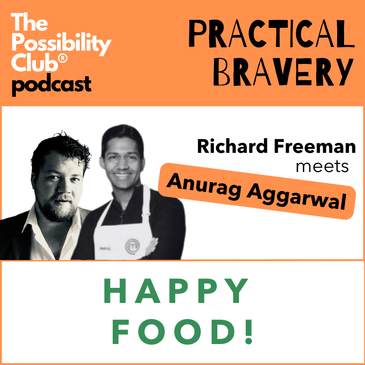
The Possibility Club podcast: Practical Bravery - HAPPY FOOD!
In this episode, we'll explore the evolving dynamics of the restaurant industry, particularly in the face of economic challenges and shifting consumer behaviours. We'll discuss the importance of maintaining cultural authenticity in cuisine and how chefs can use their platforms to educate and inspire. Sustainability is a key theme, with a focus on locally sourced ingredients and environmental compatibility, reflecting a broader movement towards more responsible and ethical food practices.
And on a personal level, how does someone transition from a stable corporate career to the uncertainty of the culinary world? What are the keys to creating a successful food business in today's economic climate? And how can a chef balance tradition with innovation to create a unique and compelling food story?
This is The Possibility Club, and our special guest is MasterChef 2023 Finalist, Anurag Aggarwal.
---
"I chose finance as my career. I was on a typical life path, wanted to make a living, raise a family. On paper I was doing great, all my boxes were checked. Then that thought started coming into my mind: what next? Something was missing. I can't do this for the rest of my life."
"Covid gave me a deeper insight that what we consider secure and permanent is nothing like that. Somebody sneezes on me and I could be gone in two weeks time. So that realisation gave me courage: I want to do something to follow my passion, which is cooking. So I need to do something about it."
Anurag's biryani pie video, via the Masterchef Facebook
https://www.facebook.com/watch/?v=1540693743124303
"Masterchef was the best experience of my life so far. It's not about being on television, to me food is much more than just ingredients, dishes or cuisine. To be able to be on that presitigious platform, to express myself through my cooking, that was very honouring. It was a brilliant experience."
"Masterchef gave me the inner conviction that yes, I'm on the right path."
BBC Masterchef UK
https://www.bbc.co.uk/programmes/b006t1k5
"They asked me bluntly off camera why I was diversifying into western food. Because I wanted to showcase I could do everything, other than just Indian food. They said you don't have to. We are not judging if you are a master of all cuisines, we just want to see your original flare, your passion for food. So if you feel passionate, feel love about Indian cuisine, stick to that. That gave me a lot of conviction."
Anurag Food Story website
https://anuragfoodstory.co.uk/
"The food aspect is at the core. But the rest is more like any other business, it's just managing the operations, managing the process."
"There's no fixed formula, there's no right or wrong but it's important that you create a product that is desirable — but more important in a restaurant, service has to be top notch. If you don't invest that time and money for your front-of-house staff, your product is of no use."
"Keep it small! It will evolve over some time."
"One thing is for sure, the current model will massively change."
"Restaurants for the time being I'm putting on hold, but I'm working on a project to open up food productions commercial units, to cater to businesses for their food needs."
Anurag Food Story via Facebook https://www.facebook.com/anuragfoodstory/
Instagram — @AnuragFoodStory
https://www.instagram.com/anuragfoodstory/?hl=en
Anurag Aggarwal via LinkedIn
https://www.linkedin.com/in/anuragfoodstory/?originalSubdomain=uk
"Especially in hospitality, one of the biggest reasons of failure is people who are passionate about food start businesses. They have a huge command of the food but they forget that food is one product in the business, they should focus on the commercial aspect of the business."
"They should focus on the process. Always think about, what is my process? Think of your business as a process so you can objectively answer those questions."
"One thing I'm a little concerned about, sometimes we give our priority to all these modern techniques and forget what was the point of food itself. You don't want to forgo the nostalgia and the real stories behind food."
------
This episode was recorded in April 2024
Interviewer: Richard Freeman for always possible
Editor: CJ Thorpe-Tracey for Lo Fi Arts
For more visit www.alwayspossible.co.uk
[00:00:00] This podcast is brought to you by AlwaysPossible AlwaysPossible.co.uk The College Tapestry of Colournary Artistry and Entrepreneurship. Look at themes of authenticity, sustainability, the transformative power of following One's passion, especially with that is in food.
[00:00:46] This is a very special episode because we have got a finalist from Master Chef UK And that's an absolute first for the Possibility Club. But more than that our guest champions are mission to elevate and diversify Asceptions of his native Indian cuisine.
[00:01:03] Born and raised in India, our guest is bought with him to the UK a deep seated love for food When he moved here in 2010. Despite achieving professional and personal milestones in the finance sector, He found himself yearning for something more, certainly more visceral.
[00:01:20] The COVID-19 pandemic was a catalyst to prompting our guests to pursue his dreams Ultimately leading him to the Master Chef Kitchen in a competition dominated by Western culinary techniques. He was unfiltingly drawn to showcase the depth and diversity of Indian
[00:01:38] cuisine, learning praise for his authenticity, and also for his bravery in sticking to one cuisine but just sharing it in always possible light and shade. We're going to talk about the evolving dynamics of the restaurant industry, of hospitality, particularly in the face of economic challenges shifting consumer behaviours.
[00:01:56] We're going to talk about the importance of maintaining cultural authenticity in cuisine, and how chefs can use their platforms to educate and inspire. Sustainability of course is a key theme with a focus on locally sourced ingredients, environmental compatibility, and how we reflect broader movements towards responsible
[00:02:14] and ethical food practices, even in the world of restaurant and dining. At a macro level, what about the significant trends reshaping food and hospitality sector from the top to bottom? Yes, the increasing emphasis on sustainable sourcing but also thinking about technological
[00:02:32] and digital transformation of the changing nature of skills and employment and careers, and how economic fluctuations and changing consumer thinking are influencing different sorts of business models and how to survive in an evolving and changing UK PLC landscape.
[00:02:52] And what about my guest? How does one like him transition from a stable corporate career to the deep uncertainty of the world of restaurants? What are the keys to creating a successful food business in today's economic planet? And how can a chef balance tradition with innovation
[00:03:09] to create a unique and compelling food story? Well, I'm Richard Freeman. This is the possibility to clap on my special guest this week. Is the innovative chef for entrepreneur, Anoreg, Agavar? Hello, welcome to the possibility club, Auckland. We've got a interesting episode this edition.
[00:03:33] As always we're looking at bravery, impact, change, leadership, what's happening in the world of business, culture, society and the lens this week is looking at food. And it's something that's very close to my heart
[00:03:47] being someone who eats a lot of food but also I'm very interested in the evolution in these strange economic times of food and drink industry, of hospitality, the world of the kind of visitor economy
[00:04:00] but also looking at the impact of particularly kind of cooking on TV and how that's a whole new sort of generation of entrepreneurs working across brand, across impact. It's an exciting area to explore and I'm delighted to be joined in this episode by none other than
[00:04:19] our Master Chef finalist. Anoreg Agavar, how do you develop? Oh yeah, I'm doing great really and thank you for having me on this podcast, the possibility club and name itself is so motivating and I think it has a lot of positive vibes.
[00:04:36] I don't think I've had a Master Chef finalist on the podcast before, what led you to that program and what was your experience there? Yeah, I think I always say it was a best experience of my life so far. I have never done anything
[00:04:52] that excited in my life probably would never do it as well. It was like green come through just to be or it's not about just being on television to me, food is much more than just
[00:05:03] including the sales of cuisine and to be able to be there on that platform such a prestigious and very global area and to express myself through my cooking. So that was very honoring like a brilliant experience.
[00:05:22] You got a particular specialist in Indian cuisine. How did you find that kind of translating into what's often quite a broad and often quite Western centric could food platform? So okay, I like the main core reason why I got into Master Chef and wanted to do anything
[00:05:42] in food that first place is again because I feel food is such a fundamental aspect of our life and it's not just physical instance. It carries a lot of stories, emotions, nostalgia.
[00:05:54] So when I think about food, of course, I was born and brought up in India. It has a lot of history. It has a lot of love. It has a lot of nostalgia.
[00:06:03] So when I went to the show, my first instinct, I can cook all kinds of cuisine to be honest like it's not just Indian. But there I wanted to showcase something which comes naturally to me, which makes me happy
[00:06:16] and which is something very honest to my heart. So that's why I started going full-fledged, absolute Indian in the beginning. And in the middle of competition, in fact, I did try to do some fusion and try to incorporate a lot of Western techniques in previous and my cooking.
[00:06:34] So to that, in fact, both John and Greg really supported me. They said like, there's no reason like, why you need to divers now into other cuisine. They asked me quite bluntly of camera.
[00:06:46] Why you are doing that? Because I will showcase again that I can do everything other than just Indian. They said, you don't have to because we are not judging that you are master of all cuisine or something
[00:06:57] like that which is what it is to see your original flair, your passion for food. So if you feel passionate, you feel love about Indian cuisine. Stick to that. So that gave me a lot of courage and I gave them the conviction to my own cuisine
[00:07:10] to just take it forward at that level. Because if you think about Indian world, they are like, I don't know, I mean, we can't even count on how many cuisines are there. So no one single person can all of them.
[00:07:21] So that kind of gave me conviction and I just took it forward something much more than just a physical aspect of cuisine. And I guess kind of reclaim Indian cuisine as something of craft, that can be finding that can be absolutely recognised.
[00:07:39] Alongside some of the more traditional ideas or perceptions we might have of master chef. You know, I guess it's tainted a little bit. Everybody in the UK has got three or four local curry houses and that's off of their only experience of Indian cuisine.
[00:07:54] So really important, the chefs like you are sort of challenging that quite limited perception perhaps. A lot of people, especially in the Indian community, I'll hospitality come pretty here and you keep people gently crib about it. Oh, they're Indian food is not about curry, this and that.
[00:08:11] So I think it goes other way around because it's kind of this our responsibility to again spread the awareness. What Indian cuisine is so whatever is available people will get trapped towards that. So it's not a British cultured for that Indian cuisine is perceived as curry is only.
[00:08:30] Yeah, as Indian I know it is curry is one aspect and it's a very important aspect. It's a very delicious aspect but it's just one aspect they are lots more. So I feel through these especially master chef through these shows.
[00:08:44] People get a chance to talk about to cook their cuisine in a very broad manner which is, I think, always, always good.
[00:08:52] Talk me through your, you know, your headline story up to that point. When did you start thinking of cooking as not just something you enjoy doing but something that actually is a professional outlet is something, you know, through which you wanted to build a career.
[00:09:12] It's almost pretty much started in somewhere in 2015 to 2017. I was born in part of India then I done education, got job, good job, good qualification then got job in London then I moved to London with my wife in 2010.
[00:09:30] So after that you know I was just on a typical life path like any other person who want to make a living, you know, raise a family and you know all those kind of things by anger house.
[00:09:41] So on paper I was doing great, you know, all my boxes were chained and then that thought started coming into my mind what next, what's more am I going to live this life again and again for a rest of my life.
[00:09:56] This is something that's missing and of course I was as a even as a trial I was so passionate about food I always wanted to do something in food but again because of the social construct you end up picking up very constructed, very, very proven social construct.
[00:10:12] So that's what I have done by choosing finance as my career. So now that inner urge to do something in food, my inner sharefuls just kind of getting restless.
[00:10:22] So that taking up all the boxes when I had my second child gave me that career here I can't do this for a rest of my life.
[00:10:33] Now I need to do something which really makes me happy which is something like very real, very fundamental and nothing can be fundamental then food. So one thing left to another and then again you get fixated and feel secure, start into your own comfort zone.
[00:10:48] So I was it was very hard you know to even think about it, you can leave a job and just started from scratch and that to impossibility which is very tough in the screen itself.
[00:11:00] Then COVID happened in 2020 and it's not a cliche everything happens for a good reason. So that gave me very deeper insight that what I'm what I consider to be secure and permanent is nothing like that, right?
[00:11:16] Somebody sneezes on me and I can be literally gone within two weeks of time. So what kind of security I'm talking about? So that in a realisation gave me courage that yes, I want to do something to follow my passion which is good.
[00:11:30] Okay, so I need to do something about it the first step I will believe my job and I do something.
[00:11:36] I didn't have any plans in having any remote map for me but that initial courage was required to give the very first step and then rest become his dream. Once you make that intentions strong intention and you give your best then everybody, everything starts supporting you.
[00:11:54] Initially I've been very naive and I wanted to go on a rest road then it worked and I've been glad that it did to work with the current economic conditions.
[00:12:04] But then I applied in Marshallshire, other than just a TV and that's very much like but I think more than that it gave me real.
[00:12:11] In a confirmation that yes, I am on the right for I can definitely take it forward as a full time earlier other than just a copy.
[00:12:21] Well, I mean that's quite some courageous leap from comfortable job in finance to go and actually know my purpose is in food to then being on you know the biggest program. From from your perspective how hard is it to establish a restaurant or maybe flip the question.
[00:12:38] The rare ones that are working at the moment certainly new ones you know what needs to be in place for something like that to thrive do you think.
[00:12:46] Again coming from finance, I would quite cumbersely active in the from the business aspect in my corporate life so I had a fear of understanding.
[00:12:56] So in business not only just restaurant but as far as restaurants are concerned so I always feel the food aspect is quite important is a core but it is just 20%. So rest is more about like any other businesses just managing the operations managing the process.
[00:13:13] And when we talk about restaurant now in the current economy economy and other scenarios, it is becoming hard because. The old traditional model financial model of restaurant is evolving.
[00:13:28] I'm sure it will take a new shape but now people spending habits are changing the cost of staff, cost of labor and energy prices have gone up which is the key ingredient in any restaurant right key input.
[00:13:44] There's no fixed formula there's no right or wrong you need to take all the right basics like what you do in any other business. But specifically for restaurants important that you create a product which is desirable, which is food in this case.
[00:13:59] More importantly in restaurant service has to be top notch. It's very respective of the level of restaurant you're operating at and that's where people sometimes get it wrong.
[00:14:10] They say okay my food is amazing but if you don't invest that time when money for your front of the house.
[00:14:17] So the product is of no use because then as the customer probably I'll get frustrated how somebody's serving me everything really matters and just keep it bit small. I think that that's that is the more probability to do well.
[00:14:33] But my personal feel as now as a chef is it would evolve over sometime like we have seen what fundamental change has gone through the retail industry.
[00:14:44] All the high-speed shops even digs globally and lifestyle stores they are closing down because people have moved into online buying or some other models.
[00:14:55] So for food I don't know like what the new model is going to look like but one thing is for sure the current model will massively change.
[00:15:05] This is an always possible podcast but making podcasts is really only one way in which we help people drive forward economic development and social innovation. We're such an exponent bread but work across the UK and sometimes further to design and deliver big projects.
[00:15:26] Projects that promote social mobility, digital transformation and equality of opportunity in business, culture and education. Projects that tell the story of growth and creative thinking in cities, sectors and communities. Projects that enable emerging leaders as well as big brands to define measure and communicate their impact.
[00:15:44] We work with teams who know that their mission is a bit braver and a bit more ambitious than others. If that sounds like you then we need to meet. Come say hello at alwaysposable.co.uk. That's alwaysposable.co.uk.
[00:16:00] This is a quick note to say that the Brighton Paradox will be back. Season 2 will be a shorter tighter series looking at the energy, impatience and opportunity happening in post pandemic Brighton and Hove. We're examining the landscape across the city in 2024.
[00:16:23] What's changing? What's building in economics, culture, community and technology. Why are people telling me that they are in fight or flight mode? What is the significance of a council with an overall majority? How is artificial intelligence maybe changing the way people solve problems in the city?
[00:16:40] And of course, how has a podcast changed the lives of Brighton's children? And it's not this one. All new interviewees and all new explorations of the city. But right now we're still gluing the jigsaw together so you'll have to wait a little bit longer.
[00:16:58] But we aren't delighted to announce that we're being supported again by Brighton Hove, Albeon Football Club. Who return as brilliant headline sponsors and partners. And the University of Brighton's helped to grow management program also returns as a really valuable project partner.
[00:17:12] And in addition, we have two new supporters. The exceptional folk at EQ investors and the legends at midnight communications. And we couldn't do this without all of these visionary people. Brilliant. Thank you. Take care. Speak soon. So that brings me to your mission now, Anna Raq.
[00:17:33] What's your focus now? Well, how are you using your experiences to date to build new things? So, you know, as a humanity, there's the aspect of tradition, stories, culture. And I think food plays that medium to pass on their stories.
[00:17:52] So that's why that is a main reason why I started calling myself un-rug food story because I see food as that medium. To carry on that knowledge from one generation to another.
[00:18:03] Now, what I want to do with that with this knowledge and current experience and exposure I got through Master Share. Of course, I want to be a business around it. Restaurant for the time being I'm putting on hold.
[00:18:15] But I'm simultaneously working on a project to open a food production more like commercial unit where I cater to business businesses for their food means. And what are you learning about the change that's happening?
[00:18:32] You know, it's a really exciting time to be to be advising people to be to be making food. But also, you know, quite a scary time unless you're you made of tough stuff. I'm sure you're learning new things all the time and then applying that.
[00:18:49] And I guess with perhaps a kind of finances and a liticle brain as well. Yeah, there are two three key aspects which I am personally considering in setting up off my own business.
[00:19:01] One is overall society is growing. There's a lot of influx of social media how people get influenced and this is kind of a. So I would say first aspect is that vibe of the food for me right now that casual vibe is working quite a lot.
[00:19:17] They are three kind of why if I want to classify a proper food one is very mass scale like very fast food kind of why which is very, very easily accessible very easily. Very price and then there's a high end which is like more like experiential.
[00:19:34] So that that is a third vibe the middle of why it is I will call it as casual vibe who is good quality probably not fine dining at such but good quality.
[00:19:45] And it kind of becomes part of your day to day life. So that is the food vibe I am going for so for any businesses so they need to make sure that they identify what wine.
[00:19:57] Food vibe they want to cater to because like sometimes I see I go to restaurant. They try to cater to all three vibes and that results in confusion because they can't do any of them well.
[00:20:10] And aspect again are talking from my own experience is to focus on the process. Especially in hospitality a lot of the one of the biggest reason of failure of a lot of restaurant that people who are very passionate about food they open businesses they start businesses.
[00:20:29] And so that's why they have a huge command on the food cuisine or the ingredients what kind of produce they are using but they forget that food is one of the product in the business.
[00:20:41] So they need to focus on the commercial aspect of business and more importantly they should focus on the process rather than the component itself. What is my process can it be scalable is it too much dependent on a particular thing like staffing or pacific supplies etc.
[00:21:02] Think of your business as a process so you will be able to objectively answer all those things as well. Last but not the least aspect which I'm also personally considering and I think everybody is now quite aware of that is more like environmental compatibility.
[00:21:20] So we keep hearing all these buzz words you need to produce your carbon footprint try to use local ingredients and employ local stuff.
[00:21:32] And I feel they are much more than just the buzz words because as a citizen of a country as a citizen of a local community we have a huge social responsibility, especially if you are making starting a new business to consider all these aspects.
[00:21:49] And in the in restaurant as clean hospitality especially what exactly you're going to cook so the deciding menu is the most flexible thing you have so can you make your menu which is pretty much full fill by your locally source in 3D ends.
[00:22:06] Can you hire the staff locally as well. So those three things like food vibe focus on the process and live with environment. You've now become quite synonymous with Essex where you live.
[00:22:22] You've got quite a big profile in that county and it's a county I love very much and do a lot of work in. There's got a long coastline and it's famous for its you know messy oysters and crabs and seafood from the North Sea.
[00:22:35] It's got a very big rural economy, you know most of Essex is farmland proximity to London East London particular where there's been lots of food innovation. But also cities like Kalchester, South End, Chumsford that will have got their own sort of urban food ecosystems.
[00:22:53] You know how do you feel about the opportunities and Essex for a real kind of sustainable food story? All right, it's just immense and I think I'll go back to your question you know talking about my masters have journey very often.
[00:23:08] I've pretty much stuck to Indian cuisine, why not to go do other cuisine. That pretty much applies to anywhere, why you need to look out, why you need to look out until you explode something you'll never find it.
[00:23:22] I say such a big county and you know surrounded by beautiful coastal line and proximity to East London so that is immense already. So I definitely like to use all of that. There are a lot of local farms here, poultry farms etc.
[00:23:38] So which can supply a lot of fruits and vegetables growers are there and we always go to this in summer, strawberry picking farms.
[00:23:47] So there you see like what beautiful produce they are which is just on my doorstep and again that's where my you know financial experience also talks about because that means I'm minimizing my compost also.
[00:24:00] It's not no brainer, I think as a society over last 1500 years then we got so called modernized with the model way of transportation.
[00:24:10] Everybody was quite dependent on their local resource pretty used right it was never a question it was that was the only option and now we're just going back to what we were before.
[00:24:24] It promotes the local economy and even biologically we don't realize as an Indian then I moved through this country.
[00:24:31] I do feel that difference because you know like you're DNA is pretty much compatible to a particular environment and what food it produces when you expose yourself to something like very diverse.
[00:24:45] You like it probably from a taste perspective but it's not biologically good for you in long run. You're excited about what you optimistic about what are you looking forward to. Every industry, every profession has a bad place right so I'm very conscious whatever I do.
[00:25:02] I don't clean it down a bad place for me. And there's being on something like Master Chef you know what sort of doors does that open you know do you find it easy and now to develop partnerships with restaurants do you find it easy to.
[00:25:18] To speak to the media if you've got something to say or or does that all disappear quite quickly when they're on to the next series and so I'm going to help how fickle is the industry is that side of the industry.
[00:25:30] Yeah it is like I think half fiction half reality like what would it this way. Yeah so nothing comes to you on a platform that yeah now you have come on Master Chef reach to top three now here is the thing like we'd like to collaborate with us.
[00:25:46] I still need to make call I need to still you know reach out to people send a lot of images. So the only difference now it makes probably people will just give a chance like just they would hear you one.
[00:25:59] And now it's up to you like where you can you can make your mark or not or get that job or you know get that new opportunity but things won't get easy as such but now.
[00:26:11] First I see more confident about my offering just because of the fact that I was able to prove myself or Master Chef plus if I speak to somebody if I introduce myself well give reference to Master Chef.
[00:26:26] They probably give me that initial two minutes. Then if I have to take it forward from there. Even I stick to very traditional kind of food but I am very open to you using different new techniques.
[00:26:42] I for example I use a micro wave not just for heating but for cooking as well and other methods which are quick energy efficient and and retain more flavor and texture.
[00:26:54] So in it cooking I am sure like this this lot's going on but again one thing I'll be little concerned about sometime we give lot of pride to all these modern techniques and forget what's the point of who itself you know.
[00:27:12] So if this all we always are balancing act you don't want to forgo the the nostalgia and the real stories behind food.
[00:27:22] There's like lot of first going about of air fryer this and that yeah it is a nice piece of equipment but as a normal human being I don't get it like if all kind of food is good for you including fat, carbs, protein it's all about how you balance it.
[00:27:41] So just saying that yeah you want to use a particular piece of equipment because you can get rid of a particular element from your diet altogether. Five years down the line I'm sure we'll be like taking supplement for fair.
[00:27:58] Food always comes back to being the most fundamental of science isn't it? Yes, that as human beings we we've got our heads around you know okay if you apply heat to something this happens if you mix as you say carbs fat salt sugar.
[00:28:14] These things and for me I think that's still what's quite exciting when I look at the you know the industry I'm down in Sussex the wine industry here is booming and whether you drink or not.
[00:28:27] The appreciation for the science of wine making which has always been something sort of heralded by you know the old world Europeans or the new world.
[00:28:39] In the Southern Hemisphere it's never really been something taken seriously in England but in Sussex and now I six I'm hearing you know that they're really exciting wine makers are setting up in in Essex and using the land differently thinking about the soil the tell why.
[00:28:56] And essentially all you're doing is fermenting some grapes and sticking them in a bottle but but the science behind it would be able to get. Some really experimental exciting new drinks is surely more more what's going to drive.
[00:29:11] And if definitely as you say like even that was master's and then I was first but even exposed to induction induction way of cooking and of course I was quite nervous about it because I never used it to put away from a show and you know you don't know how it's.
[00:29:27] I mean it's because it is very energy efficient it's very quick it's very powerful as well so all those things yeah I'm sure like with a three point.
[00:29:37] Always remember that you science to your advantage don't just become a slave to it so that that's what people need to rip. Absolutely. I'm going to say a little bit more about that.
[00:29:48] Thank you for your time thank you for being on the possibility club and good luck with your future food story. Thank you so much big. Thank you for listening to the possibility club practical bravery.
[00:30:04] If you enjoyed this episode do like share review tell everybody about it look in the show notes for all the details of today's guest.
[00:30:12] Stuff we talked about stuff that's of interest new things to read new things to listen to and if you are running a business or a charity and you are trying to accelerate or improve the impact that you have in the world.
[00:30:27] If you want to be famous for what you do and what you change rather than just what you sell. They talk to us always possible.co.uk.
[00:30:36] We want to hear from you we want to talk to you we want to amplify and elevate your ideas and who knows we might be able to help you feel more confident and clear about what's next. Always possible.co.uk.
[00:30:48] We'll be back in a couple of weeks with a new special guest and a new insight on practical bravery in action. The possibility club is an always possible podcast the interview was Richard Freeman for always possible
[00:31:02] and the producer and editor was me Chris Thorpe Tracy for Low Fight Arts. Have a good week.